


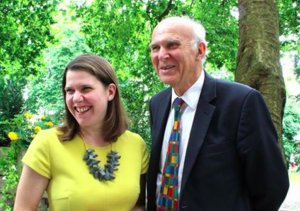
 Vince is not our almost leader any more. Just after 4pm, Sal Brinton announced that there had only been one nomination received and therefore he was our actual leader.
Having one of the country’s most credible and authoritative experts on the economy at a time when the economy is at risk is no bad thing.
We will certainly see a change in style from Vince. He won’t be as Tiggerish as Tim, but he’ll fight the recklessness of the Tories and Labour and promote our Liberal Democrat values with energy and optimism.
Vince has huge intelligence, a way of telling it like it is that makes sense to people and a wicked sense of humour. I feel much more optimistic than I did on 9th June that we can actually get somewhere.
Watch this afternoon’s proceedings here. You can see speeches from Sal, Tim, Jo and Vince. Some key points from Vince’s speech are below.
There is a huge gap in the centre of British politics and I intend to fill it. As the only party committed to staying in the single market and customs union, the Liberal Democrats are alone in fighting to protect our economy. It will soon become clear that the government can’t deliver the painless Brexit it promised. So, we need to prepare for an exit from Brexit.
Theresa May wants to take Britain back to the 1950s while Jeremy Corbyn wants to take Britain back to the 1970s. I will offer an optimistic, alternative agenda to power the country into the 2020s and beyond.
We have a government that can’t govern and an opposition that can’t oppose. Labour and the Conservatives have formed a grand coalition of chaos, driving through a hard Brexit which would deliver a massive blow to living standards.
Both parties have abandoned mainstream economics. I want to put economics back centre stage.
Under my leadership the Liberal Democrats will be at the centre of political life: a credible, effective party of national government.
We have doubled our membership and our new members have given the party enormous energy. I want to give leadership to that energy, hitting the headlines and putting our party at the centre of the national debate.
There has been some disquiet among party members over Vince’s stance on Brexit. In the immediate aftermath of the referendum, he had been quite pessimistic about the prospects of in some way overturning the result. Before the election was called, he had come round to the position of a second referendum. Two weeks ago, he wrote a piece about Brexit which went some way to reassuring those members in the party who joined us because they thought we were going to oppose it. In recent weeks he has expressed increasing confidence that Brexit may not happen once people realise what a shambles it will be.
Today’s brilliant “we need an exit from Brexit” line was the strongest indication yet that he’s going to really take the anti brexit fight to the Tories and Labour. The Liberal Democrats are the anti-Brexit party in this country and, frankly, we have work to do. We really can’t afford to stuff this one up.
* Caron Lindsay is Editor of Liberal Democrat Voice and blogs at Caron's Musings. You can find her on Bluesky at caronmlindsay.bsky.social
 Follow @libdemvoice.org on Bluesky
 Like us on Facebook
 Subscribe to our feed
 Sign-up for our daily email digest

 MI5 chief confirms Russian interference in Brexit referendum
 The abandoned platforms of South Kensington
 How many councillors has Reform UK lost since the May 2026 elections?
 Alex Macfie
 Yeovil Yokel
 Martin Pierce
 Jason Connor
 expats
32 Comments
Iam a british citzen living with my spanish wife in Northern Spain. I voted lib dem in the last election in the hope of dimininishing Jeremy hunts majority. I have no vote now as I have been living and working in Spain for fifteen years. What are your party’s proposals for giving the vote back to british citizens living overseas. I pay tax in UK. What are your proposals for british citzens post Brexit. And would you allow british citizens to return to UK with foriegn spouses without the income threshold and heallth threshold imposed by the Tories. I would add that my wife lived and worked in Uk before we left for spain so that our children could be truly bi lingual. Finally please thank Catherine Bearder for actually corresponding with me ,The only British politician who did .
GR8. Layla was on the Daily Politics. She was pressed by Andrew Neil to stand, but not this time.
I thought Vince’s speech was just right and with the new tag line #Exit from Brexit”, journalists have an easy headline. Great start Vince and Jo.
Exit from Brexit is a backward looking policy that will irritate the public. This is a backward step for the party, as is the coronation of an elderly leader who has been associated closely with the disappointments and mistakes of the past.
Why did no one else stand? It looks like downhill from here.
Thanks again to Tim and I’m optimistic about Vince! The thought of another five years of struggling at 10% and below is too depressing for me, not everything we try will fail. I think people will come around and gradually start supporting the party more.
Much as I’d have preferred a leadership competition, the Vince and Jo duo is looking good. Yes, I realise Jo is deputy leader of the parliamentary party but the distinction is not going to be the way most of the general population will see it.
Anyway, Vince was spot on and “Exit from Brexit” is a great hook. Looking at social media, I see a load of Brexiteers getting very upset and trying to dismiss the Lib Dems as an irrelevance (so why are they bothered with what we say?) or undemocratic (apparently you aren’t allowed to disagree with their view). More importantly, I see a lot of people taking notice that there is an alternative to the Red-Blue coalition. I was particularly interested to note how few people knew Vince was originally Labour/SDP, which is making a positive impression among some Labourites.
LibDems undemocratic? Well although I was, and still am, a Remainer, those laying this charge against those who reject the outcome of the Referendum surely have a point?
Imagine if the vote had squeezed through the other way and the Brexiters were crying foul and demanding another referendum. Let’s be honest how many of us would be sympathetic? How long would it be before we relied on ‘a majority is a majority’.
Given that the LibDems fought clearly on the ‘reject the referendum’ line and ended up with 7.4% of the vote what mandate can they claim for rejecting democracy, however disagreeable the outcome?
Or will the fall back on the “we are doing it for the national good” as per the Coalition justification?
It will be interesting to see what job Vince offers to Tim in his shadow cabinet – although Tim needs to carefully nurture his now-marginal constituency I’m sure he’ll still want to be at the heart of parliamentary politics, and with only 11 MP’s apart from himself Vince will need everybody to be contributing.
Dave Orbison – “Given that the Lib Dems fought clearly on the ‘reject the referendum’ line….” Did they? – I can’t have been paying attention.
@Dave Orbison.
Delighted to hear you are still a Remainer. So am I. The difference is I am fighting for what I believe in.
Exit from Brexit equals Fillip for UKIP.
@Allan Brame. The days when you fought for what you believed in on Merseyside County Council seem a very long time ago.
We need to be very careful with our Brexit policy. Banging on about a second referendum didn’t do us a lot of good in the recent GE campaign, leading to irritation or boredom among much of the electorate. On the other hand, diverting from or diluting our longstanding pro European credentials would betray the membership, not least the tens of thousands of new members. (I’m one of them.) Best, at least for the time being, to concentrate on arguing the case for staying in the single market and exposing the dishonesty of the other main parties, who seem to pretend you can somehow have all the advantages of the single market without being in it. You can’t.
Leave the issue of a second referendum to one side for now, without ruling it out. The problems with referendums are as follows:
Firstly, they’re not particularly popular; they last far too long and can be very divisive, even splitting family and friends in some cases (also true of the Scottish referendum).
Secondly, people are confused what we’re referring to. Do we want a rerun of the original referendum or a new referendum on the terms of whatever deal the Government may come back with? The latter is our current policy but could be difficult to frame as a referendum question, as there will be at least three possible courses of action.
My own opinion is that a second referendum would be appropriate in two circumstances: if there’s a clear and sustained change of public opinion on the issue (say 60% opposing Brexit) or if Parliament is deadlocked on the terms of the deal.
We must be careful not to confuse an important message with a poorly run election campaign. Vince’s Brexit message will increasingly resonate with the electorate as the Tories show that their strategy is non-existent and the consequences disastrous. The key problem Vince faces is ensuring that the party is capable of exploiting this. Involving 100,000 members before they start to drift off will be critical and this will involve more than just telling them to go to their nearest target seat or you’ll just be ignored. Vince needs to put in place a real campaigning team who can objectively analyse the situation and go back to the basics of successful campaigning.
@Dave – It’s very simple: I don’t think Brexit can be stopped/overturned except through democratic means . So my response to the “you’re anti-democratic” brigade is: “Any democratic decision that cannot be challenged through democratic means isn’t democratic at all”.
The LibDems didn’t fight GE2017 on an “oppose Brexit” line; our message was far more nuanced, although perhaps this wasn’t always well communicated or well understood. Many members/supporters on this site complained about the party not opposing Brexit!
@merseysidelib – we’re not asking for 2nd referendum (that took place last year; 1st was in 1975), but a vote on the final deal. This is justifiable as there was no Brexit plan from the Leave campaign. This means there is a democratic mandate to leave the EU, there is no mandate for any particular form of Brexit.
In GE2017, Theresa May asked voters for a mandate (in the form of a bigger majority) to deliver her vision of Brexit. One of the few clear outcomes of the election was that she failed to get such a mandate. Hence the mess the government are in now as what was proposed didn’t get a mandate, but neither did any other approach.
Had there been a detailed Leave plan like Scottish government indyref plan, I wouldn’t have a leg to stand on. Sure, Remainers could have criticised any Leave plan, but if Leave had still won (I don’t think they would have done), there would have been a clear mandate to deliver that plan.
In response to those who criticise the “Leave voters didn’t know what they were voting for” line, I would suggest the following importance distinction:
(1) People DID know what they were voting for in terms of WHAT THEY WANTED from Brexit i.e. WHY they voted Leave.
(2) People DID NOT know what they were voting for in terms of what BREXIT WILL ACTUALLY BRING. That’s because no-one knew before EUref and we don’t even know yet what Brexit will actually bring.
Cable is proposing a second referendum where the options are either to proceed with Brexit on the negotiated terms or to cancel Brexit. This proposal would disenfranchise those who believe the agreed terms are too soft and who want a harder Brexit.
If the Tories want to take us back to the 1950s and Labour want to take us back to the 1970s, will the LibDems choose the middle way and take us back to the 1960s?
Our big problem is this. Most of us want to stay in the EU because Brexiting looks like terrible economic suicide with huge problems ahead. But very many of us are also worried that we are in danger of becoming an overpopulated island. Yes, we want (and need) talented and congenial immigrants (we are not racists), and as many as we can comfortably absorb, but we see our infrastructure and housing capacity already stretched to the limit, with a genuine threat to ‘England’s green and pleasant land’ if the poulation continues to grow at the present rate. It isn’t just the Heathrow skies that are crowded this weekend — think also about Oxford’s problem at the moment. In or out, we are in trouble becuse we apparently can’t have our cake and eat it. I’d be happy with any solution in or out of Europe that solved the economic problem AND the overpopulation problem. so maybe we need to be open about whether the final decision is Brexit or Brexit-exit. Great admirer of Vince and I wish him well in sqauring circles.
Just got an invite to meet the great man at a meeting near me……………. the nearest being over 100 miles south in Newcastle.
When are you coming to Scotland, Vince ? Do you know Caron ?
Edinburgh and Aberdeen, 18th & 19th August respectively – venues to be announced.
Rebecca, I still stand by my comments on a ‘second referendum’. A referendum on the terms of any deal for Brexit would require at least three options: accept terms, reject terms and leave without deal, reject terms and stay in EU. I do not know of any major national referendum which wasn’t a binary choice (which is one reason I’m no great fan of referenda).
Some people, including our new leader, are beginning to suggest that we may in the end (in the changed circumstances) avoid Brexit altogether. Probably still a long shot, but in that case wouldn’t a straight rerun of last year’s referendum be necessary for reasons of democratic legitimacy?
A poll by Yougov for the Economist this week finds little change a year on. The result would be similar to the 52:48 split last June. Of those who voted leave 69% favour hard brexit and 24% prefer soft. Among remainers, 81% opt for soft against 15% hard. Overall, soft brexit beats hard brexit by 52% to 44%. It is not the first choice of many but it is the one option that commands a majority.
This is important if a majority is to be developed in Parliament amongst MPs from all parties.
Staying in the single market and customs union entails remaining in the EU – a revocation of Article 50. EEA membership, like Norway, Iceland and Liechtenstein; or EFTA membership like Switzerland, does not include membership of the Customs Union. Turkey, San Marino and Andorra are part of the customs union , but not in the EEA, EFTA or the single market.
Harder brexit includes withdrawal from both the single market and customs union and trading with the EU under the terms of a comprehensive free trade agreement along the lines negotiated by Canada and Japan; or reversion to WTO terms without a free trade deal.
[i][b]Joebourke[/b] 21st Jul ’17 – 10:46pm: “Turkey, San Marino and Andorra are part of the customs union , but not in the EEA, EFTA or the single market.[/i]
These three countries have individual bilateral customs unions with the EU. There are important differences: mostly limited to industrial products, custom duties from applying Common External Tariff retained by country, EU FTAs extend, but not usually reciprocal.
It is worth remembering that in most countries, major constitutional change requires a threshold based on vote percentage and/or turnout , rather than a simple slight majority as was achieved. A threshold was used on the first Scottish Referendum over devolution in the 70’s I recall.
This is needed to prevent the massive disruptions that come with such changes where there is no natural majority for such a change that can be sustained over time. This is where we are with Brexit, since the majority was just 1.9% either way and polls asking the same question are now showing a small majority against the Leave process.
If a threshold were employed it would normally be at least 60% in favour
If as Farridge said, the Remain side won by 52/48, he would continue to campaign for another vote. But the correct retort would have been that Leave would have needed to demonstrate overwhelming democratic support for change supported by a minimum threshold and not a simple majoritarian winner takes all result afforded by as little as just one single additional vote. T
The emphasis has to be on the people wanting major constitutional change to prove that there is a serious and stable support for it. The small Leave majority was instead based on people voting for NHS money or to depose Cameron, which ironically worked, but neither have anything to do with the European issue.
Being proven right over the catastrophic mess that brexit is rapidly becoming; as the economy and public finances go into reverse; will carry a lot of kudos as it did over the principled opposition to the Iraq War. Kennedy got MP numbers up to 62 on the back of that issue.
Staying in the Single Market is not only a perfectly sensible option, it’s the least damaging. However, staying in ‘The’ Customs Union is not an option. ‘The’ Customs Union is ‘The EU’ Customs Union. Leaving the EU will put the UK outside the EU Customs Union.
There will still be the option of sensibly negotiating an external Customs Union or Customs Cooperation agreement (they are not the same), rather like (but not identical to) that which the EU negotiated with Turkey. But whilst the SM has a footprint outside the EU, the EU Customs Union (which was never discussed in any respect during, or prior to the Referendum Campaign of 2016) is an EU tributary only. Remaining in that specific legal identity will not be an option.
In the EU referendum the official Vote Leave campaign used the strap line: “Take Back Control”. They frequently unpacked this as “take back control of our borders, our laws, and our money”. The EU Commission consistently stated that none of those three can be achieved whilst a member of the EU Internal Market (the ’Single Market’). Both the UK government and Britain Stronger In concurred, making the claimed disadvantages of leaving the Single Market the central plank of their campaign…
‘Brexit vote was about single market, says Cameron adviser’ [November 2016]:
http://www.politico.eu/article/brexit-vote-was-about-single-market-says-cameron-adviser/
John Littler 22nd Jul ’17 – 7:43pm
“It is worth remembering that in most countries, major constitutional change requires a threshold based on vote percentage and/or turnout”
People keep making this claim but no one ever seems to back it up with evidence. So I did a little Google and found a report for the House of Commons Library in 2011. The relevant section starts on page 10 and is conveniently summarised in two tables on pp.12-15. In summary: the claim has no foundation in reality.
Just realised that nobody has answered Alan Brown’s question (first message). Alan, frankly I don’t know the answer. Our policy on brexit is to stop it, so I don’t know if we have considered the detail of post-brexit policies. But this site isn’t really for answering policy questions. For a more definitive answer your best bet is probably to speak again to Catherine Bearder. That said, hopefully you can get from the gist of our discussions that we are very much in favour of safeguarding peoples rights.
PS Our policy is made by our members. If you join the party you can have a real input into developing that policy and others. (we have a branch of people living in the EU) 🙂
Dave Orbison’s line about remainers being sore losers and undemocratic is a familiar refrain. Like one of those cartoon villains that refuses to die, no matter how many times this argument is demolished it just pops up again good as new. Let me remind him that the referendum was so fatally flawed that it should have been thrown out even before it was inflicted on the public. Orbison must know as well as everyone else that it was based on outright lies, that it callously omitted EU nationals, expatriates and young people who would be most affected. Far from being democratic it was travesty of an exercise, a farce, and about as valid as a three pound note. But Cable is not wasting his time trying to argue with people who worship last year’s folly as a command from on high. He has set his sights the future and is showing real backbone, a contrast from the adaptable fair-weather remainers who lack the courage of their convictions.
I agree with most of what Vince has said.
Leaving the European Union, the single market, customs union and political union is economic suicide; Britain will be the weaker for Brexit.
As for the referendum. There are certain issues that should never be put to referendum, one is bring back capital punishment which will deny retrial on miscarriage of justice, new evidence becoming available.
The other is where there is no alternative policy: this case being membership of the EU and the European single free market.
A trade deal with the USA will amount to giving up sovereignty, if that is the case then the only option for Wales (and for Scotland) will be independence and apply for EU membership as a new nation.
Plaid Cymru is firmly REMAIN in EU. Constituencies with Plaid Cymru MPs actually voted to remain in EU. It was Labour that let Wales down.
Lets unite the progressive vote in Pembrokeshire.
https://www.theguardian.com/politics/2017/jul/20/are-you-happy-with-vince-cable-as-leader-of-the-lib-dems
There is a question form to complete
Vince is too old fashioned. You have to think that a LibDem-Labour electoral agreement/alliance of some sort would despatch the Tories to fox-hunting Brexitshire to continue their decline and extinction and we would gain more seats than ever before. To do that we need a radical progressive leader to make some sort of break with the past. Maybe among the newest intake, even if young. The political scene has shifted left and we must make full advantage of it.