Category Archives: The Independent View

The Independent View: tackling bad landlords

With more and more people relying on the private rented sector for their housing, the Liberal Democrats will be looking to develop a workable policy that supports tenants and encourages good landlords.

Last year Caroline Pidgeon from the Greater London Assembly published startling research. It showed that in the whole of 2015/16, just 411 landlords had been prosecuted across the capital, with a quarter of all boroughs not prosecuting any landlord at all. This is despite there being over 400 regulations governing the sector.

This highlights that the problem of tackling bad landlords is in large part due to regulations not …

Tagged | 9 Comments

The Independent View: What’s the crack?

As more countries and jurisdictions are relaxing their laws around cannabis, many questions have arisen. Will legalisation affect potency? Could some types of cannabis actually reduce psychosis? What are the choices in cannabis legislation, is it just prohibition or legalisation? And if cannabis is legalised, will everyone start using it? These are just a few of the questions answered by myself and two other researchers from King’s College London in the fourth episode of a new podcast; What’s the Crack.

We created the podcast with an aim to improve public awareness of the complexity and reality of addiction, policies, stigma surrounding drug use and drugs scandals in the newspapers by exploring the evidence base. We are all passionate about the drugs and addiction research field and every episode draws upon our collective knowledge and experience, addressing the health, criminal justice, social and individual side to a story. The podcast links the academic world to the public, bridging the gap and filling in the blanks with research evidence that the media have left out. Previous episodes have covered Dry January, Fabric nightclub in London, drug consumption rooms and now it tackles cannabis legalisation.

This episode introduces different policy options of cannabis legislation, providing alternatives to the usual dichotomous choice of prohibition (possession and supply is illegal) or legalisation (cannabis is freely and widely sold). Alternative legislation is discussed; decriminalisation (it is only illegal to supply) and regulation (a government monopoly). In addition, various factors in the legalisation debate are considered, such as psychosis and THC (active chemical that make users feel “stoned”)/CBD (cannabinoid with various potential medical applications) levels and the impact of legalisation on these. Cannabis is made up of the chemicals THC and CBD and emerging evidence suggests that cannabis high in CBD may mean that people experience fewer psychosis-like symptoms when using the drug. Arguably an incentive for controlling the THC/CBD ratios.

Also posted in Op-eds | Tagged , and | 3 Comments

The Independent View: Urgent Call for European Commission to reconsider its Dublin Transfer recommendations.

In the same week that the world marked Human Rights Day, the European Commission announced plans to resume the so-called “Dublin transfers” of refugees back to Greece. If this recommendation is adopted at this week’s meeting of European leaders in Brussels (commencing in February of next year) EU member countries will start returning refugees who arrive on their territory back to the country of their first entry into the European Union, wherever that may be. Dublin transfers to Greece from other Member States have been suspended since 2011 following two judgements of the European Court of Human Rights (ECHR) and the Court of Justice of the European Union (CJEU) which identified systemic deficiencies in the Greek asylum system. I have seen with my own eyes the desperation of the situation in Greece and it is far from pleasant. For the last year I have been been volunteering on the Aegean Island of Samos in Greece, I can confirm that to reinstate the Dublin transfers could result in a catastrophic degeneration in conditions which are already unsanitary, unsafe and badly over crowded. Grassroots organisations and volunteers on the ground in Greece are very concerned about these findings for a number of reasons outlined below.

Despite the EC’s claims that “significant improvements have been made in the reception of Refugees in Greece’’, in fact many sites in Greece remain badly overcrowded and unsanitary, with inadequate , shelter, food or medical provision, not to mention provision for minors and vulnerable groups and child safe spaces and psycho social activities. As the UN high commissioner Filippo Grandi highlighted in August, all of the EU member states need to do more to Help Greece help to manage the impact of the refugee crisis  “The challenges ( in Greece) are very serious, and we need to continue to address them together,” Grandi said. “Especially the living conditions, security in the refugee sites, and terrible overcrowding on the islands. These are all issues for which we continue to be at the disposal of the Greek government.” He also stressed the need for EU member states to speed up legal options such as family reunification and relocation through the EU’s official relocation programme.

The report stated that “with Dublin transfers suspended, there is an incentive for asylum seekers who arrive irregularly in Greece to seek to move irregularly on to other Member States (known as ‘secondary movements’), in the knowledge they will not be sent back to Greece.” However it is completely unfair that only one mechanism of the Dublin ruling which is being applied, when no moves are being made to force the schengen states to make good on their commitments to receive a quota of refugees. So far only 3,054 refugees have been relocated from Greece to other EU member states, while another 3,606 are scheduled to depart in the coming months. Still, support lags as member states have pledged only 8,003 spaces out of 66,400 committed. If the transfers are restarted Greece will once again be bearing the burden for the refugee crisis completely unsupported by other responsible Schengen states. This ‘pull factor’ ascertain is very tiring. I feel it would be far more pertinent to prioritise processing people’s asylum claims more quickly and efficiently rather than wasting time and money on sending people back to Greece, only to be processed again. It is my firm held belief that if they do this refugees and asylum seekers won’t be forced to move ‘irregularly’.It is the terrible, unsanitary and inhumane conditions in Greece & the lack of income supplement, social welfare, inadequate medical care and the glacial asylum processing system is what propels people to move illegally rather than waiting it out. I feel that authorities must work instead to speed up the relocation and family reunification transfers & to improve living conditions in Greece.

Also posted in Op-eds | Tagged and | 4 Comments

The Independent View: Making tax digital

Making Tax Digital (MTD) is a £1.3 billion investment programme intended to transform the tax system in the UK, making it more effective, more efficient and facilitating payment of the right tax at the right time.

The Association of Accounting Technicians (AAT) shares the government’s ambition for the UK to have “the most digitally advanced tax administration in the world” but like many interested parties we believe the timescale for achieving this is now very challenging.

4 Comments

The Independent View: Making common ground

We’ve lost a battle. But there are many more to come. We must not lose them all.

To win, we will need to fight more smartly than we did in the past. We must understand why we lost. The government – and Stronger In, which was in Downing Street’s pocket – had no vision for how Britain could help lead Europe. It had no vision for how to make Britain fairer either. It just had a boring case for the status quo.

To understand why we lost, we have to reach out to Leave voters. To understand why many feel left behind and left out. To make common ground with them. Because there is much that unites us.

We can make common ground on the need for a fair society. Where the economy works for all, not just the few. Where migration works for all, not just the few. The vast majority of the British people want that. We are a nation that wants unity not division. We want to share the fruits of progress.

Also posted in Op-eds | Tagged | 8 Comments

The Independent View: Time for Liberals to embrace pledged taxes?

conscienceHypothecation – the act of reserving a specific tax for a specific purpose – is making something of a comeback under this Chancellor. The question is how should Liberals respond?

The treasury only has one commandment “Thou shalt not hypothecate”.  However, George Osbourne, forever a political Chancellor, has been busily pledging taxes for a number of worthy causes such as women’s charities (Tampon Tax) PE in schools (Sugar Tax) and flood defences (Insurance Premium Tax)

The Chancellor knows that linking taxes rises to specific benefits offsets some of the political damage caused by hitting tax payers in the wallet. It’s also good for voters and it helps keep the Chancellor honest, and makes sure that tax rises remain accountable to the electorate.

Conscience: Taxes for Peace Not War is an organisation that has long argued that the right of conscientious objection should be extended to tax payers. It seems that whilst our bodies are free from conscription, our finances are not. Every bullet, bomb and soldier trained and deployed in war-zones overseas are not there by accident, but because we paid for it.

Tagged and | 18 Comments

The Independent View: Neal Lawson’s letter to Liberal Democrats

Dear Liberal Democrats,

This is one a series of letters to the progressive parties. I know you didn’t ask me to write but hope you will read it with the same emotion as it was written, a spirit of generosity, hope, realism and just a bit of frustration.

So, it’s one year on from the election and where are you? Recent results were mixed. In some councils you won back seats but in London and Wales little headway was made. Maybe bottoming out is a success – I can see that. But I can also see the potential for you to grow and be a huge part of the political and electoral force a progressive Britain needs. What is the strategy to do that?

Let me start from the fundamentals. Liberalism matters. To be liberal is to be open, to cherish freedom and start politics from the only place we can – from us as people in all our wonderful diversity. Of course liberalism can go one of two ways – you can be a neo-liberal and worship the market or you can be a social liberal and recognize that we only make sense as individuals within a social context. For me it’s the role of the social liberals that is crucial to the future of progressive politics. Indeed is there any real difference between social liberalism and liberal socialism? Someone once wrote that socialism is organized liberalism. I concur.

74 Comments

The Independent View: Obscure powers secretly used to hoover up our data


If the question relates to section 94 of the Telecommunications Act, then I am afraid I can neither confirm nor deny any issues in relation to the utilisation or otherwise of section 94 (James Brokenshire, 18.3.2014)

As an MP, Julian Huppert spent considerable time pushing for information about the ‘astonishingly broad power’ of clause 94 of the Telecommunications Act 1984, a clause which enables the Government to require telecommunications providers to cooperate with them in very broad terms. He tried to find out how often these extra ordinary powers were used and who, if anyone, was checking they were being used appropriate. He got nowhere.

As a result of litigation brought by Privacy International, the staggering use of this power has been exposed. Huppert’s suspicions were on track – GCHQ and MI5 have used section 94 to collect our data in bulk. They have been using these powers for 19 years in total secret, without even the Intelligence and Security Committee of Parliament having any knowledge of the use of Bulk Communications Data, or that section 94(1) was being (ab)used.

Tagged and | 5 Comments

The Independent View: Norman Lamb and Liberalism – a conversation at the Institute of Economic Affairs

2015 was a tale of two leadership elections, with the Liberal Democrat debate between Tim Farron and Norman Lamb overshadowed by the seismic shift in the Labour Party. But while Jeremy Corbyn winning the Labour leadership has led to a fundamental debate on the future of the Labour Party, the victory of Tim Farron may prove the more important – particularly if the time comes for the Liberal Democrats to seize back the liberal mantle in British politics.

The Liberal Democrats, like the Liberals before them, have always held a useful counter-balancing position, able to simultaneously attack Labour for their illiberal and statist economic policies – which Jeremy Corbyn has exacerbated – and the Tories for their big-state social policy and genuflection to the security and surveillance services. Should Momentum get too much for Labour and cause splits, and should the Tories finally be split asunder over Europe (or both cast out their ideological non-believers in an orgy of blood-letting that would do la Terreur proud), the Liberal Democrats must be placed to pick up voters from both.
So, what are the Liberal Democrats for? Has the party done enough to take up the torch of liberalism? Is the party still the party of Gladstone, or has it become reconciled to playing a bit part in the great debates?

Also posted in Op-eds | Tagged and | 22 Comments

The Independent View: rediscovering Grimond’s insights

At this year’s party conference, Tim Farron and Nick Clegg both argued that a huge new swathe of centre ground had opened up in British politics, with Labour shifting to the left and a newly emboldened Conservative government moving to the right. That is a risky assertion. It defines liberalism against its opponents, rather than for itself.

For a party battered, but not dispirited, by recent election results it is important that it defines itself with a positive vision for liberalism in the 21st century, not merely against its opponents’ positions.
If the Corbyn project collapses and Labour elects a more …

14 Comments

The Independent View: Trident: It’s time to make the right decision

At a time when the future of Britain’s nuclear weapons system is under intense scrutiny – not least due to the anti-Trident position of Labour’s new leader – it is good to see Lib Dem Conference once again at the cutting edge of debate on this crucial issue. In government, the Lib Dems did much to challenge the pro-Trident consensus of the main parties. It may not have been the full anti-Trident position that many of us would like, but the ‘no-like-for like’ position certainly helped open up the debate. Now it’s time to move onto the next stage. It’s a crucial time to get this policy right as parliament is expected to vote on Trident replacement in early 2016.

Also posted in Conference and Op-eds | Tagged , and | 3 Comments

The Independent View: Liberals need solutions to the migrant crisis – and conflict prevention will be key


So this was the tragedy of a Britain with open hearts and closed borders. The growing humanitarian crisis in Syria coupled with instability in North Africa is creating one greatest migrations waves seen since the end of World War II. Jordan alone has taken over 1.1 million displaced Syrians and is now suffering water shortages that could lead into larger migrations into other Middle Eastern nations.

The reaction to this has been largely isolationist policies, with commentators in the UK describing these migrants anywhere between ‘cockroaches’ and ‘a swarm’; the narrative media focused on dehumanising those fleeing conflict.

Tagged and | 60 Comments

The Independent View: Tim Farron’s election as leader provides hope that the party will embrace and enhance the green roots held dear by members and activists.

Congratulations to Tim Farron, an MP who has long championed environmental causes. His voting record, especially during the coalition years, was consistently green. In 2013 Farron was one of 16 Lib Dems to rebel and back a 2030 decarbonisation target. How different the energy politics landscape would look had more Lib Dem MPs (and later peers) joined him and ensured there was now a decarb target in the statute books to provide long term certainty for investors in the face of growing short term uncertainty.*

But that was then. With Tim Farron at the helm we look forward to the party adopting stronger green positions, such as Farron’s repeated pledge to oppose fracking. Most importantly – and in a move that puts clear water between him and Andy Burnham, the leading candidate for the Labour leadership – Farron’s opposition is on the grounds that burning shale gas is incompatible with tackling climate change:

Shale gas will only have a future in the UK if we abandon, or significantly scale back, our climate targets – and that’s something that I hope every Liberal Democrat would oppose

This is the sort of clear leadership sorely needed in the fight against climate change and the pressing need to keep fossil fuels in the ground. Only the Greens and Plaid Cymru have made so clear the climate change rationale for opposing fracking (in addition to the more widely accepted risks to communities’ air, water and peace).

Also posted in Op-eds | Tagged , and | 24 Comments

The Independent View: Benefit the nation and the voters

If the Liberal Democrats get about half UKIP’s votes (8% against 14%) but about 10 times as many MPs 20 – 30 against 2 – 3), will the Liberal Democrats stand by their principals and demand electoral reform?  In particular, will they insist on the Single Transferable Vote (STV), which they have always recognized as the best voting system for voters?

The Liberal Democrats have had five years now to learn the hard way what some of us warned in 2010, based on our observations of continental Europe where coalitions are normal; the senior partner takes the credit for popular decisions and blames the junior partner for unpopular ones.

If the Liberal Democrats had got STV for this election as a condition of entering into coalition in 2010, they could now be looking at winning about 52 seats for about 8% of the vote.  Admittedly, UKIP might be expecting about 91 seats but, if that is what voters want, so be it.

The real point of electoral reform is not to benefit this or that party but to benefit the nation and the voters.

With electoral reform for this election, the SNP could expect about half the Scottish seats (30) for about half the Scottish votes instead of all the seats (59) for half the votes and not be in pole position now to hold the UK to ransom.  Please see David Green’s excellent exposition on for more on this.

Also posted in Op-eds | Tagged , and | 21 Comments

The Independent View: Political inequality threatens constitutional holy cows

ipprIt is time to put some holy constitutional cows out to pasture. The traditional liberal reform agenda remains necessary, but it is no longer enough to reanimate our democracy. Too many of its solutions remain insensitive to how class and demography intimately shape how our political system operates; structural political inequalities in who participates and has voice will not end with a codified constitution and a more proportionate electoral system. Liberals of all party stripes and none need a new political agenda squarely aimed at reversing ingrained political inequality, a phenomenon that threatens the integrity of British democracy.

Last week, President Obama said: “it would be transformative if everybody voted. If everyone voted, that would completely change the political map in this country.” He’s not wrong. “The people who tend not to vote are young, they’re lower income, they’re skewed more heavily towards immigrant groups and minority groups,” he said. “There’s a reason why some folks try to keep them away from the polls.” America is already a divided democracy, and the UK is headed in the same direction.

Political inequality is where despite procedural equality in the democratic process, certain groups, classes or individuals nonetheless have greater influence over and participate more in political decision-making processes, with policy outcomes systematically weighted in their favour. As such, it undermines a central democratic ideal: that all citizens, regardless of status, should be given equal consideration in and opportunity to influence collective political decision-making.

Tagged and | 16 Comments

The Independent View: An apology from 38 Degrees

On 26th March, the staff team at 38 Degrees posted an image to our Facebook page, attempting to simplify the confusing debate on pledges to fund the NHS. Unfortunately, we got the numbers jumbled up and drew criticism from several different political parties – including Lib Dems on this website. This is an apology and an attempt to explain where we went wrong.

Our graph compared NHS funding pledges for 2015-16 from the Conservatives, Lib Dems and Labour, against the additional £8bn of funding that NHS England says it needs by 2020. We ended up comparing apples and pears. Lib Dems quite reasonably complained that presenting the information in this way obscured their flagship pledge to match that £8bn target by 2020. Both Labour and Conservatives have avoided matching that pledge.

Labour supporters also complained. We showed the Labour figure on the graph as £2.5bn – based on their pledge of £2.5bn in the “time to care” fund. But Labour says this £2.5bn is additional funding – £2.5bn on top of what the government has already said it’ll spend. And it’s due to be realised much sooner than 2020 (though it seems it’s disputed exactly when). So they argued that their bar on the graph should have shown them £2.5bn higher than the Conservatives or Lib Dems. Meanwhile, some Green Party and UKIP supporters complained that we’d failed to feature their positions at all.

It’s extremely hard to compare like-for-like pledges on NHS funding, given the different timescales and assumptions on which each of the parties claims are based. It’s well nigh impossible to compare them through the medium of one, simple bar chart which conveys all the relevant information.

Also posted in Op-eds | Tagged , and | 12 Comments

The Independent View: Countdown to the Election

Lib Dem Voice has received this article from Matrix Chambers, a law firm that specialises in election law. It offers the opportunity to sign up for weekly briefings during the election period.

It’s trite to say, but we are just weeks away from the most important General Election in a generation – especially for those interested in election law. The culture of fighting elections – and the public’s role within that – has changed in recent years owing to new technology. There is now also new (and untested) legislation restricting the actions of professional third party campaigners.

Tagged and | 2 Comments

The Independent View: Incentives matter in our education system

Incentives matter in our education system. The right ones encourage our schools and teachers to deliver the very best education the system has to offer.

Yet in the run up to the general election, politicians would have us think otherwise. Rather than creating the incentives for excellence to spread, they seek to drive performance from the centre. Cross-party support for a new college of teaching illustrates this shift in rhetoric, with politicians trying to magic more high quality teachers without thinking about the underlying incentives. The so-called “Cinderella” teaching profession really has found its fairy godmother.

The academy school programme is all about incentives. By freeing schools from local authority control and management, the aim is to allow innovation to drive better education for pupils.

Yet better incentives are needed if academies are to drive large scale transformation across the country. According to a survey of academy schools Reform published last year, many academies are inhibited from using their freedom to innovate. Two thirds of the 654 academies surveyed had yet to make changes to the curriculum, staff terms and conditions or the school day, despite having the freedom to do so.

Also posted in Op-eds | Tagged , and | 32 Comments

The Independent View: A new report from CentreForum highlights the problems with Labour’s tuition fees policy

A new report entitled “A Labour of Love?”, released today by CentreForum and written by Tom Frostick and Chris Thoung, weighs up the pros and cons of Labour’s recently announced policy on tuition fees, one which revolves mostly around the fees being cut from their current £9k maximum to a £6k ceiling. The report can be read here.

On the plus side, the policy does acknowledge the importance of maintenance grants. It also reopens the discussion that needs to be had regarding the balance between state and individual investment in undergraduate education by lowering the percentage of loans the government estimates will not be repaid. It would also apply to all undergrads, including those currently studying, so would be fair in that regard.

But there is a lot to say about the policy that is negative. If introduced, it would have little to no impact on a staggering lowest 60% of graduate earners and would mostly benefit higher earning graduates only (and even then, up to twenty-eight years after they’ve left university). It is also costed in such a way that could discourage pension saving, and its higher interest rate scheme for wealthier graduates contributes only modestly to the intended progressiveness of the policy. 

Also posted in Op-eds | Tagged and | 61 Comments

The Independent View: The Liberal case for airport expansion is strong

Centre Forum aviationThe debate over airport expansion, particularly in the South East, has been raging for decades. Later this year, it is due to reach a crucial moment as Howard Davies and the Airports Commission publish their final report. Ahead of this, CentreForum has published a report looking at the liberal case for aviation and explaining how genuine concerns over environmental challenges, noise and regional growth should be addressed.

Though not directly concerned with Liberal Democrat policy, the report does raise questions over the wisdom of the party’s current position.

Tagged , , , , and | 40 Comments

The Independent View: Half of the public are likely to change their vote after examining the parties’ policies

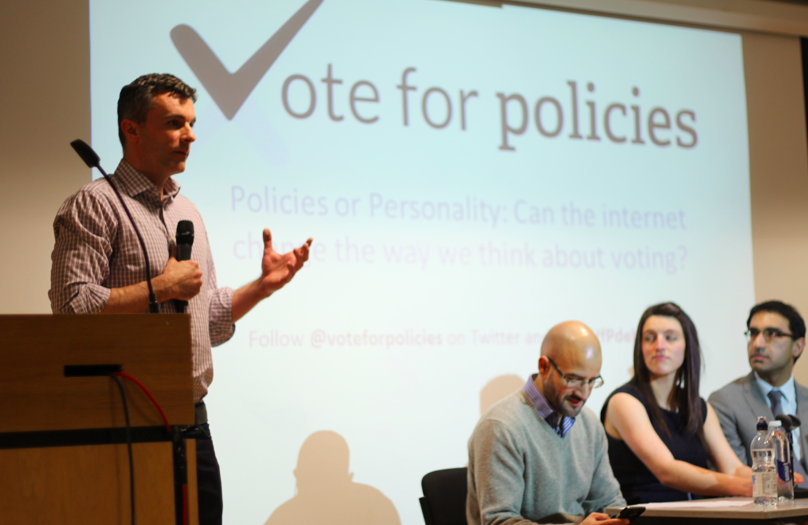
Screen Shot 2015-03-25 at 14.15.40Last night, I found myself in the strange position of introducing a panel of speakers at Birkbeck, including John Curtice and Dr Rosie Campbell, to discuss whether the internet can have an impact on our voting habits. I say strange because just 5 years ago, I had no real interest in politics. I suppose I was like most people, engaged a little around election time but otherwise never really bothered by what went on in Westminster.

But yesterday, the organisation I set up during the 2010 election, Vote for Policies, organised this debate in partnership with The Birkbeck Institute for Social Research, as we released some really interesting data from our users: 50% of people polled on the Vote for Policies website say they are likely to vote for a different party as a result of using the site. A further 63% say they are surprised to discover which party’s policies they support. You can read a full report of the debate here.

Vote for Policies allows users to compare policies on topics like education or the economy, without knowing which party they belong to. 166,000 surveys have been completed since its soft launch on February 19th 2015. 1,111 users completed the poll on which our findings are based.

I set it up because before the last election I came to the frightening realisation that I simply didn’t understand the differences between the parties’ policies, which led me to read all of the manifestos in detail. For the first time, I felt informed and ready to vote – but most people don’t have time to trawl through manifestos, so I wanted to make this process easier for everyone else. You can take the survey here.

Also posted in Op-eds | Tagged , and | 30 Comments

The Independent View: Location, location … taxation? The benefits of a locally-driven mansion tax

A tax on high-value property is a long-standing Liberal Democrat ambition, yet one which remains controversial. If and when it is adopted by government, it must be directed locally if it is to address key concerns.

The chief benefit of a mansion tax is to discourage purely speculative housing purchases. Falling demand for luxury property from prospective owners unwilling to pay tax on homes they are not inhabiting would encourage a greater focus from developers on homes affordable to the majority.

Of particular concern is the 70% of newly built homes in central London bought by non-UK residents in 2013. Existing housing stock in an under-supplied market must be used more efficiently. Combined with other new taxes on such property and a strengthening pound, the effect of a targeted mansion tax could be especially strong on ‘non-dom’ owners.

This complements the inherent advantage of a mansion tax. By taxing value arising from features inherent to the property such as its location or design rather than endogenous decision-making by economic agents, it avoids the negative incentive effects associated with income tax. 

Also posted in Op-eds | Tagged and | 37 Comments

The Independent View:  How to bring  an end to cold homes

respublica_logo_hi_res1 in 10 households in the England are in fuel poverty. This is national scandal which we need to address.

The coalition has made progress, improving the energy efficiency of over a million homes, but as the proposed ‘Green Homes Bill’ in the Liberal Democrat manifesto recognises, much more can be done to cut energy bills for the fuel poor and help bring an end to our cold homes crisis.

The current energy efficiency scheme aimed at the fuel poor, ECO (the Energy Company Obligation) in its current form is not up to the job of responding to the scale of the challenge which confronts us. We need to go further to ensure the most vulnerable in our society are not faced with the unenviable choice between heating and eating.

Tagged , and | Leave a comment

The Independent View: Let’s make 2015 the last ever lottery election

Who could have predicted it? Who would have thought that four years after the Alternative Vote was firmly rejected by voters in a national referendum, we would be approaching the 2015 general election with First Past the Post at Westminster under serious scrutiny? Or that local electoral reform could be a realistic outcome of power-sharing talks between Liberal Democrats and one or other of the major parties (provided Lib Dems make it a ‘red-line’ issue)?

What are the game-changers? Firstly, FPTP’s supposed ability to deliver clear majority government was justification enough for many to put up with the obvious lack of proportionality.  That no longer applies. As The Economist says: “Unaccustomed and ill-adapted to multi-party politics, Britain is more likely to get weak, unstable governments. That will only fuel the dissatisfaction with career politicians in the main parties. And if the parliamentary system comes to be seen as both unfair and ineffectual, then it is in for a crisis of legitimacy.”

With FPTP stripped of its main justification, other arguments are also coming to the fore. In The Lottery Election, published last month by the Electoral Reform Society, Professor John Curtice argues that relatively small shifts in opinion could have massive effects at the Westminster level. Meanwhile, UKIP could come 6th in seats but 3rd in votes, and SNP could come 6th in votes but 3rd in seats. So far, so unfair.

Also posted in Op-eds | Tagged , and | 25 Comments

The Independent View: “How to save public service choice for liberalism?” a CentreForum paper by David Boyle

David BoyleIn a series of essays that CentreForum will be releasing over the next few months in anticipation of the book, The Challenges Facing Contemporary Liberalism: 2015 -2025, the liberal think tank has today released “How to save public service choice for liberalism?” by David Boyle, which can be read here.

It is the fourth in the series; the first, On Blasphemy by Maajid Nawaz, can be read here; the second, an essay by Tim Farron, Neil Stockley and Duncan Brack on green growth and climate change, can be read here; the third, “Bold liberal tax reforms for a stronger economy and fairer society” by Adam Corlett, can be read here.

David begins by stating that never has one word caused as many problems as “choice”. The word has become nebulous, and different political parties use it in very different ways. What the paper focuses on is what the word means for liberals.

Tagged and | 50 Comments

The Independent View: “Bold liberal tax reforms for a stronger economy and fairer society” – a CentreForum essay by Adam Corlett

In a series of essays that CentreForum will be releasing over the next few months in anticipation of the book, The Challenges Facing Contemporary Liberalism: 2015 -2025, published today is the paper “Bold liberal tax reforms for a stronger economy and fairer society” by Adam Corlett, which can be read here. It is the third in the series; the first, On Blasphemy by Maajid Nawaz, can be read here, and the second, an essay by Tim Farron, Neil Stockley and Duncan Brack on green growth and climate change, can be read here.

Adam’s paper examines the tax system and identifies six key challenges facing any incoming government post-May 2015: simplifying income taxes; taxing investment intelligently; fixing corporate tax biases; reforming inheritance tax; taxing real estate; and making consumption taxes fair.

Also posted in Op-eds | Tagged , and | 20 Comments

The Independent View: Commons must debate key Medical Innovation Bill before election

Maurice Saatchi’s Medical innovation Bill has caused controversy and inspired a passionate debate on how doctors and scientists can and should speed up medical advance for currently incurable diseases.

The Bill is designed to do two things. First, it will offer clarity and confidence to doctors who want to innovate and move away from standard procedures.

When might that be relevant? In most cases standard procedures work and innovation is unnecessary. There is a vast quantity of scientifically validated data which supports standard medical procedures.

But in some cases – specially for rare and incurable diseases –  there is little scientific data and no effective treatments. In such cases, a doctor and the patient may face a choice, between applying the standard treatments, even though they are known not to work and will lead only to death, or to try something new.

Also posted in Op-eds | Tagged , , and | 64 Comments

The Independent View: A cheaper but credible alternative to Trident

TridentOne of the strange things about recent elections is the lack of debate about defence and international affairs. So far, the current election campaign is no exception, despite the reality that the choices the next Government makes will limit our strategic options over the next 30 years.

The key decision is whether or not to replace the existing Vanguard­-class Trident submarines at a capital cost of up to £33bn, £3.3bn of which has been spent thus far. A decision to pursue replacement would commit between a quarter and a third of the total Ministry of Defence (MoD) equipment budget to Trident – every year – from 2018 to 2032. It would deny the conventional forces of the investment that they need to remain capable of world-wide operations in support of the UN and regional peacekeeping and, where necessary, intervention and peace-enforcement.

80 Comments

The Independent View: Analysing the common ground between Lib Dem and Labour policy positions

Today sees the release of a combined piece of work between the Fabian Society and CentreForum that details what the policy overlaps between the Lib Dems and the Labour Party are, according to the most up to date data. The report is entitled “Common Ground? An analysis of the Liberal Democrat and Labour programmes”, and can be read here. By extension, the paper sets out what the discussion might look like should the two parties find themselves negotiating a government after the general election in May. The report does not recommend such an arrangement; it only seeks to outline …

Tagged , , and | 20 Comments

Opinion: Wanting zero suicides and dignity in dying are neither contradictory nor hypocritical

DADiDMany Lib Dems may not have been aware of the fact that amongst disabled activists recently, the Party has been at the centre of a hotly debated issue over suicide prevention and the legalising of assisted dying for terminally ill, mentally competent dying people.

Earlier this month, Leader Nick Clegg hosted a mental health conference with Liberal Democrat Care and Support Minister Norman Lamb. Together, they announced the admirable ambition of the NHS working towards ‘zero suicides’ – a key target for suicide prevention of people with mental health issues.

Tagged | 6 Comments
Advert

Recent Comments

  • Jason Connor
    The Greens, Lib Dems and Conservatives are all standing. They all see sense and believe in democratic choices....
  • Mick Taylor
    @Lawrence Cox. To read your comment one might want to believe that the Triple Lock has ensured pensioners have decent pensions. It hasn't and UK state pensions ...
  • Chloe
    A Blue Labour response recent events in Hampshire. Well worth a read. https://www.paulembery.com/p/for-the-race-obsessed-british-state...
  • theakes
    A new strategy/approach requires a new leader...
  • Kira Collins
    You use the phrase “fiscal federalism” and “financial autonomy” but have not used the phase I had hoped to see that is drawn out of both: fiscal autonom...