


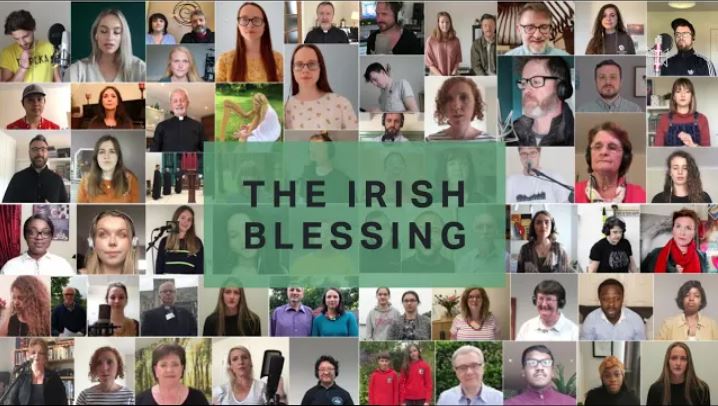
This is really rather special.
There have been lots of collaborative music projects during lockdown, with varying degrees of success, but the story behind this one is rather different. Churches in many countries around the world have stitched together their version of The Blessing by Elevation Music including The UK Blessing.
In Ireland three weeks ago a group of friends conceived the idea of producing a Blessing with a distinctive Irish flavour. But importantly it was to bring together churches and Christian organisations from right across the island, from across all the Christian traditions and incorporating all styles of music used in worship.
The old Celtic song “Be Thou My Vision” was adopted as The Irish Blessing, the music was arranged, a website was set up and a call went out for musicians to play or sing. They received 420 responses, representing all 32 counties in Northern Ireland and the Republic. You can see the breadth of the vision in the video – monks, drummers, orchestral players, Irish dancers, singers in every style, even a piper and a church bell, and The Priests put in an appearance too. Contributions came in from churches of all denominations including those serving immigrant communities.
Every single musical contribution was included in the final version. Each group dedicated the blessing to a local organisation supporting people during the pandemic – you can see the lists of all the churches and organisations involved, plus the dedications here.
That’s amazing, but that’s not why it is so special to me. My son, Stu Reid, is a music producer, and also works as a part-time priest in the Church of Ireland. He was involved from the start, and he produced and mixed the sound that you hear. It was the most complex project he has ever worked on, with over 700 tracks to integrate, and I don’t think he has had much sleep over the last week. But the result is glorious.
Please note
We have been in full self-isolation since 16th March to protect my husband whose immune system is compromised.
If you are in self-isolation then join the Lib Dems in self-isolation Facebook group.
You can find my previous Isolation diaries here.
* Mary Reid is a contributing editor on Lib Dem Voice. She was a councillor in Kingston upon Thames, where she is still very active with the local party, and is the Hon President of Kingston Lib Dems.
 Follow @libdemvoice.org on Bluesky
 Like us on Facebook
 Subscribe to our feed
 Sign-up for our daily email digest

 Bodhana Sivanandan is youngest ever female international master
 Yes, I'm still in favour of making the House of Lords democratic
 British music only!
 Whickham North Focus delivery
 United Nations Day, 24th October
 David Blake
 Richard Dickson
 Richard Cripps
 Steve Trevethan
8 Comments
That is beautiful thanks for posting. Extra special that included everyone in Ireland, so much more needs to be done that way. We are supporters of the Commymeela Community, and I would be surprised if they were not involved too.
How your son got everyont do sing together in that way is pure magic – or lots of skill.
Please Pass on our appreciation for this.
There have been some amazing online collaborations.
The Kings Singers are currently separated by the pandemic, yet their timing for this complex performance is perfect, as tough they are in the same room. The song is the theme tune to “When the Boat Comes In” which those of us of a certain age will remember well.
This is utterly beautiful. So well produced. I am as heathen as they come, but I love this hymn and I think Stu and alll the contributors have done a glorious job. If they set out to touch hearts, they succeeded with a sensitive and joyous video.
Mary , you are a blessing, Thank you Angus grà duit.
Thank you, all.
It is not easy to create music at a distance. The secret is to produce a backing track. You will notice that all the performers in any of these videos have headphones, because they are listening to the backing track. Professional musicians can work to a simple metronome, but for most performances singers are listening to a sung version of their line. You can see what was used for The Irish Blessing here: https://theirishblessing.com/resource-pack/. They also produced 25 sheet music arrangements.
The same technique is being used for Gareth Malone’s Great British Chorus which I have been following. In that case they have had thousands of submissions so it is taking them a long time to pull them together.
Engineeringwise, the first problem is varying time delays over the internet, hence the need for any individual to sing in synchronism with the backing or cue track as he/she hears it. That means that Stu would later be able to pull each track into synchronism in order to mix the whole as we hear it.
Wonderful! I recognised around 6 of the locations as I watched it. I noted that ‘opposing’ traditions were there, with the Irish dancing and the Lambeg drum and that the spoken word at the end included Irish, Standard English and Ulster Scots as well as other languages.
@Ian Sanderson – so pleased you spotted all those factors. A lot of work went into making it as inclusive as possible. Note the two kinds of pipes as well.