Broadly speaking, the party’s local government base is now back to where it was in 1993. As I put it:
For those who joined the Liberal Democrats in the last 18 months, and may not yet even have been in school in 1993, that may well seem a long time away and a big step back; for those who have seen the party’s ups and downs in the ’70s, ’80s, ’90s and ’00s, 1993 looks rather better – and nothing like as bad as the dog days of having a party leader on trial for conspiracy to murder (late 1970s) or
One of the things which Ed Miliband does right at Prime Minister’s Questions, is to start with short, straight-forward questions. He’s obviously realized this is a good ploy, as he does it invariably. Today’s shorty was: “A year into his Government, how would the Prime Minister rate his handling of the NHS?”
It’s taken a while for David Cameron to work out how best to answer these shorties. He started by waffling like billy-o, tying himself up in knots. Then he tried a short reply and came a cropper there as well. So now he goes middle for diddle with a …
Rounding off our trio of post-election views from the other parties (see here and here), we have Compass’s Neal Lawson.
So what now for any progressive alliance? Let’s start with an honest assessment of the hole we are in. Labour is now as divided between pluralist and tribalists as it is between those who think the markets needs come before those of society and those who turned social democracy on it head under New Labour. Labour did OK in the North but badly in the South, it did OK in Wales and atrociously in Scotland. The Greens have …
For decades Peter Riddell has been one of the best British political commentators, regularly providing his readers with insight rather than, as is the way with second-rate commentators, simply leaving the reader little more enlightened at the end of a piece that knowing that, yes, that commentator’s own political views are the same as they were last time.
So his book, In Defence of Politicians Inspite of Themselves, has many years of experience and analysis behind it. It originated in a lecture he gave on the same theme in February 2010 and reads like an extended version of the lecture. …
You would expect that the electoral disaster faced by the Lib Dems last Thursday, with hundreds of councillors losing their seats and the referendum on fairer Votes comprehensively lost, would have overshadowed the weekend’s political activity. Not so in Hackney, where the local party and friends gathered in the sunshine to discuss the apposite question, “what is happening to our NHS?” First to address the issues around the government’s proposed reforms was health Minister Paul Burstow, and in fairness he did begin by paying tribute to the hard-working activists who had to deal with …
The BBC handed out more negative adjectives, including “collapsed”, “destroyed” and “drubbing”, to our losses (ignoring the gains and holds) on May 5th than Simon Cowell does on the X-Factor, so really we can leave other people to castigate the party and Nick Clegg, and we should get on with being honest about what happened and being focused on where to go next.
Whilst I’m going to present this piece in a positive manner, it in no way diminishes my understanding of how badly we were flushed on May 5th, just I feel there is no point wallowing in it continuously. …
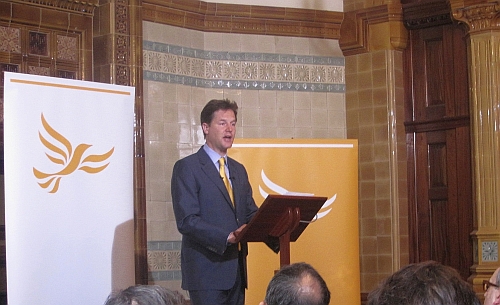
This morning, Nick Clegg gave a speech to party members to mark the first anniversary of the Coalition Government.
In the light of the past year, and of last week’s election results, Nick set out to answer what these mean for the Liberal Democrats – both as a party and in government.
Nick described the Liberal Democrat economic agenda in government as one of “short-term repair and long-term reform,” while promising “a strong liberal identity in a strong coalition government”, “muscular liberalism”, and “a louder Liberal Democrat Voice” .
Nick said that having created a strong, stable government and set out credible plans to reduce the deficit, it was time to “make the Liberal Democrat imprint and influence on government more visible.”
Liberal Democrats have long known that grassroots campaigns can win a ward, a council or a constituency – but they don’t win national election campaigns. It’s the knowledge that you need both the grassroots campaign and an effective national media and/or advertising campaign that explains why when Chris Rennard was the party’s Chief Executive not only did the Campaigns Department grow hugely in size – but so too did the national press team.
Yet at the heart of the Yes campaign in last week’s AV referendum seems to have been a big mistake: trying to run a grassroots campaign to win …
The advanced leaking of a supposedly highly confidential Parliamentary report is just the sort of tip that political journalists love and we all often enjoy reading or hearing about.
But there are leaks and there are leaks, as the widespread leaking of the Parliamentary Commissioner’s report into David Laws demonstrates with the three questions it raises.
First, it’s not news that the Parliamentary Commission has found David Laws broke rules – he himself previously said he had and reported himself to the Parliamentary Commissioner. What will be new news, when it comes out, is what the Commissioner has found as a result of …
I think nearly all Liberal Democrats will take this as good news rather than bad:
The highly-critical assessment of the coalition’s first year in power was delivered by the Centre for Social Justice (CSJ) – which was founded by Work and Pensions Secretary Iain Duncan Smith.
And it comes just months after the former Tory leader himself risked stoking tensions with Liberal Democrat colleagues by renewing calls for the state to reward marriage financially.
In a report to mark the anniversary of the power-sharing deal, the CSJ complained that the tax break plan had “moved off radar” because of opposition from the
Just about everyone in the Westminster Village will shortly be talking about the latest book that tries to explain why people vote the way they do.
The Social Animal, by US journalist David Brooks, has just been released in the UK and it suggests that people are driven more by gut instincts than rational thought when it comes to voting choices.
That rather obvious point has been haunting the Liberal Democrats from the moment they produced a joint programme for Government with the Conservatives on the weekend after the last General Election.
On the rational side of the challenge facing my colleagues and I a year ago were the electoral maths, the opposition from Labour politicians to contemplate compromise, the absolute imperative to produce a plan to reduce the deficit, and the need to act quickly to calm the markets.
My irrational instinct was that such a coalition arrangement was nothing short of a pact with the devil and it will end in tears, while my democratic rational side went along with a majority of the Parliamentary Party, the Federal Executive and Special Conference vote.
Days have now passed since the last result for the Scottish Parliament was declared. At least that provided a bit of happy news; my local colleague and former Dunfermline MP Willie Rennie was elected as the last MSP from the Mid Scotland and Fife regional list. But frankly, what went on in the 18 hours prior to that was not much short of a horror show – I never thought that “Losing Deposits” would ring true again.
Normally, after a drubbing like that, attention turns to the campaign itself and where it all went wrong. This time, though, there’s no real …
Is Nick Clegg’s time as Lib Dem leader coming to an end? Over on his Telegraph blog, Julian Astle poses a question which undoubtedly deserves a place on John Rentoul’s list of Questions To Which The Answer Is No – while also answering another QTWTAIN which others have posed.
And here’s why Julian think Clegg is here to stay:
First, the coalition is supported by the political equivalent of the “automatic stabilisers” which ensure that the weaker the coalition partners become, the stronger the coalition gets. Why? Because just as turkeys don’t vote for Christmas, so politicians don’t trigger general elections if they
Despite our best efforts, we Liberal Democrats failed last Thursday to make electoral reform sexy. Quelle surprise. The economy is faltering, public services have a shaky future and, frankly, how people vote for their MP’s is not of major concern to the British people.
Using my trusty retrospectoscope, I can tell you that the Yes campaign got the message wrong, and it did not resonate with people. The campaign went for the anti-politics, anti-politician approach of saying they were offering the people a way to make their MP’s work harder and suffer more. Britons shrugged. The fundamental nature in which politics …
Liberals, I put it to you that we are neither wannabe conservatives nor right wing Labourites. We are distinct as Liberal Democrats and need to start making this clear.
The small ‘c’, conservatives who fought for a no vote in the referendum show, at heart, narrow party interest drives activists in both Labour and Conservative parties. As long as they remain tribal, with every motivation checked against what is best for party, it will prove fatal if we continue to seek pluralism in a world where pluralism is derided and to ignore the self preservation of our own party and values.
A newspaper’s decision to secretly tape Liberal Democrat MPs breached press rules on “subterfuge”, a watchdog says.
The Press Complaints Commission said the Daily Telegraph had produced material “in the public interest”.
But it said the paper had not had enough evidence to justify what it called “a fishing expedition”.
Among those taped by reporters posing as constituents was Business Secretary Vince Cable, who was recorded saying he had “declared war” on Rupert Murdoch…
The PCC ruled the newspaper launched the “disproportionately intrusive attention” without sufficient reasons and said it would issue fresh guidance over the acceptable use of subterfuge.
Even after last Thursday, I’ve come across very few Liberal Democrats saying, “we should have made a deal with Labour last May”. That’s not a surprise, given the Parliamentary arithmetic and also all that has come out since about just how split Labour’s negotiating team was, not to mention the almost farcical lack of preparation from Labour for talks. Peter Mandelson grabbing a quick cup of tea with Ed Balls to sort out Labour’s negotiating line before walking into the first meeting may be very English, but competent or prepared it wasn’t.
That does, of course, leave the question of whether …
Over on his New Statesman blog, lawyer and Liberal Democrat member, David Allen Green, has posted a piece setting out his thoughts as to what the Liberal Democrats should do now to avoid another round of election results like the one we have just experienced.
Here’s an excerpt:
If the Liberal Democrats are to be a serious party in respect of central government, there are two things to be done. First, they need to be more realistic and consistent in what they campaign for: manifestoes and pledges now need to practical and attainable. The luxury of striking populist poses is for
So what next for the Lib Dems? The next general election and probably many more will be fought using the flawed and unfair first past the post system. We can vent some steam and complain about the poorly executed Yes campaign. Or look like sore losers and blame Cameron and the No campaign’s underhand tactics. But the fact is electoral reform is not on the cards any time soon.
The challenge for the Liberal Democrats is now prove to the country that coalition government works. Our party needs to provide the country with strong, stable government …
After the polls, some perhaps more welcome news for the Liberal Democrats.
I’ve recently started running a series of articles on the allthatsleft.co.uk website that set out how the boundary changes in 2015 could play out and what this would mean for the political parties.
On Tuesday, I looked at the impact of changes for Devon and Cornwall. These two counties will be linked in the next review, creating a controversial trans-Tamar seat linking parts of both counties. The two counties are set to lose one seat between them, falling from 18 to 17.
It looks as if the changes could be to the Liberal Democrats’ benefit. I …
After the humiliating defeat of the AV referendum, a system to which no party aspired to before the General Election, and the disastrous rout of elected Lib Dems in Scotland and England, serious questions must be asked about the future direction of the party and its place in the coalition government.
In order to reclaim the trust of the British electorate, we need to be bold and radical, and we must speak up for the aspirations of the British people, particularly the disillusioned young; the Facebook generation, who are the future of our democracy. Despite Nick Clegg’s promise of a ‘New …
1. What’s your formative political memory?
In 1984 Ken Clarke gave me an award at a thank you party for delivering leaflets for him. In front of the 200+ people there he also asked me if I wanted to join the party – and in front of them all I said no! I was pleased he’d won but said that the more I had got to know the party I realised why I couldn’t. He was somewhat embarrassed!
2. When did you start blogging?
Tuesday 15 May 2007.
3. Why did you start blogging?
I worked for Lynne Featherstone from just after the 2005 general election until the end of 2006, before becoming one of the two London Campaigns Officers. I was amazed Lynne found time to write her own blog posts so this was my initial inspiration. I also signed up to run the Great North Run in 2007 and so wanted to use it for a training diary.
4. What five words would you use to describe your blog?
I cheated here, I asked some friends for their five words – here is a selection: friendly, personal, prolific, timely, political, caring, liberal, sharp, punchy, researched, readable, passionate and straight-talking.
5. What five words would you use to describe your political views?
I’m a social liberal democrat.
6. Which post have you most liked writing in the last year (and why)?
I enjoyed writing this, not because I was suspended from Twitter, because to be honest that was a nightmare, but thanks to the support shown by the online community, inside and outside the Liberal Democrats: Andrew Reeves is still suspended on Twitter – but the support is awesome
7. Which post have you most liked reading in the last year (and why)?
I love reading Caron’s writing, because unlike my shoot from the hip and rant style, Caron is more methodical and this shows in her writing. In this post Caron highlights the hypocricy of the Labour party while still maintaining decorum – perfect: Labour didn’t love NHS Direct
8. What’s your favourite YouTube clip?
I don’t particularly bother with YouTube, but this was my favourite ever:
Aside from the major changes in tax rates (such as income tax allowances up, capital gains tax brought much closer to income tax levels, cuts in tax breaks for the richest on pension contributions), one of the most significant economic policies that the Liberal Democrats have brought to government is the massive expansion of apprenticeships.
With Vince Cable overseeing the creation of a minimum of 250,000 more apprenticeship places by 2014, the number will be at record levels – and should bring three major benefits.
First, they are good for the apprentices, giving people the opportunity to learn skills which help them …
Welcome to the Golden Dozen, and our 220th weekly round-up from the Lib Dem blogosphere … Featuring the seven most popular stories beyond Lib Dem Voice according to click-throughs from the Aggregator (1st-7th May, 2011), together with a hand-picked quintet, normally courtesy of LibDig, you might otherwise have missed.
Don’t forget: you can sign up to receive the Golden Dozen direct to your email inbox — just click here — ensuring you never miss out on the best of Lib Dem blogging.
As ever, let’s start with the most popular post, and work our way down:
After the party’s battering at the polls on Thursday, and the simultaneous rejection of electoral reform, the Lib Dems’ future in the Coalition government has been the subject of much media discussion this weekend, with Nick Clegg, Vince Cable and Simon Hughes all leading the fightback. Here’s a round-up of some of their BBC interviews…
Over on the Guardian’s Comment Is Free, former Liberal Democrat MP, Evan Harris, has an article defending the party’s decision to enter a coalition with the Conservatives last year, but also setting out some of the mistakes that have been over the last year – with the benefit of his “retrospectoscope” – as well as some suggestions of how they can be avoided in the future.
Here’s a sample:
When we opted last year to form a coalition with the Conservatives, the Liberal Democrats were not so naive as to think these elections would be anything better than extremely difficult. But last
As a Liberal Democrat member*, I’m proud of the fact that our party is in government, with ministers making tough choices about the UK.
While most attention is on electoral reform and tuition fees, I want to steer your attention towards foreign policy. In the Foreign Office there is one Lib Dem minister, Jeremy Browne MP. He takes the responsibility in the FCO for human rights policy among other things.
The reports this week were that the Government is planning to scale back its proposals for outsourcing public services. A significant policy shift means that the delayed Open Public Services White paper will not feature proposals for “wholesale outsourcing” to the for-profit private sector when it finally emerges in a few weeks time.
Notes drawn up by the CBI following a meeting with Cabinet Office Minister Francis Maude, leaked to the BBC, suggest that the Government remains committed to “transforming services”. But the White Paper will focus on moving services from the public sector to charities, social enterprises, and employee-owned …
When LibDem MPs return to Westminster this week they could be forgiven for having a collective panic attack. In their 22 year history they have never had such an onslaught of the political heebie-jeebies as they experienced at the hands of 12 million grumpy voters this week.
Cleggmania has turned into Cleggophobia. Every policy Nick Clegg touches now is seen to be toxic.
Westminster pundits are already writing him off as a political busted flush. But then again, these are the very same commentators who didn’t see the SNP landslide coming in Scotland. They are the same people who predicted the Tories …
During the week, I’ll be writings a series of posts on the lessons for the Liberal Democrats from Thursday’s elections, but in the meantime this is what I told the BBC this morning:
Jason Connor Please clarify specifically how they miss the mark?
Christine is a very popular and highly capable Lib Dem MP, if not one of the most popular. If she is ous...
David Blake If Alex Cole-Hamilton has anything to do with this he should resign....
Steve Trevethan Thank you for an interesting and relevant article.
Might the rise of extreme right, populist parties be a/an (unsurprising) consequence of Neoliberalism, aka...
Alison Smith Christine Jardine is a highly respected MP of national stature so this concerns Lib Dems far outside the boundaries of Edinburgh West. Furthermore, if other Sco...
Chris Moore I was another member who wanted Christine to stand for leader in 2015 and 2018/9. Indeed, wrote to her to that effect. Her qualities are undeniable.
The man...




 Follow @libdemvoice.org on Bluesky
 Like us on Facebook
 Subscribe to our feed
 Sign-up for our daily email digest

 The Joy of Six 1583
 Inside the refurbished library
 Is the Labour government split on immigration?
 How Home Secretaries change immigration rules without telling Parliament
 Jason Connor
 David Blake
 Steve Trevethan
 Alison Smith
 Chris Moore