Conference preview: party strategy

When I last made a broad-brush comment about how many conference strategy motions pass without leaving much of a trace behind, Tony Greaves pointed out the major exception to that: the Community Politics strategy motion of 1970. When it comes to details mattering, the triple lock mechanism from the No Glass Ceilings strategy paper also turned out to be important, as we saw last year.

The prime author of this year’s strategy paper is one of the founding fathers of Community Politics and the author of the triple lock, Gordon Lishman. The related motion being debated on Sunday morning at the Liberal Democrat spring conference may be lengthy but is unlikely to have the same impact of either of those two other texts. It can be summarised as, “We’re an independent party and we don’t want any pre-election deals”.

The motion rules out pre-election pacts or any preferences for post-election partners and sets out a five point list for how the party should decide who to make any future post-election deal with. Unlike the triple lock, this list is likely to have little lasting value as the political and media pressures to have a simple, clear one sentence answer to such questions means the list will be stripped down to a much shorter position as the next election nears – and it’s the debate over that which is what will really matter.

Tempting though it is to find reason to object to the motion calling for the party to win elections … I suspect the motion itself will not be controversial (unless there is an amendment submitted which kicks off a dispute). Rather, it will give people the opportunity to talk on a wide range of matters and it is the tone and balance of those contributions which will be the more revealing and, possibly, the more influential.

An overwhelming vote for a motion that says no to pre-election pacts and no to picking a preferred post-election partner may also be useful in both quieting some of the more fanciful speculation in the Conservatives and the media, and also in reminding one or two Liberal Democrats what the party overall thinks.

The full text of the strategy motion (F16) is in the conference agenda and directory embedded below.

Liberal Democrat Spring Conference Agenda and Directory 2011

Posted in Conference | Tagged and | 7 Comments
Advert

More of the Liberal Democrat manifesto in practice

Just before Christmas, I blogged the Liberal Democrats’ achievements in Government. Since then, even more of the party’s manifesto has been enacted.

For example, the ID card database was publicly destroyed on 11th February 2011 and Project Merlin has ensured that the UK has the most transparent banking pay disclosure scheme in the world.

Sarah Teather’s SEN Green Paper has proposed key reforms to the way Special Education Needs are diagnosed and the support that children and parents receive.

The National Curriculum is under review, with the aim of replacing the current system with a slimmed-down and more competitive version.

The Government are backing Lord Clement-Jones’ Live Music Bill, which aims to cut red tape for putting on live music, as set out on page 46 of the Lib Dem Manifesto.

For the full update, see below:

Posted in News | Tagged , and | 14 Comments

Fred Goodwin gets super-injunction that even stops him being called a banker

The Independent reports:

Sir Fred Goodwin, the former chief executive of the Royal Bank of Scotland who became a focal point for anger over the financial crisis, has obtained a super-injunction banning the media from identifying him as a banker.

The existence of the super-injunction was revealed today by John Hemming, a back-bench Liberal Democrat MP who tabled a question in Parliament about the gagging order.

Normally the media is forbidden from even reporting that a super-injunction exists but Parliamentary privilege allows MPs to speak on the floor of the House of Commons without risk of prosecution.

Posted in News | Tagged and | 9 Comments

Dinti Batstone writes: diversity opportunity at #ldconf

This weekend in Sheffield, Liberal Democrats will be debating important internal steps to ensure that by 2015 our parliamentary party in the House of Commons better reflects the diversity of modern Britain.

In the coming months, with the Draft Bill on House of Lords reform, Liberal Democrats will also have a key external opportunity to kickstart culture change at Westminster.

Here’s why we need to grasp that opportunity:

§ Diversity is part of the solution to our broken politics. Diversity is good not just for under-represented groups and parties who want their …

Posted in Conference | Tagged , and | 9 Comments

Opinion: Time to put party first

Long before the Barnsley Chop was felt by the unfortunate Dominic Carman, an increasing number of Liberal Democrats have been murmuring about the longer-term effects of the coalition on our electoral chances in 2015.

That murmur is now a whisper among those who focus four years ahead and feel queasy about our longer-term survival. Putting the Party First does not mean opposing the coalition. Quite the contrary.

We should trust those in government to get on with it, while keeping to the agreement and other pledges. The 2013 Review will be the proper time to voice concerns and make corrections. In the …

Posted in Op-eds | 40 Comments
Advert

Opinion: Are the Government in danger of recreating the GLC by the back-door?

When is localism not localism? When it comes to London apparently!

As the Localism Bill makes its way through its committee stages in the House of Commons the clauses that have an impact on London were rushed and hardly discussed on Tuesday afternoon.

This is unfortunate because this is the one part of the bill where the idea of localism is stopped dead in its tracks. In contrast to the localist approach applied across England in the rest of the bill, when it comes to London it seems that devolution stops at a regional level.

There are three specific proposals in the …

Posted in London and Op-eds | Tagged and | Leave a comment

Paul Burstow writes: I will be listening to members on NHS at #ldconf

This is the first spring conference since we entered Government. In all the years I’ve been a Liberal Democrat I’ve never known of such a potentially explosive spring conference. Or at least that’s what the media would have you believe. Debating policy is part of our DNA. And it shouldn’t change now that we’re in Government. This spring conference we’ll be debating the coalition’s proposals to update the NHS. And unlike in the media, it won’t be a case of who shouts loudest wins.

I understand why people are so concerned. Every time I meet party members …

Posted in Conference and Op-eds | Tagged and | 12 Comments

Councillor sacked, councillor arrives, councillor departs

A trio of local council news:

Posted in News | Tagged , , and | 9 Comments

Opinion: a British Bill of Rights should include judicial review of legislation

British people’s attitude to fundamental rights is deteriorating alarmingly. Liberal Democrats in government have a key opportunity to reverse the trend.

When the incoming Labour Government issued ‘Bringing Rights Home’, in the wake of the UK having the worst human rights record in terms of adverse judgments except Turkey, we all applauded.

But the weasel words of the Human Rights act, which explicitly ruled out judicial review of legislation (as happens in Canada under the Charter, and has happeed in the USA since Marbury -v- Madison) has created a climate where the majority of the British people now think that fundamental …

Posted in Op-eds | Tagged , , , and | 13 Comments

Putting community politics back into election campaigns

This is the chapter I contributed during the last Parliament to ALDC’s Community Politics Today publication. The John Pardoe quote applies all the more now the party is in coalition government and the general advice to local campaigners is in my view even more important now than it was then:

It’s a common complaint – that modern Liberal Democrat election campaigns have lost the original campaigning and ideological spirit of community politics. Instead, so the critics say, campaigns have become a dumbed-down recitation of techniques, campaigning by numbers, where the only objective is votes and only the ballot box …

Posted in Op-eds | Tagged , and | 2 Comments

Conference preview: Improving the diversity of our MPs

Motion F9 Improving the diversity of our MPs is up for debate late on Saturday afternoon at the Liberal Democrat Sheffield conference. It attempts to be a successful, and not toothless, compromise between the strongly held conflicting views in the party on what should be done in response to not only the continuing dominance of the (Commons) Parliamentary Party by white men but also the significant slippage of the party’s diversity record compared to that of both Labour and Conservatives over the last few general elections.

As it is a motion explicitly about MPs, I can appreciate why it does not address local government. However, the flatlining of the proportion of Lib Dem councillors who are female for two decades now is a much neglected subject, and the male (and white) dominated pool of councillors is an important contributory factor to the similar pattern amongst MPs in my view.

What the motion does cover is better mentoring, setting of targets and then the heart of the proposals:

The creation of a Leadership Programme for outstanding candidates from under-represented groups, which will:

a) Have a maximum number of approved candidates, with a minimum of 30 by the end of 2011, and within that, 50% of the places will be reserved for women, and 20% for those from BAME backgrounds, and 10% for those with disabilities.
b) Provide advanced training and support, particularly in media, leadership and team building skills, and fundraising.
c) Provide mentoring and coaching from the moment they are approved as a candidate until after the election day.
d) Offer them opportunities to shadow a Parliamentarian.
e) Raise funds to provide practical support to PPCs from under-represented groups.

As an added impetus, the motion says that if there are enough applicants, then at least two people from the Leadership Programme must be included on the shortlist for a priority seat. Also, development seats should advertise in clusters, making it easier for them to hit targets for diversity in shortlists across the whole cluster.

Liberal Democrat Spring Conference Agenda and Directory 2011

Posted in Conference and Party policy and internal matters | Tagged | 10 Comments

PMQs: Libya sits on Hague’s head like a baseball cap

Ed Miliband boot the put in at Prime Minister’s Questions this week, regarding the string of cock-ups on the Libyan front, presided over by one William Hague, Foreign Secretary of this parish.

He said: “We have had the flights fiasco, talk of Colonel Gaddafi heading to Venezuela when he was not, overblown briefing about potential military action, and the setback last weekend.”

All in all, Libya is starting to rank alongside baseball caps in the list of things William Hague should leave well off his CV.

“We have an excellent Foreign Secretary” was finally squeezed out of Cameron by way of “support” for …

Posted in PMQs | 19 Comments

Sarah Teather MP writes: Seeking your views on Special Educational Needs proposals

Today I published proposals for improving services for disabled children and those with special educational needs.

This doesn’t affect everyone, but if you are a family with a severely disabled child struggling to give 24-hour care, or the parent of a child falling behind at school who doesn’t know where to turn for help, then I hope it will make a significant difference.

As Liberal Democrats in government, we started by listening to parents, families and young people. We had 1800 responses to our “Call for Views”, and each person will be getting an email letting them know we’ve now published …

Posted in News | 26 Comments

Opinion: NHS reforms need careful examination

I am a public health doctor and a member of the Liberal Democrats. I am also, in the words of Gordon Birtwistle, when he spoke in the debate on the new Health and Social Care Bill, one of the “faceless bureaucrats in palatial offices” that he blames for the failings of the NHS. I’d like to put a couple of arguments against the new health reforms, as I don’t believe that as a party we are very well informed about what these health reforms mean.

The reforms of the NHS are a substantial departure from what we had before. …

Posted in Op-eds | 39 Comments

Independent View: Health Bill doesn’t have to be a poisoned chalice, just put patients first

For all the face time that health secretary Andrew Lansley gets, Lib Dems can’t forget that come election time, they’ll be judged by the success or failure of the NHS reform package too.

This isn’t a reality that many members of the party are warming to. After almost a year of being cast by both the public and media in the role of scapegoat or political cover for their coalition partners, nobody can blame them for being wary.

But the Health and Social Care Bill doesn’t have to be a poisoned chalice. The Lib Dems have succeeded in securing compromises in other …

Posted in The Independent View | 2 Comments

The two crucial email numbers I didn’t mention

When talking about how tortoises hold the secret to online success, I only talked about the total number of people on email lists. If you are a campaigner wanting to build up an email list to effectively communicate with residents in your area, that is an important number to have a sensible target for and to work towards.

But it’s only one of the three crucial email numbers.

The second is the open rate on your emails. Email open rate statistics are provided by most of the email management services available, and indeed it’s one of the main reasons for using …

Posted in Online politics | Tagged | Leave a comment

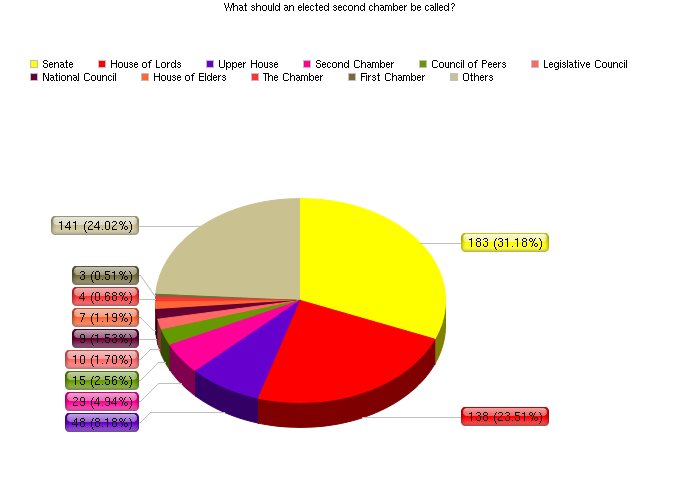
LDV readers prefer “Senate” as name for elected second chamber

Second chamber piechart
Last week we asked Lib Dem Voice readers what an elected second chamber should be called, following Nick Clegg’s answer in the House of Commons:

The cross-party Committee, which I chair, has been considering proposals for a wholly or mainly elected second Chamber. The Government will publish a draft Bill shortly, which will then be subject to pre-legislative scrutiny. The Government hope that that will be carried out by a Joint Committee of both Houses.

Our readers’ poll results are as follows:

Posted in Polls | Tagged | 15 Comments

Opinion: Its time for a well informed response on Diversity

Conference is almost upon us once again, and glancing my eye over the agenda I am pleased to see a motion based on Baroness Sal Brinton’s report on party diversity.

You may remember this came up at the last conference. The speech I made at Liverpool was my maiden at a federal conference; the amendment I co-sponsored helped pave the way for the motion on improving diversity we will debate this coming Saturday.

It was also one of the most depressing experiences I’ve witnessed as a party member. Friends who supported the amendment were treated appallingly by supporters of the motion. I …

Posted in Conference and Op-eds | Tagged , , and | 13 Comments

Huhne and Clegg launch government’s Carbon Plan

Yesterday Deputy Prime Minister Nick Clegg and Energy and Climate Change Secretary Chris Huhne launched the Government’s Carbon Plan, setting out in draft form the steps the government will take to cut carbon emissions. The plan is now going out to consultation, with the final version due in the Autumn.

There are three priority areas in the plan for change in the way we do things: electricity generation, heating of homes and workplaces and transportation. The plan also commits the government to working for tough international agreements on tackling climate change.

Reflecting Chris Huhne’s eagerness to see environmental action as being good for the economy as well as the environment, the plan was accompanied by a scheme to train at least 1,000 Green Deal apprentices. That would both help implement environmental improvements and provide people with the skills to get jobs.

Nick Clegg said at the launch that,

Nick CleggWe want to be the greenest government ever. We will reshape the economy, change the way we power our transport, heat our homes, and generate our electricity. We must put the development of the green economy at the centre of our ambitions to rebalance the economy.

The Green Deal is about the future – and it is important we ensure that future generations have the skills they need to take advantage of the opportunities of the green economy. These apprenticeships are a perfect example of how government and business can work together towards a low carbon future.

There is a noticeable difference between the comprehensive environmental action in the climate change plan (coming from a Liberal Democrat led department) and the government’s sustainability policies (coming from the Conservative-led Department for Environment, Food and Rural Affairs).

Key proposals in the plan include:

  • Legislating to create a floor in the carbon price by April 2011
  • Awarding the contract for the first UK Carbon Capture and Storage demonstration by end of this year
  • Getting the Green Investment Bank operational by September 2012
  • Reducing central government’s emissions by 10% in twelve months to May 2011

Nick Clegg talked about the plan on a visit to B & Q, one of the firms which has been at the forefront of building environmental considerations into its work. Here’s a short video from his visit:

Posted in News | Tagged , , , and | 4 Comments

Chris White writes: Liberty, Equality, Happiness – and most of all the Environment

Less than one year since the Coalition was formed we aren’t doing so well in by-elections (with the notable exception of Oldham East and Saddleworth).

This was totally predictable.

We knew in May 2010 that those who backed us because we were a leftish alternative to Labour would walk away. So would those who liked us as a protest party, forever out of power. And those hacked off with Brown and Labour authoritarianism were likely to flirt with Miliband, even if he currently stands for nothing at all.

Our core support remains, and in addition there are still many who admire the fact …

Posted in Op-eds | Tagged , and | 14 Comments

Conference preview: two of the coalition’s most controversial policies

Saturday morning in Sheffield this weekend sees the LibDem conference debating two of the areas of coalition which have generated the most controversy: the NHS and the future of the Disability Living Allowance.

The motion on the Disability Living Allowance (F4) has been slightly overtaken by events as the debate within government over the Welfare Reform Bill develops and in fact the plans in this area have in effect been sent back to the drawing board. That makes the motion all the more important, because rather than being simply a chance to cast a verdict on what the government has done, it is a chance to influence what is yet to be decided. The heart of the motion calls for “the Coalition Government to reinstate the Mobility Component or otherwise fund the mobility needs of those who cannot afford to do so themselves”.

Paul BurstowStraight after this debate comes one on the NHS (F5). The choice of Andrew Wiseman, Federal Conference Committee’s chair, to chair this debate is a good sign that this is expected to be one of the liveliest of conference as is the news that two Liberal Democrat MPs have signed an EDM expressing concerns over the policy.

Buried in the middle of the motion are lines 16-17 which says that “Conference welcomes the vision for the NHS set out in the Government’s White Paper”. That may be glossed over as a bit of padding between long lists of less controversial points or it may be the trigger for an all-out row, as also may be the amendment likely to be debated that is coming from ex-MP and doctor Evan Harris and Lib Dem peer Shirley Williams (who made her views clear in “I can’t support the coalition plan for the NHS“).

The gap between what the amendment calls for and what Liberal Democrats in government have been pressing for is not that large, however – and some have already expressed the view that the amendment may be a good route to getting more changes made to the health plans. That will provide a pointed choice for those promoting the amendment – whether to try to bring about change through aggressive antagonism or through emollient persuasion? And is modifying the government plans or setting out what a Liberal Democrat majority government would do their top priority?

The full text of both motions are in the Spring Conference Agenda and Directory embedded below.

Liberal Democrat Spring Conference Agenda and Directory 2011

Posted in Conference | Tagged , , , , , , and | 2 Comments

Youth Justice day: thanks and farewell

A final thanks to all those who have contributed to today’s focus on Youth Justice. I trust, dear readers, you have found the debate enlightening and challenging and those of you heading for Sheffield will join us for the debate on Saturday afternoon. We have a fringe event on Friday evening at 8pm in Suite 5 in Jury’s Inn. Peter Oborne will be chairing a debate with Tom McNally, Simon Hughes and others on Youth Justice in an Age of Austerity.

In the midst of all that I personally find unpalatable about the Coalition this is one area where I have …

Posted in Op-eds | Tagged , , , and | Leave a comment

Youth Justice: the minister’s view

Since I became Minister of State at the Ministry of Justice last May I have been working with Ken Clarke and the other Ministers within the department to make radical changes to the criminal justice system. Our plans are about finding out what works – the methods of rehabilitation and punishment which actually reduce crime.

One of the key aspects of this vision is preventing and tackling offending by young people. In England and Wales the number of children aged 10 to 17 grew rapidly during the course of the 1990s and into the second term of the Labour government in …

Posted in Op-eds | Tagged , , and | Leave a comment

Youth Justice: the magistrate’s view

just over 100 years ago a Liberal government decided that young people should no longer be routinely tried in the same courts as adults. Thus was born the juvenile, now youth, court system in England and Wales. During the last hundred years much has changed in penal policy, both corporal and capital punishment have been abolished, and the prevention of re-offending has taken on a greater importance over the punishment of offenders. There is also a live debate about the minimum age of criminal responsibility.

For some, magistrates, and especially lay magistrates, sometimes seem like the ogres in the system. They …

Posted in Op-eds | Tagged , and | 2 Comments

Youth Justice: the lawyer’s view

Society has gone badly wrong in the way in which it deals with those crimes committed by young people.

There are far too many children coming into contact with the criminal justice system. Children can appear in the adult Crown Court charged with grave crimes or if they are jointly charged with an adult. Under those circumstances, a child is confronted with the full rigour and formality of the court process. Following a finding by the European Court of Human Rights that the applicants Thompson and Venables had been a denied a fair hearing before the Crown Court, …

Posted in News | Tagged , and | Leave a comment

Youth Justice: on raising the age of criminal responsibility

The UN Convention on the Rights of the Child requires that states should set an age below which children cannot be held criminally liable – but does not specify a minimum age. A quick survey of other jurisdictions confirms that by comparison the age of criminal responsibility in England and Wales – at ten years – is extremely low.  Indeed, it is the lowest in the European Union. In other member states it ranges from 13 to 18. A survey of 90 countries by found that the most common age of criminal responsibility was in fact 14 years

Taking into account …

Posted in Op-eds | Tagged , and | 4 Comments

Youth Justice: the prison governor’s view

One of the most powerful pieces of learning for me during 34 years of being in and out of custodial establishments is the capacity of their residents to respond to opportunities; to being appreciated and congratulated for work well done; to being respected for doing something worthwhile. It is the realisation that this might have been their first experience of any of this that initially takes the breath away, and always disturbs. Although, therefore, Governors have to concern themselves with secure and safe custody and, yes, maximising resources to provide opportunities for offenders in their custody, and doing …

Posted in Op-eds | Tagged , , , , and | 1 Comment

Youth Justice: Linda Jack’s guest editor day

At Spring Conference we will finally get the opportunity to debate our Youth Justice policy – we have taken a “muscular liberal” approach – recognising that the present system fails not only some of our most vulnerable young people – but more importantly, society itself.

Other countries, even the most unexpected, have a far more enlightened approach to youth justice, recognising that punishment and rehabilitation have to be combined with meeting welfare needs of children and young people who have often been badly neglected.

Today a number of fellow Lib Dems express their professional and personal views of what our response should …

Posted in Op-eds | Tagged , and | 5 Comments

Conference preview: consulting on the future, inequality and digital policy

This weekend’s Liberal Democrat conference in Sheffield starts on the Friday afternoon with three policy consultation sessions: Facing the Future, Information Technology and Intellectual Property and Inequality.

The Facing the Future policy working group is chaired by Norman Lamb MP and, as Norman explained on this site last autumn, is intended to set the party’s broad policy framework for the next few years. Having such a key party leadership figure chairing the group is good news as it raises the chances of the group’s deliberations and outcomes having an impact on what the Liberal Democrats in government subsequently do.

The big challenge for the group is to avoid the fate of previous similar broad policy reviews which generally have done a good job at the technical details of what policies need reviewing and in which order, but have tended to have either very muddled overall messages or messages that sink largely without trace. (It’s a time for Facing up to the Future of Challenge, Opportunity and Responsibility while Moving Ahead to Meet the Challenge, Make the Change a policy wonk might almost say.)

Norman LambThe success of this group is all the more important this time round as without a clear direction, the party’s policymaking processes are likely to get over-shadowed by the day-to-day decision making impetus from government – where the policy teams are coalition rather than Liberal Democrat teams.

Norman’s presence as chair of the group is therefore particularly welcome, and it’s the absence of a similar senior leadership figure from the chair of the other two groups that illustrates their main challenge.

The Information Technology and Intellectual Property group (chaired by Julian Huppert, and which I’m a member of) and the Inequality group (chaired by David Hall-Matthews) both need to get their own recommendations right. But almost as important is to have recommendations which Liberal Democrats in government then pay some attention to. In both cases, the more closely the policies are drawn up with regular discussion with those in government, the more likely they are to have an impact on what happens.

Take the example of the Inequality group, which amongst other issues looking at those of social mobility and how important, or not, overall levels of equality are. The consultation paper says both are “crucial” and that tackling the former “would not necessarily” lead to improvements in the latter. That, and the chairmanship of David Hall-Matthews, give a fairly strong clue as to the recommendations the group is likely to produce. The key test, however, will be the degree to which any such recommendations influence the words and actions of Liberal Democrat ministers, especially Nick Clegg whose emphasis has been very much on only the former.

In my experience, policy working groups are very open to the views of others in the party where they are clearly put and with some evidence or experience to substantiate them (not a hurdle all submissions pass, alas!). So although some of the bigger questions may be beyond the direct reach of individual party members, I’d strongly encourage people to take part in the consultation processes.

Liberal Democrat Spring Conference Agenda and Directory 2011

Posted in Conference | Tagged , , , , and | 2 Comments

Giving everyone shares in the banks: Stephen Williams’s proposals examined

This morning saw the launch of a plan for giving away bank shares from Liberal Democrat MP Stephen Williams. Laid out in a pamphlet published by CentreForum, Stephen Williams’s plan is to give shares owned by the government in the banks to everyone on the electoral register. A floor would be set so the shares could not be sold until they had passed the price paid by the government and individuals would only keep any gains made above that floor price. In other words, as the shares rise in price and get sold the government gets back the funds it put into the banks and, if the banks do well, the public gets to profit from that.

It’s a neat idea, and one of the first substantive plans for what the government could do with its 83% of RBS and 41% of Lloyds. As is to be expected with any plan for such a controversial area, it raises a number of questions.

First, the government only gets back the money put into the banks if people sell their shares. If people hold on to them, those funds do not come back to government – and in particular that means a large source of possible government funds ends up being highly dependent on what can be very volatile stock markets. Such uncertainty would apply to other policies too – including direct government selling of shares on the stock market – but it is still an issue.

Second, even leaving aside the uncertainty, would this route raise more or less money for the government than a straight-forward sell off of shares? Stephen Williams and colleagues think so, as their Q&A explains,

The absolute and relative size of the Government’s shareholdings in Lloyds Group, and RBS make it conventional exit through share sales impossible at a reasonable price. In other words, shares would have to be sold at a substantial discount over many transactions over a number of years. This increases the risk that the public would never get its money back – as has happened in the US, where the Obama Administration has lost at least $10bn in selling a tranche of its GM shares.

Third, the degree to which shareholders have failed to hold boards of directors to account has been bad enough even with big institutional shareholders, let alone with mass small-scale shareholdings. But given how poor institutional shareholders have been, would this situation really be that much worse?

Fourth, by giving the same amount of shares to everyone, there is a neat piece of simplicity combined with fairness. Because the sale of shares would be subject to capital gains tax, the initial allocation of shares would have the virtue of simplicity whilst subsequent capital gains tax revenues would mean that the richest end up paying more of what they have been given back in tax.

Fifth, although I said “simplicity”, relying on the electoral registers raises issues of principle and practicality. The principle is about whether the electoral register should be used solely for electoral purposes. The practicality is about the accuracy of the electoral register. The offer of money in return for being on the register would most likely be an extra incentive for people to register, but what about then deliberate fraudulent register entries? Having a system that is resistant to fraud makes the idea not quite as simple as it looks at first.

(Strictly speaking, it’s not just the electoral register the proposal uses. As the Q&A explains, shares would go to “those on the electoral roll for UK elections who are resident in the UK for tax purposes. In addition, non-UK nationals serving in HM Forces and their dependents should be eligible on the same basis”.)

In other words, there are plenty of questions that the scheme raises, but as this is a proposal designed to help set the political agenda rather than a finely worked out imminent piece of legislation, that is as much a compliment as anything else. It’s a good contribution to the debate.

The Facebook page to support this proposal is at http://www.facebook.com/supportpublicshares.

Getting your share of the banks: Stephen Williams

Posted in Op-eds | Tagged , and | 24 Comments
Advert

Recent Comments

  • Chloe
    'What is our offer to Leicester, Birmingham, Liverpool, Nottingham and Newcastle, to name but a few' By the sound of it , rejoin the EU and we'll be the land o...
  • Mick Taylor
    There have been too few facts and far too much speculation. I do think we should be told exactly what has happened and why. Attempts to cast aspersions on indiv...
  • Mohammed Amin
    I agree. Whenever I speak or write about Israel & Palestine, I am immensely careful about the words I use....
  • Iain Brodie Browne
    There is far too little talk of spreading wealth. Anyone interested in just how radical the party was should check out David Steel's essay in his book Partners ...
  • Miranda Pinch
    Simon Lytton. Thanks for pointing out the issue with the expense of going to conferences. I have given up on York and Brighton is now so expensive and shabby. B...