


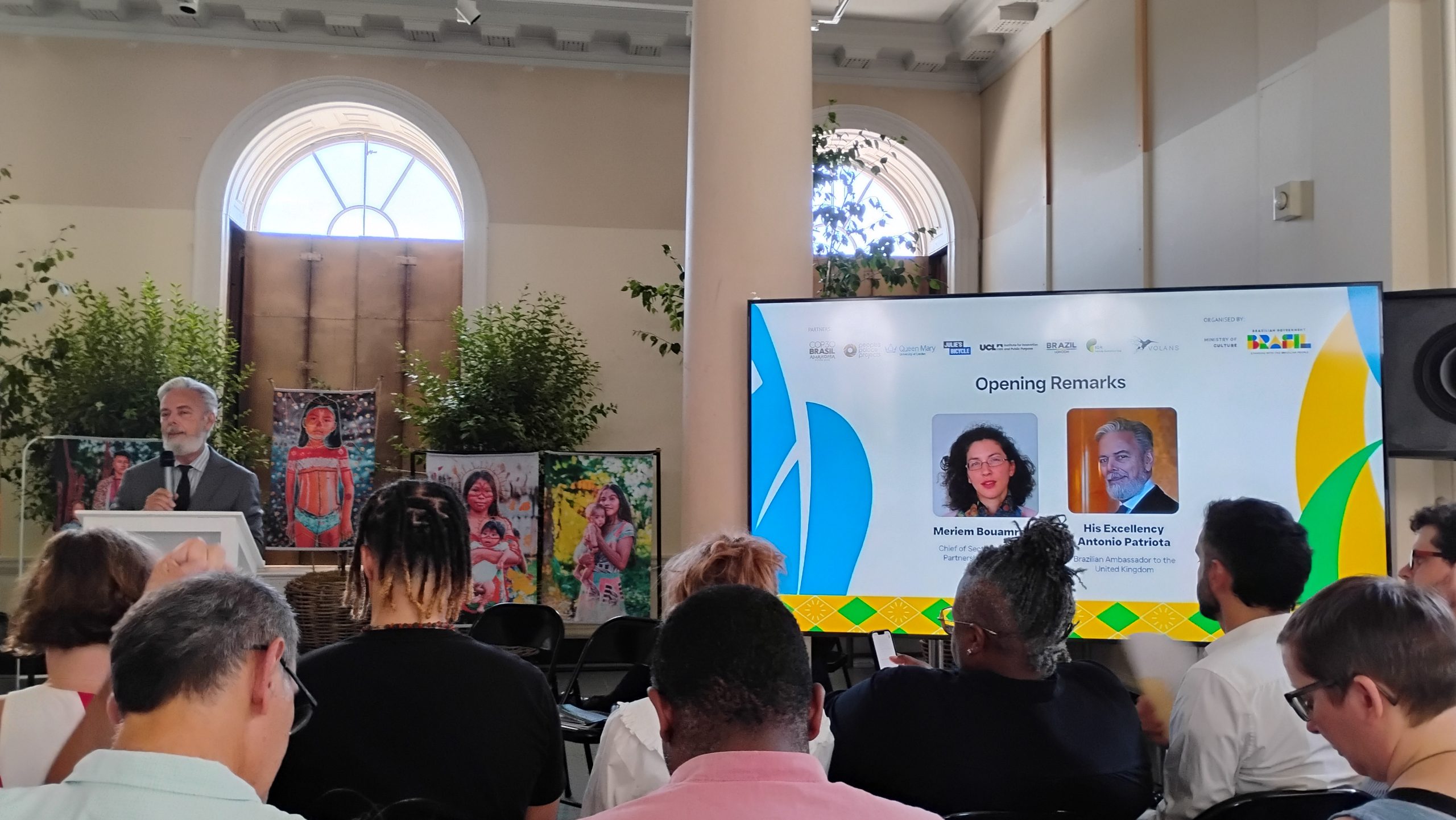
 Thanks to a Brazilian friend, I had the opportunity to attend the International Seminar on Culture and Climate Change, which took place on Friday afternoon at Somerset House in London.
The event was organised by several institutions, including a department of my alma mater, UCL’s Institute for Innovation and Public Purpose, and was attended by His Excellency Antonio Patriota, Ambassador of Brazil (pictured speaking above). Given last week’s heatwave, the seminar took place in a particularly warm room, with a humid atmosphere that created an almost symbolic reminder of the Amazon rainforest, which was central to many of the discussions.
The central theme of the seminar was the recognition of the inseparable — yet still insufficiently understood — relationship between culture and climate change, and the need to involve local Indigenous communities because of their deep ancestral knowledge of nature and ecosystems.
Some of the strongest arguments in support of this approach were expressed by the multi-award-winning founder of the aforementioned UCL department, Professor Mariana Mazzucato CBE, both during her speech and in the latest Policy Brief No. 36, published this month, a copy of which I was fortunate enough to obtain. The publication concludes with several key recommendations that policymakers, including the Liberal Democrats, should carefully consider:
* Treat culture as social infrastructure and fund it accordingly.
* Embed culture across every mission, rather than limiting it to the remit of a single culture ministry.
* Build ambitious coalitions around culture as a form of infrastructure.
* Support cultural ecosystems through multi-year funding programmes rather than one-off projects.
* Co-create missions with communities that have genuine decision-making power.
Professor Mazzucato argues that the green transition is currently stalling, not because of a lack of technology or evidence, but because it lacks the imagination, legitimacy, and social infrastructure required to make it happen. I would add that greater clarity in political thinking and policy direction is also essential.
Meanwhile, temperatures across the planet continue to rise, as we have unfortunately witnessed over the past few days. Hundreds of people have died in Europe because of extreme heat, while more than twenty people in the UK alone have died from cold-water shock. This may only be the beginning of a much larger challenge.
Some argue that reducing humanity’s heat footprint is impossible until the United States and China significantly reduce their industrial and other activities. This is a fallacy. Temperature maps across Europe clearly show that some of the highest heat signatures — including those recorded from Wednesday to Friday last week — originate and spread from some of the continent’s major urban and industrial areas: Paris and its wider metropolitan region, Berlin and the Ruhr, Madrid, Rome, Athens, and of course Greater London. If heat emissions are to be reduced urgently, action must begin in these densely populated and highly industrialised European regions.
The party’s current policy approach is to reduce the emissions driving future warming, minimise waste heat from buildings and transport, and make cities cooler through measures such as greener roofs. However, a policy is only as effective as the transformation it creates and the results it delivers. The urgency of the climate crisis means that immediate action is required, including stronger regulation of the construction industry, which still relies heavily on ordinary Portland cement (OPC) and, more shockingly, consumes millions of gallons of freshwater in its production and use — despite the existence of alternative materials and additives that can reduce this impact.
As temperatures continue to rise, water scarcity is becoming an increasingly serious concern, with alarming projections for 2050 suggesting that a significant proportion of the world’s population will have no access to clean water – including in Europe.
Acknowledgement. My sincere thanks go to Mrs Juliana Serafim MA, from Recife, Brazil, currently at Brunel University, for inviting me to accompany her to this important event.
* Christian de Vartavan is an eminent scholar and now CEO of a London blockchain consulting company and Associate, APPG AI, House of Lords.
 Follow @libdemvoice.org on Bluesky
 Like us on Facebook
 Subscribe to our feed
 Sign-up for our daily email digest

 The abandoned platforms of South Kensington
 How many councillors has Reform UK lost since the May 2026 elections?
 IFS warn on the budget
 Graham Evans
 David Allen
 Roy Gregg
 Nonconformistradical
One Comment
An excellent and thought-provoking reflection. The political dilemma, however, is that elected politicians must ultimately respond to the concerns of the average Joe or Joanne Bloggs. For most people, the immediate priorities are whether the local pub stays open, how long they’ll wait for a hospital appointment, whether they can still afford a family holiday on the Costa Blanca, and paying the bills. By comparison, climate change, Russian aggression, or the gradual loss of our digital sovereignty, privacy and freedoms to powerful technology platforms remain distant, abstract issues.
The challenge is that democracy tends to reward responses to today’s problems rather than tomorrow’s risks. My fear is that many people will only fully appreciate the urgency of climate change when mosquito-borne diseases become a normal part of British summers, repeated flooding makes homes increasingly difficult or expensive to insure, and prolonged heatwaves place growing pressure on hospitals, water supplies and critical infrastructure. By then, our room for manoeuvre may be far smaller than it is today.