


Today’s announcement by Ed Miliband that Labour would double, not treble, tuition fees from the current £3k pa has prompted much vigorous discussion already. But what would be the actual impact for different income groups of the change in policy?
To find out, I fed different figures into Martin Lewis’s Student Finance Calculator. I made one assumption: that all students would need to take out the maximum maintenance loan to live on while studying. Here’s what the figures show…
Who pays nothing?
With fees at £6k…

… anyone whose salary doesn’t exceed £15,600 in today’s money.
With fees at £9k…

… anyone whose salary doesn’t exceed £15,600 in today’s money.
What if you earn the national average wage?
With fees at £6k…
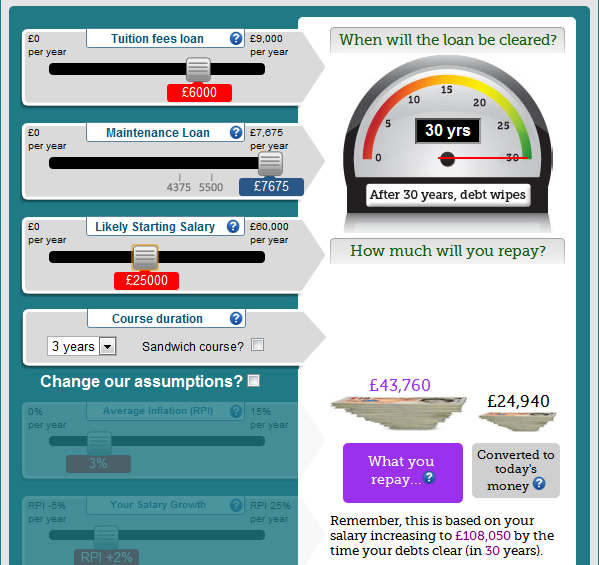
… you pay back £24,940 in today’s money over the next 30 years.
With fees at £9k…
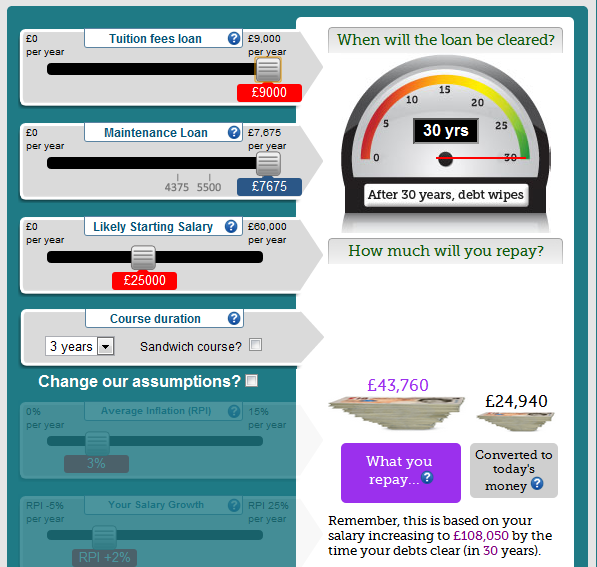
… you pay back £24,940 in today’s money over the next 30 years.
What will I be earning to incur the maximum debt?
With fees at £6k…
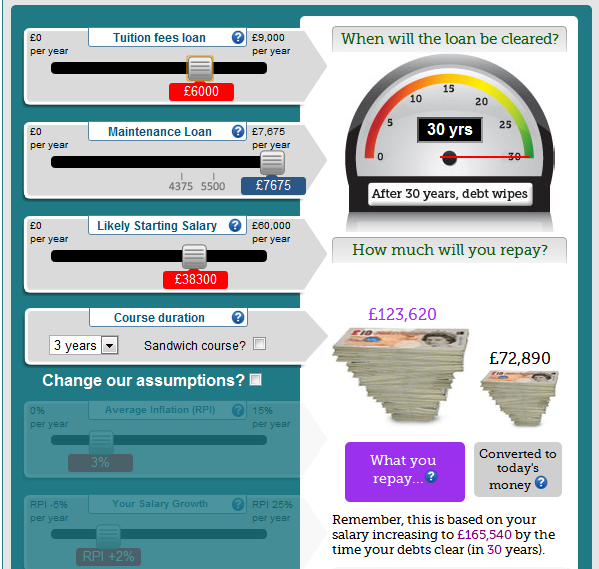
… if you have a starting salary of £38,300 you will have to pay back £72,890 in today’s money over the next 30 years (the same as you would with £9k fees).
With fees at £9k…
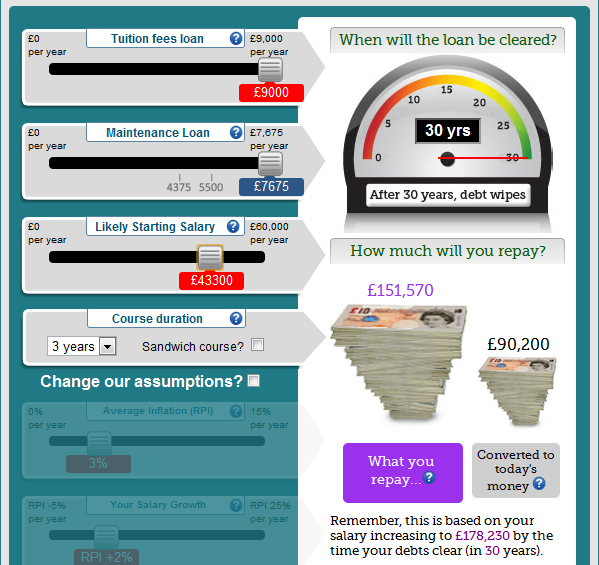
… if you have a starting salary of £43,300 you will have to pay back £90,200 in today’s money over the next 30 years (compared to £67,380 over 24 years if your fees are £6k pa).
What’s the impact on the wealthiest?
With fees at £6k…
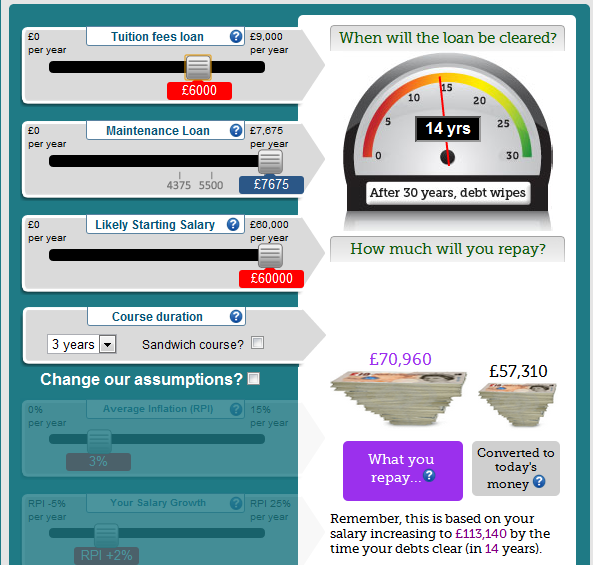
… if you have a starting salary of £60,000 you will have to pay back £57,310 in today’s money over the next 14 years.
With fees at £9k…
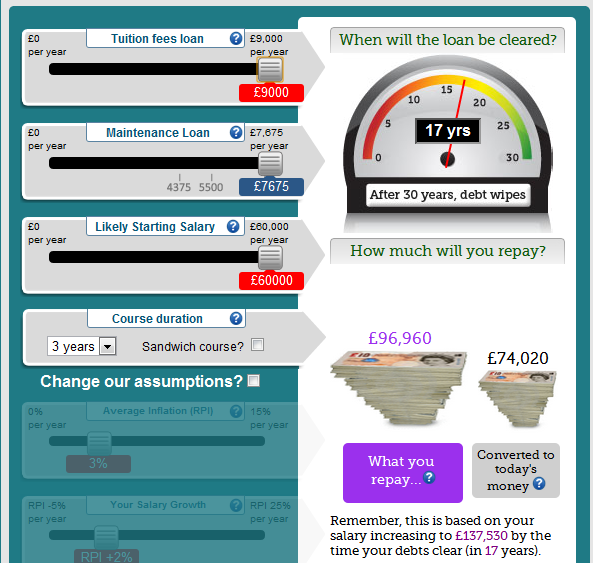
… if you have a starting salary of £60,000 you will have to pay back £74,020 in today’s money over the next 17 years.
What do the figures show?
Well, if your starting salary after graduating is under £38,300 there is absolutely no difference between £6k pa tuition fees and £9k pa tuition fees.
But if your starting salary is more than £38,300 you will be better off under Labour’s proposed £6k pa tuition fees.
However, as Labour has said they will fund the cut to tuition fees by increasing the loan repayments for the wealthiest (and a tax on banks), we don’t yet know whether or by how much these wealthier graduates will benefit from Labour’s proposals.
Looked at in this way, it is clear students from poorer backgrounds will not benefit from the cut in tuition fee while they are students. Only those who earn above £38.3k per annum after graduating will actually benefit. Labour’s argument is that the poorest are put off by the fear of debt rather than the actuality, and it is this fear that the fee cut is intended to address.
 Follow @libdemvoice.org on Bluesky
 Like us on Facebook
 Subscribe to our feed
 Sign-up for our daily email digest

 Reform makes first gain from Conservatives in this by-election cycle
 How Chancellor Reeves torpedoed the economy
 The Disneyfication of Hayley Mills
 Michael Meadowcroft: A Liberal of Intellectual Rigour and Uncommon Integrity
 Peter Martin
 Chris Cory
 Ruth Bright
 BigTallTim
26 Comments
“it is clear students from poorer backgrounds will not benefit from the cut in tuition fee”
You’re making an assumption that those from poorer backgrounds will not go in to high paid jobs. The Labour proposals will probably mean the wealthiest *graduates* paying less regardless of their financial situation before they entered university education.
That’s an excellent point Ewan. I’ve lost count of the number of times people on here conflate poor backgrounds with poor graduate salaries. The tuition fee debate is about the effect of repayments on different graduate income groups – which should have nothing to do with the background of the graduate (assuming, laughably, we live in a meritocracy).
All of this just demonstrates why we need a proper graduate tax rather than Miliband’s slightly-less-awful-than-the-coalition’s plan.
Yeah. We should change our phrasing on that.
It’s insulting to those students when we assume they’ll be lower earners.
How about “Graduates who don’t benefit from the qualification” Vs “Graduates who hugely benefit from their qualification”?
(Still a bit weak – needs more thought)
Also, I think there’s a mistake in your “who pays nothing” section.
You seemed to place the threshold at £15k rather than £21k.
Just nit-picking! The main thrust of the article was spot on! 🙂
Yes, we need to be clear about the reason this is not progressive: it’s not progressive because it only benefits wealthier graduates, not poorer ones. Background is not totally irrelevant, since the size of the maintenance loan depends on your background. Family incomes around £45k get the biggest maintenance loan and so have the least chance of benefiting from the proposal. Students from the poorest backgrounds get a package which comprises a grant and a loan, with the loan itself being not much more than that available to students from wealthy backgrounds. They are therefore only very marginally less likely to benefit than their wealthier colleagues.
In electoral terms, the detailed figures count for very little. He has simply gone for our achilles heel and we will have to live with it.
Ed Miliband attacked us brutally on this issue at the end of last year. He implied his total opposition to an increase. Now he’s changed his mind – he just doesn’t want to go quite as far.
This raises a lot of questions. Suppose the government had proposed an absolute maximum fee of £6k last year. Would he have asked his MPs to support it? Is his objection to the government’s plans just one of degree? If he wouldn’t have asked his MPs to support it, why not? Does he not really support it himself? Has he changed his mind? If so, why?
Ed Miliband nailed his colours to the mast this issue in December and has now ripped them off and nailed them elsewhere. Even the NUS has said his proposal only helps wealthier graduates. This can and should be extremely bad for him.
@Ewan –
Depends how you read it, I guess. To be crystal clear, students from poorer backgrounds don’t benefit from cutting the fee to £6k while they are students.
@Daniel Henry –
You’re right on the threshold for fees. However, I assumed everyone would take out the maximum maintenance loan (see 2nd para) – as most of those from poorer backgrounds will need to. That changes the threshold for repayments as a whole.
Oh right… I just assumed that the maintenance loan would be part of the same loan with the same repayment terms. I learned something new today! 🙂
Stephen,while you’re actually at university it doesn’t matter to students whether the fees are £9k, £6k, or £60k for that matter – you don’t pay anything back until you leave so at that stage it’s really just a number on a website. That doesn’t depend on your background at all.
When it matters is when you are a graduate, earning enough to pay off the loan in under 30 years assuming one fee level but not another fee level.
News and political commentators are still talking about the ‘cost of going to university’ makes it prohibitive for many.
I suggest that the LibDems monitor the news media more closely and those organisations still saying this should be paid a visit by those who know better. Send the boys round !
The Cons aren’t going to do it because it is in their interest to let the LDs continue to take a pasting on this issue.
“as most of those from poorer backgrounds will need to”
My wife’s from a poor background, yet managed to pay her way through university and leave without any debt by working part-time (without any parental or instituional aid). It is perfectly possible.
I notice in all the examples you’ve given above you have assumed that the maximum maintenance loan has been taken out. I guess your conclusions don’t fit other assumptions.
Nice to see more figures fleshed out. We need to use this as an opportunity to explain the reality of the situation again. Labour have inadvertently created a chance for us to communicate the fairness of the Coalition system, which we squandered first time around.
Our message has to be simple: Ed Miliband’s changes represent a graduate tax cut on high earners. It’s nothing more, nothing less.
If he really wanted to improve access to those from poorer families, he would increase the maximum monthly student loan payment and increase the maximum maintenance grant on the same basis. If he really wanted to make University more affordable for less-well-off graduates, he could either increase the threshold above £21k or create different tiers of effective graduate tax over the threshold (e.g. a 4.5% over £21k, followed by 15% over £40k or something like that). His proposal of a tax cut for high earning graduates could only be mitigated by astronomical rates of interest on his proposed >£65k earnings to meet the funding gap.
For my own take, see http://www.predictableparadox.co.uk/2011/09/ed-milibands-tax-cut-for-rich-graduates.html
So what is Lib Dem party policy on this issue now?
Is the assumption that the party will drop its opposition to fees and adopt the coalition policy instead?
Of course, what he isn’t saying is whether in return, universities will get some of their teaching grants back. I am not holding my breath, to be honest.
Funding universities properly should be of paramount concern, because it is essential for the economy as a whole, but also for the students, since underfunded universities will not be able to give them a good higher education.
This side of the equation is always neglected – politicians play politics with tuition fees, universities be damned. This is, in fact, one of the worst unintended consequences of introducing tuition fees in the first place. Universities are always at the mercy of politicians’ tactical use of this issue, and the long term planning which would be crucial to keep the sector competitive world wide becomes futile.
One would have hoped that after what the LibDems went through in 2010, people would be a little be more cautious with this issue – but apparently not, if Ed Miliband manages to jeopardise university funding at the same time as making a U-turn on his original stance that he wants a graduate tax rather than tuition fees. I guess Ed Miliband took a leaf out of the record of Welsh Labour, which blatantly offered to send a good part of its Welsh higher education funds to England in order to subsidise those students who can afford to study away from home, while Welsh universities will see an even more serious funding gap than Labour’s policies have already produced during the last ten years. It got them votes – so who cares whether the university sector will be able to function?
It’s the blatant cynicism and the callous disregard for Britain’s higher education and universities sector (which includes the students!) which really gets me.
I feel the main point of this announcement is being missed. It’s essentially a symbolic gesture which, I feel, is designed to wrong foot the Lib Dems as much as anything else. Sure, a policy which benefits the poorer far more than this one could have been proposed but as Lib Dems know to their cost, such policies tend not to grab the headlines because they hardly ever sound as dramatic. This announcement gives Labour an attractive sounding policy (tuition fees ‘slashed’ by a third) which will appeal to great deal of people concerned including the all important middle class far more than an announcement of something like improved grants for poorer students (which while better, would lose their media punch in the inevitable convoluted explanations and would also risk being construed as Labour tacitly supporting the Coalition’s £9000 cap).
Additionally, the fact that Labour still DO raise the cap to £6k means they deflect the obvious comeback of being fiscally irresponsible, opposing everything for the sake of it, having no real alternatives, etc. etc. Should the coalition still try such a comeback, they risk reigniting the whole controversy or at the very least make themselves appear to be cruel money grabbers (the coalition appearing to be furious that students are being ‘let off’ with a mere doubling of fees rather that a tripling.)
Basically I don’t imagine this announcement is designed to gain Labour vast amounts of support on its own. The intention, I imagine, is to lead Lib Dem MPs and pundits up the garden path in a hope they’ll make themselves look ridiculous. Charges that it doesn’t help the poor enough (regardless of how accurate these charges are) will generally be perceived by the public at large as absurd as they come from ministers that supported the rise to 9k in the first place. Essentially it risks making Lib Dem MPs, Ministers and even pundits look like horrendously hypocritical tribalists when they come out against it. It doesn’t matter how carefully the proposal is deconstructed or thoroughly criticized, Labour will counter with (and the media will probably take it up) that “Lib Dems oppose cutting tuition fees”.
The Lib Dems have started to enjoy a slight recovery of late, thanks, in part, to the fact that the spotlight of media attention has swung away from the issues that show Lib Dems in a bad light (tuition fees, NHS reforms). This announcement is an attempt to bring the spotlight back to those issues and is probably a taster of what we can expect to hear from the Labour conference.
CentreForum will be publishing an analysis of this in a day or so, using Labour Force Survey data to capture the range of graduate earning trajectories. http://www.centreforum.org for those who are interested…
At first I thought “Damn, Milliband’s stolen an idea we could have used in 2015”, in a purely LibDem Manifesto which could use a relaxation of austerity (or lots of land value taxation!) to return £1bn to University tuition grants and reduce the cap on fees. Instead, if we play it right, we can say that Ed M. has come to agree with us that fees had to rise and we can then agree with him on the new £6000 cap after 2015. Where that leaves those Labour MPs who also signed the Pledge in 2010 would be interesting.
In any case, the new NUS leadership has already condemned Millibands £6000 as ‘agreeing to a doubling of fees’ and ‘only the wealthy benefitting’. Goody!
“as most of those from poorer backgrounds will need to”
My wife’s from a poor background, yet managed to pay her way through university and leave without any debt by working part-time (without any parental or instituional aid). It is perfectly possible.
I notice in all the examples you’ve given above you have assumed that the maximum maintenance loan has been taken out. I guess your conclusions don’t fit other assumptions.”
Well that depends on how much you earn, and what kind of fees you would be paying.
If your wife was studying part time before the fee hike, then she would have paid lower fees that were subsidised by the government (that subsidy has been entirely removed) regardless of whether she took out a grant or a loan.
Milliband isn’t stupid. Tuition fees is not a big issue for the general public and Vince’s solution is actually better for the poorer students as argued above. Surely a principal reason for bringing the issue back into the spotlight is a not too subtle reminder that we betrayed a signed pledge big time. If I were a Labour campaigner I would repeat the reminder that the Lib Dems lacked principle on tuition fees and sacrificed our crredibility.
Oh Dear navel gazing again and missing the point, The upper middle classes will simply pay for the fees upfront or month by month by DD as they do now for their childrens private school fees now. Only the working class will take these loans. The poor paying for the education of the poor. We need a real graduate tax! This in not, even though it is nice to pretend that it is as it hides the real truth.
“Tuition fees is not a big issue for the general public and Vince’s solution is actually better for the poorer students as argued above. ”
Tuition fees is a massive issue – di dyou not notice the riots? There may be a significant proportion of the voting population that thinks fees are OK, but that’s because they have already had their education paid for (by their parents’ generation) or they didn’t go to university. As the old die and the young get older, the voting population will increasingly reflect the anger at tuition fees.
As to poorer students: for the vast majority of people that go to university, the whole point is to get a better job at the end of it (especially those from poor backgrounds who see education as a means to bettering their circumstances). The fact that the current system is benevloent to low earning graduates is meaningless to those from poor backgrounds that want to get a decent job. If they get themselves a decent job then they will get hammered by the fees; fees that disproportionately hit the middle of the graduate income scale, leaving low-earners and high-earnerswith less money to pay.
Tuition fees are a good system if you want to become a doctor, lawyer, work in the City, go on the dole or work in McDonalds but very bad if you want to become a teacher, social worker, engineer, scientist and a hundred other middle income jobs.
There are a number of ways the new system could be adjusted to help the less well paid graduates rather than the best paid. The threshold could be raised or the starting percentage could be lowered, for example. Either would be a lot more progressive than what Labour have proposed.
@Dave_Skate “The upper middle classes will simply pay for the fees upfront or month by month by DD as they do now for their childrens private school fees”.
I’m not so sure. It’s a subsidised interest rate so maybe the upper middle classes will borrow to the max while earning interest on their savings – and being upper middle class they may be able to lock up a large sum for a fixed term and hence get maximum interest. And/or they may buy a student house, get rent from their son / daughter’s housemates, and hope to make a profit when they re-sell.
Isn’t that one reason why a graduate tax would be fairer than a scheme which may cause a £191 billion black hole for taxpayers? http://www.telegraph.co.uk/education/educationnews/8769269/Government-will-take-35-years-to-recoup-tuition-fee-losses.html
Old Codger Chris,
” I’m not so sure. It’s a subsidised interest rate so maybe the upper middle classes will borrow to the max while earning interest on their savings ”
I doubt they will until it becomes clearer what the early re-payment charges will be! I cannot believe a decision on this has not been made! Again we are stuffed with this one. If we say you cannot re-pay early we will be labelled loan sharks. if we allow early re-payment we certainly cannot claim the system is progressive, even if it is now which is very questionable.
You are right the only truly progressive system is to either introduce a graduate tax or raise it through general taxation.