Category Archives: Op-eds

Is Trident’s successor a white elephant?

On Saturday afternoon Spring Conference debates motion F11 “Towards a World Free of Nuclear Weapons” which actually endorses the government’s plans to replace Trident with Successor at a cost of £200 billion, twice the original estimate.  The motion also talks about developing multilateral negotiations and ending Continuous-at-sea Deterrence (CASD) but in essence it supports a like-for-like deterrent, which we opposed through the coalition years.

I was on the working group which drafted the report which this motion approves, but I don’t agree. I’m tabling an amendment which agrees with most of the motion’s analysis and call for beefing up negotiations but also calls for Trident to be phased out and NOT replaced.

Many party members have long supported ending the UK’s nuclear weapons but others have placed their faith in nuclear deterrence on balance.  People may feel the global security situation inclines them more than ever to support replacing Trident with the Successor programme.  The argument can be summarised as “Oh my God, Putin !, Oh my God, Trump !  We better have our own nukes”.  I originally felt that the party’s latest working group on the subject was a waste of time.  Nothing had changed.  But I was wrong.  

Tagged , , , and | 8 Comments

What’s the REAL state of the parties?

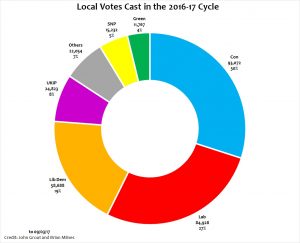
Frequent Opinion Polls since May 2016 show one picture; Conservatives way ahead, Labour & Liberal Democrats suffering, UKIP hanging on.

But when we look at “Real Votes from Real People”, from a 310,000+ sample size, from 3 countries since May 2016, we get a much different picture:


Local government by-elections may not be translatable into General Election results, but they show a remarkably different position – and one that is much more attuned with feedback from the doorstep.

Tagged and | 12 Comments

Welcome back to York and join us campaigning!

As the countdown to party conference continues, I would like to say how pleased I am to be welcoming Spring Conference back to York.

Visit York estimate that the weekend will boost the city’s economy by more than £600,000. And I know that pubs, hotels, B&Bs, guest houses, and restaurants will be reporting soaring demand. Added to the short-term economic boost is the long-term impact that the continued national exposure will bring. It is a showcase for York as a destination for conferences and events. York is a beautiful, well-connected city with the potential to hold many more big political and business conferences.

It is also a chance for our members in York to meet our MPs and peers as well as councillors and campaigners from across the country. And as we all know, a chance for local party members to actually debate and decide national party policy.

In York, our councillors and members have been working hard since we formed a joint administration in May 2015 to run City of York Council.

Tagged , and | 4 Comments

Now we must stand firm, and proclaim our own powerful vision.

So we come to the crunch. We have voted against triggering Article 50 in both the Commons and the Lords. We are being attacked, as Tim Farron was on Radio 4’s Any Questions last Friday night, for being anti-democratic.

I have read this accusation many times here on Liberal Democrat Voice. I have occasionally heard it on Copeland doorsteps too, during the recent by-election. No amount of pointing out, as Tim did again that night, that the people who voted Leave in the Referendum had not voted to leave the EU Single Market has cut much ice with those voters who simply demand, ‘We voted to leave – get on with it!’  Theresa May’s government will shortly obey them.

Were we wrong in what we insisted on? And if so, are our electoral chances being harmed by that public perception? Maybe the latest Tory wins in local elections, maybe the commanding Tory lead in the opinion polls, maybe the too-few votes for us in the recent by-elections – perhaps they all had some small connection with public disagreement over our known stance. Could that be the case?

Tagged , and | 7 Comments

Rennie’s independence referendum risk: why it may well be a good thing

There’s a phrase that goes “Be careful what you wish for. You might get it.” I have sometimes said to Willie Rennie that I think he’s being too safe and that he needs to take more risks. He’s taken a pretty big one this morning by saying in no uncertain terms that Liberal Democrat MPs at Westminster will vote against a Section 3o order, the mechanism that would allow the SNP to hold another Scottish independence referendum. Certainly, the Tories will no longer be able to say, as they have been falsely alleging for the past year or so, that we have gone soft on independence.  Showing Scots that they have a progressive pro UK party prepared to stick by its word is a good thing.

So why is this a risk? Well, there’s nothing more likely to get Scottish backs up than being told by Westminster that they can’t do something. If that actually happened, it might drive people to support having another referendum, even if they didn’t want to leave the UK. At the moment, though, every poll suggests an increasing number of Scots who don’t want to go through the divisive trauma of 2014 all over again. Willie’s announcement is very much in keeping with both our principles and public opinion. That’s actually a point that the didn’t make in his Sunday Politics Scotland interview, but worth pointing out.

Our party is and always has been a pro UK and pro EU party.  We are against leaving the UK  for all the same reasons that we are against leaving the EU – we believe in partnership and collaboration and see nationalism and isolationism as a recipe for disaster. We explicitly ruled out supporting another referendum on independence in our Holyrood manifesto last year and there is no way we could go back on that. Reneging on key manifesto promises has not gone so well for us before. It’s therefore entirely logical and consistent that we would oppose independence at every opportunity to do so.

Tagged , and | 60 Comments

Lynne Featherstone interview part 3: Same sex marriage and life as a Minister

In the hours following the icy gales of Storm Doris, I caught up with Lynne at Taunton’s most distinguished hotel, The Castle. This is the final instalment of our chat. You can read the others here.

You were and still are a campaigner against important issues such as Female Genital Mutilation (FGM), child abuse and violence against women. However, perhaps your greatest achievement is being the originator and architect of the equal marriage act, which was passed into law in 2013. No party had equal marriage in their 2010 manifestos nor was it part of the coalition agreement. Why did you take this issue on and why is it important to you?

When we entered into coalition, 20 ministerial posts had to be filled. After two days, I received a call from Nick Clegg offering me the post of Equalities Minister. In fact, I ended up with three-quarters of me as a Home Office minister and one-quarter as Equalities Minister. So I’m a minister in the coalition, we have Liberal Democrats in government, and I’m thinking to myself ‘I’ve got to do something to make sure everyone knows that there are Liberals in this government’. It never crossed my mind that it wasn’t in the manifestos or portfolio because to me it was an obvious piece of equalities work that needed doing. Labour were great with civil partnerships, but I thought they were a kind of apartheid – one rule for gay people and one rule for straight people. My view is that you should have marriage and civil partnerships for both gay and straight, both for both. The state’s job is to facilitate that union, not to judge if one is good or one is bad.

We were all new Liberal Democrat ministers and didn’t have a clue what we were doing, so the Institute for Government put on a morning instruction for newbie Liberal ministers. They invited Michael Heseltine and Andrew Adonis to advise us. Heseltine said ‘you are going to be really busy. You do not understand the tsunami of work that will hit you when you become a minister. You will have debates, orals, speeches, correspondence and endless other things. Your diary will be full from morning to night. If you do not ruthlessly prioritise one or two things you want to get done in your time in the sun, you will not achieve it. You will be a very good minister doing very important things but you won’t have done anything you went into politics for’. Adonis encouraged us to trust our civil servants. He said it wasn’t like The Thick of It or Yes Minister, although, I have to say, I thought it was quite like Yes Minister! He told us  ‘If you don’t direct your civil servants, they will fill your diary from first thing in the morning until midnight, all with very worthy things but you’ll just be executing what they want you to do. If you trust your civil servants, you have to direct them. They will go to the ends of the earth for you’. As I walked back from the Institute for Government to the Home Office, it just crystallised in my brain that I wanted to do same sex marriage because it was a piece of equalities legislation that needed doing. I came back into my office and said to one of my assistant private secretaries ‘I want to do same sex marriage, what do I do?’ That is literally how it started.

If I hadn’t had that morning, we would not have same sex marriage. It’s really strange how things happen.

Can you explain the process? What did you have to do?

Tagged and | 8 Comments

Lib Dem councillors on a fact-finding trip to Brussels

On the 2nd March at 7.50 am I boarded a Ryanair flight from Manchester to Charleroi in Belgium. It is an hour and a half train journey from Charleroi to Brussels and the first thing that you notice is the friendliness of the people and the matter of fact way they switch from one language to another without pause. The next thing is the extent of the industrialisation of the landscape as it flashes by.

I was travelling to join Catherine Bearder at the EU Parliament in Brussels on the European Information Program in the hope of finding out how Brexit will be affecting us here in the Wirral. I was not surprised in the least to find that Brussels knows as little about Brexit as we do here in the UK.

The visit lasted two packed days and I found it very informative during the conversations I had with colleagues, from across the UK, and the question and answer sessions with MEP’s.

I found out, for instance, that the only country to have left the EU so far is Greenland who had only one treaty to negotiate (fish).  It took over seven years to complete their single negotiation, whilst here in the UK we have over four hundred agreements to unravel.

Tagged , and | 1 Comment

Observations of an Expat: The Brexit elephant


There was a massive elephant in the British House of Commons on Wednesday. It was rampaging back and forth across the chamber, overturning tables, loudly trumpeting and waving his trunk from side to side.

Its name was Brexit.

Chancellor of the Exchequer Phillip Hammond did his level best to ignore the distinctly unfriendly pachyderm. In fact, he did not utter the B-word once during his 45-minute budget speech.  But the Brexit elephant was as plain to see as the chancellor’s traditional red box.

Growth forecasts for 2017, said the Chancellor, have been upgraded from 1.4 to 2 percent.  Employment forecasts are rosy, and predictions for government borrowing are down, down, down. The pound remains at rock bottom levels against the dollar, but the economy has not fallen off the cliff as some pro-European campaigners said it would do on the 24th of June.

But then Britain is still in the phoney war period. Article 50 has not been invoked. Details of the government’s negotiating position remain shrouded in mystery. Details of the European Commission negotiating position are a total enigma.

Tagged and | 3 Comments

Lynne Featherstone interview Part 1: Early life and influences

As Minister for Equalities in the recent coalition government, Lynne Featherstone was the originator and architect of the Marriage (Same Sex Couples) Act 2013. She has received various accolades and awards for her work on equalities. In his book Gay Shorts (2015), the former Conservative Party politician turned broadcaster and member of the LGBT community, Iain Dale said that:

Same-sex marriage will be associated with Lynne Featherstone in the same way that we associate David Steel with the 1967 Abortion Act and Roy Jenkins with the legalisation of homosexuality.

In the hours following the icy gales of Storm Doris, I caught up with Lynne at Taunton’s most distinguished hotel, The Castle. The previous evening, she spoke at a party fundraiser in East Devon. After our interview, she was heading off to another commitment,as the guest speaker at the Bridgwater and West Somerset Liberal Democrats annual dinner. She is certainly a woman in demand! Among the bustling crowd of Saturday night revellers, who were making good use of the historic hotel’s bar and restaurant, Lynne and I managed to find a table and a couple of chairs, tucked away in a reasonably quiet corner.

In the hour that I had with the Lib Dem peer, I wanted to cover a lot of ground. Obviously, the subject of her new book Equal Ever After was going to dominate much of the conversation. Besides the same sex marriage bill, I wanted to find out more about the former MP and her life before  and after her time as Minister.

You are a north London girl, could you tell me a bit about your childhood?

Tagged and | 1 Comment

The amber kickstart

The slough of despond which we find ourselves in comprises not just being severed from 49 parliamentary seats two years ago, but the backdrop to this: one where social democratic and liberal endeavours are losing their credibility throughout Western Europe. A well-timed response to the cultural aspect of this was posted last February calling for a `counter-narrative` of our own `myths and stories`. Here are some of my pointers at not letting the devil have all the best tunes.

To get some visceral appeal some have proposed that we embrace some kind of English patriotism, others that the call for `Freedom` should be our watchword. Richard Dawkins has opined that we rebrand ourselves as the` European party`. All of these ideas – as interesting as they are – strike me as a search for shortcuts. Yet, as Roland Barthes said  `The key to the treasure is the treasure`.

We only need to enhance what we are – a newish party with a left but non-authoritarian ethos  –and to do so with style.

Being non-conformist and rationalist type people, Liberal Democrats tend to spurn style as being pomp and circumstance. Thus along have come the trendy neo-righties – the Bo Jos and the Farages – who have been able to portray themselves as human and anti-pomposity. The liberal love of thinking aloud, of diversity and informality is just not coming across. Somehow we have to prove that being popular need not involve being populist.

18 Comments

Get in the game – why the Liberal Democrats must be champions for the video games industry

The government should be celebrating the success of the British video games industry.  With the British market valued at £4.2bn in 2016, making it the biggest market in the entire creative sector, the video games industry achieves the double whammy of being both lucrative and a shining light for other growth sectors.

The games industry is spread across the country, with over a dozen thriving clusters popping up in places like Bristol, Liverpool and Dundee.  The success of the industry has drawn in the biggest names from gaming, with EA, Sony, Bethesda and Nintendo just some of the companies setting up shop in London. It’s companies also think globally, with British games selling brilliantly across the world.

However, the success story is being ignored government circles because of an uncomfortable truth: it’s dead set against Brexit.

In a survey carried out prior to the referendum, 80.6% of businesses came out in favour of remain compared to just 3.2% for leave.  And in a new report commissioned by UKIE, which drew on survey responses and research conducted in nationwide roundtables (one of which I attended), the industry has revealed that it favours the softest exit possible.

Tagged and | 3 Comments

Are we spending enough on our military?

I recently attended a seminar led by a specialist in international relations, and one of those attending asked “How likely do you think it is that the UK will fight a conventional war in the next ten years?”. Without any hesitation the reply came: “Almost certain.”

It’s hard to avoid noticing the changing political environment we find ourselves, both at home and abroad. For the first time in decades, the prospect of large-scale non-nuclear war seems plausible (though President Trump seems keen on removing “non-nuclear” from that equation). Russia’s aggressive actions can’t be written off as isolated incidents, and the situation in the Middle East is even worse than it was a decade ago.

It’s very likely that, due to aggression against us or our allies we will be at war again in the not too distant future. As someone who has always fancied themselves a pacifist, this is all a bit depressing, but it would be naive to think that my wishes have any impact on reality. It seems important, therefore, that we continue to meet our spending commitments to NATO, however many reservations we have about the use of military force.

Tagged | 11 Comments

The other side of Brexit: What about the Leavers?

I’m increasingly conscious that one really important group has become invisible in the storm around Brexit: the people who actually voted for it.

Canvassing recently my ear was firmly bent by someone who voted Leave and is worried about the NHS. The promise of £350 million per week might have evaporated on the morning after the referendum, but her concerns have not. She’s not angry at the lie: for her this is just one more in the chain of politicians’ lies. The worry is real.

One of the memorable moments in  Laura  Kuenssberg’s documentary on the referendum had  Leave voters  in Sunderland saying “now people in London have got to listen to us”.

Instead we have a prime minister saying “Brexit means Brexit” and talking of the “will of the people”, but who reacted to being reigned in by the courts by bring a bill before parliament to give her huge powers in the Brexit process. This sounds like a land grab from No.10 rather than an attempt at listening.

Tagged | 69 Comments

Inspiring women: Sarah Olney MP

How brilliant was it at 3 whatever it was in the morning of 1st December when Sarah Olney was declared the MP for Richmond Park? She certainly deserves to be acclaimed as one of this year’s inspiring Lib Dem women. Her speech at the count, full of liberal principle, got many of us in the gut.

Last week, she spoke for the party in the International Women’s Day Debate in the Commons. Here is her speech in full:

May I say how pleased I am to represent the Liberal Democrats in this debate on International Women’s Day, as the 454th female MP? I am proud to say, in contrast to some previous Members’ contributions, that I am not the first, nor even the second, woman to have held my seat. I am, in fact, the third Liberal Democrat woman to represent Richmond Park, and I am extremely proud of that.

One of the advantages of being a London MP is that I get to go home to my family every evening and spend time with them every morning. As the mother of young children, this is a particular blessing to me, but it does mean that I live a life of contrasts. Yesterday, for example, I spent the first part of the morning trying to get my son to clean his teeth and my daughter to brush her hair. I then travelled into Westminster and challenged the Prime Minister in the Chamber about her spending priorities for education. Of the two things, the latter was more remarked upon—it was heard by Members here, recorded in Hansard and shared on Twitter—but getting my son to clean his teeth was the greater achievement in many ways. It took more ingenuity, effort and emotional commitment, but nobody noticed, cared or applauded me for it.

It often sounds ironic or self-deprecating to refer to the tasks of motherhood as being more taxing than tasks carried out in the professional sphere, but in this case, I am not being ironic; it is precisely true. We are so used to underplaying the work we do as mothers and in the home that we do not think anyone will take us seriously if we talk seriously about it. So today, in the spirit of the motion to recognise the achievements of women, I want to celebrate the everyday, unacknowledged, unrewarded and unnoticed achievements of women.

Tagged and | 6 Comments

Real women

One of the things I really wanted to say on this International Women’s Day is that it’s a day to celebrate all women, to think about the various barriers that women face across the world. Women have all sorts of different experiences and it’s important that they are listened to because it’s by understanding what needs to change that we make the world a better place. Quite a simple concept. It’s also, for me, a simple concept that International Women’s Day is for everyone who identifies as a woman. No exceptions.

I say that because Women’s Hour presenter Jenni Murray wrote one of those “I’m not transphobic but” articles in the Sunday Times this week. She questioned the right of transgender women to identify as “real women.” She justified her argument by talking about transgender women saying things she didn’t agree with. One was a vicar who had talked about clothes and the other had said that women should wear high heels and shave their body hair. Apparently they were “playing into the stereotype – a man’s idea of what a woman should be.”

I would suggest that this was nothing to do with being transgender. I’ve heard cis women express similar views.  It was only in the last decade of her working life that my mother felt able to wear trousers to work. I might utterly disagree with their opinion, but I’m not going to question anyone’s identity.

1 Comment

Inspiring Lib Dem Women: Kelly-Marie Blundell

On this International Women’s Day, we are celebrating some inspiring Lib Dem Women.

Since being selected PPC for Lewes, which requires just a 1% swing to take it back from the Tories, Kelly-Marie Blundell has been a campaigning force, increasing the local membership, helping to elect four new Lib Dem councillors in by-elections, campaigning against Brexit and just this Saturday collecting an impressive 700 signatures for the rights of resident EU citizens.

Tagged | 5 Comments

Inspiring Lib Dem Women: The women who chair our state and federal parties

For the first time in our history, women are at the helm of all three state parties and the federal party.

Of course, Sal Brinton is our federal party President. I am constantly in awe of her seemingly endless patience as she has to navigate all the different interest groups in the party and bring them all together to agree on a way forward.

I shudder to think how many hundreds of thousands of miles she has travelled in her two an a bit years as President through a General Election, Welsh and Scottish elections and visiting every by-election. She spent a few days in Cornwall the other week boosting their county council campaign and then popped up in Stoke several times – including the gruelling all night shift.

As well as all this she puts in some considerable work in the Lords. Watch her speak here on the effect that Brexit will have on health and social care.

On International Women’s Day, it is appropriate to recognise her work in protecting her students from harassment by introducing considerate conduct contracts for construction workers.

Tagged | 5 Comments

Making women’s work visible

As Kirsten pointed out earlier, women do the lion’s share of unpaid caring work.

In Scotland, Engender, an organisation dedicated to advancing the cause of gender equality, is concentrating this International Wonen’s Day and throughout 2017, on that work that women do that often doesn’t get credited or appreciated. Today they have been asking women to tell others about that unrecognised work using the hashtag #MakingWorkVisible. Why not join in? I thought today was going to be a quiet day until I filled in their survey and realised how much of my day was going to be spent looking after the other members, human and canine, of my household,

Here’s a video they originally published a few years ago which shows how women’s work is marginalised:

Tagged | Leave a comment

Lorely Burt writes: We can’t call ourselves a democracy when men monopolise public life

The theme for International Women’s Day 2017 is ‘Be Bold for Change’ – this got me thinking about how we, as Liberal Democrats, can do our bit to help forge a better and more gender equal world. Of course, as a party we have already taken a great leap forward for the future to make sure we reflect the diversity of the country with the ‘Electing Diverse MPs’ motion passed almost a year ago. But as individuals what can we do to make sure that more women get involved and active in the party at every level?

It was less than six months ago that we, both men and women pulling together, managed to get Sarah Olney elected to Parliament. Like many of you there was a defining moment that made her join the Liberal Democrats and get stuck in, but we have to remember that not all women will put themselves forward like that and some may need more encouragement than others. We all have a responsibility to reach out to those women we think would make great Liberal Democrat elected representatives, and let’s face it we can all think of one or two. The evidence is clear – if a woman is approached to stand then she is most likely to consider it.

Change will not happen overnight, it will take all our efforts to make these incremental changes. Let us never be complacent, as this year’s theme reminds us – we must be bold. We are a country that prides itself on being progressive and inclusive – yet Parliament, our country’s highest decision-making body, is only 30% female.

Tagged , and | 9 Comments

Not all hanging together

Back in the late 1990s, the various local government associations for county councils, district councils and metropolitan authorities decided that it would be best to work together rather than in separate silos: so the Local Government Association was born.

The principle is obvious: local government, unprotected by a written constitution and loathed by much of the press, needs to make its case with central government, which can legislate away its powers and much of its money at the drop of a hat, regardless of the consequences on services or communities. MPs know best, after all, and Whitehall knows even better than MPs.

Conservative-controlled Surrey County Council seems keen on tearing up this approach. Like all shire counties it is between a rock and a hard place when it comes to social care: government grants have been cut, as part of never-ending austerity, while the demand for services rises annually as we all live longer.

The proposal for a 15% increase in the council tax precept drew intakes of (sometimes admiring) breath from around the country but we all suspected that the referendum necessary to approve such a large increase would be lost. It must, we thought, be principally a political move to put pressure on Tory ministers with seats in Surrey.

Amazingly, this cynicism proved to be close to the mark. Accidentally leaked texts showed the Surrey Tory Leader negotiating some sort of deal on behalf of his council (good for his council but bad for other councils who don’t have this sort of access to government). Ministerial denials followed as news got out: and the Government pretended that the contacts were just routine – not specific deals for Surrey.

Sadly the accident-prone Tory Leader of Surrey has been caught out again (see Guardian) because someone secretly recorded the Tory group meeting on 7 February.

Tagged and | 1 Comment

Inspiring Lib Dem Women: Daisy Benson

On this International Women’s Day, we are celebrating some inspiring Lib Dem Women.

PPC for Yeovil Daisy Benson’s infectious liberalism and energy has led her to be one of the driving forces behind the Lib Dem Newbies group on Facebook.

As a councillor in Reading, she was the executive member for housing  and social care.

She was one of the most successful early social media campaigners, recognising that it’s not just a  broadcast platform but a space for dialogue.

Daisy is now concentrating her energies on winning back the Yeovil seat. We need her energy and ideas in Parliament.

This week she’s been featured on the Daily Politics. Watch below:

Tagged | 2 Comments

International Women’s Day – Who cares?

Today we are celebrating International Women’s Day.  For some, it is a chance to recognise the achievements of women in the arts, sport and science; to others it is an opportunity to highlight inequalities. I wish to do both: to celebrate the contribution women make up and down this country although that contribution causes them more inequality. I speak of caring.

In the world of caring, women are indispensable. And undervalued. 58% of carers in the U.K. are women, but in relation to the number of hours worked the percentage is higher. European Parliament’s Committee on Women’s Rights and Gender Equality commissioned report found that European women spend an average of 26 hours a week on caring activities, whilst men spend only 9 hours.

In the U.K., 73% of those who receive Carers’ Allowance (giving care more than 35 hours a week) are women. 38% of carers are caring for over 100 hours a week.

Tagged | 4 Comments

Rock or Island? Disputes in the South China Sea

Whilst researching this subject, I couldn’t help thinking that here were the ingredients ripe for the design of a board game.  It could be something of a cross between “Diplomacy” and “Vendée Globe”?

Each player representing a country of choice could set its mission and collaborate with other players to achieve their desired outcomes.  Chance cards might include whether, say, an international tribunal has decided in their favour.  And tokens could be earned along the way to enable them to reclaim rocks and reefs, build air strips or even patrol the islands with clone submarines?

We are, of course, not speaking of a game but of what is happening in reality, and the countries involved in a potential war game include South East Asian countries (such as Vietnam, Philippines, Indonesia, Malaysia and Brunei) and also greater powers such as China (Taiwan) and the US.  At stake are the rights to valuable resources such as oil and gas, fishing rights and the protection of vital sea routes.

Tagged | 17 Comments

From UKIP to Social Democrat in the LibDems

This piece is long overdue, as I joined the Liberals Democrats back in October 2016. Since then, I have been elected Secretary of Runnymede & Spelthorne Liberal Democrats. I am also deeply involved with the newly formed (or regenerated) Royal Holloway LibDem Society.

So how does one defect from UKIP to the LibDems? I shall be frank.

I started involvement with UKIP in 2010, at the age of thirteen. This was when the party was an anti-EU pressure group. It felt outrageous and fantastically rebellious to participate in an idea that could undermine the entire establishment. When I saw the three main parties, I saw spin, snobbery and fakery. I did dream that one day something big would take down the political elite, who to me had a contempt for ordinary people and democracy.  Today, I still believe this contempt exists strongly, but now we have a situation where they are forced to listen a little bit more.

My involvement in UKIP allowed me to channel my indignation. Also, being the only young person in the room, on many occasions, allowed me to develop a range of political and communication skills that may have taken much longer to attain in another party.

However, I came to realise that the party was seriously limited: organisationally and intellectually.  There is no plan, for anything. It’s all improvisation. And if there is  someone with a plan, he/she will probably leave or get kicked out, because the party’s vested interested in keeping the party like a pressure group is too strong. It felt like what Party HQ really needed was a textbook explanation of the roles and functions of a political party on every wall, before anything serious could begin.

Tagged | 53 Comments

Donald Trump is a dangerous and complete joke – but the joke is on the American people

I give you this series of early morning tweets from the President of the United States of America, as collated by Taegan Goddard’s Political Wire:

Terrible! Just found out that Obama had my “wires tapped” in Trump Tower just before the victory. Nothing found. This is McCarthyism!

Tagged and | 19 Comments

History doesn’t always have to be written by the victors

On 5th March 1770 outside the customs house on King’s Street, Boston, Private Hugh White was talking to some off-duty comrades when a passing Bostonian made a crack about the British soldier’s commanding officer – prompting Pvt White to clock the civilian across the side of the head. The off-duty soldiers made themselves scarce, leaving the private to deal with the fast-growing ring of angry Bostonians that soon surrounded him. White backed up against the custom house door – gun raised out of fear of what might happen next. The growing crowd heckled him, daring him to shoot.

Up the street, Captain Preston, commander of the custom house garrison, watched events unfold. The Captain was hoping that the situation would resolve itself naturally but soon the church bells started tolling and more men, many armed with clubs, started showing up and Preston knew it was high-time that he went to get his man. He led a corporal and six privates through the crowd, now numbering 300-400 strong, towards Private White but rather than just pulling the soldier out from the situation he ordered his men to form a semi-circle around him while facing the crowd, guns unfortunately loaded.

Tagged , and | 6 Comments

This is our time now: a time for assertiveness and for anger

This country deserves better than to be ruled as it is by an Alice–in-Wonderland government, feebly countered by a Humpty-Dumpty official opposition.

I am angry that, as a result, in my neighbouring Copeland constituency our Liberal Democrat candidate Rebecca Hanson was sidelined by the clash of these tottering Titans. Of course she did well to double our share of the vote and beat the hollow UKIP, but not nearly as well as such an excellent standard-bearer deserved.

Instead the representative of this uncaring, and ultimately incompetent government of ours went to Westminster.

The Liberal Democrat campaign in Copeland was focused. ‘Who is fighting hard Brexit?’ demanded one leaflet, which explained how the Liberal Democrats are the only party fighting to protect jobs, jeopardised by the Conservative plan to leave the Single Market. Rebecca’s support for the further investment in the local nuclear industry was there, with back-up details.

Tagged , and | 77 Comments

Why I was furious to get an email from Liz Leffman

Before I even start this, let me just say that Liz Leffman, the Chair of the English Party and our wonderful candidate in the Witney by-election is one of my favourite Liberal Democrats and that none of this is her fault.

She is one of the most constructive and practical people I have come across in the party and I’m delighted that she is leading the English Party on its journey to reform.

However, I got an email from her the other day, sent out by party HQ, that made me furious. Here’s what it said:

Tagged and | 50 Comments

The Independent View: What’s the crack?

As more countries and jurisdictions are relaxing their laws around cannabis, many questions have arisen. Will legalisation affect potency? Could some types of cannabis actually reduce psychosis? What are the choices in cannabis legislation, is it just prohibition or legalisation? And if cannabis is legalised, will everyone start using it? These are just a few of the questions answered by myself and two other researchers from King’s College London in the fourth episode of a new podcast; What’s the Crack.

We created the podcast with an aim to improve public awareness of the complexity and reality of addiction, policies, stigma surrounding drug use and drugs scandals in the newspapers by exploring the evidence base. We are all passionate about the drugs and addiction research field and every episode draws upon our collective knowledge and experience, addressing the health, criminal justice, social and individual side to a story. The podcast links the academic world to the public, bridging the gap and filling in the blanks with research evidence that the media have left out. Previous episodes have covered Dry January, Fabric nightclub in London, drug consumption rooms and now it tackles cannabis legalisation.

This episode introduces different policy options of cannabis legislation, providing alternatives to the usual dichotomous choice of prohibition (possession and supply is illegal) or legalisation (cannabis is freely and widely sold). Alternative legislation is discussed; decriminalisation (it is only illegal to supply) and regulation (a government monopoly). In addition, various factors in the legalisation debate are considered, such as psychosis and THC (active chemical that make users feel “stoned”)/CBD (cannabinoid with various potential medical applications) levels and the impact of legalisation on these. Cannabis is made up of the chemicals THC and CBD and emerging evidence suggests that cannabis high in CBD may mean that people experience fewer psychosis-like symptoms when using the drug. Arguably an incentive for controlling the THC/CBD ratios.

Also posted in The Independent View | Tagged , and | 3 Comments

Living on borrowed time

Many of you will have read Kate Atkinson’s novel, Life After Life. If you haven’t, I recommend it. On one level, it is a story of alternative realities, but its real theme is war. In chapter after chapter, the central character, Ursula, meets a different untimely end. Each time, this is followed by a chapter in which, in an alternative reality, the tragedy is averted, and Ursula lives longer, on borrowed time. Perhaps we are all Ursula, in one of her more fortunate realities. I’m sure I am.

I was born in the early hours of the 9th September, 1962. I had picked an inauspicious moment. Within a few hours of my arrival at Epsom District Hospital, a consignment of Soviet ballistic missiles had arrived in Cuba. This led, when I was a month old, to a confrontation between the USA and the USSR, which came close to leading to nuclear war.

On this occasion, disaster was averted. But my friends and I grew up with deadly Soviet weapons aimed permanently at us. Meanwhile, our government had equally deadly weapons aimed permanently at Russian children.

On 26th September 1983, a couple of weeks after my twenty-first birthday, the world again came close to nuclear war. This time, by a complete accident. The Soviet satellite early warning system appeared to detect five missiles from the United States heading towards the Soviet Union. The officer in charge at the time, Stanislav Petrov, would have been expected to report this to his superiors. Had he done so, a retaliatory strike might have been ordered, almost certainly leading to full scale nuclear war. But Petrov chose to “wait and see”. And it turned out the system had malfunctioned. Petrov may have saved millions of lives.

Tagged | 63 Comments
Advert

Recent Comments

  • Jenny Barnes
    "The idea that VAT is not charged on essentials " Sounds like a nice idea. Definitions are tricky though. Is a Jaffa Cake a biscuit? or a Cake? How about de...
  • Stephen Nash
    @Peter Davies and @Rob Heale. I support the proposals and Basic Income. The huge reduction of shame and uncertainty for applicants for 'benefits', along with ...
  • Peter Davies
    @Rob Heale: You can't really end poverty through taxation unless your tax system unless you include rebates for those without enough income to pay tax. That's k...
  • Alex Macfie
    Take on Big Tech — properly. Not with user bans and age verification. Not only are these shockingly paternalistic and illiberal, but they wil...
  • Rob Heale
    The boldest option would be to adhere to our aims set out in the Party Constitution to be free from poverty. People living in poverty can rarely be free because...