Two snippets of news today about freedoms – a reminder of the importance of libel law reform and good news on extending freedom of information.
In the Independent, John Kampfner (Chief Executive of Index on Censorship) writes:
“There’s nothing like a boob job cream to get readers going on an important issue. The case of Dr Dalia Nield, one of the country’s leading plastic surgery consultants, goes to the heart of the problem with English libel law. Dr Nield took issue with the company producing the cream, which claimed to increase a woman’s cup size. Her remarks, in a national newspaper,
Welcome to my new column, a humble bureaucrat’s contribution to internal Party debate and participation. When Mark Pack invited me to become a columnist for this august website, I was a mite surprised but, after some thought, realised that this might be an opportunity to help people to take a greater role in their Party. So here we go!
The Party’s internal workings are varied and strange. Indeed, so strange are they that when Ros Scott asked for an organogram before taking office as President two years ago, she was moved to remark, “Shouldn’t the boxes be joined to each other?”. …
There’s still time to listen to BBC Radio Sheffield’s documentary about Nick Clegg, which features an exclusive interview with Nick, as well as comments from Paul Scriven (Leader of Sheffield City Council), Allan Wisbey (Nick’s election agent in Sheffield Hallam for the 2010 General Election) and Joe Otten (Lib Dem blogger and Chair of Sheffield Hallam Liberal Democrats).
There’s no prize at stake – just the opportunity to prove you’re wittier than any other LDV reader…
(Image by Alex Folkes/Fishnik Photography via Lib Dem Flickr photostream.)
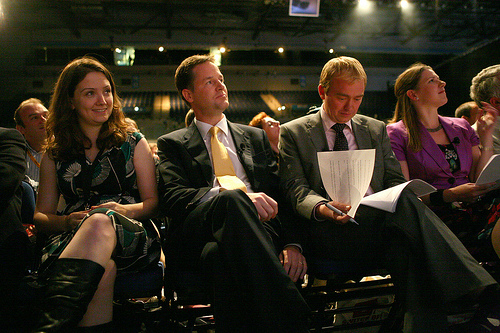
Here’s the new Lib Dem party president Tim Farron side-by-side with Lib Dem leader and deputy prime minister Nick Clegg. What do you think they might be saying to, or thinking about, each other?
2010 has been a challenging year for many. There are some positive signs but the economic recovery will be slow and uncertain.
The Liberal Democrats made the right decision to be part of turning things around in government. Of course, in government, some decisions will be controversial, particularly in a time when there is not as much money as we would like. But having a stable majority government to steer us through difficult times is of vital importance.
Coalition government is a new experience for many in England. In Wales, as Scotland, it
Nick Clegg has released his New Year message to Lib Dem members, a simple and positive riff on the party’s four key manifesto commitments from the 2010 General Election.
In fact, for a New Year’s message, it’s very much about continuity; there are no fireworks or surprises, as I found when I played a little game earlier with a couple of colleagues – “Guess what’s in Nick’s New Year message?”
And we guessed correctly, almost to the word: a reiteration of the party’s “big four” commitments, with examples of where we’ve delivered (more examples here); a quick mention of coalition politics, without dwelling overly on “incredibly difficult decisions”; a look towards three themes for 2011: political reform, social mobility and economic recovery – each with a helpful, yet sparing definition in plain language. (AV, after all, is best presented as a fairer system which makes MPs work harder for your vote, rather than a mathematical conundrum.)
Nick rounds off with a rallying cry, to prove the naysayers wrong, and “continue to build the Liberal fairer, greener Britain that we all believe in.”
Here’s Nick’s message in full:
Well what a year! A white-knuckle election; a new coalition government; Liberals in power for the first time in 70 years.
Just eight months ago we were campaigning on our four big manifesto priorities – fairer taxes; extra money for disadvantaged children in schools; a green, rebalanced economy; a new, open politics.
And now we are delivering on every single one, and more.
First, fuelled in part by Labour’s debate about how it should be seen relative to the trade unions, we have the news that Ed Miliband may be about to break the logjam on party funding reform:
Ed Miliband is to distance Labour from its trade union paymasters by diluting the party’s financial dependence on them and reducing their role in electing the party leader.
Labour has proposed introducing a ceiling on donations to any political party which could be as low as £500, The Independent has learnt.
The move could break the long-running deadlock between the parties on agreeing a new system of
This is the final piece in a series of posts on the main Liberal Democrat challenges for 2011. You can find all the posts in the series here.
Having started this series with the economy and then moving on to more internal issue in latter posts, it seems fitting to return to economic issues for the final post in this series.
Getting the substance on economic fairness right is and should continue to be a top priority for the party. In addition, getting the messaging right will help differentiate not only the Liberal Democrat contribution to the coalition from that of …
Over the festive season we’re running a series of posts on the main Liberal Democrat challenges for 2011. You can find all the posts as they appear here.
Looking back through the emails I have received from the party centrally since the formation of the coalition, very few have asked me to do anything. Some have asked for money, requested I come to conference or suggested I go and help in elections – but even those, whilst being good stuff, have been drawn from a very narrow conception of what members and supporters can do. When it comes to policy areas, campaigning …
By Antony Hook
| Thu 23rd December 2010 - 12:53 pm
The Sunday Times(£) has played echo for anonymous “Downing Street sources” briefing that “if it looks like he will lose his Sheffield Hallam seat, there will be an emergency exit strategy which could see him land one the big jobs in Brussels” namely becoming a Member of the Commission.
The “Downing Street source” behind this must not have Nick Clegg’s or the Liberal Democrats’ interests at heart. It feeds the narrative of “Nick Clegg under siege” of which “Nick Clegg may lose his seat” is the hyperbolic epitome.
Nick Clegg would be extremely well qualified for the Commission, although …
Here’s your starter for ten in our Saturday slot where we throw up an idea or thought for debate…
Bonus for bankers are in the news once again, with talks involving the banks not yet reaching any agreement and with Deputy Prime Minister Nick Clegg keeping up the political pressure, telling the Financial Times:
“The banks should not be under any illusion this government cannot stand idly by. It is wholly untenable to have millions of people making sacrifices in their living standards, only to see the banks getting away scot-free…”
Mr Clegg, the son of a banker, said that he wanted
A Republican urging Barack Obama to be more like Nick Clegg is not a combination often seen, but that is what Michael Gerson argues in his Washington Post column, in a trans-Atlantic continuation of the debate over what counts as economic fairness:
Addressing the actual causes of inequality should be common ground for the center-left and center-right – and politically appealing to American voters, who are generally more concerned about opportunity than income equality. A mobility agenda might include measures to discourage teen pregnancy; increase the rewards for work; encourage wealth-building and entrepreneurship; reform preschool programs; improve infant and child health;
Watching the Liberal Democrat angst over tuition fees takes me back to 1989, when I was a young, considerably trimmer and clean shaven young Progressive Democrat activist. There had just been an Irish general election, and we had been devastated, dropping from 14 seats to just 6, which in Westminster terms would be like dropping from 50 odd seats to the early twenties, so you can imagine the howls of anguish. But that wasn’t even the worst bit: we were now faced with the nightmare scenario of entering coalition with Charles Haughey’s Fianna Fail, which in British terms was like …
Labour MP Frank Field’s Independent Review on Poverty and Life Chances, commissioned by the government and published last week has added to the debate over whether efforts should focus on increasing social mobility:
He proposes that the government switches focus from Labour’s anti-poverty measure, based on material income, to a set of life chance indicators.
He writes: “Poverty is a much more subtle enemy than purely lack of money,” adding that he does not believe poverty is the dominant reason why disadvantage is handed down from one generation to another.
Parenting is more important than income or schooling to a child’s life
Deputy Prime Minister Nick Clegg is interviewed today in the Independent on Sunday, with the report inevitably featuring tuition fees:
He says he is still determined to tackle social disadvantage and educational underperformance, and says that a £150m national scholarship scheme will give a year’s free tuition to 18,000 students on free school meals. Universities wanting to breach the £6,000 cap on fees, to charge up to £9,000, will have to give another free year to the poorest students.
In the coming weeks, months and years he will need to “grit my teeth, display a bit of resilience, and explain calmly and
Nick Clegg is seeking cabinet approval for his plans to secure an end to the practice of detaining children in immigration removal centres, with government sources suggesting he wants to see no children in detention by the spring…
Clegg will promise a timetable before Christmas for ending the practice, but he will say he is unable to announce a final deadline as the policy is wending its way through the cabinet home affairs committee.
He is also said to be limited by the pace of working out humane alternatives to locking up families with children who
Conservative MP Rob Wilson’s book on the formation of a coalition government in May 2010, 5 Days to Power: The Journey to Coalition Britain, plays up the drama of the events, talking of how “Gordon Brown and David Cameron were both determined to do whatever was necessary to secure the position of Prime Minister” as if the story is one of a cliff-hanging drama which could have gone either way.
Whilst the outcome is certainly significant for British political history, what the book is far less convincing on is that there was really any serious chance of a Labour – …
In his Hugo Young lecture last week Nick Clegg clearly signalled the imminent end to control orders. Now over the last couple of days the shape of the likely conclusions from the anti-terrorism review are starting to emerge, with the current 28-day limit on detention without charge coming back down to 14 days. A new set of tighter than usual bail conditions could then be imposed for a further 14 days.
The police’s stop and search powers are also likely to be curtailed, particularly following the news that in the last year over 100,000 stop and searches were conducted under …
Nick Clegg, has written to Aaron Porter, President of the National Union of Students, in response to the NUS’ ‘Right to Recall’ campaign.
His letter in full:
Dear Aaron,
Thank you for writing to me about your ‘Right to Recall’ campaign.
The idea of a right to recall was something I proposed when I first became leader of the Liberal Democrats and I am proud that it is now part of the Coalition Agreement. However my proposal was for it to apply to MPs who were found guilty of serious wrongdoing by the parliamentary authorities. My intention has always been that it should be
How to avoid a three-way car crash with most ministers voting for the Browne Report, some ministers and many backbench MPs abstaining and yet a further group of Lib Dem MPs voting against is now the main debate within the Parliamentary Party over tuition fees.
Some changes to the original Browne report proposals have already been promised, but the debate has now moved on from the question of whether or not there could or should be more modifications to how people will vote on that modified package, which is unlikely to change any further at this point.
Many insider accounts have already appeared of the events retold in David Laws’s book 22 Days in May: The Birth of the Lib Dem-Conservative Coalition. It is therefore one of the book’s strengths that not only is it written in a lively style which gives some freshness to the now familiar sequence of events but it also adds many new insights.
Although only briefly mentioned by Laws himself, perhaps the most important is how much the Liberal Democrats owe to Chris Huhne. In April, just before the second TV debate, I wrote,
Earlier this evening I went along to the Guardian’s offices at King’s Place to hear Deputy Prime Minister Nick Clegg give the Hugo Young lecture. Given the fractious recent relations between Liberal Democrats and Guardian journalists, it was a slightly incongruous combination, especially when the topic of Clegg’s speech – progressive politics – was preceded by rather posh canapés.
In the Hugo Young lecture tonight, Nick Clegg all but said that control orders were to go when – in pre-prepared comments in the middle of the speech – he said:
Old progressives pose a trade-off between individual liberty and national security. But, for liberals, liberty is the guarantor of our security. It is a false trade-off. For old progressives, national priorities will automatically trump individual freedoms. By contrast, the Coalition Government has already halted ID cards, and set out plans to regulate CCTV and end the indefinite storage of innocent people’s DNA. We will also shortly be published the results
Best was his line on the “spectacular” coupling. “I can’t believe,” he said, “that someone middle class, from the Home Counties, could get together with someone so wealthy whose family own a string of mansions.”
Not Kate … he was talking about his beautiful relationship with Nick Clegg. Touché.
It is nothing new for a government to be talking about improving electoral registration by matching data between different sources. What is different about Nick Clegg’s latest comments on the subject, in a speech to the Hansard Society, is that the talk is now becoming much more specific, with pilot projects starting next year.
Local councils, for example, hold name and address information about people in several different databases. If they are able to make use of the data from other sources to highlight either gaps in the register, or suspicious entries that may be the result of fraud, this …
An intended side-effect of the government’s decision to close the Strategy Unit is that some civil servants are being redeployed to beef up Nick Clegg’s team. As the Financial Times reports,
The addition of some more policy specialists will be welcome relief for his hard-pressed team. The sheer range of issues he has to handle has left them struggling to cope at times. Clegg’s office was in danger or being branded a Whitehall black hole, from which policy submissions never re-emerge.
That is good news as far as it goes, though as I wrote before,
“Ineffective in the fight on terror – but a devastating blow to freedom” – that’s the pithy and accurate summary of control orders by Mary Riddell over in the Daily Telegraph. And the newspaper in which the piece appeared is are reminder of how civil liberty issues cut across the political spectrum in not always expected or neat ways.
Riddell points out,
Within the next few days, Mr Cameron and his deputy must reach agreement on the future of security in Britain and, in particular, on control orders and how long to hold terror suspects without charge. The “car crash” foreseen
Many left-leaning liberals in the media are outraged at what they consider to be broken pledges on the part of Nick Clegg.
Johann Hari writes in The Independent, “In just a few days after the election, he cleared a space in his swanky new ministerial offices and staged a bonfire of his principles”.
Aside from the fact this article is laced with hyperbole (look carefully – barely a paragraph without some emotive language!), I can’t help thinking this is exactly not what the country needs.
I don’t mean that in a patriotic sense; I believe this country will operate perfectly well …
The story is clearly designed to make the reader believe that, even as Nick Clegg and the Lib Dems spoke out against tuition fees, it was secretly their plan to renege on the party’s manifesto pledge. Yet, if you read more carefully it becomes clear that the party was simply anticipating the likely hung parliament scenario — that faced with two parties, Labour and the Tories, committed to tuition fees …
A defeated candidate from the May 2010 general election is facing court action following claims he made false statements during the election. The Portsmouth News reports:
Les Cummings, who stood as the city’s Justice and Anti-Corruption Party will appear at Portsmouth Magistrates’ Court on Friday, charged with breaching the Representation of the People Act.
Police at Fareham Police Station charged Mr Cummings on Thursday afternoon, with having made, on April 22, before an election, for the purpose of affecting candidate Mike Hancock, false statements that he knew to be untrue.
Meanwhile in other election law news, Nick Clegg has rejected calls from …
David Warren We have been far too cautious for far too long. A bit like Thomas Tuchel in the last half hour of that World Cup semi-final against Argentina.
I fear that l...
Jana I agree with this but would add something I believe important: we need to address the idea that those seeking ‘a place of safety’ should be allowed to pass ...
Nick Hopkinson Fully agree with Chris’ assessment. We should focus on one defining issue and that indeed should be Europe. That not be because EU membership in an end in its...
David Warren Some really good points here Matthew!
My big concern is how we are falling behind the Greens in urban areas. In my home town of Reading two wards that return...
Leon Duveen Moral, I know what Ed said & how Calum refred to the events in Gaza. I also know what is actually happening in Gaza is horrific and the actions of the Netan...




 Follow @libdemvoice.org on Bluesky
 Like us on Facebook
 Subscribe to our feed
 Sign-up for our daily email digest

 How will Burnham "fix social care"?
 Sir Ranulph Fiennes admits he narrowly avoided prison after blowing up Dr Doolittle movie dam
 Is Labour's success in curbing immigration harming the economy?
 Should the Grimond Society Become an Associated Organisation?
 Does money buy votes?
 Inside the refurbished library
 David Warren
  Jana
Jana  Nick Hopkinson
  Leon Duveen