


Since June 9th, I’ve been keeping a little spreadsheet to show the exact majority of the government.
First of all, the question arose: ‘What is the working majority of the government?’ That is, if the DUP don’t vote with the government but simply abstain (because they don’t want Jeremy Corbyn to become Prime Minister). My calculations suggest this working majority is four, based on the following assumptions:
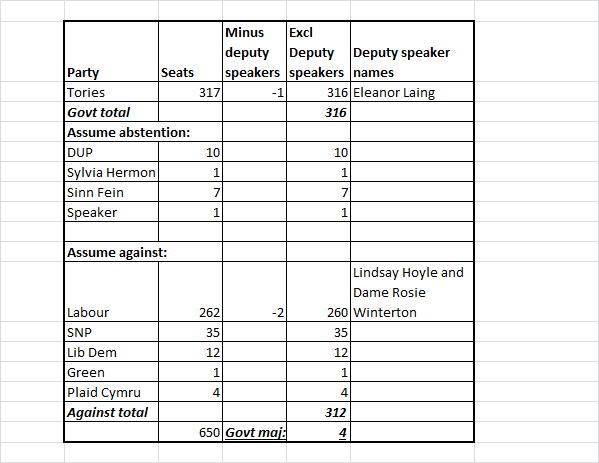
As you can see, I assume that Sylvia Hermon would abstain, given her similar opposition to Jeremy Corbyn in Number Ten. I’m also assuming that the Deputy Speakers would abstain.
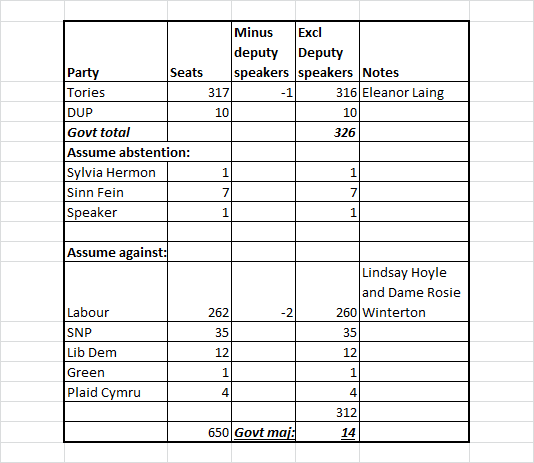
If we then go to the government’s majority with DUP support, it is fourteen, as follows:
Please let me know any errors I have made, either in rationale or maths, in the comments below.
The question then arises: ‘How long will the government’s majority, working or otherwise, last?’
This often boils down, unfortunately, to an actuarial discussion.
The John Major government 1992-1997 suffered a high amount of by-election losses for various reasons. It is said that Theresa May will not suffer such a high rate of attrition in her team, due to it being somewhat younger. I can only find six Tory MPs over the age of 70 (Clarke, Bottomley, Cash, Beresford, Chope and (Glyn) Davies). Please enlighten me if you can correct me on that.
How does this compare to the Tory MPs elected in 1992 that Major was dealing with? I suspect there were more over the age of 70, but currently I cannot find an analysis of the 1992 Parliament by age. If anyone can spot one, please let me know in the comments below. However, we should bear in mind that none of the MPs who sadly died, causing by-elections, during the 1992-1997 parliament were older than 63 years old. The youngest was only 45 years old.
John Major started in 1992 with a majority of 21. He lost nine MPs through death (the final vacancy at Meriden did not have a by-election because it was so close to the eventual 1997 general election) and three MPs via defections.
Any other comments about the likely longevity of the Conservative government are also welcome. I can’t help thinking the Northern Ireland dimension is likely to banjax the government, or at least Theresa May’s leadership. We may find out more about that today.
* Paul Walter is a Liberal Democrat activist and member of the Liberal Democrat Voice team. He blogs at Liberal Burblings.
 Follow @libdemvoice.org on Bluesky
 Like us on Facebook
 Subscribe to our feed
 Sign-up for our daily email digest

 Lime Garden: Moving Target
 Yes, I'm still in favour of making the House of Lords democratic
 British music only!
 Whickham North Focus delivery
 United Nations Day, 24th October
 Richard Cripps
 Steve Trevethan
 Peter Davies
 Jenny Barnes
20 Comments
Sylvia HermOn voted with the Tories on the Queen’s Speech. She cares about Northern Ireland and is unlikely ever to support the vile Sinn Fein groupie Corbyn
Who is Sylvia Herman? What is she? That all our swains commend her? . .
Politicalbetting.com reports that since 2001 there has been 1 conservative by-election due to I’ll health/death. 15 labour. (1 lib dem 2 others).
It seems under the fix term parliament act, that it would be possible for Labour to try and form a minority government if the Tories lost a vote for no confidence rather than call a general election see http://blogs.lse.ac.uk/politicsandpolicy/under-the-fixed-term-parliaments-act-a-minority-government-doesnt-need-a-confidence-and-supply-arrangement-to-be-able-to-govern/
Written before the 2015 general election.
Whether they would wsant to do this especially if late on in the five years and whether others would support them would be interesting.
Many thanks for pointing out the spelling mistake. Now corrected.
‘it would be possible for labour to try to form a minorty government’…but not possible to form it..sin fein abstain the DUP and lady Hermon would alwsy vote against and if you add lib dem snp and labour numbers together you get fewer seats than the Tories have on their own.
Why is it assumed Sylvia Hermon would abstain? I’d have assumed she was would more reliably vote with the Conservatives than the DUP, indeed more reliable than some Conservative MPs. Has she said that she will be abstaining from parliamentary votes?
Why is it assumed Sylvia Hermon would abstain? I’d have assumed she was would more reliably vote with the Conservatives than the DUP
Why do you think that? Remember, as I’m sure you knew, that the whole reason she’s an independent is that she quit the UUP when it formed an electoral pact with the Conservatives, because she didn’t want to stand under a Conservative banner.
That doesn’t exactly scream ‘would reliably vote with the Conservatives’ to me, but maybe you know more about her than I do?
(She’d clearly vote for the Conservatives in confidence motions in order to stop Corbyn getting to even attempt to form a government, but I would have thought that when it came to supporting normal votes on regular Conservative policies she’s certainly no more likely to support the government than the DUP).
There might be a by-election in South Thanet.
@Dav
As I understand, her reasoning for leaving the Ulster Unionists and becoming an independent rather than go with the then (2009) new Conservative-Ulster Unionist alliance set up, was more an issue of nomenclature, lack of inclusion in the deal and a desire to retain autonomy.
She doesn’t have very fixed politics, though her Ulster Unionist history indicates Conservative leanings. But I don’t see why she is in the “Assume Abstain” column, since she certainly will be sitting in and voting at Westminster (a mixture with and against the minority Conservative block, but I assume more often with)
Sylvia Hermon is a (relatively speaking) liberal Unionist, who seems to be genuinely independent and certainly not Tory lobby fodder. She is also pro European and voted in favour of staying in the Single Market.
Thanks all. John, the reason I put her in “assume abstain” is to establish the working majority of the Tories without the support of Unionists. In other words, I doubt that the Tories could rely on Sylvia Hermon to vote with them, rather than abstain.
I see in The Times today the Tories have approached the Lib Dems to help get mental health legislation through – which I hope we do – but I suggest at the cost of ending the public sector pay cap. Win- Win if it’s made clear that it’s a one off.
Lady Sylvia Hermon is the widow of a former Northern Ireland chief constable, Sir John Hermon. She was originally elected as an Ulster Unionist, loyal to David Trimble and the Good Friday agreement, and holds her seat with the DUP second. Her constituency includes a number of towns to the east of Belfast, some of them seaside resorts and some open countryside. It’s a nice place to live. Probably a lot of her voters commute to Belfast to work. She probably counts as less Unionist than the DUP and possibly the UUP and definitely more socially liberal than the DUP.
Sylvia Hermon voted for at least two of the amendments to the Queen’s Speech (the one on publc-sector pay and the one on the single market). Voting for an opposition amendment to the Queen’s speech implies that the Tories can’t necessarily rely on her abstention (let alone support) in a confidence vote.
It’s a teensy bit better for the government than listed above as (I believe) the speaker’s deputies don’t vote. So that’s one more off the government total but two off the opposition total.
One trivia note that doesn’t affect the majority is that the announced figures in any vote are always two lower on each side than ‘expected’ because they don’t include the tellers.
As I understand it technically at least under the fixed term parliament act the only thing that can bring down a government is a vote of no confidence (or a 2/3rds majorirty for a general election) other votes such as a queen’s speech cannot be construed as votes of confidence. So Lady Hermon certainly could vote against the Queens speech or ammendments and for a vote of confidence if she doesn’t want Corbyn to be PM
In general it would be good if we got more separation between the legislature and the executive as in America.
That is against a vote of no confidence!
slyvia heron’s husbadn was chief of the northern irish police during the troubles..the idea she would vote in a way that could help corbyn become PM is fantasy though she will vote against tories on indivudual matters
John Lister
“It’s a teensy bit better for the government than listed above as (I believe) the speaker’s deputies don’t vote. So that’s one more off the government total but two off the opposition total.”
John, I’ve catered for the deputies in the numbers – see the second column in from the right headed “Excl Deputy Speakers”.