Category Archives: Op-eds

How FPTP caused the catastrophic vote to leave the EU

The EU Referendum demonstrated the extent to which the “First-Past-The-Post” (FPTP) system has allowed politicians to become distanced from the people they purport to represent and has contributed to a sense of powerlessness amongst large sections of the UK population.

Three key effects of FPTP were at work:

  1. Safe Seats
  2. Distorted election results
  3. Distorted politics

1. Safe seats:
Under FPTP, safe seats (where a change in the party holding the seat would only happen in very unusual circumstances) account for the majority of parliamentary constituencies.

An MP in a safe seat does not need to worry about getting re-elected; he or she does not have to listen to …

Tagged | 33 Comments

Brexit: Government’s first rumblings are encouraging

At long last we have had some statements from the government concerning Brexit. If anything, they are revealing through what they don’t say, but I find Theresa May’s first rumblings encouraging.

First of all, via Laura Kuenssberg, the BBC’s political editor, we learnt that the Prime Minister has ruled out a “points system” for EU immigration.

19 Comments

What the Electoral Reform Society Report on the Referendum missed out

Recently, the Electoral Reform Society published its report on the EU Referendum. It’s an interesting read.

It’s main recommendations include:

  • greater pre-legislative scrutiny of a Referendum Bill
  • a more deliberative approach
  • a body which can rule on the veracity of claims

In the immediate aftermath of the referendum, ERS conducted a poll to find out the key influencers of  and perceptions about the campaign.

This graphic, showing where people got their information from, sums up how well the Leave campaign hit its target market and how completely rubbish the Remain campaign was.

Tagged and | 27 Comments

How computer-driven cars are likely to transform planning in your town


It’s 2026 and you’re heading to your local town with the family. Not owning a car, you tap your phone and within a few minutes a self-driving taxi pulls up. You relax in comfort as it drives to your destination, then drops you off by the shops and heads off for its next fare.

Your neighbour is heading to the shops too. She prefers to own and drive her own car. Having got to her destination, she taps a button and her car drives itself off to park in in out-of-town car park, where it waits for her to call it back to meet her.

The technology to do all of this not only exists today, but is in use on public roads. Uber has been testing self-drive taxis on the streets of Pittsburgh for months and Tesla and Google have self-drive cars on the roads. Right now a driver has to sit at the wheel, ready to take over if something goes wrong. That won’t be the case for long. Tech giants like Google, Apple and Uber along with traditional car makers like Ford are investing billions to bring genuine self-drive cars to our roads.

Tagged , and | 10 Comments

LDV interview: Chris Bowers talks about The Alternative

The AlternativeLast week, Chris Bowers wrote about The Alternative, the book exploring the potential of a progressive alliance he has co-edited with Green co-leader Caroline Lucas and Labour MP Lisa Nandy.

I have really enjoyed reading the book. After a referendum campaign filled with divisiveness and nastiness, it’s good for the soul to read about how progressive ideas on the economy, immigration, public services could improve our society and our democracy.

While the book offers a vision of what life could be like, it doesn’t, nor does it claim to, provide a roadmap for getting there. Too many barriers and obstacles stand in the way and more work has to be done to overcome them – if the political will exists.

So, my first question to Chris was basically, how realistic is all of this?

Politics is in disrepute so co-operation is paramount and we need to start out on a path of exploration to see what is possible.

People didn’t vote Tory or for Brexit because of a passion for them. We need to look at ways of making politics more relevant to their lives.

He went on to talk about the  article written by Uffe Elbœk one of the founders of The Alternative movement in Denmark:

Tagged and | 9 Comments

Is austerity working? And do all debts have to be paid?


These questions invite binary “Yes” or “No” responses. More considered approaches exist. We need to consider the economic consequences of debt repayment, structural and attitudinal causes and contributions, responsibility for debts both particular and general, beneficiaries and losers, and, how they may be prevented in the future. Also, can such enormous debts be paid?

This requires analysis and accurate, accessible language. In Economics and Finance, that which has different labels is sometimes not significantly different and that which is under one label has significant differences. For example, money consists mainly of credit creation since loans create deposits and loans are debts.

Debt is a form of relationship: financial activity connects and affects people.

Tagged and | 35 Comments

A whole world of sexist fail in today’s Sunday Times

It’s hard to imagine how today’s Sunday Times could possibly have got it more wrong.

It trailed that it had a “tantalising secret” about Nicola Sturgeon’s private life.

That turned out to be the fact that, five years ago, she had a miscarriage. What a crass way to headline an intensely painful experience.

And to add insult to injury, the paper accompanied the article with a panel featuring childless politicians. All of them were female.

As ever, women are judged by different standards. The excellent Women 50/50 campaign group made the point visually:

It was the Sunday Times sister paper, The Times, which published that interview when Andrea Leadsom suggested that being a mum meant that she “had a real stake in the future of this country.” Some culture change in that organisation is urgently required.

Tagged , , and | 16 Comments

Lib Dems march for Europe

Lib Dems at start of March for EuropeEU nailsThousands of people across the UK Marched for Europe yesterday, with demonstrations in London, Bristol, Edinburgh, Oxford and Cambridge plus many more.

In London we put on a huge Lib Dem splash, with more than 300 Lib Dems joining us at the start in Marble Arch. An army of volunteers distributed placards, balloons and flyers. There were so many of us, police escorted us down to the main march on Park Lane!

President Sal Brinton fronted the march, leading a rally of Lib Dems from a banner at the front, flanked by Catherine Bearder MEP and Baroness Sarah Ludford as well as Parliamentary Candidate for St Albans Daisy Cooper and some of our Newbie members Ukonu Obasi and Elizabeth Barnard.

The march took on quite a pace, leading us down Picadilly and on to Trafalgur Square before ending at Parliament Square. Along the route we were chanting ‘We love you EU, we do’ and ‘We don’t want no Brexit’ with the use of a small megaphone and Bradley Hiller-Smith’s melodic tones! 

Tagged and | 23 Comments

Clegg in the Guardian: “Why on earth would you not want to try and do s**t?”

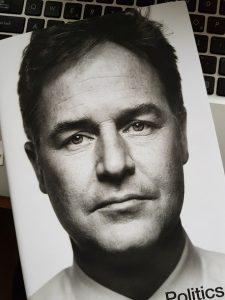
We’re going to be hearing quite a lot from Nick Clegg over the next couple of weeks in the run up to his book being published on 15 September.

Today he has a long interview with the Guardian in which he talks at length about some of the key moments of the Coalition. Just to get this over with. I come from the Highlands of Scotland. If any journalist had written about some of the villages I love in the same patronising way that Clegg’s interviewer, Simon Hattenstone, did about Miriam’s home town in Spain, I’d be furious.

Whilst I have often disagreed with decisions that Nick took during the Coalition years, I stand by my long held view that he was often unfairly criticised, too. We can see with ever-increasing clarity that he brought a lot of common sense and stability to government. The minute he and the Liberal Democrats vacated Whitehall, everything started to fall apart. We are suffering the consequences of an arrogant Tory party governing exclusively in its own interests.

Naivety

Any feeling that we might have had that we could have been a lot better prepared for the realities of government is confirmed by the interview. However, the caveat is, of course, that we onlookers have the benefit of hindsight now and detachment at the time. Nick does admit to what appears to be astonishing naivety. It perhaps underlines the fact that he should maybe have had more people around him who had spent years fighting the Tories and knew first hand what they were capable of.

Also posted in News | Tagged , and | 151 Comments

Don’t stand a candidate

I have wondered many times in the last few years whether Lib Dems really want PR. And the reason for this scepticism is that we keep propping up First Past The Post (FPTP) in the way we campaign and act politically – with disastrous results for our political success, our influence within government and for liberalism across the UK.

The arguments for a change in the electoral system are well known – for every million votes cast for a party at the 2015 general election , the Greens won one seat, UKIP won a quarter of a seat, the Lib Dems won 3, Labour 25, Conservatives 29 and the SNP 39. The figures might change a little from election to election, but the unfairness won’t.

For a generation, Lib Dems have worked to win within FPTP by targeting individual wards or constituencies, and this has been a successful strategy compared to other smaller parties. But it has never achieved democratic parity with Labour or the Conservatives. For example, at our high point of national vote in the general election of 2010, it took 120,000 votes to elect a Lib Dem MP and 35,000 to elect a Conservative. Our leaders accepted the reality of FPTP and we took our place in government based not on our national vote but on our number of MPs. We have all seen the consequences, and they are not pleasant for our party, however optimistic we all like to be.

Tagged and | 33 Comments

Jenny Willott writes: Is Citizens’ Income the answer to the failures of our social security system?

I recently wrote a piece for Lib Dem Voice about “Mending the Safety Net”, the policy paper on social security which will be discussed at conference in Brighton.  One of the issues raised in the comment on the piece was, understandably, why the group ended up not supporting a move to a Citizen’s Income.  Rather than a long comment on the original piece, I thought it would be helpful to explain the groups view in a separate post.

In a nutshell, the Citizen’s Income pays the same amount to every resident, regardless of whether they are in work or not.  There is no means testing and no conditions apply to those receiving the payment.  Every citizen receives the same amount, although in some schemes there are different amounts for children, working age adults and pensioners.  There are a number of different monikers and different ways of doing similar things, such as Negative Income Tax and Universal Basic Income, most of which we looked into, but for simplicity I’m just going to refer to ‘Citizen’s Income’ throughout.

At first glance it seems simple and easy to administer, and could help put an end to the divisive ‘them versus us’ narrative that has infected the debate on welfare.

That is why I and many others on the social security group were initially very attracted to the idea. We read a lot about it and invited a number of people who have advocated the policy to give evidence to the group. 

Tagged , and | 65 Comments

Let’s get tough on the causes of eurosceptism

At the very outset of the referendum campaign both Norman Lamb and Anna Soubry took part in a BBC Radio 4 Any Questions programme broadcast from Spalding. During that debate a North Lincolnshire farmer appearing on the panel alongside Kate Hoey for the leave side said he wanted free movement of labour to remain, because he would be unable to recruit workers without it. He also made positive remarks about the diverse nature of shops in the town. Both remarks resulted in audible boos from the audience, showing the strength of feeling in the hall. Frankly you would not have heard a stauncher defender of the EU than Anna and Norman that evening. Just what the Remain campaign was up against became very clear.

62 Comments

Young, disabled and believed in

glasgow conference 2014I am young and partially sighted (registered blind so far as law is concerned). At times it can feel as if these factors make me fairly insignificant in economic and political society.

Factually, I have far less economic potential than my parents. What little savings are in my name have been scuppered to get through university. My peers and I face harsher economic prospects with less opportunity to buy and control our own destinies than our parents.

Politically, I am part of a demographic that isn’t valued or represented by the quintessential modern politician, who learning from trends set by 1980s Conservatives (and followed still by that party today) seeks victory based on cold statistics and media spin. It helps them win in a First Past The Post system, but that comes at cost of developing best policy for, including engagement with, and seeking to represent, young people. So many of us cannot vote for being too young, and by voting age not enough young people do vote. So we do not entice this winning obsessive type politician. The system is biased against the future generation, and broken.

Tagged | 6 Comments

Baroness Jenny Randerson writes…Consumer rights should cover train franchises

The recent poor performance of the Southern rail franchise, operated by Govia Thameslink Railway, have cast concern at the Government’s decision to exclude rail from the 2015 Consumer Rights Act. An Act which allows customers to be adequately compensated for any excessive disruption. In addition, passengers being forced to travel in cramped conditions when ironically, there are tight regulations preventing the overcrowding of animals when they are transported by train, but no similar rules relate to people.

Recent news headlines have been filled with these chaotic tales and the genuine distress of travellers, but what is more worrying is that this relentless and overwhelmingly negative impact appears to have no end in sight despite the recent reinstatement of 119 services. Both Tim and I have provided numerous comments on how the Government should and must intervene in a situation that is completely and utterly out of hand, and we share the exasperation of GTR’s customers.

Tagged , and | 21 Comments

Two reports highlight ongoing need for feminism

Two reports today show that feminism’s work is far from done.

A worrying analysis from the Children’s Society says that 1 in 7 girls are unhappy with more than 1 in 3 being particularly anxious over their appearance.  Given the massive media pressure on what constitutes beauty, it’s hardly surprising that body image remains such a strong trigger of unhappiness.

Girls suffer significantly more unhappiness than boys and this feeds into greater rates of mental ill health.

It’s not difficult to see why if you look at the SRE Now tag on Twitter and read Laura Bates’ and Sarah Green’s recent Telegraph article which highlights the issues of sexual harassment girls face in school. Even in primary school, damaging attitudes about gender roles and consent are prevalent. Green and Bates say:

The evidence is not just anecdotal. A recent BBC Freedom of Information request revealed that 5,500 alleged sexual offences, including 600 rapes, were reported to police as having taken place in schools over three years. That’s an average of almost exactly one rape per school day. Meanwhile, a YouGov survey for the End Violence Against Women coalition revealed that almost one in three 16-18 year old girls experienced unwanted sexual touching at school.

Against this backdrop, we desperately need to educate children about concepts like consent, respect and healthy relationships. But at present, there is no requirement for schools to teach anything apart from the basic biology of sex.

Tagged , , , and | 9 Comments

Open Britain divides opinion

Yesterday’s announcement of Stronger In’s rebranding as Open Britain pushing for greatest possible openness, and greatest retention of the benefits of EU membership post-referendum has divided opinion.

Statements like this one

Despite being drawn from different political parties, all of us campaigned proudly and passionately for Britain to remain in the European Union. The result was not the one we wanted, but of course we respect the democratically expressed verdict of the British people.

The UK may have voted to leave the EU, but the certainty ends there. What does Brexit actually mean? Europe will continue to be our biggest trading partner and

31 Comments

Nuclear weapons policy: the zero option

Members of the Nuclear Weapons Working Group are presenting their personal views as part of a wider consultation process into the party’s future policy on nuclear weapons. The full consultation paper can be found at www.libdems.org.uk/autumn-conference-16-policypapers and the consultation window runs until 28 October. Party members are invited to attend the consultation session at party conference in Brighton, to be held on Saturday 17 September at 1pm in the Balmoral Room of the Hilton.

1945, August 6, 8.15am. Slicing through the clear blue sky, a previously unknown “absolute evil” is unleashed on Hiroshima instantly searing the entire city, Koreans, Chinese, Southeast Asians, American prisoners of war, children, the elderly and other innocent people are slaughtered. By the end of the year 140,000 are dead.
Witness, a boy of 17: “Charred corpses blocked the road. An eerie stench filled my nose. A sea of fire spread as far as I could see. Hiroshima was a living hell

Witness, a girl of 18: “I was covered in blood. Around me were people with skin flayed from their backs hanging all the way to their feet – crying, screaming, begging for water”.

– Taken from the Peace declaration of the City of Hiroshima’s Mayor.

20 Comments

Vince Cable writes: What Brexit means


I appreciated the large response to my post-referendum blog on the 48 Movement.  The Bank Holiday Sunday press reminds us that this issue will very soon return with a vengeance as the politicians come back from their holidays.  The Brexit hardliners in the Tory party are already preparing their narrative of betrayal by Remainer ministers and sabotage by civil servants.

When I wrote my note there was agreement on many points, not least the negative impacts which still await us, but two things I said triggered a negative reaction.  One was my argument that the result was final and could not be wished away by legal subterfuge or attempts to reverse the vote.  I see that  Owen Smith in the Labour leadership contest is arguing for a re-run through a second referendum and that position appeals to many in our own party.  There will be debate on this issue at Conference. Since, unlike Labour, we have nothing to prove on the EU issue I hope we can be more realistic.  The most recent polls show that almost all Brexit voters and half of Remainers accept the result however much we deplore it.  Shock, anger and remorse are very understandable but not if these harden into the conviction that the majority of voters are gullible fools.

The second point of controversy was my view that the free movement of EU labour should not be regarded as an inviolable principle, but is now politically unsustainable and of questionable merit when at the expense of non-EU migration.  There are better ways of being liberal on immigration: opposing the self-harming stupidity of the current ‘crack-down’ on overseas, non-EU, students to help Theresa May meet her absurd target; defending the position of EU nationals who are already resident here; promoting a less pusillanimous approach to refugees, as Tim Farron has been doing.

Tagged and | 41 Comments

How to treat a new Labour party

We need to talk about Labour. Specifically, we need to start talking about us and Labour.

Not the bit of the party that Jeremy Corbyn gets to keep after its leadership election – the trademark and some very shouty people – but about our attitude to, and relations with, the c.170 MPs who will likely decide that that they need another vehicle to jump into when Owen Smith loses, and who would then enter the next election as some mutated strain of Labour.

They will be attempting something quite difficult, and it will be messy.

37 Comments

Save our MPs

On September 13 we are due to see the deliberations on the proposed boundary review, which will reduce the number of seats at Westminster from 650 to 600. The number of parliamentary constituencies has varied over time; since the split of Ireland in 1922, it has ranged between 615 and 659, but it has not been below that range since the 18th century.

House of Commons. Crown Copyright applies to this photo - http://www.flickr.com/photos/uk_parliament/4642915654/

In 1921, the UK’s population stood at 44.027 million, so, in 1922, there were 71,589 people (not electors), per constituency. Under these propsals, with the UK population, based on the 2011 census, at 63.182 million, there will be 105,303 per constituency. If this change in ratio was replicated in terms of doctors or teachers, there would quite rightly be an uproar. Due to the low public esteem in which politicians are held, it is quite easy for the government to get away with it, on the basis of cost saving. Nevertheless, if a member of the public feels themselves aggrieved, they will often ‘write to their MP’, with the expectation that their problem will be resolved, or at least addressed, in a speedy manner. With a larger population to deal with, this will become harder for MPs to achieve. The cost savings, in terms of salary, and accompanying expenses, are negligible in the context of total public expenditure.

24 Comments

To realms unknown

North Korea 2

I have long used Voyages Jules Verne for interesting places to visit.

In 2012 one flyer caught my notice. The chance of a trip to the hermit nation, North Korea. I instantly booked up. This trip is no longer on offer and I am pleased I took the chance in May 2013.

To begin, it is the only country where I have had to fill in a pre visa application form. It is certain that my son, as a former RAF intelligence officer, would not have got in. I was pleased that, despite being a former East Lothian Councillor, I got a visa.

Flights are only on Air Koryo from Beijing. Eat well before – in flight food was a tasteless cold hamburger. The in flight magazine is Kim propaganda.

Having arrived you need to go with the flow and pay heed to regulations. I was on one of the first tours where tourists were allowed to keep their mobiles – although there was no connection anyway. First night food  at the Koryo Hotel was grey boiled chicken, but it got better. One tour member rarely got off the bus. I wondered why she had booked given the clear statements by the tour company about severe restrictions on movement and food quality.

Tagged | 3 Comments

Liberal Democrats must enthusiastically occupy the clear pro EU space – nobody else will

The Liberal Democrats have historically been enthusiastically pro EU. The strength of that enthusiasm, it’s fair to say, has not always been uniform. While a small number of Liberal Democrats campaigned to leave the EU, the vast majority of us wanted to remain. That was very clear to the tens of thousands who have joined us in the aftermath of the vote to leave.

As a party during the referendum, we did more than any other to campaign for a Remain vote. That’s quite a staggering achievement given our size and resources compared to the Labour party.

However, there are signs now that the consensus is starting to develop some fault lines. Our position in the aftermath of the referendum has been very clear. We campaign to stay or go back in to the EU at the next election. We want the voters to have their say on the Brexit deal. It’s only polite, really, given that they weren’t given any indication about what it would look like before they voted.

I don’t want to over-egg this particular pudding, but it looks like our general unity as a party on this is now under threat. Many Liberal Democrats  have been very concerned to see that Norman Lamb and Nick Clegg have endorsed Open Britain, the organisation formerly known as Britain Stronger in Europe.  Open Britain accepts the referendum result as final even though they also accept that nobody knows what they actually voted for. They will not be calling for a second referendum which seems to be a bizarre and contradictory stance to me.

Tagged , , , , and | 93 Comments

Please understand what The Alternative is about

The AlternativeJudging by the reaction to Andrew George’s post last week  there seems to be a lot of unnecessary fretting among Liberal Democrats caused by ‘The Alternative’, the book I have co-edited with the Labour and Green MPs Lisa Nandy and Caroline Lucas. Allow me to explain why I think some people are getting the wrong end of the stick.

I fully understand the views of those who say Labour is not a progressive party, and that we sometimes have more in common with the liberal wing of the Conservatives than we do with Labour or the nationalist parties. Those views can be defended, but they don’t alter the practical reality of what we face.

Everyone is talking about how we were hammered at the 2015 election, which we were in relative terms, but the 8% of the vote we polled would have given us around 55 seats if we’d had a proportional election system, which was roughly what we had in the last parliament.

As a liberal, I’d happily accept whatever our core vote is – probably something between 8% and 20% – under PR. We’d probably never be a party leading a government, but we’d have real influence, and could pursue liberal-democratic policies in association with whichever other parties were receptive to our ideas.

Tagged , and | 36 Comments

LDV at 10: Pick of the posts: The one with the naked man

On 27th August, LDV will be 10 years old. In that time, we’ve brought you over 24,000 posts and published over 337,000 comments. Over the Summer holidays, we’ll take you on a nostalgic meander through a decade of Liberal Democrat history, seen through the eyes of our editors and contributors. We hope you enjoy our choices.

This is one of our more iconic posts. Former co-editor Stephen Tall made a bit of a rash promise on the Daily Politics in 2013. He said that if the Liberal Democrats only  won 24 seats in the General Election, he would run naked up Whitehall.

Well, sadly, the election result is history. Stephen could have got off on a technicality, but he did the run, on, of all dates, the anniversary of Margaret Thatcher’s birth, pretty much naked and filmed for the Daily Politics. Enjoy.

Stephen Tall, formerly of this parish, has honoured the pledge he made to run naked down Whitehall if the Liberal Democrats were reduced to 24 seats.

Also posted in From the LDV Archive | Tagged and | Leave a comment

What would you do if you were Mayor of Nice?

Nice is still in shock. It’s just about a month and a half since the appalling attack which killed 84 people. That sort of carnage happening on your doorstep takes some getting over. People experience a huge range of emotions from anger to fear. What should the authorities be doing to help people through this time?

They should be reassuring people. They should be helping the whole community stand together in solidarity.

Instead, their headline response has been to pick on innocent women because of their attire on a beach. I have rarely been more annoyed by anything than the sight of a sleeping woman on a beach being surrounded by armed police and being forced to remove clothing. All this in the name of protecting women from oppression. I’m not quite sure how that works as a logical explanation.

Tagged , , and | 21 Comments

Renationalising the railways is trendy but not smart

Virgin trainWho should own the railways? Both contenders for the Labour leadership, Owen Smith and Jeremy Corbyn, believe it should be the public sector. They point to rising ticket prices., widespread industrial action and a lack of seating (or so Corbyn claims.) as evidence that privatisation has failed. The public seem to agree, with 62% now in favour of renationalisation. But is it worth it?

It certainly wouldn’t be progressive. Households in the highest real income bracket make up 43% of yearly rail journeys, with those in the lowest income bracket making up only 10% of journeys. Nationalisation would mean that low-earners who very rarely use the train would be funding through their taxes reduced ticket prices and the maintenance of rail travel for the highest earners in the country. Such large amounts of public sector finances would be far better spent on services which low earners need most.

Nor would nationalisation eradicate large scale industrial disputes. Look no further than across the Channel: in the run up to Euro 2016 the French railways endured huge strikes. Even under a Socialist government the railways were not immune from clashes with the unions.

Tagged and | 91 Comments

Are party consultations with members worth the paper they’re written on? 

At Liberal Democrat autumn conference party members will have the opportunity to debate a Federal Policy Committee policy paper and an accompanying motion laying out an overall vision for the social security system – the first such policy paper on the subject for over a decade. Sadly, however, the contents of the paper and motion are scandalous in their blatant disregard for the views of party members.

As part of the process of writing the policy paper, the working group which wrote it ran a members survey which included a question about which model should be used as the basis for social security.

45 Comments

We shouldn’t criticize Jeremy Corbyn for finally doing a bit of reasonably clever “media”

Jeremy Corbyn is getting a bit hammered, particularly by Richard Branson, for a video of him sitting on the floor of a Virgin Train.

You can read the ins and outs of “Traingate” elsewhere.

Tagged , , and | 42 Comments

Andrew George writes…Can progressives unite to defeat the Tories?

The AlternativeFailure to fully fathom the ‘shy Tory’ at the 2015 general election didn’t just leave egg on the faces of opinion pollsters. It produced shock waves across the political spectrum; from a delirious Conservative party to Paddy Ashdown’s exasperated milliner.

Of course psephologists weren’t really suggesting that a significant proportion of Tory voters are bashful by nature but were perhaps politely implying there may be a sense of ‘shame’.

Politics in its most basic form is polarised between, on the one hand, those who feel ‘shy’ about their self-absorption and (when the mask slips) their distaste for those they consider are ‘low achievers’, and on the other, ‘progressives’ who seek to appeal to our better instincts (for others, a wider community, the common good, future generations, the climate etc). Less bashful ‘progressives’ may believe they are in a majority when in fact the country may be evenly divided.

Indeed, there’s an assumption amongst many ‘progressives’ that the 2015 general election represented a high water mark for the Tories; that the pendulum will inevitably swing back at the next election, and that scores of Tory marginals will be comfortably won back. A reality check is needed.

Tagged , and | 102 Comments

The UK and the rapid deterioration in global security

Members of the Nuclear Weapons Working Group are presenting their personal views as part of a wider consultation process into the party’s future policy on nuclear weapons. The full consultation paper can be found at www.libdems.org.uk/autumn-conference-16-policypapers and the consultation window runs until 28 October. Party members are invited to attend the consultation session at party conference in Brighton, to be held on Saturday 17 September at 1pm in the Balmoral Room of the Hilton.

Trident

UK nuclear defence policy does not exist in isolation. As the Lib Dem’s Nuclear Weapons Working Group Consultation Paper makes clear, nuclear defence policy exists in the context of the UK’s broader policy on defence and foreign policy. Changes to Lib Dem nuclear weapons policy are best seen in the context of a changing defence and foreign policy environment.

From a UK perspective, the key recent shifts in the foreign and defence policy context include the continuing economic and military rise of China (and our Allies’ response to this), the adversarial turn in relations with Russia, and the rise of IS in the Middle East – together with its effects on Western Middle East policy, NATO and Turkey.

The most significant change in the foreign and security policy landscape for the UK concerns China and its relationship with the US. Up until 2013 China pursued what they called a ‘peaceful rise’ policy; rapid economic development avoiding involvements in conflict.

This changed with the new leader Xi Jinping, who, for example, announced the ‘String of Pearls’ policy, otherwise known as the ‘maritime silk road’.  This is a string of Chinese-controlled ports and associated inland infrastructure that dots the world’s trade routes, with economic investment closely followed by military investment; for example in Pakistan/Afghanistan, Djibouti/Ethiopia, and Sri Lanka.

Tagged and | 8 Comments
Advert

Recent Comments

  • David Allen
    "According to the headline in yesterday’s ‘Daily Telegraph’ (28 August) : “Ed Davey refuses to rule out Tory pact”." More deafening silence! Well,...
  • Peter Hirst
    If the political make up of the eu changes significantly would we be better to have stayed in? It probably depends whether you are more interested in global or ...
  • Mrs Rita Baker
    I agree with everything in this post. We need a national message as well as local ones. As I am currently disabled, waiting for a hip replacement and knee opera...
  • Peter Hirst
    An agreement with other countries to coordinate action when their interests collide would be a useful addition to the array of groups, organisations and bodies ...
  • Peter Hirst
    Our political strategy as I understand it does not make it easy for us to have a single message that gives us the publicity we need. We can talk about empowerme...