Tag Archives: democracy

“We are not going to let them anywhere near power again” – a PM too comfortable with power

Theresa May has not even been Prime Minister for two months. However, she is already displaying a complacency in power that is quite chilling.

At only her second Prime Minister’s Questions, she had this to say to Jeremy Corbyn:

What we do know is that, whoever wins the Labour party leadership, we are not going to let them anywhere near power again.

These are not the words of a Prime Minister who believes that power comes from the people.

You could dismiss that as banter if the Tories were not trying to stitch up the entire political system in their favour. Lib Dem Peer Paul Tyler warned of a crisis of legitimacy in parliamentary democracy if the boundary changes were allowed to go through:

Reducing the number of MPs without also reducing the size of the Executive is a mistake. With the pay-roll vote approaching half the membership of the government side of the Commons, the power of government to control Parliament is increased. And with no prospect of democratic reform of the Lords, we are edging towards a dangerous lack of democratic legitimacy in parliament.

The Conservatives are blatantly attempting to fix the system to keep themselves in power.

Individual electoral registration means that young people who move around a lot are unlikely to be on the electoral register – and they would be more likely not to vote Conservative. In April this year, a report, Missing Millions, outlined why this matters:

Posted in Op-eds | Also tagged | 15 Comments

Muddled mandates and the EU Referendum

Brexit means Brexit were among the first words spoken by Theresa May when she was anointed by Conservatives as our new Prime Minister. She swiftly followed that up by appointing prominent Brexiteers to key Government roles to direct the UK withdrawal from the EU.

Brexiteers argue that the outcome of the EU referendum provides the UK with a clear and unequivocal mandate to take the country out of the EU. Well, not quite: the result delivered confused and conflicting mandates.

Firstly, two out of the four countries which comprise the UK voted to remain: overwhelmingly so in the case of Scotland. Brexiteers do not therefore have a UK-wide leave mandate. It is important to remember that Scotland and Northern Ireland are countries not English counties. Scottish and Irish voters delivered a clear and unequivocal Remain mandate which deserves as much respect as the UK-wide vote: quite how that can be achieved is, at present, unclear.

Secondly, during the campaign Brexiteers offered voters all sorts of different alternatives to UK membership of the EU – the Norwegian model, the Swiss model, UK in the Single Market, UK outside the Single Market etc. Consequently, there was no single definitive leave mandate. Many of the leave voters I spoke to during the campaign were convinced that UK access to the Single Market would be guaranteed post-exit: if that is not the case will they still be so keen to leave?

Posted in Op-eds | Also tagged and | 111 Comments

Referenda need not offer binary choices

It might well be that the United Kingdom, or its successor rump state of England and Wales, will be relying on the skills of the New Zealand’s trade negotiators to help shape the Brexit agreement with the EU. Amusingly, these might be the same people who are also representing  New Zealand and Australia in areas where those two countries collaborate to reach common terms with the post-EU British / English-Welsh state.

That’s a mouthful of a paragraph because it’s a mind-blowing idea, or should be.

But it would unlikely to have become reality had it been thought about before the Brexit referendum.

Unfortunately, we have somehow got it into our heads that referenda are binary, yes / no questions.

But they needn’t be.

And we could have learned that lesson from New Zealand before forcing many people to choose between the status quo and an option that was, really, many options, none even remotely defined.

Last year and this, New Zealanders voted in two referenda designed to address one issue: to keep the current flag or replace it with a different design.

In developing the question to be put to the electorate, prime Minister John Key, his advisors and the parliamentary committee tasked with establishing the rules under which the referendum would happen realised that a simple yes / no option along the lines of “would you like to replace the current flag of New Zealand with a new design?” might well have resulted in a yes vote. There would then have followed a lengthy period of bitter argument about what the resulting flag should look like, at the end of which a significant percentage of the population who had voted for change might well have ended up wishing after seeing the new flag that they had voted, instead, to keep the current one.

Posted in News | Also tagged , and | 6 Comments

It’s time for a Constitutional Convention

We are now facing the reality of life outside the EU and with it the prospect of a new United Kingdom. With the result of the referendum so close it is essential that the path we move forward on as a country is determined by a wide range of views: those who voted in and those who voted out; the young and the old; people from the left, the right and centre; voices from all parts of the United Kingdom.

We have a chance to take this huge, albeit unwanted, change in our relationship with the world and turn it into …

Posted in Op-eds | Also tagged and | 6 Comments

The mess we are in

The EU referendum delivers an unmanageable mess. The UK will lose its membership of the EU, and more immediately has lost its elected Prime Minister. Like many Lib Dems, I have never voted Conservative, but I do recognise the dignity and decency of David Cameron. The referendum outcome creates space instead for Michael Gove, Boris Johnson, and the reactionary Nigel Farage.

Democracy itself is in an impossible contradiction. The UK norm is representative democracy expressed in Parliamentary sovereignty. The policy of the majority of Members of Parliament is to remain in the EU. But the referendum decides to leave. Paradoxically, those wanting to leave the EU favour Parliamentary sovereignty, but reject this principle on the question of EU membership. This is an irresoluble conflict.

There is therefore a greater decision UK society has to make – whether government is to be by representative democracy or by popular referenda. We cannot have both. This is the first question of principle. The second is the criteria which should apply to either representative democracy or referenda. The last general election showed how unrepresentative first-past-the-post constituency voting is. The referendum highlights the huge problem of maintaining social cohesion when half the population wants exactly the opposite of what the other half wants. Reconciling this is nigh impossible.

Posted in Op-eds | Also tagged | 22 Comments

In praise of…New Zealand’s referenda culture

This summer, the global news media was not at all rocked to its foundations by news of New Zealand’s forthcoming referendum on a national flag.  The centre-right National Party led by John Key is in the middle of a (possibly misjudged) bid for centre-ground opinion by pursuing a symbolic rebranding of the nation. In a country with a complex colonial legacy, this is arguably opening a can of worms – but maybe a necessary one.

I’m in no position to assess the relative merits of the many flag proposals, but I am intrigued by the process. A long-list will be …

Posted in Op-eds | Also tagged and | 7 Comments

Lord Paul Tyler writes…Tackling the Tory Democratic Deficit

The advent of a Conservative government might once have meant no reform at all to our political system.  However, David Cameron is almost accidentally opening the door to a review of party funding regime, the electoral system and the procedures of the House of Commons.  During the Queen’s Speech debates, the Lib Dem team in the Lords has been tackling all three issues.

The Government wants to dry up some of the money available to Labour by placing restrictions on trade union funding.  The principle that trade union members should consent to their subscriptions funding a political party is quite right.  Yet it will be totally unbalanced to introduce that reform without something on the other side of the ledger, namely a cap on the large individual donations which fund the party arms race in spending.

Posted in Op-eds | Also tagged , and | 18 Comments

Opinion: Electoral funding reform is vital for the future of our democracy

Election finance reform may not be at the top of many people’s Christmas list, but it is arguably a more important issue right now than even electoral reform. As Liberals we hold the fundamental values of fairness and equality as sacrosanct, while as democrats we believe that power and influence should be derived through the ballot box. The most grotesque feature of this election was the amount of money that the Conservative party spent.  To be absolutely clear, until the Electoral Commission releases the spending stats, all we can work off is declared donation income, which reveals an eye watering income disparity between the parties. In the first two quarters of 2015, the Conservatives received around £24m in donations – nearly 4 times that received by the Liberal Democrats, in fact, the top 20 Tory donors gave more than all Liberal Democrat donors put together. The influence that these rich and powerful donors have over their parties is potentially toxic to our democracy, skewing politics towards special interests, and weakening the power of individual voters. While I am no fan of the Labour party, or the money which comes from the Unions, David Cameron has already announced his intent to weaken this financial association, thus crystallising for his party an insurmountable fundraising advantage, this is a naked attempt at a ‘political kneecapping’, and an outrageous abuse of Government power.

Posted in Op-eds | Also tagged , and | 12 Comments

Opinion: What the Liberal Democrats can learn about democracy from the people of Ireland

I cannot be alone amongst Liberal Democrats, after the general election result we have just been through, in questioning the collected wisdom of the UK electorate.

Fortunately, as an Irishman, my faith in the collective wisdom of the people has been dramatically restored by the result of the equal marriage referendum in Ireland, as my people lustily endorsed equality, and cast off the comfort of bigotry to which it is easy to resort in times of economic strife.

But, just as Ireland becoming the first country on earth to enshrine this type of equality into the law by popular vote will, I hope, act as a beacon for other states around Europe and the world to follow a similar path, I hope that the Liberal Democrats also manage to learn the lessons from Ireland’s result.

Of course, the Liberal Democrats have much of which to be proud in these matters, being the driving force behind the introduction of marriage equality in the UK.

Posted in Op-eds | Also tagged and | 27 Comments

Opinion: “Britain isn’t a democracy – we can’t possibly say that!” Yes we can!

When I was at secondary school in the early 1970s, my history teacher was a man with a passion for his subject who always encouraged critical discussion. So while he taught us enthusiastically about British “democracy”, he was indulgent towards me when I challenged his assertion following the February 1974 election: the one where the Tories came top with 11.9 million votes (297 seats), Labour “won” with 11.6 million votes (301 seats) and the Liberals’ six million votes delivered 14 members of the House of Commons.

The reality is that the outcome of every election before and since 1974 has been unfair to a greater or lesser extent. Labour got more than nine times as many seats as the Liberal-SDP Alliance in 1983 with just 2% more of the vote. Tony Blair had a comfortable overall majority with 35.2% in 2005 while David Cameron fell well short five years later with 36.1%.

The 2015 election is more striking than most. The SNP got 95% of Scotland’s seats on just under half the vote. Each SNP MP represents roughly 25,000 voters while almost 3.9 million ballots were cast to get Douglas Carswell into Parliament. 51 of the 55 seats in South-West England are Conservative and Labour is the only other party with representation in that region.

Posted in Op-eds | Also tagged and | 36 Comments

Opinion: Why the First World War matters for government for,and by, the people

Lloyd george public domainIn this 100th year since the Great War’s outbreak, and especially around Remembrance Day, we have all been united in sorrow for the pain and loss of life, respect for the ultimate subordination of self to a common good, and gratitude that war on such a scale has been unknown to us for decades and may, with wise leadership, never be seen again.

There is sometimes a view that the First World War was a pointless slaughter. That analysis is too simplistic, in my view. At university, I was privileged to spend a whole year looking at primary sources on British political, economic and military strategy in the First World War. The strategic picture reveals what was at risk in 1914-18. Beyond the pain there was a reason and a purpose.

Today, we see the First World War through the prism of the Second World War, which appears a blatant struggle between good and evil.

Posted in Op-eds | Also tagged and | 24 Comments

Opinion: The reason an EU Referendum is a bad idea is one that no politician dare utter

European Union flagWe are constantly told that we “need” a referendum on Britain’s continued membership of the European Union. Here’s the thing: we don’t. We don’t actually need a referendum on anything just now. Referenda are, in general, actually a bad idea.

They are vital every once in a while: the vote happening in Scotland on September 18th of this year is a good example. The government of Scotland is made up of nationalists who want to make Scotland an independent country. To legislate directly for this would be unthinkable, so …

Posted in Op-eds | Also tagged , and | 63 Comments

Opinion: Shropshire is slipping into black hole democracy

Shropshire Logo in Black Hole

I am lucky enough to live in Shropshire, in Ludlow – one of the most treasured places in my known universe.

I am so unlucky to live in Shropshire, in Ludlow – one of the most trashed places in my known universe.

Yesterday, we lost our dream hospital. This was not for any real reason; it just fell through the widening cracks in the national health system.

We have also lost our local tip and recycling centre in Ludlow. It’s not official. It’s just that the staff have been told they have no jobs any more.

Posted in Op-eds | Also tagged | 21 Comments

Opinion: UK democracy and political parties – as seen from space

EarthHow would non-partisan observers see the condition of UK democracy over the decades as viewed from above the  stratosphere ?

With Labour they might see a political party that replaced the Liberals as the party of reform in the 1930s and after WW2, based on representing the ‘working class’ – then working mostly in industry. They might contrast this with today’s Labour party – now mostly funded and controlled by public sector unions – both a strength and weakness in terms of the progression of democracy. A public sector union is a very peculiar animal. Without the constraints of industrial competition, and with senior ‘two-hatted’ civil servants facing conflicts between the public interest and the interests of their unions, one can understand why the Labour party has certain weaknesses as part of the democratic system. Hence their conflation of the public interest with ever-expanding public employment, usually couched in the language of additional benefits to the public, (and a policy cohabitee with Tory centralization). Therein lies Labour’s key weakness as well as its strength.

Posted in Op-eds | Also tagged | 9 Comments

Opinion: The Arab Spring – a liberal paradox?

What should a liberal make of the Arab Spring as it becomes a bloody winter? The recent wave of violent protest at a mindlessly Islamophobic YouTube video is not an isolated incident. In Tunisia in June, hardline Salafists attacked an art gallery and a trade union office. Since Egypt’s revolution there have been regular attacks on Egypt’s Coptic Christian minority. An Islamist-dominated panel reviewing Egypt’s constitution is likely to water down women’s rights, making child marriage easier and withdrawing from international conventions protecting women and children(£). Husni Mubarak, Egypt’s former President, must be wailing “I told you so” …

Posted in Op-eds | Also tagged , , , and | 20 Comments

Opinion: Why I am a royalist

There’s nothing democratic about the royal family. They are the descendants of a thug who defeated another thug to become the despot of these Isles. If that was all there was to them, I would be the first in the queue to get rid of them.

The greatest invention in the history of the world is not the wheel, or fire, or the scientific method: it’s democracy and the rule of law. What’s wonderful about democracy is he principle it establishes, that everyone, no matter their colour or creed, is of equal worth. That each person has the same number of …

Posted in Op-eds | Also tagged and | 24 Comments

Opinion: are we participants in ‘elective dictatorship’ ?

A formula. Politicians who are weak, plus ‘Sir Humphreys’ who are strong, equals elective dictatorship.

It was Tony Blair who introduced the idea to the British public of politicians who see themselves primarily as spokespeople for the decisions and interests of officials. With Blair and his New Labour concept, it became more obvious that there was a new class of ‘professional’ career politician – seeing their role primarily as spinning-for-the-state and controlling public opinion.

A little-noticed last phrase in a BBC news item last week may be another symptom of a weakening democratic system of elected politicians – those who used …

Posted in Op-eds | Also tagged | 15 Comments

Opinion: Support for emerging democracies – we’ll do it our way

Speaking at the recent Munich Security Conference, US secretary of state, Hillary Clinton said “Americans and Europeans must send a clear and common message to despots that they must respect the rights of their people….America and Europe stand shoulder to shoulder.”

However, the UK role in encouraging emerging democracies must be determined through a process of working closer with the EU and by identifying limited areas in which tangible gains can be made through shared resources. That is to say that we do what we can with our European partners to achieve the best results within our areas of influence. Continually …

Posted in Op-eds | Also tagged , , and | 1 Comment

The Independent View: Participatory democracy and the People’s Budget

It’s budget season and here’s a question ….

Is it an exaggeration to claim that there is a crisis in our system of democracy? When so many people don’t bother to vote and there are communities in the UK which no longer have any faith in the willingness of parliament and local government to address their needs and concerns, to actually represent their interests, then I think not. However, the direction of the coalition government’s policy is avowedly towards greater accountability and a stronger role for local people in decisions about local services.

The reality is that, despite the rhetoric about localism …

Posted in Op-eds and The Independent View | Also tagged , and | 3 Comments

The differing approaches of the Lib Dem and Tory leaderships

The Guardian reports an interesting, and revealing, distinction between the respective leadership styles of the Lib Dems’ Nick Clegg and the Conservatives’ David Cameron.

The two party leaders gave a taste of their different styles of leadership yesterday as they consulted their parties . Clegg and his fellow Lib Dem ministers presented the document to a meeting of their parliamentary party last night where MPs and peers were taken through the document page by page.

Cameron used a meeting of the Tory parliamentary party to announce an immediate ballot to limit the power of backbench Tory MPs. In a move

Posted in News | Also tagged and | 2 Comments

Opinion: Michael Gove is a banana

Michael Gove is a banana. I’m not being rude, he confessed as much this morning on Radio 4: “If that’s democracy then I am a banana”. This in reference to the potential for a Lib-Lab coalition brought about by our archaic first past the post system.

Well, he might not be a banana, but I should imagine that he would rather argue that he is, indeed, a particularly yellow type of fruit, than admit that our democracy is a sham, perpetuated only by a broken electoral system. For the Conservatives to admit that FPTP should be changed would be a disaster. …

Posted in Op-eds | Also tagged , and | 10 Comments

Daily View 2×2: 5 January 2010

With the thought that there are only 353 days to Christmas and considerably fewer until the General Election, we launch into today’s Daily View.

On this day in 1918, the Free Committee for a German Workers Peace, which would become the Nazi party, was founded. In 1941, the aviator Amy Johnson, disappeared over the Thames Estuary and was never found. And 28 years ago today, Peter Sutcliffe, a 35-year-old lorry driver from Bradford appeared in court, charged with 13 murders of women in West Yorkshire.

Happy birthday to the second most famous son of Abbots Langley, footballer, actor and current Celebrity Big Brother ‘inmate’ Vinnie Jones, who is 45 today and to former US Vice President Walter F. Mondale, who is 82.

2 Interesting Stories

With the thought that some of you may have already noticed other parties’ pronouncements in the news yesterday, here are two more slants on the coming election.

 We’re being outgunned by slick Tory machine, says Labour’s Andrew Slaughter

The Labour MP for Hammersnith believes that his chances of re-election are being hampered by a lack of funding compared to his Conservative opponent. Slaughter said;

“People should be concerned that money is being poured into seats like this and the consequences of that for democracy,”

Funny how Labour never saw this as a problem when they were the ones bringing in large donations?

Posted in Daily View | Also tagged , , , , , , , , , , , , , and | Leave a comment

Time for a Citizens’ Convention

I’m one of some 30 signatories to a letter submitted to the Guardian, and published today, calling on the Prime Minister to take immediate action to reform democracy in the wake of the public collapse in confidence sparked by the MPs’ expenses row. Gordon Brown signalled some half-hearted recognition of the need for change in his conference speech by advocating a referendum to introduce the alternative vote electoral system some time in the next Parliament – it’s a typical Brown demi-measure, falling far, far short of even the minimum required.

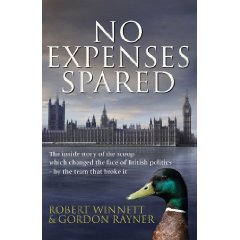
no expenses sparedThere’s something rather bizarre at seeing on display the Telegraph’s book of this year’s scandal, No Expenses Spared – it’s the subtitle, The inside story of the scoop which changed the face of British politics. Bizarre for this reason: it’s hard to see how the face of British politics actually has been changed. For sure, some of the faces within British politics will have changed, with many of those MPs who were implicated standing down, voluntarily or under pressure.

But in every other significant respect, British politics is – six months on from flipping, duck island etc – entirely unchanged.

Posted in News | Also tagged and | 13 Comments

Opinion: Why not try democracy for a change?

It has become a truism to say that interest in politics has hit an all-time low among “ordinary” voters. All parties have come up with proposed remedies, but none of these shows any sign of working. At the same time, we have recently seen in the US an example of how exciting politics can be. Why, in a country which boasts of being one of the world’s oldest democracies, should things have come to this pass?

Part of the answer is that our present political model is totally inappropriate to the contemporary scene. We have a system which in every respect, from our voting system through to the arrangement of MPs’ seating in the House of Commons, assumes confrontation between two parties opposed to each other on every issue. Yet we currently have not two but three major parties, which seem to crowd onto the centre ground, with ever fewer obvious differences of principle between them.

Nonetheless, despite the lack of obvious differences, the parties behave as if they were still driven by diametrically opposed principles. What one party proposes is, with few exceptions, immediately rubbished by the others.

The result is that most people feel a profound disillusionment with political activity, and an alienation from the posturing, as they see it, of politicians who seem to them to be driven by personal ambition rather than political principles.

The situation is exacerbated by the fact that, increasingly politics is seen as a career choice. It is by no means uncommon now for talented young graduates to serve for a few years as researchers or assistants to an MP, then move straight on to a safe seat. This means not only that they have no real experience of anything other than politics, but also that the skills they acquire from the start are those of the politician – the skills of presentation, of turning the question asked into the one for which one has a good answer, and all the other skills which collectively are know these days as “spin”. Is it any wonder that when such highly skilled and talented men and women talk to “ordinary” voters they all too often fail to convince people either that they are speaking from experience (they are usually not) or that they are sincere?

Add to all this the fact that, since the days of Mrs Thatcher governments have stripped away many of the powers of local government – and increasingly rely on non-elected or indirectly elected quangos to run the things that matter to people – and we are left with a situation where only at the highest level, that of Parliament, is there anything which can reasonably be described as “democratic”, in the sense that MPs are elected, and are accountable for what they do in office. (By contrast, councillors are elected, but then have their actions circumscribed by central control of their spending, meaning they are not meaningfully accountable).

How, one might ask, can there be meaningful parliamentary democracy when at all lower levels democratic structures scarcely exist?

Posted in Op-eds | Also tagged , , and | 3 Comments
Advert

Recent Comments

  • John Bicknell
    I do think it's a mistake to make no more than just a token effort in by elections unless they are considered as potential gains. However, those who are embarr...
  • expats
    Matt (Bristol) 19th Jun '26 - 2:47pm....Expats, Oh, for sure. Badenoch made slightly phoney claims about green policy and bribing voters with jobs that may be ...
  • Andrew Tampion
    "@ Chloe In privately owned institutions supplying personal care too often the prime driver is profit not people, that’s certainly been my experience." Where...
  • David Le Grice
    Honestly our performance in Aberdeen south is Aberdeen south is an indictment of where our party is at. In 2010 it was one of our top target seats, we held the ...
  • nigel hunter
    UKcould keep special pre Brexit terms if it rejoined the EU----Michel Barnier says----Guardian article. Negotiations can achieve great things....