


My very first isolation diary on 16th March was titled Paying the Newsagent. That was followed by Going for a walk and Doing the shopping. A pattern was emerging, and I love patterns, so I have started each title with a present participle ever since.
My fascination with patterns fuelled my interest in the English language, Maths, Philosophy and eventually Computer Science. When I took O level English Language I always attempted the optional questions in analysis (ie grammar) because I knew I could get them right, whereas other questions had more subjective elements to them.
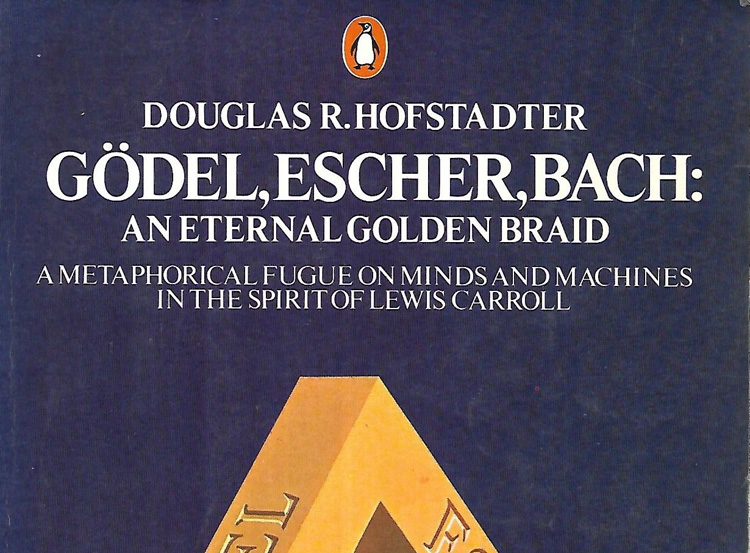
At various times in my life I have been fascinated by the patterns to be found in the tessellations within Escher’s paintings (I used one to illustrate this diary), in the repetitive elements of Bach chorales and in the elliptical thinking of the logician Kurt Gödel. So it is perhaps not surprising that I loved Douglas Hofstadter’s book Gödel, Escher, Bach: An Eternal Golden Braid, when it came out in 1979. The problem now is that I can’t find my copy of it. I must have lent it to someone – at the time I was recommending it to anyone who I thought might enjoy reading it. (Before anyone kindly offers to send me their unwanted copy I have now ordered it again.)
What I do remember is that the book was not an appreciation of the three creative people in the title, or even an assessment of their greatest works. Apparently, it can be found categorised in bookshops and libraries variously under maths, general science, philosophy, cognitive science, religion and the occult (the last two don’t quite hack it). So what is it about?
Amazon lets me ‘peek inside’ the edition I have ordered, which includes a new preface from the author to mark the twentieth anniversary of its publication. He writes that the book “is a very personal attempt to say how it is that animate beings can come out of inanimate matter”.
He refers to ‘strange loops’ – “certain special swirly, twisty, vortex-like, and meaningful patterns that arise only in particular types of systems of meaningless symbols. It is these strange, twisty patterns that the book spends so much time on, because they are little known, little appreciated, counterintuitive and quite filled with mystery.”
The book “was inspired by my long-held conviction that the ‘strange loop’ notion holds the key to unravelling the mystery that we conscious beings call ‘being’ or ‘consciousness’.”
Any clearer? No, probably not. But if you do ever come across the book my best advice is to approach it like a new piece of music – don’t try to over-analyse it but just let it sweep over you. Eventually patterns will emerge, and with them insights. And don’t start by reading the Preface, just get stuck into the first chapter.
Another obsession of mine is with Lewis Carroll’s Alice in Wonderland and Alice Through the Looking Glass. I have known those books all my life and I used quotes as subheadings to chapters in my MSc dissertation. I think I had as much fun choosing appropriate extracts from Alice as in designing a critiquing approach to problem solving in expert systems.
To my delight, I have just noticed that in the original edition of Gödel, Escher, Bach the subtitle was “A metaphorical fugue on minds and machines in the spirit of Lewis Carroll”.
When I started writing this post I thought it was going to be about my love of the English language, but, in the spirit of Gödel, Escher, Bach, it has taken me down a rather different path – a strange loop indeed.
Please note
We have been in full self-isolation since 16th March to protect my husband whose immune system is compromised.
If you are in self-isolation then join the Lib Dems in self-isolation Facebook group.
You can find my previous Isolation diaries here.
* Mary Reid is a contributing editor on Lib Dem Voice. She was a councillor in Kingston upon Thames, where she is still very active with the local party, and is the Hon President of Kingston Lib Dems.
 Follow @libdemvoice.org on Bluesky
 Like us on Facebook
 Subscribe to our feed
 Sign-up for our daily email digest

 Ed Davey on working with Greens after Zionism conference motion
 Oh! What a Lovely War: An interview with Murray Melvin
 Green leader doubles down on Zionism is racism policy
 Chris Williams
 Andrew Moore
 Steph
Steph David Evans
 Chloe
Chloe
8 Comments
This is the sort of piece here from Mary, revealing that which only a Liberal Democrat could, showing why only the Liberal Democrats are a party I am in.
On the surface, obscure, bookish, wonkish, underneath, deep, thoughtful, intelligent.
It does not immediately speak to that which is popular, nor, especially not, populist, but it is wrong to regard it as pointless.
It needs further exploration, discoveries of ways to cook , bake, utilise resources, services, pleasures.
Just as some thought it obscure, it is suddenly, practical, helpful, sensible, insightful, simple.
I am not one for patterns, nor am I one opposed to these, but I see one here.
Here is a very worthwhile little thread of some real significance…
Following the links led me a merry chase.
I particularly liked Indras Net.
thank you
Patterns? There some structuralism there.
Thanks, Lorenzo Cherin.
And Paul Barker – you sent me off on another path to look at Indras Net. It’s going to be one of those weekends…
Manfarang – yes indeed
All this stay at home has given me a chance to look again at some of the books I have kept from my university days.
I am in awe of this by Mary. I had not even thought of participles in connection with LDV. In fact I normally do not think of participles at all. At school I never really believed in English grammar. This was mainly because my observation was that no-one I met seemed to follow any rules that I was taught.
However back to participles. They seemed to me to exist mainly in Latin. I remember being presented with ‘Carthago delenda est’ whose meaning the teacher gave as ‘Carthage is a to be destroyed thing’. I have no memory of anything else about it. I have now discovered thanks to Google that ‘delenda’ is a gerundive, coming from the verb meaning to destroy. I do know that the Romans succeeded in destroying Carthage. In fact I have been there to check.
There we are, the universe to me is a set of unrelated facts. So my awe comes through reading something by someone who sees patterns where I see chaos.
Tom
Some English grammar rules of course come from Latin and they don’t really apply to English which is why they are not really followed.
Thanks Mary – you’ve inspired me to dust-off my copy of ‘Godel, Escher & Bach’ this weekend.