So reports The Observer, writing up its interview with Nick Clegg:
In an interview with the Observer, he launched a withering attack on the economic policies of Margaret Thatcher and promised instead to look to the examples of Sweden, Canada and the US to deliver “progressive” cuts.
“It is important that people understand that fiscal retrenchment does not mean a repeat of the 1980s. We’re going to do this differently,” said Clegg, in a move that risks angering MPs on the Conservative right, many of whom admire their former leader. The deputy prime minister said he would use his authority “ruthlessly” to
The Voice is only a success because of the interest and support from our readers. For many people just lurking and reading the site is all they want to do – and that’s fine, we’re grateful for people taking the time to read the site.
You can though help us continue to produce interesting content for a growing audience. Here are three simple ways:
1. Let us have your tips for stories. Perhaps there’s something outrageous going on in your local council? Or you’re an expert in a particular area and have spotted a story other people have missed? Or you’ve seen …
As the uber-secretive Bilderberg group meets in Spain this weekend, lets cast our mind back 33 years to when they met in the fading surroundings of Torquay’s Imperial Hotel and messrs Hattersley, Thatcher, Healey, Schmit etc met over cocktails to shoot the establishment breeze.
Then, in 1977 it felt like the “fag end” of a political era. Labservatives had been failing to get to grips with the country’s ills since the war. Strikes, three day weeks…we all know the script. The ill fated Lib-Lab pact had just been announced to an underwhelmed electorate, keeping Labour in power until collapsing in …
Whilst political pundits struggle to fathom the implications of coalition and ‘new politics’, the signs are that Lib Dem voters are optimistic and that they are responding well to the new vision. It seems that when the new order combines with a strong local campaign and a candidate who offers the traditional Lib Dem promise of ‘service and action all year round’ success follows.
A series of elections over the last two weeks brought first an encouraging result in the extended Parliamentary election in Thirsk and Malton. This being a safe Tory seat with a notional majority of over 14,000 and …
Back when Cix was the main way of talking to other Lib Dems online, a tradition emerged of posting Lib Dem MPs’ maiden speeches so that people could read them and respond – a tradition LDV would like to continue. Earlier today, we read Simon Wright’s speech, and tomorrow we will bring you David Ward.
Duncan’s speech is also available to view here at the Parliament website until 1 June 2011.
Thank you, Mr. Deputy Speaker, for giving me the opportunity to make my maiden speech so early in this Parliament. I congratulate the hon. Members for Harlow (Robert Halfon) …
Here’s contender for the Lib Dem deputy leadership Tim Farron at the Lib Dem conference last autumn, drumming up funds for the party. What do you reckon he might be thinking, or saying?
Although when talking about other parts of the agreement I’ve sometimes being quite critical about the parking of issues with commissions or reviews, the commission on long-term care is a good move. It has a clear remit, has to report within a year and tackles an area which requires policies that have a chance of long term cross-party agreement given the nature of the subject. The failure of cross-party talks prior to the election means the …
Back when Cix was the main way of talking to other Lib Dems online, a tradition emerged of posting Lib Dem MPs’ maiden speeches so that people could read them and respond – a tradition LDV would like to continue. Scheduled this weekend are Simon Wright, below, Duncan Hames and David Ward.
Thank you, Mr Deputy Speaker, for giving me this opportunity to make my maiden speech. I am pleased to follow the maiden speeches of the hon. Members for Walsall South (Valerie Vaz) and for Stroud (Neil Carmichael) and of many other Members who have spoken today with great pride …
I’ve been intrigued these past couple of days to see themainLabourblogs fall over themselves to argue that the current three front-runners for the Labour leadership – now they have the MP nominations needed to be on the ballot – should urge their parliamentary colleagues to nominate one of the three also-ran contenders to ensure “the widest possible field of candidates in the leadership election”.
I can understand the principle behind the campaign, of course. Frankly, if I were in the shoes of a Labour member (as I was for a number of years), I …
After an extended election break, we’re reviving our Saturday slot posing a view for debate:
The election campaign of 2010 will, above all, be remembered for the transformative effect of the television debates, and the breakthrough of Nick Clegg. They were, in the main, substantive discussions in which real policies – and real political differences – were openly debated. But they also re-inforced the impression that British politics is, above all, about personality; and in particular, that the quality politicians need above all is empathy, an ability to connect with the voters they seek to represent.
Empathy is a vital quality of leadership. It is one which is perhaps tipping the balance of opinion in the Labour party against David Miliband, who comes across as less of a listener than his brother and rival, Ed.
But empathy can all too easily tip over into something else: an overly emotional reaction which blinds politicians to sound reason. The moment a politician loses his rag – however understandably, however provoked, however gloriously – is the moment I feel my respect draining away.
I do not want a politician who knows only how to emote. I want a politician with cool, clear, concise judgement. Our leaders are faced with umpteen improbably tricky decisions before breakfast: they cannot afford to waste their energies as the mood takes them.
Perhaps the ultimate exemplar of the non-emoting politician happens also to be the world’s most powerful leader, President Obama. Yet he has come in for criticism in recent days from the Washington media for failing to show sufficient anger at BP, forcing Obama to declare himself somewhat falsely ‘furious’ (while reasonably pointing out he wasn’t hired to yell at people):
Total Politics has picked Burnley Liberal Democrat MP Gordon Birtwistle for its diary of the week:
I am just beginning now, to find my feet in this strange place (and to find my way around). To say the first couple of weeks have been overwhelming has been an understatement! I did not think that when I was eventually successfully elected, it would be as part of a party in government.
Over at The Guardian’s Comment is Free, LDV Co-Editor Mark Pack notes that the behaviour of the new Lib Dem chief secretary to the treasury, Danny Alexander, wasn’t a patch on the sort of tax avoidance measures the Telegraph repeatedly recommends. Here’s an excerpt:
… a piece by Ian Cowie, from May 2010, lays out in detail how Telegraph readers can avoid paying capital gains tax. It even says: “Do as MPs do and ‘flip’ your home … large potential CGT liabilities can be avoided quite legally in this way.” The story goes on to urge a full exploitation of expenses
Simon Hughes already has the firm commitment of 30 of the 57 Liberal Democrat MPs that they will vote for him to be Deputy Leader of the party in the vote on 9th June, his spokesman has told PoliticsHome today. …
Only some of the MPs have publicly declared their support for Mr Hughes, which the spokesman explains as follows: “We haven’t had that many people coming out publicly … because many of them are senior party officials, government officials and they don’t want to be seen to be supporting anyone at this stage.”
At the time David Cameron started talking about the Big Society, the concept struck me as a mix of traditional community politics and vagueness. Looking at the specifics in this section, there is still a fair amount of vagueness, but the specifics are ones that often touch on themes which our party (or more precisely the Liberal Party) has talked about in the past and rather neglected in more recent years. In other words, it’s …
There’s been some interesting discussion on LabourList about whether Labour should – yet again – pick Ken Livingstone as their candidate for London Mayor. Declan Gaffney has made use of some very interesting research into the demographics of London elections (published here).
That demographic analysis deserves a long second look; and once you do, the picture isn’t pretty for anyone who wants Ken Livingstone to be elected as Mayor of London.
The most striking feature in the demographic facts and figures is the polarisation of London politics between 2004 and 2008. The study looks at the election results, ward …
The public health section is very brief and rather anomalous as a section on its own, though given the length of the NHS section splitting this area off makes some sense. There is little of surprise in what there is of this section – public health is important (gosh), it should be improved (shock) and the government will be ambitious (crikey). Innovation is also good (well I never).
In response to a question from Tom Watson, Government minister Francis Maude asserted that Government departmental websites should “wherever possible” use Open Source Software. This is very significant change in emphasis from the previous government, which merely said that open source and proprietary solutions should both be considered on an equal footing.
The implication, if this policy is implemented, will be departments having to justify not using open source for their websites should they choose to go down the proprietary route. We await seeing how this turns out in practice, since warm words from the cabinet office don’t necessarily translate …
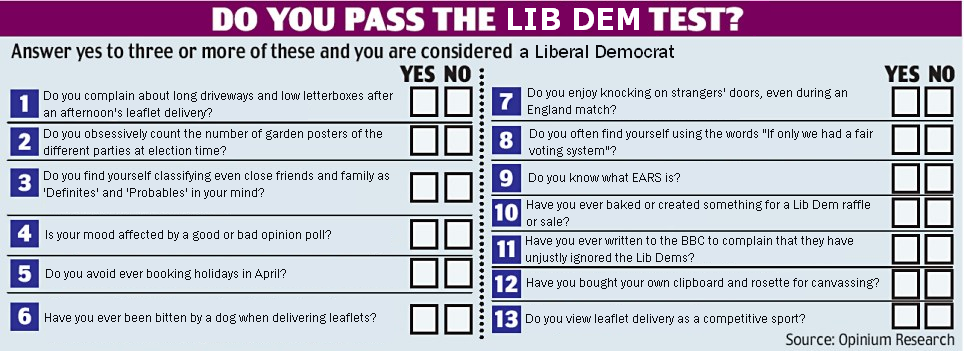
With a tip of our hat to the Daily Mail – which today asks its readers 13 questions so they can tell if they’re posh or not – Lib Dem Voice presents our special How Lib Dem are you? test:
(Click on the image to enlarge).
All you have to do is answer ‘Yes’ or ‘No’ to the following questions to get your answer …
1. Do you complain about long driveways and low letterboxes after an afternoon’s leaflet delivery?
2. Do you obsessively count the number of garden posters of the different parties
Mark Prisk is Minister of State for Business & Enterprise and is MP for Hertford & Stortford:
Cutting the burden of regulation is vital if we are to help the private sector grow. This is especially the case for small and medium sized enterprises that face disproportionate costs from unnecessary red tape.
Under Labour the burden of regulation grew inexorably, to the point that by the time of the May 2010 election it was implementing the equivalent of 14 new regulations every working day. The Federation of Small Businesses has worked out that this meant that the average small business is spending …
As a result of the formation of the coalition Government, a number of responsibilities will be transferred from the Secretary of State for Justice to the Deputy Prime Minister.
Nick Clegg has already been given special responsibility for political and constitutional reform; now Prime Minister David Cameron has listed the powers which will help Clegg bring this into effect:
There was a kind of bittersweet irony that, on the day of the first Prime Minister’s Question Time of the coalition government, the former Liberal Democrat MP Lembit Opik was performing an open-spot stand-up gig in a tiny basement comedy club. Opik, it could be argued, has performed comedy in a niche environment on both
We were conscious this was a much more expensive way of managing our lives than if we had just been honest about our relationship, because if we had, we could have claimed a significantly greater amount of money than we did.
We would often say to ourselves ‘this is ridiculous’, as a consequence of having this bizarre private life, we are costing ourselves far more than if we had just been honest about things.
To me in particular it seemed that was a price worth paying to protect our privacy.
To me, what is really important for people to understand is that none of the things that we did were done to make financial gain. They were done to protect our privacy.
I guess it was pretty stupid really, because all of the people I have spoken to since have accepted it without hesitation: my parents, family and friends. Not being honest with them has meant a huge price over recent years.
David Laws also said that he used the money from his City career to fund his political one:
A nationwide survey by PoliticsHome shows that Vince Cable, Business Secretary and outgoing Lib Dem deputy leader, has a higher approval rating from the public than David Cameron.
Deputy Prime Minister Nick Clegg enjoys a clear popularity gap ahead of the Prime Minister, holding an approval rating of 17, compared to David Cameron’s rating of 11.
While the two men both attract the approval of 39% of the public, fewer disapprove of Mr Clegg (22%) than Mr Cameron (28%).
Jamie Stone, Scottish Liberal Democrat MSP for Caithness, Sutherland and Easter Ross, has announced that he will step down from the Scottish Parliament at the next Scottish election. Mr Stone is stepping down 25 years of public service to pursue new avenues.
Jamie is the second Highland Liberal Democrats MSP to announce he is standing down.
John Farquar-Munro MSP is also standing down and Alan MacRae has been selected to replace John and fight the seat at next years election.
Nominations closed at 5pm yesterday for the Deputy Leadership of the Liberal Democrats, and it’s going to be a contest between Tim Farron and Simon Hughes. Already the Independent is calling it for Simon:
Simon Hughes, the Liberal Democrat left-winger, was on course last night to become the party’s deputy leader.
The former party president is understood to have secured the backing of more than half of its 57 MPs. Although he voted in favour of forming a power-sharing deal with the Conservatives, he is likely to prove a thorn in Nick Clegg’s side.
The political reform section of the coalition document is the second longest in the whole agreement, beaten for length only by the NHS section. By now the headlines from this section are very familiar:
Fixed-term Parliaments
A referendum on the alternative vote
The ability for voters to force an MP to face a special by-election if they have been found guilty of serious wrongdoing (“recall”)
A “wholly or mainly” elected House of Lords, using proportional representation
I don’t pretend to understand a huge amount about the science of opinion polling – like any political geek, I dabble, but that’s it. However, I do understand a little more of the art of opinion polling, of manufacturing the response you want to deliver a story.
So I was pretty disappointed to read the latest ComRes poll, commissioned by The Independent, which asked a couple of deeply flawed questions. Here’s the worst of the bunch, asking the public to agree or disagree with the following statement:
The political horsetrading which followed the inconclusive General Election result showed that an outright win is much more desirable than a hung parliament.
Now it’s an interesting question to find out what the public did feel about Britain’s first taste of post-election bargaining in the full glare of rolling news – I’d love to see a genuine question putting it to the test.
But this question by ComRes is risible – a serious pollster would not use the loaded term ‘political horsetrading’ if they were genuinely interested in finding out the public’s views. Unsurprisingly the public reacted negatively to the notion of ‘horsetrading’, with 74% saying they preferred an outright win.
What, though, if the pollster had tested the public’s attitudes with a more neutral question, something like:
On 7th May no single party won an overall majority, so the three major parties opened discussions to see if they could reach agreement. Some people say that this is a good thing, resulting in a programme for government based on the most popular policies from each of the parties. Other people say it is a bad idea, and that it would be better if a single party had won an outright majority and could govern alone. What is your view?
Now I wonder what might have happened if ComRes had asked that question. I suspect they would have got a very different answer to the one they got. Which leaves one question hanging … Why did they ask a slanted question that they must have known would provoke a negative response?
Voting intentions:
For the record, ComRes found support for the parties as follows:
Conservative 37% (-1), Labour 33% (-1), Lib Dems 21% (n/c)
This is consistent with most other polls – indeed, I think it’s the sixcth consecutive poll which has shown the Lib Dems at 21%. Okay, the balloon of ‘Cleggmania’ may have popped, but that’s a lot better than some of us would have dared hope in the immediate aftermath of the coalition deal being struck. But it’s very early days of course.
ComRes also tested post-coalition attitudes to the Lib Dems, using one of those “putting words in your mouth” questions beloved of newspapers but which brings political science into disrepute: “Now that they have joined a coalition with the Conservatives, it is difficult to know what the Liberal Democrats stand for” – 65% agreed, but 29% disagreed. Given it’s a statement which invites the public to offer a nod of cynical agreement, I was mildly encouraged that getting on for one-third of the public disputed it.
Electoral reform:
ComRes also asked a question about changing the voting system, testing the statement: The first-past-the-post system for elections to the House of Commons should be replaced by a system that reflects more accurately the proportion of votes cast for each party.
It’s welcome, though entirely unsurprising, to discover that 78% agree, with only 18% disagreeing. It would have been more interesting, though, to find out what the public thought of the Alternative Vote (a non-proportional system) compared with a genuine system of proportional representation (such as STV) or the status quo of First-Past-The-Post.
A propos almost of nothing, here’s a famous clip from Yes, Prime Minister which looks behind the opinion polls:
Alex Macfie @Chloe: The public mood has shifted considerably on the EU since 10 years ago. Obsession with keeping the faith over the Brexit referendum is confined to the fa...
Meg Thomas Completely agree with this. Andy Burnham wants to improve politics. We are an opposition party so we oppose. It is pathetic, I am sorry to say....
expats I give up!.. Reading some of the posts it seems that Burnham shouldn't have mentioned the EU, the 'triple lock' and also how his electoral reform is the 'wrong ...
Chloe A huge mistake by Burnham. Opening the EU's pandora box will sap the energy from this government . Everything will be overshadowed by that question....
Big Tall Tim An excellent article Victor on the great work you are doing. It's a great shame people like David can't give credit where credit is due....



 Follow @libdemvoice.org on Bluesky
 Like us on Facebook
 Subscribe to our feed
 Sign-up for our daily email digest

 So many questions over Burnham's agenda
 The disturbing folklore behind Alan Garner's stories
 The geography of Liberal Democrat potential (LDN#214)
 The sun still shines on PM Burnham
 Alex Macfie
 Meg Thomas
 expats
 Chloe
Chloe Big Tall Tim