Mr Kennedy won convincingly after securing 2601 votes out of a possible 3166. The writer received 565 of the votes from students.
The contest to become Glasgow University’s 121st rector came as the institution faces protests over course cuts. And both candidates attempted to win the hearts and minds of the student body by issuing a warning to university bosses.
Mr Kennedy told the Herald before his win: “My job, if re-elected, is to get all
The BBC reports from Southampton Magistrates Court:
A Liberal Democrat MP has described allegations he was a paedophile as “absolutely untrue and offensive”.
Mike Hancock told Southampton Magistrates’ Court he was “horrified” by a leaflet published during last year’s general election.
The court heard Les Cummings, who was standing against the MP, had written: “Mike Hancock is a paedophile”.
He denies making a false statement with the purpose of affecting the result of the election in Portsmouth South.
Mr Cummings, 66, from Portsmouth, is accused of publishing the leaflet last April, while he was standing against Mr Hancock as an independent for the Justice
As at the time of blogging this, there are only 32 days to Census Day on 27 March 2011. On that day every household will be required to complete and return a census survey (on pain of a fine of up to £1000 and a criminal record) with information on every member living at that address including any overnight visitors!
The first census conducted in March 1801 revealed a total population for England and Wales of just under 9 million. By 2001, the population in England and Wales had grown to over 52 million (58 million in the UK). Every ten years the census provides a benchmark. It not only counts the population but tells us about the percentage of young and old, what jobs people do, the type of housing we live in, our ethnicity and religion.
So why is it important that we should have an accurate head count of people living in Britain?
Nick Clegg’s visit to Sheffield yesterday included the first in a new series of town hall meetings – this one in partnership with local newspaper the Sheffield Star:
THEY say the best form of defence is attack, which is exactly what Sheffield Hallam MP and the Deputy Prime Minister Nick Clegg decided to do by launching a new wave of meet the people sessions, here in his home city.
Mr Clegg is the first to admit he is under fire at the moment. He faces a barrage of criticism about his decision to renege on his promise not to vote for
Are the Liberal Democrats a party of untrammelled ideology – sorry,“principles” – or do ethics and evidence also play a role in thinking? This question struck me forcefully when reading David Cameron’s article on public service reform in the Telegraph. It appears that the imminent Open Public Services White Paper has been formulated with collaboration from the Chief Secretary to the Treasury and Nick Clegg is fully ‘on side’. We await the details, but if Cameron’s article gives us an accurate sense of what is to come then I think there is – or should be – a significant …
In today’s Times (£) Paddy Ashdown argues that the Ministry of Defence is “no longer fit for purpose.”
Ashdown says that the current government are not making enough progress with addressing the Ministry’s problems: the large annual deficit, bureaucratic blunders and project overruns and puts them down to a lack of political direction.
Here’s an excerpt:
The dust is now settling on the Strategic Defence and Security Review, published last October. And what it reveals is that the deeply painful cuts already announced are not going to be enough to balance the books. There will have to be more — there may
The Financial Times has been reporting this week again about the ongoing vigorous debate within government over the forthcoming Green Investment Bank and how much power it will have:
Nick Clegg is now the main driving force of the government’s “green investment bank” amid a Whitehall struggle over how precisely the new entity will function…
The Treasury is determined to hold back financing until the deficit is under control, towards the end of the current parliament. Officials have also argued for the bank to be a fund with little or no leverage.
Diary details released by the Metropolitan Police show that senior police officers met personally with senior editorial staff from the News of the World eight times in the last two years alone and a further five times in the previous three years. The tally excludes any general crime briefings or encounters at social events put on by third parties.
Dee Doocey, Liberal Democrat London Assembly Policing Spokesperson, has reacted to this revelation saying,
I find it quite extraordinary that when allegations about illegal phone hacking relating to the News of the World were still unresolved that the Met Commissioner thought it
Sunday’s Scotland On Sunday newspaper featured an interesting interview with Liberal Democrat MP for Berwickshire, Roxburgh and Selkirk and Secretary of State for Scotland, Michael Moore. The interview begins with a discussion of the pre-Christmas ‘sting’ on Liberal Democrat MPs by journalists from the Daily Telegraph, of which Michael was one of the (albeit less publicised) ‘victims’. Also touched on is the Scotland Bill, which is one of the main focuses of Michael’s attention.
Here’s an excerpt from the interview, in which the upcoming Scottish Parliamentary elections are discussed:
The other big issue on the agenda is May’s election. While Clegg has
The Welfare Reform Bill was introduced to Parliament on the 17th February. It involves the biggest changes to the welfare system in at least 20 years, probably a lot longer. It includes the Universal Credit, intended to significantly reduce the poverty trap, by making it clearer to those on benefits that they would be better off in work.
Here’s the question I’m submitting to the Report of the Federal Executive at the party’s spring conference in Sheffield:
The report makes only very brief mention of several important topics (e.g. the party’s KPIs and review into the general election, for neither of which are details provided). Overall it is far shorter than previous FE reports, with for example less than a third of the words of that from the first spring conference after the 2001 general election. Will the FE consider providing more substantive reports in future?
The Federal Executive’s report is being debated at 5:30pm on the Saturday in the main …
Bill Atiken, the Conservative Convener of the Scottish Parliament’s Justice Committee, has tonight resigned over comments he made to the Sunday Herald regarding a series of particularly horrific rapes in Glasgow.
He implied that the victim of a gang rape in a City Centre lane could have been a prostitute, and that “the police say that there’s a lot of drunken carry ons that lead to rape allegations which are subsequently dropped, put it that way.” His comments were first reported eight days ago, and although Scottish Conservative leader Annabel Goldie sought to distance herself from them, she took …
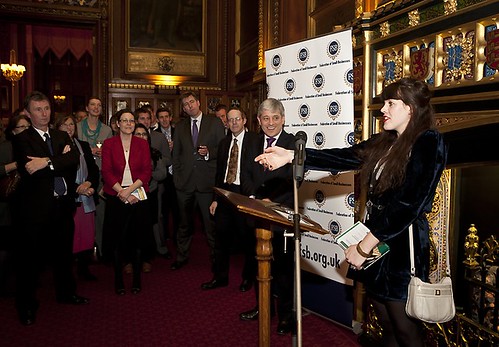
Erin Harvey, researcher to Liberal Democrat MP Gordon Birtwistle, scooped three prizes at last week’s Dods Parliamentary Researcher of the Year Awards.
Erin Harvey, the Liberal Democrat researcher who previously worked for Susan Kramer before joining the Burnley MP Gordon Birtwistle in May, stole the show where she won three of the seven awards; Liberal Democrat Researcher of the Year, the Federation
Richard Willis is a Conservative Councillor on Reading Borough Councillor, and over on his blog he has a thorough post looking at the pros and cons of both first past the post and the alternative vote. He is particularly unimpressed with the misleading nature of the debate so far, and helpfully shoots down quite a few of the canards propounded by the No campaign:
I have long thought that AV was a good system for use at Parliamentary elections and I have heard nothing from the “No” campaign to persuade me otherwise. Indeed I have been annoyed by the misleading
By Terry Ryall
| Mon 21st February 2011 - 11:57 am
We at v believe that the idea of a Big Society is a good one. However it needs to be properly resourced. Not just financially with the Big Society Bank, but with input and ideas from the people on the ground who will make it a reality.
What is really important to all charities and to the vision of the Big Society is having an active and growing base of volunteers. We support the Big Society in principal but agree that it’s the implementation that needs to be developed.
At v, we are experts at inspiring and mobilising young people to take action. …
The Government has overhauled the way in which the number of rough sleepers is counted in order to more accurately show the reality of what is happening around the country. The new figures show that on average 1,768 people sleep rough each night, compared to 440 under the old system.
The big increase is due to every council taking part in the new counting measure. Previously figures were only gathered from areas considered hotspots for rough sleeping. In addition, the figures are now verified by the umbrella group Homeless Link rather than relying on government officials.
Welcome to the Golden Dozen, and our 209th weekly round-up from the Lib Dem blogosphere … Featuring the seven most popular stories beyond Lib Dem Voice according to click-throughs from the Aggregator (13th-19th February, 2011), together with a hand-picked quintet, normally courtesy of LibDig, you might otherwise have missed.
Don’t forget: you can sign up to receive the Golden Dozen direct to your email inbox — just click here — ensuring you never miss out on the best of Lib Dem blogging.
As ever, let’s start with the most popular post, and work our way down:
It’s rare to have an election-free year these days but 2015 is set – for the moment – to be a voters’ bonanza in Scotland and Wales. Fixed, four-year terms at Holyrood will coincide with the end of the first fixed five year term at Westminster, meaning two national elections in the devolved nations. Unless Scotland and Wales decide otherwise.
On Thursday, the government wrote to the Presiding Officers and party leaders in Scotland and Wales, offering them the chance to move the date of their respective Parliament and Assembly elections. This follows a period of consultation between the two sides. For 2015, …
The fact that it is AV on offer and not one of the other systems is the product of three specific factors: the offer on PR made by the last Labour government to woo the Lib Dems; the arithmetic of the general election result; and the mechanics of the deal between David Cameron and Nick Clegg that delivered the coalition administration. It is the product of specific circumstances. It is also the only game in town. In the world of realpolitik an academic debate
As bankers continue to scandalise the country with the scale of their pay and bonuses while the real economy struggles and youth unemployment soars, we should take a long hard look at the role of banking in the wider economy.
For years the received wisdom has been that they make huge profits so they must be simply wonderful, Masters of the Universe, the jewel in the crown of the British economy and so unlike the broken-backed manufacturing sector. But how do they do it? I can see why top footballers are paid a fortune and why Apple’s brilliant …
Late on Wednesday night Nick Clegg was at the back of the House of Lords to see Royal Assent granted to the Parliamentary Voting Systems and Constituencies Bill.
His presence there emphasised his achievement in getting this Bill through Parliament in time to enable the referendum on switching to the Alternative Vote to take place on May 5th.
Of course people may not vote to change from First Past the Post. But I have never thought that any measure of electoral reform for Westminster would come about without a referendum. The self-preservation instincts of many MPs means that they are never …
A report published by the Institute for Public Policy Research North shows polarisation between rich and poor was rising even before the recession of 2008 took hold…
The report found that, of the northern regions, the north-west has the greatest pay inequality, with the top 20% earning £427 more a week than the bottom 20%.
The greatest disparities are found in London, where the top 20% earn £686 more a week than the bottom 20%.
In my previous post I said I thought the role of social media in Tunisia was a bit of a red herring. I wanted to expand on that thought.
As I said on my own blog Wikileaks and social media played a role in Tunisia, and also in Egypt, but these things should be understood as helpful tools, not the root causes themselves. I thought the Foreign Policy article George Kendall cited was weak and the case for Wikileaks as a direct cause of the protests somewhat thin – even by the Foreign Policy article author’s own …
Over on his Mandate, Hogarth and Penrose blog, Lib Dem Voice’s Mark Pack provides the time-pressed among us with a whistlestop guide of the agenda for the upcoming Liberal Democrat Spring Conference in Sheffield.
Here are the bits of conference that Mark suspects are liable to be the most controversial:
Saturday 10:15am: conference debates the Disability Living Allowance – mobility component, which is one of the areas of proposed welfare reform that has generated much controversy between Liberal Democrats and Conservatives in the coalition.
Saturday, 10:45am: a long motion supporting the NHS reforms, including the words, “Conference welcomes the vision for the NHS
During the week I commented on how “Community Politics” is a term becoming worryingly scarce amongst the public utterances of senior Liberal Democrats. One practical example of this is how so much of the running, both intellectual and practical, in political circles on developing social investment is happening in the Conservative Party.
Finding ways to improve the availability of funds to social enterprises is an issue that has got increasing intention in recent years and is an important part of the Conservative vision for a Big Society bank, but Liberal Democrats have been mostly silent as it has become all about the Big Society, with Community Politics rarely getting a mention on the national stage even from Liberal Democrats.
If you are not familiar with the issue, here is an example of a social enterprise taken from the government consultation paper published during the week:
Bikeworks was set up in 2007 with the aim of using bikes to tackle environmental, social and economic challenges in Tower Hamlets, east London. Bikeworks provides employment and training opportunities for marginalised individuals in recycling and refurbishing second-hand bikes. Bikeworks’ approach is to develop and build on the best of small-scale community cycling initiatives but to do so on a greater scale, achieve significant outcomes and build a viable replicable model. They recently opened a second community cycling hub in Kensington and Chelsea, west London, in September 2010, and have aspirations to replicate the service further. Bikeworks’ income is earned through contracts to provide a range of organisational cycling services to local authorities, civil society organisations and corporate clients. It also generates income from the retail sale of recycled bikes and the provision of repairs and maintenance services to the public.
The consultation paper looks at how more investment funding can be made available for such enterprises, particularly through fixing flaws in the current state of the financial markets (section 3.10 lists five major areas where markets are not working properly in this regard). Here it is in full:
Here’s your starter for ten in our weekend slot where we throw up an idea or thought for debate…
During the week, Lord McNally said in Parliament, as part of an answer to a written question, that “The Government do not have a role in encouraging party political activity on the ground”.
Is he right: should it be part of the government’s role to encourage party political activity or should government have nothing to do with it? For example, should the government fund (directly or indirectly) publicity campaigns to encourage people to get involved in politics, including via parties? Should it …
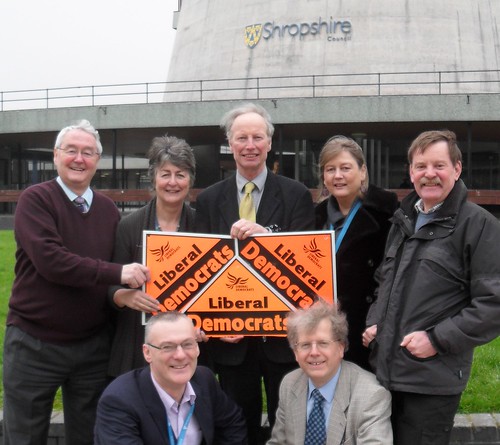
Liberal Democrats celebrated a gain in the latest council by-elections from Tories who, however, defended two other marginal seats and control of South Cambridgeshire District.
Andrew Bannerman triumphed for Lib Dems at Quarry and Coton Hill, Shropshire despite a strong intervention by Labour which did not fight last time.
The result in Quarry and Coton Hill:
LD Andrew Bannerman 356 (41.8; +5.7)
Con 268 (31.5; -12.1)
Lab 197 (23.1; +23.1)
Ind 30 (3.5; -2.3)
Chloe 'What is our offer to Leicester, Birmingham, Liverpool, Nottingham and Newcastle, to name but a few'
By the sound of it , rejoin the EU and we'll be the land o...
Mick Taylor There have been too few facts and far too much speculation. I do think we should be told exactly what has happened and why. Attempts to cast aspersions on indiv...
Mohammed Amin I agree.
Whenever I speak or write about Israel & Palestine, I am immensely careful about the words I use....
Iain Brodie Browne There is far too little talk of spreading wealth. Anyone interested in just how radical the party was should check out David Steel's essay in his book Partners ...
Miranda Pinch Simon Lytton. Thanks for pointing out the issue with the expense of going to conferences. I have given up on York and Brighton is now so expensive and shabby. B...




 Follow @libdemvoice.org on Bluesky
 Like us on Facebook
 Subscribe to our feed
 Sign-up for our daily email digest

 Should the Grimond Society Become an Associated Organisation?
 An interview with Bodhana Sivanandan, the youngest woman grandmaster of all time
 Does money buy votes?
 Inside the refurbished library
 Is the Labour government split on immigration?
 Chloe
Chloe Mick Taylor
 Mohammed Amin
 Iain Brodie Browne
 Miranda Pinch