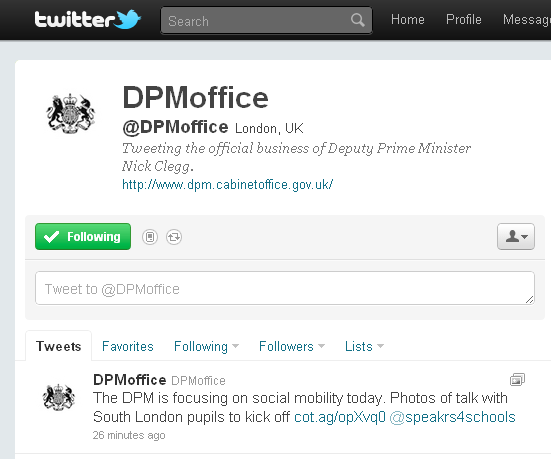
Nick Clegg has added another string to his social media bow – this time it’s a new Twitter account.
@DPMoffice will be “Tweeting the official business of Deputy Prime Minister Nick Clegg.” It will be run separately from his existing party Twitter account, @nick_clegg, which will still cover Nick’s Liberal Democrat and Government-related activities.
In the top 50 of the blogs list, Lib Dem Voice is in at number 12 (up from 27 last year), Caron Lindsay at 25, Jonathan Calder at 38 and Andrew Reeves at 44.
In the top 50 of the bloggers list, I’m in at number 20, Caron Lindsay at 29, Andrew Reeves at 43 and Jonathan Calder at 49.
Out with a little less fanfare than usual this week have been various categories in the Total Politics Blogger League Tables, including the top Liberal Democrat blogs:
Autumn is traditionally the season why many local councillors and would-be councillor start thinking about sorting out their online activity ahead of next spring’s elections. It’s certainly a good item on the to-do list as leaving it all till after Christmas is leaving it all rather late. So as the weather is distinctively autumnal, here are four tips to make your use of email lists more effective:
A quick plug for ourselves: voting closes on Friday in the Total Politics Blog Awards 2011. You can cast your votes hereand if you would be so kind as to remember both The Voice and the blogs run by the various contributors to this site, that would be most spiffing. Thank you!
It’s that time of the year again, the Total Politics blog awards, in which people very kindly voted The Voice number one Liberal Democrat blog last year.
This year the voting rules are slightly different both to remove the old system of sending in emails and also to reflect that some people blog in several different places, so you can now vote for bloggers as well as blogs:
Your votes must be ranked from 1 to 10. The higher you rank a blog
The Government has just launched its brand new e-petitions system. You can find it here. The first petitions will be going live next Thursday.
Haven’t we been here before? Well, it is true that Labour surprised us all by setting up the Number 10 online petitions website some years ago, and that this attracted thousands of petitions.
But after the initial enthusiasm there was inevitable disappointment, because, in the vast majority of cases, the only response received by petitioners was a statement from a civil servant. It is true that, in some cases, petitions channelled strong public concern about …
Over on Huffington Post, Mark Pack has a piece looking at the way US Republican presidential hopefuls are using technology in their campaigns, and at the difficulties of judging online activities from the ‘outside’, given the often hidden nature of much of it.
Here’s an excerpt:
The old days of ‘count the features and say those with the most are the best’ are, thankfully, long gone when it comes to political Internet campaigning. As is common with many technological areas as they mature, after the initial proliferation of features and services, the real success and progress comes with technology that is hidden
From Groupon, here is one way to discourage people from unsubscribing from an email list: show them what happens to a member of staff after someone leaves the email list. (Hint: involves throwing coffee.)
In its favour, Political Communication in Britain brings together a strong cast of journalists and politicians who were active participants in the election, with six of the nineteen chapters coming from insiders such as Sky’s Adam Boulton, the Labour Party’s Greg …
1. What’s your formative political memory?
In 1984 Ken Clarke gave me an award at a thank you party for delivering leaflets for him. In front of the 200+ people there he also asked me if I wanted to join the party – and in front of them all I said no! I was pleased he’d won but said that the more I had got to know the party I realised why I couldn’t. He was somewhat embarrassed!
2. When did you start blogging?
Tuesday 15 May 2007.
3. Why did you start blogging?
I worked for Lynne Featherstone from just after the 2005 general election until the end of 2006, before becoming one of the two London Campaigns Officers. I was amazed Lynne found time to write her own blog posts so this was my initial inspiration. I also signed up to run the Great North Run in 2007 and so wanted to use it for a training diary.
4. What five words would you use to describe your blog?
I cheated here, I asked some friends for their five words – here is a selection: friendly, personal, prolific, timely, political, caring, liberal, sharp, punchy, researched, readable, passionate and straight-talking.
5. What five words would you use to describe your political views?
I’m a social liberal democrat.
6. Which post have you most liked writing in the last year (and why)?
I enjoyed writing this, not because I was suspended from Twitter, because to be honest that was a nightmare, but thanks to the support shown by the online community, inside and outside the Liberal Democrats: Andrew Reeves is still suspended on Twitter – but the support is awesome
7. Which post have you most liked reading in the last year (and why)?
I love reading Caron’s writing, because unlike my shoot from the hip and rant style, Caron is more methodical and this shows in her writing. In this post Caron highlights the hypocricy of the Labour party while still maintaining decorum – perfect: Labour didn’t love NHS Direct
8. What’s your favourite YouTube clip?
I don’t particularly bother with YouTube, but this was my favourite ever:
When you’re out campaigning this weekend for the elections and Fairer Votes referendum, make sure you let your friends on Facebook and Twitter know what you’ve been up to.
Hundreds of people are already using Lib Dem Voice’s new Facebook app to do just this. It’s a great way of building up a buzz around our campaigning – and the more someone sees their friends have been campaigning, the more likely they are to join in.
You get a list of actions – select one and publish it to your …
1. What’s your formative political memory?
The 2005 election was the one I was probably first properly aware of as a 15/16 year-old. I remember reading the Liberal Democrat manifesto and seeing posters up in my area (mainly Labour, though I’m pleased to say that’s no longer true, and orange diamonds are now far more pervasive during election campaigns).
2. When did you start blogging?
September 2009.
3. Why did you start blogging?
I’d been reading various blogs for a while, and had previously thought about starting my own, but the catalyst was probably chatting to a number of bloggers at Lib Dem Voice’s BOTY awards at the 2009 conference.
4. What five words would you use to describe your blog?
Straightforward, rational and occasionally random.
5. What five words would you use to describe your political views?
In every possible way: liberal.
6. Which post have you most liked writing in the last year (and why)?
Attending and blogging about the court case which ultimately led to Phil Woolas being kicked out of Parliament was obviously quite an experience, and I also particularly liked writing this post on a rather daft claim by Ed Balls, which was very short and simple but which, I think, demonstrates the value of blogging as a medium.
7. Which post have you most liked reading in the last year (and why)?
I hope the rules can be bent, as this was just over a year ago, but I found this post by Stephen here on Lib Dem Voice on why Clegg should rule out a coalition (!) extremely compelling. It was faultless in its logic, and I agreed with Stephen at the time, but its arguments were based on a number of assumptions which we all made but which ultimately proved to be false (particularly that the Conservatives would never give enough ground, including on electoral reform, to ever make a coalition even remotely possible). Speculating on what might have been had the Lib Dem leadership followed Stephen’s advice is an interesting game, and I can’t help coming to the conclusion that we would now be in a (perhaps significantly) worse position than that which we are currently in.
8. What’s your favourite YouTube clip?
My Twitter followers won’t be surprised that I’ve picked this clip from the magnificent West Wing, the script-writing and acting in which demonstrate just why the show is so brilliant.
I’ve long been sceptical about the scope for online fundraising in British politics. That’s partly because I’ve seen a sequence of American political consultants come to the UK, say they know much better than Brits, promise lots and then raise not very much – across the political spectrum. I’ve also seen a sequence of people from Britain go, “Oooh! American! Shiny! Must be better!”, promise lots and then raise not very much – again, across the political spectrum.
Having been responsible for (along with Ashley Lumsden and Martin Tod) the first candidate website in the UK to take credit card donations, …
Lib Dem Voice have launched a new Facebook app to make it easy for you to let your friends on Facebook and Twitter know what campaigning you’ve been doing.
This is a great way of building up a buzz around our campaigning – and the more someone sees their friends have been campaigning, the more likely they are to join in.
You get a list of actions – select one and publish it to your newsfeed.
Some actions are of the simple “I have done” variety whilst others have the …
A politician running to lead the B.C. New Democrats says he is refusing to comply with a requirement of leadership hopefuls to hand over the passwords to their social media accounts.
Nicholas Simons, an NDP MLA who’s hoping to run in the leadership race, says he’s left that information off his nomination package.
The party’s intent is to try to ensure there are no skeletons hidden in candidates’ private profiles.
As the report mentions, leaving aside the gauche politics of this, it’s also rather unwise to demand someone hands over passwords when it is a common feature of terms …
1. What’s your formative political memory?
Jo Grimond came to my school during the 1964 general election, kept 400 normally fidgety boys rapt, and I thought, ‘Yes, I believe that!’
2. When did you start blogging?
March 2007.
3. Why did you start blogging?
Blogging replaced many years of keeping a diary. Why only write for myself and whoever clears my house when I snuff it?
4. What five words would you use to describe your blog?
Local and global in content.
Here we go again. As Barack Obama hits the online campaign trail for his 2012 re-election campaign, expect a trickle, then a steady flow and finally a flood of posts about how Obama’s online campaigning should be copied by everyone from your pet cat to your grandparents.
On past form, many will gloss over the big differences between US and UK politics and the differences between a campaign headed up by the first non-white President and one aiming to make people buy your brand of shirts.
But as the BBC’s Rory Cellan-Jones, one of the more perceptive commentators on Obama online first …
When talking about the party’s plans to move to a new election database package I made reference to the advantages the Labour and Conservative packages bring their parties. However if instead of dealing generally with the electorate you look at marshalling and motivating supporters and members, in some ways it is the SNP which is now setting the yardstick by which the Liberal Democrat packages should be judged.
The SNP has just bought in to a new service from the US called NationBuilder. As one informed commentator (Mick Fealty) has said:
Welcome to the latest in our series giving the human face behind some of the blogs you can find on the Liberal Democrat Blogs aggregator.
Today it is Liberal Democrat peer (and former MP) Paul Tyler who blogs at www.lordsoftheblog.net.
1. What’s your formative political memory? Suez, October 29th 1956. Israel with British collusion bombed the Suez Canal on my 15th birthday!
2. When did you start blogging?
About three years ago.
3. Why did you start blogging?
I was invited to do so by the Hansard Society, who set up LordsoftheBlog to try to engage people outside Westminster in the work of the House of Lords.
4. What five words would you use to describe your blog?
Irreverent analysis of anachronistic antics.
5. What five words would you use to describe your political views? Radical, egalitarian, pragmatic, fundamental liberal.
6. Which post have you most liked writing in the last year (and why)? Exit Routes: this post got the most sensible comments but also has been repeated in the media.
7. Which post have you most liked reading in the last year (and why)?
The excellent analysis of Michael Ashcroft’s polling of, and focus groups with, Liberal Democrat voters: The verdict of Liberal Democrat voters so far.
8. What’s your favourite YouTube clip?
President Obama’s speech at Tucson Memorial:
Good content produced at the right time is at the heart of any successful blog. Good content often needs a helping hand courtesy of sensible promotion too. All of which is to say that fiddling with the technical details can be a tempting distraction from main business at hand, but it can make a difference even if it isn’t the main factor in success or failure.
Earlier in the month I talked about how the “little and often” rule is a good approach for candidates and those elected to public office when using the internet to keep in touch with voters. There have been two good recent examples of blog posts from Liberal Democrat councillors that illustrate the different roles blog posts can play in that.
First, Ealing Councillor Gary Malcolm and his short, simple summary of a residents’ association AGM. That sort of quick but very local information often has a ready audience, because even diligent readers of local newspapers rarely get that much information about what is happening day to day with local services.
Second, there is a post from The Voice’s own Alex Foster, who is also a councillor in Nottingham. His post, So What’s Going on at Broad Marsh?, takes a story which has been in the local news but provides the context and explanations which the local media very rarely have the time or space for. Yet for a big issue such as the fate of the centre of a town, again there is very often a ready audience for that sort of background and extended information.
1. What’s your formative political memory?
The morning after the 1992 election – remembering my parents’ disappointment that Labour hadn’t won (again) and the pervading sense of gloom of another Tory government.
I also remember one election in the 80s when my parents displayed an SDP and a Labour poster in the same window!
2. When did you start blogging?
2007
3. Why did you start blogging?
I started because I wanted to communicate to my constituents what I did as a councillor on their behalf.
4. What five words would you use to describe your blog?
Local
Personal
Topical
Passionate
Committed
5. What five words would you use to describe your political views?
Humanistic
Instinctive
Pragmatic
Empathetic
Social
6. Which post have you most liked writing in the last year (and why)?
It’s the post I wrote about the budget-making process in Reading Council. I felt proud to have played a role in delivering one of the most difficult budgets in Reading Council’s history whilst protecting key services, and I wanted to contrast our approach with that taken by Labour opposition which I thought was totally lacking, obviously.
7. Which post have you most liked reading in the last year (and why)?
I really enjoy Mark Thomposon’s posts as they are always intelligent and thought-provoking. I enjoyed this post as I thought it was a point that need making about Labour.
When the public is searching for information about prominent politicians online, one of the most common things looked for is their Twitter account – so says the data from search engine giant Google.
Chances are you’ve noticed that as you start typing a search term into Google’s search box, it tries to guess what you are typing, suggesting several ways to complete what you are typing in. Those guesses are derived from Google’s huge data set of what people having been searching for online, so seeing what Google suggests also reveals what the most popular searches made by other people have …
I’ve talked before about how slow and steady progress is usually the way to successful online politics (as in The secret to getting 1,000 ward residents to follow you on Twitter), but slow and steady progress often runs into a problem: where do you get the content from?
Whether it’s building up an email list, getting a decent readership for your blog or accumulating a good network of residents on Facebook, as you steadily build up towards large audiences you need a regular supply of content, and all the more so once you have got your large audience. Being seen …
1. What’s your formative political memory?
My first memory was a mock election at my primary school during the 1979 general election when I was one of about four people to vote Liberal. My most abiding memory is of David Penhaligon driving me home after a party fundraising event in about 1983. I only lived about 100 yards from the venue but he insisted on driving a group of youngsters to their various homes and dropped me off last. During the half hour or so that it took we had a great chat about all things political and he became my political hero.
2. When did you start blogging?
I had a couple of abortive attempts but started properly in February 2008.
3. Why did you start blogging?
I wanted to write about a combination of local and national politics as well as my own interests of football, rugby and horse racing. I also thought it would be a good way of getting across to a range of people who don’t read leaflets pushed through their doors and I had it in mind to stand for election to Cornwall Council (the election took place in June 2009). Since then the local politics has taken over and it’s regrettably rare I write about much else.
4. What five words would you use to describe your blog?
Robust, local, argumentative, frequent, did I mention local?
5. What five words would you use to describe your political views?
See above.
6. Which post have you most liked writing in the last year (and why)?
Probably the one about our council leader drinking in Downing Street on a Monday evening and then saying he had flu the next day when we had a full council. All brought about because I spotted him in the background of a photo on ConHome.
7. Which post have you most liked reading in the last year (and why)?
I’m terrible about not reading very many other blogs, particularly those by fellow Lib Dems. But I like reading a good rant – particularly if it’s one attacking Ryanair.
Jana Consider the following:
The Green Party is suddenly very vulnerable
Labour has a new leader seeking to push a different approach and different direction
Refo...
Chloe Tax cuts based on Unicorn growth from EU membership which we have no idea of a pathway & timeline to get there. I see mps have been given a memo from HQ and...
Anthony Acton What I find so disappointing about the last 2 years is that the 2024 GE result gave the party a massive boost in resources and, potentially, political influenc...
Nigel Jones I agree with Nigel Quinton, Tony Robertson and Katharine Pindar on the lack of a clear party lead on our overall vision for the future of the country which must...
Katharine Pindar Ed concluded our Autumn Conference by telling us that 'We are in the fight of our lives - and we will win!' Of course, rapturous applause followed. But somehow ...




 4. What five words would you use to describe your blog?
 Paul Walter reports …
 Follow @libdemvoice.org on Bluesky
 Like us on Facebook
 Subscribe to our feed
 Sign-up for our daily email digest

 State of Play: the classic BBC drama, part 2
 Can Davey survive as leader?
 A Week in Politics #9
 The Joy of Six 1589
 Jana
Jana  Chloe
Chloe  Anthony Acton
  Nigel Jones
  Katharine Pindar