For years Europhobes have been propagating the misconception that Britain has to choose between the EU and the rest of the world.
However, this ‘choice’ between the EU and the rest of the world is a false choice. Indeed, being part of the EU is the best way to increase Britain’s trade with emerging markets. As Nick Clegg pointed out in his speech on Europe last week, the EU has free trade agreements in force with 46 countries and negotiations with another 78 countries are currently under way. In addition, the European Parliament last week lent its weight to launching new negotiations with the USA and Japan.
In the Independent, Sir Menzies Campbell gives his perspective on the latest Tory shenanighans on Europe:
Europe is the glass jaw of the Tory party. Some of their dissidents have been heard to say that Mr Cameron should behave like Margaret Thatcher. But it was her “No, no, no” to Europe which was the straw that
Those of us familiar with the EU are used to its complicated processes, obscure acronyms and often unfathomable procedures. We sometimes forget that it is still a hybrid project that no-one has ever tried before: a multinational, multilingual experiment in international cooperation where countries decide by common accord to pool decision-making in certain areas and under certain conditions for their own mutual benefit.
Europe is rising up the political agenda. It’s an issue that could bring down David Cameron or break-up the coalition. Yet the Liberal Democrats are strangely silent. The EU didn’t appear on the Brighton conference agenda and we no longer have a Minister in the Foreign Office. We need to develop a vision for a liberal, democratic EU and get smart about fighting for it.
The awarding of the Nobel Peace Prize to the EU on Friday was met with predictable derision from the likes of Nigel Farage, who described it the decision as “baffling,” and leader of the Tory MEPs Martin Callanan, who said it was “a little late for an April Fools’ Joke.”
Admittedly, the current social unrest across Southern Europe made the award seem a little incongruous, especially coming just days after Angela Merkel’s visit to Greece was met with violent protests in Athens.
Something I wrote back last autumn is rather applicable to my views of the Nobel Peace Prize going to the European Union:
Sat on a shelf a few metres away from me is a box containing the various military medals won by my relatives over previous generations. The medals criss-cross Europe, coming from different countries, over the three wars that had a German-French conflict at their centre. To British eyes that count of three wars may seem odd at first, but for the German and French politicians building new European structures in the aftermath of the Second World War, their
Liberal Democrats in the Budget Committee of the European Parliament voted against a proposed 6.85% increase in the EU 2013 budget yesterday. George Lyon, MEP for Scotland and Vice President of the Budget Committee, said:
There is still much uncertainty over the Commission’s estimates on what it needs in 2013 to pay the bills from Member States. The prudent approach at a time when there is huge
Writing in the Financial Times, liberal leader in the European Parliament Guy Verhofstadt and his colleague and fellow contributor to this new book Daniel Cohn-Bendit (leader of the Greens) set out their vision for the future of the EU after the Eurozone crisis:
The crisis has shown up the key weaknesses in economic governance at EU level where a monetary policy was introduced without a parallel fiscal policy. Unlike other global currencies such as the
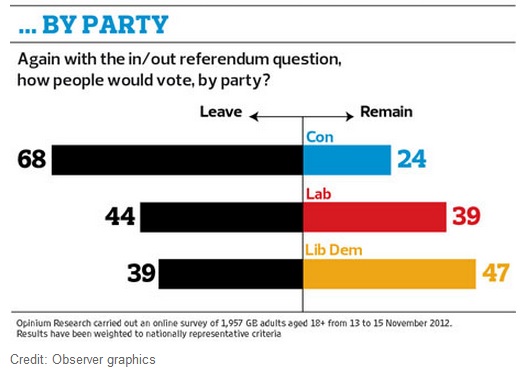
We all know Britain’s relationship with Europe is a fault-line for the Conservative party. Equally, we know that Labour has its own divisions. In both parties, the split is between pro-Europeans and anti-Europeans, between staying in Europe or getting out of Europe.
Affirmation of the Liberal Democrats’ pro-European position comes from the findings of a survey I conducted among 457 Liberal Democrat councillors in the South West region at the beginning of September, which delivers an unambiguous message of support for the Party’s Europe policy*.
In July this year, YouGov asked this question: ‘Imagine the British government under David Cameron renegotiated our relationship with Europe and said that Britain’s interests were now protected, and David Cameron recommended that Britain remain a member of the European Union on the new terms. How would you then vote in a referendum on the issue?’…
We are not going to have a mansion tax, or a new tax that is a percentage value of people’s properties.
Before you rush to spot the loophole in that – what about adding extra higher bands to Council Tax? – he opposed that too. Given Osborne made much of his reputation as was by opposing changes to inheritance tax, perhaps it is on capital gains tax that there will be room fro an agreement with the …
While the UK Draft Energy Bill is creating headlines in the UK as it makes its way through Parliament, the EU agreed on what is regarded as the biggest ever piece of legislation in the field of energy efficiency earlier in the summer. The adoption of the Energy Efficiency Directive (EED) was preceded by a whole year of tough political scrutiny and weeks of negotiations between the European Parliament and Member State ministers in the Council, led by the Danish Presidency. Both Chris Huhne and later Ed Davey were heavily involved in these negotiations for the UK, which was one …
It will some as no surprise to members in the North West that I asked them some questions on issues relating to the environment and reform of the EU Common Fisheries Policy (CFP).
I have led on environmental issues for the pan-European Liberal group in the Parliament since 1999, but since being re-elected in 2009 I have made sustainable reform of the CFP my biggest policy priority.
I asked whether members agreed with the majority of the world’s scientists that the climate is changing. 88% agreed and only …
Writing in the Financial Times this week, Nick Clegg warned:
In the debate on banking union we back greater co-operation on various aspects of an integrated financial system: common rules on the restructuring of failed banks, shared principles on how to protect depositors, high minimum standards for the capital EU banks should hold and a strong European Banking Authority.
Welcome back to a suddenly rather quieter set of benches, as the avalanche of key votes has settled, and a new Parliamentary session glides effortlessly away from the Gracious Speech. We’re still catching up after the recess, so bear with us…
Having debated the Speech itself, and given the Government several pieces of its mind over Lords Reform, the Groceries Code Adjudicator Bill has its Second Reading today. For more information, check out Norman Lamb’s piece, published in Liberal Democrat Voice last week.
A fortnight ago I was in Strasbourg where I was lucky enough to speak to two Liberal Democrat MEPs from farming backgrounds about their work to reform the EU’s Common Agricultural Policy (CAP).
Phil Bennion, Liberal Democrat MEP for the West Midlands, explained to me how the CAP, which has two pillars of funds, works.
“Pillar one is common to every country in the European Union, pillar two is devolved and co-funded by member states. In the UK we spend 80% of our pillar two money on environmental schemes, while other countries spend theirs on things …
Liberal Democrats are an oddly reticent bunch when it comes to the European Union, defined more by our opponents than by our own words. We are, by the very nature of being internationalist, in favour of a European idea. But we appear increasingly unsure as to what that might be, so we tend not to talk about it much these days.
What that means is that when the question of Europe is raised, UKIP loudly distort the truth, joined by the Eurosceptic wing of the Conservatives, whilst everybody else talks about jobs, education and crime, perhaps mentioning Europe in passing. So, …
The right-wing populist policies of the Hungarian Prime Minister Victor Orban, have created real concern over a growing constitutional crisis within the European Union (EU). His Fidesz party secured a two-thirds majority in the 2010 elections giving Viktor Orban, total authority to pass legislation.
Since then, he has been much criticised across the EU, in particular, for his new law setting unacceptable limits on media freedoms. He has also declared the country’s previous constitution invalid and passed legislation with no consultation, declaring a new constitution requiring that all judges older than 62 retire – a cynical ploy thought to favour …
By Stephen Tall
| Sat 11th February 2012 - 7:55 am
Lib Dem Voice has polled our members-only forum to discover what Lib Dem members think of various political issues, the Coalition, and the performance of key party figures. Some 570 party members responded, and we’re publishing the full results.
Party members split over the future of Europe
LDV asked: Which of the following options would be your ideal future for the UK and the European Union?
46% – The UK should remain a full member of the EU and work towards ever closer union, economically and politically.
40% – The UK should remain a full member of the EU but reject working towards ever
There’s no escaping history in our party, and current debates of nationalism, unionism and secession should prompt Liberal Democrats to delve back into the Gladstonian past.
The Liberal Party split over the Union. Gladstone favoured Home Rule for Ireland, Liberal Unionists didn’t, and ultimately joined the Conservative Party. This cemented the Conservative Party as the party of the Union, and it is a position the Conservative Party still holds.
The purpose of this article is, however, to challenge the Conservative Party’s stranglehold over being British.
The existing Conservative argument goes that a Conservative Britain is a Britainthat stands proud and takes no nonsense …
By Paul Walter
| Thu 22nd December 2011 - 10:03 am
Time was when Deputy Prime Minister’s Questions was the closest you got to bloodsports in the House of Commons. The DPM would be tethered, red-faced and growling, to the dispatch box, as Labour MPs taunted him and propelled all sorts of bile at him, augmented by the odd tactical nuclear missile rear-launched by the Tory swivel-eyes.
We’ve come a long way in a few months. Now, DPMQs are relatively sedate affairs. The DPM is well in control and there is little mischief from the Labour benches. Well, none that would spoil LibDem MPs’ lunches.
By Antony Hook
| Tue 20th December 2011 - 12:53 pm
David Cameron’s renunciation of a Treaty not even yet fully negotiated was the culmination of a process that began around 1992.
In 1992 a small group of Tory ultras, “the Maastricht Rebels”, began fighting their party’s traditional pro-Europeanism. It has taken 19 years to make their fringe views a normal Conservative Party and conservative press position. 1992 has led to 2011 like a river flows to the sea.
Anti-Europeanism’s hold on a major political movement has caused a poorly informed anti-Europeanism to take hold among many of our fellow citizens in the UK, as it has among some of …
I have yet to watch Meryl Streep’s portrayal of Margaret Thatcher. I’m sure it will be fascinating, but I just fear that it might also be a bit too painful – I find it hard to divorce my views on the politics of that era from my memories of avoidable hardship experienced by the community I grew up in. Then again, perhaps I should try and get over my Thatcherphobia and view her record a bit more dispassionately. Where better to start than Mrs T’s record on Europe?
Sat behind me in Parliament, amongst the ranks of my valued coalition colleagues, …
Into my inbox yesterday came an email from London Liberal Democrat MEP Sarah Ludford, welcoming a sensible new decision which the European Parliament has made that will give the public better information and – thanks to that better flow of information – make the relevant market work more efficiently. Just the sort of good news that liberals should trumpet: giving people power and fixing market failures.
By Paul Walter
| Wed 14th December 2011 - 12:53 pm
It was the last pre-Christmas Prime Minister’s Questions today and we saw the return of Nick Clegg loyally sitting at the PM’s right-hand side.
Ed Miliband started on the economy, and the news that unemployment is up again. He quoted David Cameron’s words when he came to office, saying that jobs would be “uppermost”. “What’s gone wrong?” asked the opposition leader.
Cameron’s main thrust during the 2010 election campaign was that new private sector jobs should lead the economic recovery and more than replace lost public sector jobs. Miliband did a good job of exposing that this bright idea has allegedly failed. …
Nick Clegg has emailed party members this afternoon, following the EU summit last Thursday:
Support for Europe has always been a cornerstone of what our party stands for. Recent days have been tough for pro-Europeans in our country, but I am clear that it is in Britain’s national interest to remain at the heart of Europe.
As I have made clear since Friday, I am bitterly disappointed by the outcome of last weeks summit, which ended with the UK in a minority of one. There is now a real danger that over time the UK will be isolated and marginalised within the
Sat on a shelf a few metres away from me is a box containing the various military medals won by my relatives over previous generations. The medals criss-cross Europe, coming from different countries, over the three wars that had a German-French conflict at their centre. To British eyes that count of three wars may seem odd at first, but for the German and French politicians building new European structures in the aftermath of the Second World War, their heritage was one of three wars – the Franco-German war of 1870 and then the two World Wars.
For them something drastic was needed to stop the dreadful arrival of conflict three generations in a row, each time on a bigger, longer and bloodier scale. Moreover, the wars were not started despite popular opinion, for they were all popular to start with.
That background helps explain two of the defining features of the European project – the determination of French and German politicians to stick together with each other and a sense that whilst democracy is good and welcome, and a vital antidote to the grotesque internal horrors of the early twentieth century dictatorships, the European project is about binding countries together rather than about giving people more democratic control over international affairs.
Add in another, far more recent, event – Brown winning out over Blair in keeping Britain out of the Euro (the closest Britain got to joining, for under Major that was never likely) – and Britain’s isolation after the last Euro summit is no sudden departure but rather a sudden, stark reminder of the quieter trends that have long been going on. The summit did not create those trends, however sharply it illustrated them.
Germany and France are, for reasons of history and economics, desperate both to stick together and to save the Euro. It was never essential to do more than try a bit to make nice to a country that is outside the Euro and whose largest political party has so often been hostile to so much European work. A country, moreover, whose leader chose to take his political party out of European alliance with mainstream continental parties and who had done precious little alliance building over the previous years with the key sources of power.
When France or Germany can wheel in Britain as an ally in their jostling with each other, Britain can exert some successful leverage, but fundamentally a different history and being out of the Euro has always made it the dispensable one of the trio.
More crafty negotiation by Cameron might have avoided the stark outcome of the summit, but the failure of his negotiating tactics did not cause the rifts. It simply shone a sharp light on the long standing political dynamic at the heart of Europe.
What the British government asked for at the European summit was not unpalatable to ardent pro-Europeans – Sarah Ludford MEP called it “reasonable” and Graham Watson MEP went one step further to call it “perfectly reasonable”.
But starting with that negotiating list, Cameron’s tactics at the summit did go off the rails, especially in turning down of the deal suggested by the President of the European Council only then to see the whole room turn against Cameron. Talking to people who saw Cameron’s support team after the talks broke down, they seemed genuinely shocked that they negotiating had turned out so badly and senior Liberal Democrats have been extremely critical of Cameron’s negotiating tactics at the summit. That the Lib Dem Deputy Head of Press has been retweeting today’s Independent story about Clegg’s fury over how Cameron conducted the talks is a pretty strong steer as to how accurate that story is. As one Lib Dem told The Observer:
He could not believe that Cameron hadn’t tried to play for more time. A menu of choices wasn’t deployed as a negotiating tool but instead was presented as a take it or leave it ultimatum. That is not how he would have played Britain’s hand.
But if you have allies who want talks to succeed with you as part of the outcome, when you dig yourself into such a hole people come to help pull you out. That is what would have happened if France or Germany had got into a hole. In Britain’s case, people did not come rushing to pull Britain out, instead they were happy to walk away from the hole.
As for the fallout, it is riddled with ironies. If the summit’s fiscal deal works and saves the Euro, that will continue the trend towards Britain being the outsider, but avoiding economic meltdown on the continent will be good news for our own economy. If the deal fails, then Cameron’s unwillingness to back it will look better, but the cost to the British economy will be great.
And that is what really matters and is really at stake at the moment: the Euro and the continent’s economy. The summit has not broken Britain’s position in Europe. Whether its steps are enough to save the continent’s economy from being broken is the big question. On that, the jury is very firmly still out.
So says 1066 and All That (Sellar and Yateman – a prewar forerunner of ‘Horrible Histories’) when summarising the Reformation.
It’s a good line and we can smile at the vanities of sixteenth century isolationism, knowing that today’s politicians, and people, are much more sophisticated. Nor do we regard the continent as cut off if there is fog in the English Channel.
During the early hours of 9th December (mark that date) David Cameron, we are told, played a blinder and ensured that 26 out of 27 countries in the EU were rescued from their fiscal and financial folly by …
I have said for months that it would be best to avoid arcane debates about treaty change altogether and if we had to proceed down that road, it would be best to do so in a way that did not create divisions in Europe.
The demands Britain made for safeguards, on which the Coalition Government was united, were modest and reasonable. They were safeguards for the single market, not just the UK.
There were no demands of repatriation of powers from the EU to Britain and no demands for a unilateral carve-out of UK financial services.
David Evans This strikes me as a proposal for a very complex system that needs to be thoroughly thought out before it gets anywhere near becoming party policy. As a party ...
Paul Holmes Rif - "..taking on both Conservatives and Labour and challenging the Establishment." Yes I identify with those sentiments, which is why I joined the SDP in 1983...
Peter Davies @Peter Wrigley: The key word is option. The landlord has the option to let it fall down or bet it on a Lib Dem win in Makerfield. In either case, he will end up...
cim This is where Coalition comes in. Sure, you didn't make a lot of centre-left voters very happy by backing the Conservatives, but more importantly you went into ...
FS People Expats
If we are being “fair to the police” we need full facts:
A neighbour called 999 saying someone had been stabbed,
The brothers call contains signif...