Mihir Magudia is Head of Strategy & Public Affairs for St Andrew’s Healthcare, the UK’s largest mental health charity that provides more services to the NHS than any other charity. On his blog, Spotlight, he praises Norman Lamb for signalling “parity of esteem” between mental health and physical health treatment at a recent conference:
…Norman Lamb went further than his predecessors. After rightly pointing out that people with mental health problems suffer from an institutional disadvantage in the health system (mentioning how they have been ignored by the reforms on waiting times, choice and payment by results) he went on to call
By Simon Allen
| Sat 29th September 2012 - 1:18 pm
Much of the talk at the Autumn Conference in Brighton has rightly centred on the economy and we, in my opinion, are rightly sticking to Plan A and not being deviated towards Plan B or Plan V.
However, we as Liberal Democrats in government and on the ground have another area of policy in which we can make a significant and lasting change in this parliament. Social Care is not a sexy subject, it is not often at the forefront of people’s minds nor does it command a full chamber in parliament but it is vital to a liberal, fair and …
I love reshuffle days, they’re just like transfer deadline day. You sit there at your office computer pretending to work while secretly updating the Guardian live blog to see who your side has brought in and let go.
So, have we strengthened the side for the second half of the season or left gaping holes in our defence?
Well, we have managed to hold on to all our big players – Cable, Alexander, Davey and Moore – and, despite losing his place to Alexander after his suspension early in the season, we now have a fighting fit Laws back and ready …
Writing for Which? in his capacity as consumer affairs minister, here’s what Norman Lamb had to say about his hopes for improving consumer protection:
I want to develop a single, comprehensive set of shoppers’ rights, which sets out in plain English, all the rights and remedies that consumers have. The intention is to drive up business standards and help you settle issues much more quickly and easily.
At the start of July we launched a consultation seeking your views on proposals to strengthen the law on goods, services, and digital
Following a consultation, the government has announced its intention to press ahead with proposals to mutualise Post Offices. Here’s what Norman Lamb – who has previously set out his vision for the future of Post Offices here on the Voice – had to say, as reported by the Independent:
Post Office branches are relied upon by communities the length and breadth of the country.
That is why we have committed £1.34 billion of funding to the business and why there will be no closure programme under this Government. I want to make sure that the Post Office becomes a successful
It was Norman Lamb’s turn to appear before the Leveson Inquiry this afternoon. He dropped a bombshell in the form of handwritten notes (which you can see here) that he made of a meeting with Fred Michel of News International in 2010. The transcript is:
Wed 27/10 0900 meeting Fred Michel News International. An extraordinary encounter. FM is very charming. He tells me News Int. papers will land on VC’s desk in next 2 weeks. They are certain there are no grounds for referral. They realise the political pressures. He wants things to run smoothly. They have been supportive of
Lib Dem Voice has polled our members-only forum to discover what Lib Dem members think of various political issues, the Coalition, and the performance of key party figures. Some 560 party members responded, and we’re publishing the full results.
28% choose Vince, 21% tip Tim: how you voted
Yesterday we reported the finding that 34% of Lib Dem members surveyed thought Nick Clegg should step down as party leader before the 2015 general election compared to 59% who thought he should stay to fight it. Today we report the hypothetical question we then posed: who should take up the reins if for …
Over at PoliticsHome, Lib Dem business minister Norman Lamb says business can be a powerful force for good in society, and insists responsible practice is central to his vision. Here’s an excerpt:
Business is not just about turning a profit and creating wealth. It can, and should also be a powerful force for good in our society. Through responsible behaviour, business can help regenerate communities, develop people’s skills, and produce the innovative products and services that improve our wellbeing.
Neil Stockley has often, and rightly, written about the power of stories in conveying a political message. A dry recital of bullet points and decimal points may make for a good conference motion or a useful background briefing document. What it does not make for is a message that will move and convince people. It needs a story to bring it to life.
Last week I heard Norman Lamb talking to Twickenham and Richmond Liberal Democrats, at a fundraiser for Munira Wilson’s GLA campaign. His speech neatly illustrated the point. As he was getting into the flow, he veered …
More than 6,000 branches of the Post Office are to be revamped by the government in the next three years.
An investment programme costing £1.34bn will modernise the sub-branches…
The government repeated its pledge that there would be no further closures of post office branches…
The postal affairs minister, Norman Lamb, said: “This government has made a commitment that there will be no closure programme and invested £1.34bn to secure the long term future of the Post Office.
“However, change is needed to secure the long term future of post offices; the pilots are showing the new ‘locals’ and ‘mains’ models
It is hard to believe but we are shortly to approach the half-way point in this Parliament. It seems a very long time ago that the Coalition Agreement was negotiated and voted on at the Special Conference at the NEC in Birmingham. That document articulated several goals including deficit reduction and being the greenest government ever.
Having been in government for a little under two years, the time has come to take stock and consider what has been achieved thus far and what more there is to be done.
At Federal Conference in Birmingham, Norman Lamb MP ran a consultation session on …
According to the No. 10 website, Ed Davey MP will replace Chris Huhne as Secretary of State for Energy and Climate Change, with Norman Lamb to replace Davey in his role at the Department for Business.
Completing the changes, Jenny Willott becomes an Assisstant Government Whip, and Jo Swinson replaces Norman Lamb as Nick Clegg’s PPS.
Congratulations to those Lib Dem MPs taking up new positions in government.
In the debate on so-called crony capitalism two things are clear. First there is genuine and widespread anger at corporate greed and irresponsible capitalism. Second, politicians from the left have been groping around, without much success, trying to come up with convincing responses. Ed Miliband drew a distinction between producers and predators. But he failed to offer any answers.
We see power and wealth concentrated in the hands of the few – the benefits of success going to those at the top rather than being fairly shared between all those who generated that wealth. Even worse, company bosses too often get …
I have spent my entire working life in the field of health and social care. For many years I worked for Age Concern and for all my time in the Lords I have been a member of the Health and Social Care team. I am, and always will be, a passionate supporter of an NHS which is free at the point of need and open to all regardless of their ability to pay.
Although the Health and Social Care Bill only came to the Lords this week I have been working on it for several months along with Liberal Democrat colleagues, including …
By Stephen Tall
| Wed 21st September 2011 - 10:15 am
At Birmingham and so missing out on how the Lib Dem conference is being reported? Not at Birmingham and so missing out on seeing Lib Dem MPs and government ministers up close and personal? We hope these videos will help re-connect you…
Norman Lamb, Lib Dem MP for North Norfolk and political advisor to Nick Clegg, writes over at The Guardian about his view of how the party is delivering in government. First he defines the audience he is addressing: open-minded progressives:
For some on the left, the mere act of working with the Conservatives is a sin. We’ll never convince those people driven by hatred of the other tribe. But for progressives willing to examine the facts rationally, it is time to reassess the case. After all, 13 years of Labour government ultimately disappointed.
Norman then identifies two specific policy areas where he …
Recently Ed Miliband’s Labour Party TV broadcast expressed his frustration that the world of politics wasn’t like the real world. Considering that the entire broadcast was along the lines of painting Ed Miliband as an ordinary guy, it got me thinking on the subject of whether we really want our politicians to be ordinary people. It seems common sense that we want the people who represent us, to be like us. I would question this assumption, especially when we look at some of the other requirements we place on them.
The first requirement is obviously that they are knowledgeable about the …
On 8th April Norman wrote an interesting article here entitled “The NHS: safe in our hands”. That article is a good basis on which to discuss a few of the problems with the bill and the Government’s approach so far.
We should be clear that Norman Lamb is one of the good guys, who spotted earlier than most the problems with the White Paper and the Bill, and has been very clear that it requires radical surgery. He has also been particularly concerned, and this week expressed this publicly, that the pace of change is financially (and …
Note: If you’re catching up with this post after it was published, read it from the bottom up.
Final result – both amendment and motion passed overwhelmingly. The overall tenor of the debate was more good natured than might have been expected – people did not take the opportunity to express any unhappiness in strident tones, and the party being in coalition with the Tories until 2015 was accepted and expected, explicitly or implicitly, by all speakers. Tuition fees and NHS got mentions, but brief ones. Norman Lamb’s comments about the health debate (see below), however, were unexpected and welcome.
There’s a common theme to the party’s official reactions to both the Disability Living Allowance (Mobility Component) and health reform motions being passed at conference today. That is to welcome the party staking out its own views on the issues, even where they clearly contradict those of Conservative ministers, and for two reasons.
First, it more clearly sets out where the coalition partners disagree on policy. As having a relaxed, adult approach to admitting in public that people in government don’t always agree on everything is something I’ve talked about in the past, this is certainly good to see – and …
Richard Kemp summates on motion, asking people also to back both amendments; i.e. cooperation rather confrontation to improve bill. Some MPs vote for amendment 1, some abstain. Amendment overwhelmingly carried. As is amendment 2. Lines 6-15 deleted from motion, amended motion carried. All MPs can spot voted for.
Evan Harris summates on amendment 1. “It is unusual for me to summate on a debate where there have been no speeches against my amendment”. Says government ministers must work hard to change the bill radically. Amendment 1 lays out how it should be improved – and Liberal Democrats in government “should follow …
This weekend’s Liberal Democrat conference in Sheffield starts on the Friday afternoon with three policy consultation sessions: Facing the Future, Information Technology and Intellectual Property and Inequality.
The Facing the Future policy working group is chaired by Norman Lamb MP and, as Norman explained on this site last autumn, is intended to set the party’s broad policy framework for the next few years. Having such a key party leadership figure chairing the group is good news as it raises the chances of the group’s deliberations and outcomes having an impact on what the Liberal Democrats in government subsequently do.
The big challenge for the group is to avoid the fate of previous similar broad policy reviews which generally have done a good job at the technical details of what policies need reviewing and in which order, but have tended to have either very muddled overall messages or messages that sink largely without trace. (It’s a time for Facing up to the Future of Challenge, Opportunity and Responsibility while Moving Ahead to Meet the Challenge, Make the Change a policy wonk might almost say.)
The success of this group is all the more important this time round as without a clear direction, the party’s policymaking processes are likely to get over-shadowed by the day-to-day decision making impetus from government – where the policy teams are coalition rather than Liberal Democrat teams.
Norman’s presence as chair of the group is therefore particularly welcome, and it’s the absence of a similar senior leadership figure from the chair of the other two groups that illustrates their main challenge.
The Information Technology and Intellectual Property group (chaired by Julian Huppert, and which I’m a member of) and the Inequality group (chaired by David Hall-Matthews) both need to get their own recommendations right. But almost as important is to have recommendations which Liberal Democrats in government then pay some attention to. In both cases, the more closely the policies are drawn up with regular discussion with those in government, the more likely they are to have an impact on what happens.
Take the example of the Inequality group, which amongst other issues looking at those of social mobility and how important, or not, overall levels of equality are. The consultation paper says both are “crucial” and that tackling the former “would not necessarily” lead to improvements in the latter. That, and the chairmanship of David Hall-Matthews, give a fairly strong clue as to the recommendations the group is likely to produce. The key test, however, will be the degree to which any such recommendations influence the words and actions of Liberal Democrat ministers, especially Nick Clegg whose emphasis has been very much on only the former.
In my experience, policy working groups are very open to the views of others in the party where they are clearly put and with some evidence or experience to substantiate them (not a hurdle all submissions pass, alas!). So although some of the bigger questions may be beyond the direct reach of individual party members, I’d strongly encourage people to take part in the consultation processes.
When historians looking back on Gordon Brown’s career are searching for an epitah, they may well settle on the former Chancellor’s claim to have “abolished boom and bust”.
Questionable at the time it was uttered, the crash of 2008 rendered it a nonsense, but there are lessons to be learned for the coalition as they try to unravel the mess left by the Labour Government. The comment mentioned above is an example of a Chancellor falling victim to hubris, and the Coalition must be careful to not to be afflicted by the same condition.
Today saw a weird piece of media face with an impostor conning several news outlets into reporting that Edinburgh West MP Mike Crockart was going to resign as a PPS and vote against the tuition fees increase. The impostor even got as far as being interviewed by the BBC on the World at One before the hoax was rumbled. His office said that, “Mike is still waiting to see what the final offer will be before he votes and that has always been our line”.
(Ironically just before this took place, I was in Millbank to appear on the BBC’s …
The appointments of various LibDem MPs to be PPS to ministers have been rather low-profile, so in case you have missed any here is the complete list:
Gordon Birtwistle – PPS to Danny Alexander
Mike Crockart – PPS to Michael Moore
Duncan Hames – PPS to Sarah Teather
Jo Swinson – PPS to Vince Cable
Jenny Willott – PPS to Chris Huhne
and in addition Norman Lamb as Chief Parliamentary and Political Adviser to Nick Clegg is also his PPS.
Now is an exciting time for Liberal Democrats. We have the chance to implement ideas in Government – an opportunity denied our predecessors for many decades. For the next five years, instead of contributing ideas from the national sidelines with no real prospect of them ever being adopted, we have a real chance to realise key elements of our agenda. We have all come into politics to make a difference, to be effective. Liberal Democrat Ministers know that they carry the weight of the party’s principles and expectations as they work in coalition with Conservatives.
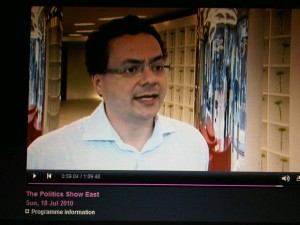
The BBC Politics Show East today profiled Norman Lamb and his new role at the heart of government. As Norman says, “This is all extraordinary. We’re conditioned to being on the outside, looking in.”
It gives an insight into how the party is adapting to government, what Norman thinks the big challenges are in his role as Chief Parliamentary and Political Advisor to Nick Clegg and, er…, has a short clip of me talking.
That seems to be the implication of Labour’s education secretary’s interview in the New Statesman, where he says:
For Balls, defeating the Tories is the top priority. Given this, what is his advice to Lib Dem supporters in the 100 or so Tory-Labour marginals? “I urge Lib Dem voters to bite their lip and back us.” But what about Labour supporters in Tory-Lib Dem marginals? “I always want the Labour candidate to win, but I recognise there’s an issue in places like North Norfolk, where my family live, where Norman Lamb is fighting the Tories, who are in second
A few days ago Liberal Democrat spokesman Norman Lamb (aka the man who beat Iain Dale by 10,606 votes in 2005) kindly gave up some time to be interviewed about the party’s plans for the NHS.
Having previously pointed out that the party’s “four steps to a fairer Britain” doesn’t include how we will improve public services, I started by asking him how the Liberal Democrats would improve the NHS.
He explained that whilst the four steps are a plan to transform Britain, for the NHS the priority over the next few years would be “making sure it doesn’t get destroyed” …
Jeff David 9th Oct '26 - 10:13am:
Some very useful food for thought for the party.
Here's the next course...
Well good folks of Br...
Nick Baird The problem in 2019 was "Vote Lib Dem, Get Jeremy Corbyn", as was being illegally fly-posted around Cheltenham on polling day.......
David Wright The problem in 2019 wasn't that we were going to "rejoin the EU if we won", but that we were going to do so without another referendum first, something we'd bee...
Sarah I am glad to hear that Charlie and others are pushing Ed for change. He’s ignored the stagnant polls and the frustration among MPs for far too long. He’s be...
David Raw @ Paul Barker, "The start of the process that got The Greens into their current mess was in the 1990s with The “Gap on The Left” strategy".
What got the ...


 The success of this group is all the more important this time round as without a clear direction, the party’s policymaking processes are likely to get over-shadowed by the day-to-day decision making impetus from government – where the policy teams are coalition rather than Liberal Democrat teams.
 Follow @libdemvoice.org on Bluesky
 Like us on Facebook
 Subscribe to our feed
 Sign-up for our daily email digest

 Why I'm fighting these plans
 Latest voting intention and leadership ratings opinion polls
 Reform councillor breaches rules by being leader of his own political party
 Liverpool near bottom of the league for recycling
 Vote Tory, get Reform?
 Jeff
Jeff  Nick Baird
  David Wright
  Sarah
Sarah  David Raw