As the economy slowly rebuilds, Vince Cable’s Industrial Strategy will play a key role in whether we will manufacture more in Britain. The challenge is to replace imports, export more and to be at the cutting edge of new technologies.
The case for government nurturing and supporting long term manufacturing growth in the UK is a compelling one. The challenge is to make this intervention work. This article is the first of four articles – brought together by the Lib Dem Campaign for Manufacturing – from around the country and from different industrial perspectives to inform this debate.
Government should have a different agenda from business. This needs to be said, because too often business’s agenda is self-serving. Shareholders want more profit and lower corporation tax, big business interests want favourable government legislation and employers want to lower the cost of employment. But nearly all these issues are valid for large numbers of businesses whether successful or struggling, whether exporting or not, whether investing or not.
Liberal Reform has responded to the BIS Consultation on ‘Employee owner’ status. Like most Lib Dems we do not see that there is any need for this and it is noticeable that no evidence has been presented that this reduction in employee rights would make any difference to growth. We are also concerned that an association in people’s mind between owning shares and losing rights will put people off owning shares in their employers, through well established plans like Save As You Earn .
We believe that there are two additional questions which need to be asked:
At the moment we are being outmanoeuvred by the Tories on the PR front, as the Osborne distortion of employee ownership illustrates, and we are not differentiating ourselves in an increasingly right wing government. We need to issue two challenges, right now, in addition to the clamour around the Employee Share Ownership issue – especially with the TUC demonstration looming on Saturday, which I shall be attending (hopefully I will see other yellow rosettes there).
They are related. The first is the austerity measures translated into
The awarding of the Nobel Peace Prize to the EU on Friday was met with predictable derision from the likes of Nigel Farage, who described it the decision as “baffling,” and leader of the Tory MEPs Martin Callanan, who said it was “a little late for an April Fools’ Joke.”
Admittedly, the current social unrest across Southern Europe made the award seem a little incongruous, especially coming just days after Angela Merkel’s visit to Greece was met with violent protests in Athens.
We, the undersigned, are extremely concerned by the employee share ownership policy. We call for this bill to be amended to remove the part where workers have to give up their rights for share-ownership and, rather, for the proposal to mirror that agreed by the Liberal Democrat conference in this document.
The proposal appears to allow for workers to give up their rights in return for company shares, as detailed on the HM Treasury website:
Under the new type of contract, employees will be given between £2,000 and £50,000 of shares that are exempt from capital gains tax. In exchange, they
The atmosphere in Brighton was stormy. Not, as journalists would have you believe, inside the hall but on the Brighton seafront.
It had started well. On Saturday, with temperatures soaring into the 20s, delegates debated early years, schools and House of Lords reform – all solid Lib Dem territory. Excellent speeches from a succession of mothers and grandmothers highlighted how childcare costs skew the economics of working, and delegates overwhelmingly backed investment in free early years education when finances allow. Debating Lords reform, Conference endorsed Nick Clegg’s withdrawal of support for constituency boundary changes, and Lord Tyler put forward a popular …
You’ve got to give him credit. Nick Clegg stands strong as the party leader in the face of some truly dreadful polling. He has shrugged off a leadership challenge, and remains upbeat in spite of relentless media criticism.
This resilience must, in part, come from a belief that taking the Lib Dems to the centre ground was right for the party. Going into coalition with the Tories, the leadership knew votes would be haemorrhaged to Labour. But it was the correct decision, and one that was backed by all quarters.
They also have been text messages sent to the wrong person if Ed Miliband’s serious about preparing the ground for future Labour-Liberal Democrat cooperation.
It’s Liberal Democrat conference, so it’s time for the latest Iain Dale / Daily Telegraph list of the 50 most influential Liberal Democrats. Of course our interest in covering the story on Lib Dem Voice is in no way related to two of the team appearing in the list…
In less than shocking news, Nick Clegg still tops the list at #1. Up to #2 is Vince Cable, followed by Tim Farron, Danny Alexander and then Nick Clegg’s Chief of Staff (and former double winning general election agent) Jonathan Oates.
Going further down the rankings finds the double blogger appearances:
One of our central aims as Liberal Democrats is to show that coalitions work. And Nick Clegg’s major contribution as leader has been to do just that.
I believe we need an industrial strategy – a positive and ambitious vision, built around long-term investment in innovation, skills and science.
We must now implement the ‘pioneering’ coalition policy of splitting the investment bank casinos from mainstream personal and business banking, as in the Vickers report. Without Liberal Democrats in government you can be
Earlier in the day, Clegg was repeating his calls for a mansion tax in some form:
Our focus does remain on very high value property for the simple reason that I think most people in this country just don’t understand why people who have very high value properties just don’t pay their fair share, in the way that everybody does.
Danny Alexander has been calling for speedier action to implement social care reforms:
Danny Alexander will warn his Conservative colleagues on Monday not to delay plans to reform social care for the elderly and state pensions, amid Treasury fears that the changes would cost too much.
The Treasury chief secretary plans to use a question-and-answer session at the Liberal Democrat conference in Brighton to insist that the government goes ahead with both the Dilnot reforms and a single-tier state pension, according to officials.
Meanwhile, Vince Cable is winning out in the arguments with the Treasury over creating a new business bank:
Vince Cable reveals £1bn backing for business bank to help small firms…
In what Liberal Democrats are hailing as one of the major announcements of their conference, the business secretary will say that the new bank could leverage up to £10bn to help businesses struggling to find funds from high-street banks…
The Lib Dems say they have had to fight hard to persuade the chancellor to sign up to the bank, which will be funded from “underspends” by Whitehall departments. These are the funds that remain unspent by departments, which are then clawed back by the Treasury.
And here is Ed Davey and colleagues explaining the Green Deal:
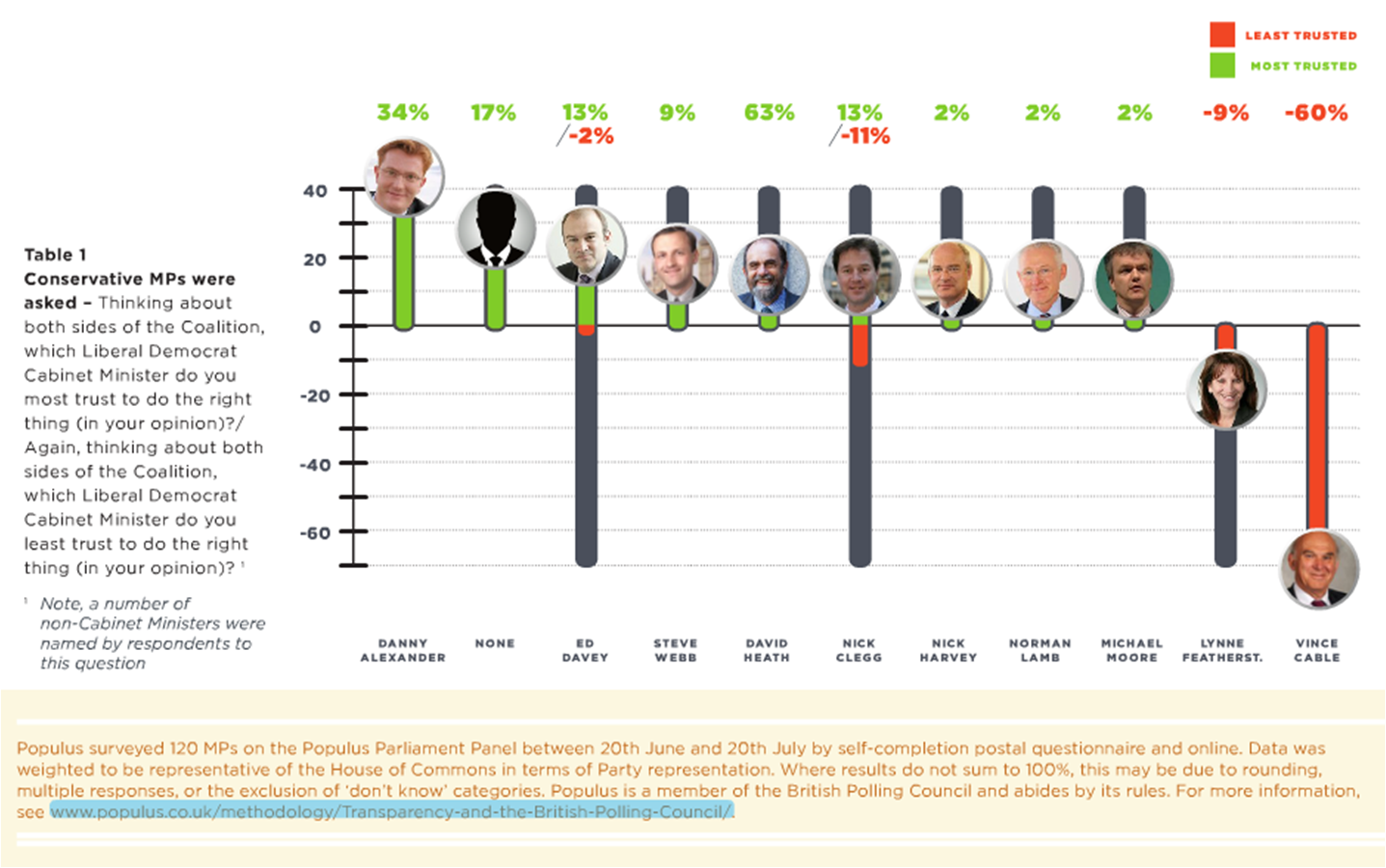
Having political opponents think you are honest, decent or hard-working are all accolades to be welcomed. But trusted to do the right thing? As one party’s right thing is another party’s wrong thing, hearing that the MPs of another party doubt you’ll do the right thing is rather an accolade in itself.
Speaking on the Andrew Marr Show this morning, the Liberal Democrat leader ruled out the possibility of the Government filling the gap in public finances through cuts to the welfare budget – something reportedly being mooted on the Conservative benches.
He said the Government would “start at the top and work down”, and was optimistic about his chances of persuading his Conservative colleagues to agree to a so-called ‘wealth tax’.
Cable said that introducing regional pay was “completely unacceptable” and “terrible economics”. He said that although the Lib Dems were prepared to contemplate a measure of public sector pay
By Stephen Tall
| Sat 22nd September 2012 - 9:30 am
You’ve gotta love ConservativeHome. No, really. This morning Tim Montgomerie reports a deliciously mischief-making poll from YouGov, commissioned by the Lord Ashcroft-backed site, comparing the standing of Nick Clegg, Vince Cable and the Liberal Democrats in general.
It won’t surprise anyone to learn that Vince Cable performs better than Nick Clegg in all the measures of leadership qualities asked about. (You can see the results in the graph at the foot of this piece.) This leads Tim to conclude: ‘If the Liberal Democrats are looking for a leader who can increase their electoral competitiveness these are powerful numbers.’
Nick Clegg will veto George Osborne’s demands for a two-year freeze in most state benefits from next April and a further £10bn of welfare cuts…
The Deputy Prime Minister revealed he will block the Treasury’s demand for more cuts before the 2015 election to compensate for lower-than-expected growth. “Not a penny more, not a penny less,” he declared.
The message is reinforced Danny Alexander in The Guardian:
Monday is jobs, with policy motions on creating jobs and policy papers on both sustainable prosperity and also on mutuals, employee ownership and workplace democracy. The first of these (F23) may generate some lively debate around an amendment that would delete the reference to keeping to the government’s “fiscal mandate”.
Back for its fourth year (see 2009, 2010 and 2011) is my conference fringe meeting league table, showing how many fringes each MP will be speaking at. As ever, this is based on the information from the official fringe listings in the printed conference directory. With the reshuffle, I expect a fair number of fringe organisers are reshuffling their panels too; the table is still however a good indicator of the combination of demand for certain MPs and their enthusiasm for working the fringe.
Trends to note include that Cable topped the table the first two times, then slipped to third …
I love reshuffle days, they’re just like transfer deadline day. You sit there at your office computer pretending to work while secretly updating the Guardian live blog to see who your side has brought in and let go.
So, have we strengthened the side for the second half of the season or left gaping holes in our defence?
Well, we have managed to hold on to all our big players – Cable, Alexander, Davey and Moore – and, despite losing his place to Alexander after his suspension early in the season, we now have a fighting fit Laws back and ready …
By Stephen Tall
| Mon 3rd September 2012 - 10:02 pm
It’s not often that polling companies ask how alternative Lib Dem leaders would impact the party’s popularity — in fact, I’m struggling to recall a single example — but ComRes has asked what difference Vince Cable leading the party would have on its fortunes. Here’s the result:
By Stephen Tall
| Sun 2nd September 2012 - 2:15 pm
Today’s papers are full of speculation about Nick Clegg’s leadership prompted by a handful of party members — inevitably labelled ‘senior’ — calling on Nick to go, such as Lib Dem peer Lord Smith of Clifton, with Torbay MP Adrian Sanders urging Nick to get better advice to avoid “bumbling along”. Here are the three thoughts on the issue which strike me (before I head off to the Olympic stadium for tonight’s Paralympic athletics action)…
1) I’m more surprised by how few people are calling for Nick Clegg to go
It’s not especially surprising there’s some discontent among members. The party is …
Strangely, that Liberal Democrat Voice poll which showed that members were split 47%-46% on whether Nick Clegg should still be Liberal Democrat leader at the next election has attracted a bit of coverage in the press.
Clegg is vulnerable because he is seen as one of the few people at the top of the party who is ideologically sympathetic to the Conservatives.
Well, that’s maybe because Polly Toynbee and the Guardian are always trying to paint him that way. David Cameron, on the other hand, who is probably in a better position to judge, is
Lib Dem Voice polled our members-only forum recently to discover what Lib Dem members think of various political issues, the Coalition, and the performance of key party figures. Some 500 party members have responded, and we’re publishing the full results.
47% say Nick should stay to fight 2015 election; 46% say he shouldn’t
LDV asked: Thinking about Nick Clegg’s position as Deputy Prime Minister and leader of the Lib Dems, which of these scenarios do you want to see happen?
47% – I want Nick Clegg to continue both as Deputy
Lib Dem MP John Pugh has written a thoughtful, balanced piece on economic policy for the New Statesman website. He freely admits he has voted for every part of George Osborne’s economic strategy brought before the Commons (“I did not know if it would achieve all its major objectives but I certainly did not know it would not”) but says the facts are plain: it’s not working. Here’s an excerpt:
Yes, jobs are being created in the private sector, unemployment is not moving upwards, the deficit is down, our export markets are engaging with the emerging economies, inflation is low and
The Coalition needs to get over its obsession with small businesses – and deregulate Sunday trading
With the recent fragility of the Coalition, it’s easy to forget that the Lib Dems do agree with the Tories on some issues. If we didn’t, it would have been impossible to forge a workable government in the first place. Mounting instability over constitutional reform makes it all the more important that the two parties can work together where their philosophies do align. One of those areas is economic and regulatory policy. Despite some notable blind spots, the Conservatives do share our belief in the strength of the free market to provide long-run economic growth. While many regulations are necessary and right, the Coalition should be able to work together in order to eliminate arbitrary and damaging rules that distort rather than level the economic playing field.
One of the best speeches given by a Liberal Democrat Cabinet Member in the last year was Danny Alexander’s to the GMB conference. It was not only a good speech, it went down well with a tough audience that disagrees strongly with many things the government is doing.
The future of the Royal Bank of Scotland is back in the headlines today.
The Financial Times reports that ministers are discussing buying the remaining shares in RBS, bringing it fully under state control. This would allow them to force it to lend more to viable small and medium-sized businesses without having to worry about other shareholders challenging such a direction in the courts.
The Guardian reports that Liberal Democrat Vince Cable is the driving force behind this plan. He believes that it’s the only way to get money to businesses.
What we do know, and Vince Cable confirmed when taking …
Stephen Tall, co-editor of Lib Dem Voice, has been blogging away at Huffington Post.
Lots of politicians have 20:20 hindsight. Foresight, however, is generally in shorter supply, which explains why Vince Cable is being acclaimed once again, tipped at the age of 69 both as a potential successor to either the 40-something George Osborne as Chancellor and/or the 40-something Nick Clegg as Lib Dem leader. The ‘Septuagenarian Sage of Twickenham’ is enjoying a Second Coming-of-age. Age does not weary him, nor the years condemn. What’s his secret?
Edinburgh was spoiled last weekend. Not only was there a Madonna concert and a performance of the Hitch Hikers’ Guide to the Galaxy radio show (which I went to), but Business Secretary Vince Cable answered questions from Liberal Democrat members on Sunday evening.
Readers will be glad to see former Edinburgh West MP John Barrett, sufficiently recovered from illness and on his usual sparkling form, chairing the session.
Vince answered questions for well over an hour on subjects ranging from renewable energy to high executive pay to winning back …
Drew Durning Conference stopped being supreme the day Ed Davey became leader. Conference had voted (albeit with provisos on timing) to rejoin the EU. Just about Ed's first p...
Jason Connor Please clarify specifically how they miss the mark?
Christine is a very popular and highly capable Lib Dem MP, if not one of the most popular. If she is ous...
David Blake If Alex Cole-Hamilton has anything to do with this he should resign....
Steve Trevethan Thank you for an interesting and relevant article.
Might the rise of extreme right, populist parties be a/an (unsurprising) consequence of Neoliberalism, aka...
Alison Smith Christine Jardine is a highly respected MP of national stature so this concerns Lib Dems far outside the boundaries of Edinburgh West. Furthermore, if other Sco...




 Follow @libdemvoice.org on Bluesky
 Like us on Facebook
 Subscribe to our feed
 Sign-up for our daily email digest

 Does money buy votes?
 The Joy of Six 1583
 Inside the refurbished library
 Is the Labour government split on immigration?
 Drew Durning
  Jason Connor
  David Blake
  Steve Trevethan
  Alison Smith