Here is Vince’s speech in full.
It’s good to be back in Southport.
I was last here in October.
It was pouring with rain.
The local party was licking its wounds after a difficult General Election…
…and there was a challenging council by-election to fight.
But a week later our candidate, and former MP, John Pugh, was swept on to Sefton Council with a big majority, and more than half of the votes cast.
Congratulations John!
Shortly after my trip here, I went to the North East.
I took in Newcastle, of course.
It’s a former council stronghold with a big Lib Dem tradition under John Shipley and others.
From there, my office had agreed I would go on to visit Sunderland.
Sunderland is a Labour one party state. Brexit Central.
On arrival, my car was surrounded by a group of young people…
…there were face tattoos and nose rings in abundance.
Some might have found it intimidating.
I emerged from the car clutching my mobile phone nervously.
I was greeted by Councillor Niall Hodson who told me this was the local Lib Dems!
They had captured two Labour strongholds, in as many years.
A few weeks ago, they did the same a third time.
They knocked on 2000 doors in a month, and were rewarded with a massive 46% swing from Labour.
Congratulations Sunderland Liberal Democrats!
These local successes are reflected across the country.
Teignbridge and Tyneside. Norfolk and Cornwall. Somerset and Sussex.
In Leave areas. In Remain areas.
Against the Tories. Against Labour.
They show us that there are opportunities to regain and rebuild our local government base which has always been the lifeblood of our party.
And we fight our campaigns at a time when normal politics has disappeared.
We have a Brexit obsessed Conservative Government: a single issue government in a single issue Parliament.
Brexit is sucking the life out of Westminster and Whitehall alike.
Urgent attention needs to be given to the NHS and social care, the housing crisis and homelessness, schools and policing, national defence and much else.
But the political appetite to grapple with these issues isn’t there.
The greedy Brexit machine devours all the political energy required to get the country moving forward.
People were told that Brexit would be simple, cheap and good natured.
Like real world divorce, it is proving complicated, expensive and bad tempered.
There is a temptation to blame everything on Theresa May. I don’t.
I have always rather admired her dogged determination.
But that determination means that she thinks…
‘When in a hole, keep digging…. you might eventually get to Australia… and when you get there there’ll be a shiny new trade deal and a cold beer waiting’.
She is one of a number of otherwise sensible people persisting in a course of action that they know to be foolish, damaging and wrong, saying ‘just let’s get on with it’.
I have myself been on a journey.
I confess that my own initial reaction to the referendum was to think there was little choice but to pursue Brexit: I thought ‘the public have voted to be poorer. That is their right.’
What changed my mind was the evidence that Brexit had overwhelmingly been the choice of the older generation.
75% of under 25s voted to Remain.
But 70% of over 65s voted for Brexit.
Too many were driven by a nostalgia for a world where passports were blue, faces were white, and the map was coloured imperial pink.
Their votes on one wet day in June, crushing the hopes and aspiration of the young for years to come.
The excuse for this outrage – a vision of a Global Britain signing lots of new trade deals– is a fraud.
Far from opening our arms to the world, we will be tearing up preferential trade deals we already have with 27 countries in the EU and 74 outside it.
There is no more eloquent testimony to the government’s folly about trade, that at a time when the world is descending into Trade War, they put more faith in the Warmonger in Washington than they do in our friends and trade partners in Europe.
It was never a good idea to leave the EU. To leave it now borders on extreme recklessness.
And only our Liberal Democrat team, led by Tom Brake, are making that argument in Parliament.
Old wounds that were slowly healing within the European family are being re-opened.
Ireland. Gibraltar.
I went to Dublin before Christmas to meet business and political leaders.
They are afraid, very afraid, that the Good Friday Agreement and the close economic links with Britain will be trashed to accommodate Brexit hard liners.
The Gibraltarian Government is afraid that their people – our people, British citizens – will be sacrificial pawns in this needless rush for the EU exit door.
And while all these crucial questions are up in the air, we still don’t know which faction of the Conservative Party will win.
There are two totally different views of Brexit on offer. One is to stay as close as possible to the rules of the Single Market and Customs Union to minimise the damage. To be like Norway with a customs union attached. So called ‘soft Brexit’.
This is plainly more sensible economically than the alternative, but it raises the obvious question: why on earth bother to leave?
The other is to diverge as much as possible, causing maximum disruption to manufacturing industry, financial services and creative industries, all in the name of ‘sovereignty’.
What we are left with is incoherence. The doctrine of diverging convergence or converging divergence.
The one certain consequence is that with a divided, confused team of 1 facing a united, determined team of 27, the European negotiators will dictate the terms.
This will, in turn, create the sense of victimhood Brexiteers crave: being under the European yoke.
I would go so far as to say Britain is now mired in a protracted, non-violent civil war.
Allied to the poisonous rhetoric about ‘traitors’ and ‘saboteurs’, and what Theresa May calls ‘citizens of nowhere’…
….we have a toxic brew which fuels the populist right.
What a disgrace that the fools’ errand of Brexit…embarked on to paper over cracks in the Conservative Party has resulted in hate crime on our streets.
Our message is clear: Liberal Democrats will rebuild an open, tolerant, outward-looking Britain.
We want our country back.
And amid all this where is the Leader of Her Majesty’s Official and Loyal Opposition?
What does HE want?
These early days of 2018 have seen Labour has make a few tentative gestures in the direction of sanity. But very few. And very tentative.
To be a member of a customs union. Not the customs union.
And still strongly committed to working with Theresa May to make Brexit happen.
Make no mistake about it, Conference:
Jeremy Corbyn is letting down the very people he claims to defend…because:
You cannot speak up for the poor and be complicit in making the country poorer.
You cannot claim to love the NHS knowing that Brexit will starve it of cash.
You cannot be an advocate of strong rights at work, and stand by while your country walks away from the organisation which has most stood up for workers.
The Labour Party has imported into politics the principles of quantum physics where an object can be there and not there, at the same time.
They believe you can be for Brexit it and against it.
But politics is not physics.
Jeremy –
The time has come to decide.
There is no ‘jobs first’ Brexit.
But there is a new way to inspire those young supporters you won last year, and to make a real difference.
Join our campaign.
Together we can win an Exit from Brexit.
One likely consequence of the coming Brexit confrontation is some kind of political realignment.
We must be open to working with people in other parties, and with other parties.
In my own borough I have encouraged an electoral understanding with the Greens for national and local elections.
This approach may not be feasible everywhere in the UK. But it signals the value of an inclusive and collaborative approach to politics.
I am determined that we Liberal Democrats should lead a new groundswell for political renewal.
Our sister Liberal Party in Canada, under Justin Trudeau, leapt from third to first in a ‘first past the post’ system every bit as unforgiving as ours.
I have turned to them for advice on modernisation on how we can apply their successful model here.
The Canadian liberals engaged all their registered supporters – their voters – as well as their members in leadership elections and candidate selection.
They became a new party; a movement.
Building on our own traditions, we must address how we in the Liberal Democrats can become a movement for those who are alienated by the Conservatives and Labour.
I want to see a movement fizzing with ideas…
…and the vehicle for a practical programme for government …
…driven by the need to drive down inequality between the generations,
…facing up to the challenge of climate change by investing in renewable energy and green transport
…and preparing our country for a future when technology be harnessed to the optimism of opportunity rather than the pessimism of job destruction.
So as a party I want us to think big.
To be as radical and forward-looking with our ambitions for the party as we are with our ideas and our policies.
Central to that must be an effort to reflect better the society we want to serve.
We celebrated the centenary of women’s suffrage this year, and International Women’s Day last week, with a better proportion of female MPs in our House of Commons group than we have ever had before.
We are, still, very male but…
… thanks to the work of Jo Swinson and Sal Brinton, along with our other women parliamentarians, councillors, and others…much less so than we were.
But to be frank, we have an even bigger challenge to address.
Looking around the auditorium, we are very, very white.
We must prioritise making our party more ethnically diverse.
John Alderdice has shown us the way in his recent report.
I raised a mixed family in Britain.
I have seen prejudice first-hand.
Where it is outright or outspoken, it is easy to call out. And I know everyone in this room would do so right away.
It is subtle, unseen prejudice which is harder to counter.
It exists in every organisation, but I want us as Liberal Democrat to commit at this conference to rooting it out.
Theresa May once said of the Conservatives that they were a ‘nasty party’.
We are not a nasty party.
But sometimes we have been a complacent party.
Under my leadership, that complacency ends.
Progress in building a big, modern, diverse party requires help from every one of you…
….so I ask each of you to leave Southport today thinking about what you can do to make our party a welcoming home to people of every age, ethnicity, gender identity and sexuality.
And in making that effort, I want to arm you with our vision of a new, Liberal Democrat Britain.
We must answer the question: if not Brexit, then what?
We have to start with an economic model which works, delivering good jobs, freedom from want and economic security for everyone.
For many British people the collapse of the banking system a decade ago
…and the austerity and inequality which followed in its wake destroyed their faith in the system of free-wheeling finance and light-touch government.
To build a fair society, we need an economy which harnesses the energy and innovation of the private sector but where government is not afraid to intervene to deal market failure, or the arrogance of monopoly.
A Liberal Democrat economy would be one which welcomes entrepreneurs…
…which rewards profitable, risk-taking companies…
…which embraces new technology….
…and which sees active government.
We would tax pollution and unearned wealth, while promoting work, innovation and environmental protection.
And on tax we are the party, unlike Labour, which will be honest with the public that spending on our priorities – the NHS, schools, policing – has to be paid for:
A penny in the pound on income tax for the NHS; reversing the tax cuts for the rich of the last two years.
And government borrowing would be for investment not for day-to-day spending.
We would build a Britain where finance serves the real economy not the other way round.
And we do need competition authorities to be strong and tough enough to withstand bullying and tax dodging by giant global monopolies like Amazon and Google….and if necessary, to break up concentrations of economic power.
At present the European Commission does just that.
In contrast to the feeble British competition authorities, Europe helps us ‘take back control’ for citizens in the modern, digital world.
There is a huge risk that Brexit Britain will lose that control, surrendering real sovereignty for fake sovereignty.
The technological revolution also poses a different kind of challenge.
We do not yet fully understand the impact on jobs of Artificial Intelligence and the spread of automation from manufacturing to professional and other services.
I believe we should welcome the advent of new technologies and the opportunities they bring.
But we must anticipate that those without adaptable skills could be badly hurt.
The answer – the only answer – is massive investment in education, skill training and retraining: schools, FE colleges, universities, lifelong learning, remote and college based.
The Tories will not do it because they do not believe in public investment.
Labour will not do it because they are still fighting the old political battles and their main education policy is to provide a large subsidy to highly paid university graduates.
We must not forget that 60% of young people do not go to University, and 80% of the British population never went.
These are – mostly – the people least prepared for the disruption of technological change…
…and who have been left behind by Britain’s scandalous neglect of vocational education and skill training.
I know about the value of life long learning from my own experience, growing up in York, as my parents strived to climb the economic and social ladder through further and adult education.
And I was one of the first generation of Open University tutors.
Then, in my two years of exile from Parliament, I worked with the President of the National Union of Students on a project all about giving students in FE parity with universities.
To build on that work, I want to develop further the idea of individual learning accounts – a cash fund to spend on training and career changes through your life.
I have asked Rajay Naik, an education entrepreneur with long experience at the Open University, to lead a Commission on Life Long Learning.
Because these coming years will be more than important than ever for giving adult education the priority it deserves.
We need to educate people for the jobs of tomorrow.
Jobs which will build a confident Britain, complete with new infrastructure including…
…a 5G superhighway;
…and fast rail links across the north of England, Wales and the South West.
…new tidal lagoons for low carbon energy;
…big advances in carbon capture and storage;
…and all the opportunities offered by offshore wind, which Ed Davey promoted in Government, and which today is reaping great rewards for our country.
This forward looking vision of Britain stands in stark contrast to what both big parties offers.
We are used to thinking of Labour and the Conservatives as polar opposite. They are actually very similar.
What they share is nostalgia.
In the case of the Tories, the seriousness with which a Rees-Mogg premiership is now being taken says it all.
A man steeped in the values of Downton Abbey… a world where the working class consist of servants and nannies;
…where women have babies but no vote;
…and charities suffice to meet the needs of the deserving poor.
Corbyn’s nostalgia is a different one.
But it is just as backward looking.
A world where the Health Minister decides how much cod liver oil each five year old should enjoy or endure each day.
Where the Minister for Prices sets the price of a loaf of bread.
And the Royal Mail was the envy of the world, before those modern contraptions – internet and email – destroyed its business model.
If Britain still had a stagecoach industry, John McDonnell would be demanding that it be saved by taking it into public ownership.
Neither of these rose-tinted visions of the future make any kind of sense.
The Liberal Democrat vision of Britain is built on a commitment to properly funded public services, consumer and citizen choice, and honesty about taxation.
For example, as we ask people to contribute a little more to the health service, with a penny in the pound on income tax, we promise a better, more flexible service in return.
The principles of the NHS are as strong today as they were when the service was inspired by a great liberal, William Beveridge.
But if Beveridge were alive today, he would see a service whose ambition of universal free health care, free at the point of use, is in danger of foundering as costs inexorably rise.
So just as we’d protect that service for the long term with a dedicated NHS and social care tax.
Liberal Democrats will also work with nurses and doctors to develop ideas that could save billions and improve the patient experience too.
Let me give you some examples.
Isn’t it time that when you need to be referred to a consultant, their calendar is shared electronically with the GP, so you can arrange a convenient slot right-away without a lengthy exchange of letters?
And social prescribing – which I saw in action campaigning with Lisa Smart in Stockport – can divert people from medication to exercise and other healthy activity, as part of a ‘prevention’ approach to healthcare.
And we need to revisit the principles around sharing patient information, as in the blockchain experiments in Leeds, where new technology provides enhanced security for data sharing.
Crucially, we need to build on the work Norman Lamb did in government giving priority and enforcing firm targets for mental health treatment.
Liberal Democrats insisted on targets in coalition, but now those targets are being missed.
The human effect is shocking.
It is simply not good enough that children suffering severe psychosis – sometimes suicidal thoughts – is left languishing on a waiting list.
There is a growing crisis in child mental health with as many as 20% of teenagers in my local schools needing help.
In a Liberal Democrat NHS mental and physical health will be put on an equal footing so that every taxpayer – every citizen – gets the care they need.
When I won back my seat last June, the number one issue on the doorsteps wasn’t Brexit, as it happens, but school funding – or the lack of it.
We would reverse Conservative cuts to schools.
Under the excellent stewardship of Layla Moran, Lib Dems would democratise education once again, by returning control to local authorities over places planning, exclusions and special needs.
Locally, many of us see the chaotic and wasteful consequences of having free schools and academies engaged in dog-eat-dog competition.
And we see wasted time too, as teachers are forced to keep a look out for the traffic wardens of the education system – Ofsted – waiting around the corner ready to slap a ticket on those who haven’t ticked the right boxes.
Liberal Democrats will bring in a new independent inspection regime, which values the overall wellbeing of individual children and the culture of learning in the school.
We want a wider curriculum reversing the current exclusion of performing arts and languages, and introducing life skills like first aid and personal finance.
A Liberal Democrat education system will prepare our children for the future, and consign tickbox testing to the past.
By making ourselves, once again, the party of education we commit to redressing the imbalance between generations…
Nowhere is the sharp generational divide in Britain greater – and more bitterly felt – than in the housing market .
My generation, or at least those of us who own property, have been enriched by house price inflation.
It is that same house price inflation which has priced the majority of younger people out of owner occupation and created Generation Rent.
For the last two decades, under successive governments, housing supply has been allowed to fall well behind demand…
This scarcity of supply, together with lax credit for the already well-off, and subsidies like Help to Buy, has caused prices to spiral to dangerous and socially divisive levels.
Like Brexit, this shortage is not inevitable.
House building isn’t rocket science. Even the Babylonians knew how to do it.
I am confident that Britain under the Liberal Democrats would do it.
I recently revisited my old haunts in Glasgow, where I served as a city councillor in the early 1970s in one of the most deprived wards in the City.
We built houses, houses, and more houses.
Quantity sometimes triumphed over quality and amenity.
But the lesson was clear: that a determined, ambitious, public authority, using compulsory purchase powers or publicly owned land can get houses built at scale.
The Government needs to do that now.
I know the Conservative Party finds it difficult.
But if Donald Trump can meet Kim Jong Un, surely the Tories can deal with the psychological shock of having councils build…. council housing!
Private housing, social housing, self-build and shared ownership are all part of the mix Britain needs.
And as we build that stock Liberal Democrats would say ‘goodbye’ to ‘Right to Buy’.
I have spent some time in recent months, engaging with charities who work with rough sleepers.
Those at the bottom of the pile – the homeless street sleepers, hostel dwellers, and sofa hoppers; the young families being pushed from one short let to another – are not just homeless.
They are largely voiceless.
Many do not vote.
They are at the sharp end of disengagement with our failing democracy.
A broken democracy which gives too much power to the privileged and too little voice to the people.
…an unelected second chamber;
…a funding regime desperately in need of cleaning up;
…a system of local government often run as one party statelets.
…an unfair voting system, where so many votes don’t even count.
And now the next big extension of the franchise, to 16 and 17 year olds, is being resisted by Conservatives whose power base is in old folks’ homes.
So how do we secure a new forward-looking country for the next generation.?
Our recent election successes show us something.
Not that winning is easy, but that winning is possible.
I know many of the longer-standing members in this room got pretty fed up with hearing a particular slogan during the Coalition years.
‘Where we work we win’, was a mantra. But in truth for many years too many Liberal Democrats did work – very hard – and still didn’t win.
I know, I was one of them! I know the pain of losing. And I know the satisfaction of fighting and winning again.
It can now be done.
Those local successes in Sunderland and elsewhere were not coincidences, and though our party is building its social media capacity, it wasn’t about new technology either.
It was about talking to people, on their doorsteps – just as it always has been.
Friends, we have celebrating our thirtieth birthday.
And we do so at a time when the old forces in British politics are so distracted by settling scores on Europe and on socialism, that they have forgotten about the country.
We have a big task ahead of us.
I want us to be able to look back in another thirty years (or, I want you to be able to, anyway) and see 2018 as a turning point.
The year, when from a low base of support and against the political odds, we showed Britain a new and different path…
…the promise of a new government acting and speaking for the vast majority of decent, tolerant, hardworking people, whom the other parties had forgotten…
…A beacon of real hope, in a political sea of fantasists and dogmatists.
The Liberal Democrats:
A modern, diverse party – winning again …
Winning an Exit from Brexit.
Protecting our public services.
And giving young people the start, the voice and the hope they deserve.
There’s no time to lose.
Let’s get out there together and win.


 The first events of the Southport Conference last Friday afternoon were three policy consultation sessions. These sessions are the intermediate stage of the policy development process. The first is the establishment of a policy working group which looks at the key issues and takes evidence and then produces a consultation paper to be discussed at Conference and which is also accessible online for members to comment on.


 Vince Cable was on robust form this morning, being interviewed by John Humphrys on
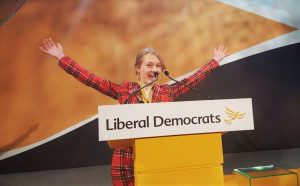 Given that there has been some comment about this policy proposal in the media and in some Liberal Democrat circles, it seemed like a good idea to publish Jess’s speech to Party Conference this weekend by way of answering some of the sceptics…




 It is rare that governments get to do exactly what they want. Opposition parties, the judiciary and others have traditionally also wielded significant influence, tempering the more extreme ideas of those in power and highlighting the pitfalls of proposed policies.
 Follow @libdemvoice.org on Bluesky
 Like us on Facebook
 Subscribe to our feed
 Sign-up for our daily email digest

 Conservative councillor Paul Dick joins the Lib Dems
 Ianto's shrine to be saved
 Walkabout
 Talbot Street and Church Street, Ellesmere
 PM
PM expats
 Slamdac
 Peter Davies
 Jana
Jana