Southern Rail Debacle. Time for the Tory MPs in the South East to step up!

Rail users have had to put up with an appalling service from Southern Rail over the last few months. Even before the strikes the company’s service was one of the worse amongst all the train companies across the UK but now the situation has become totally unacceptable.

Businesses in the South and South East of England are being adversely affected, important hospital appointments missed, everyday family routines of commuters are being wrecked, people are losing their jobs because they cannot guarantee their employer what time they will get into work or, on strike days, even that they will get into work.

All this because of the deplorable non-service provided by Southern Rail. This cannot go any longer.

It is time for the Secretary of State at the Department of Transport (Dft), Chris Grayling MP, to act now before it is too late and serious long term damage is done to tens of thousands of lives and businesses as a result of the shocking rail service southern commuters have had to endure for far too long.

Posted in Op-eds | Tagged and | 18 Comments
Advert

The triumph of mendacity, and what we can do about it

Brexit. Syria. Trump. 2016 in three words. It is human nature to see commonalities where there are none, but there are surely some here.

First, of course, there is the not-so-invisible hand of a resurgent Russia to be seen in each. Time magazine’s choice of Donald Trump as its Person of the Year was a mistake: it is not Trump but the subject of his admiration, Vladimir Putin, who has shaped world events this year more than any other individual.

Second (and not entirely unrelated to the first) is the triumph of mendacity. Key to each of the year’s key events was dishonesty. The referendum campaign felt at points like a contest to see which side could bend the truth furthest but it will, in the final analysis, be the Leave campaign that will be viewed as one of the most dishonest political campaigns in this country’s democratic history. Its mendacity was of course easily surpassed by Donald Trump, a man who in the face of inconvenient facts doesn’t just deny their existence but creates his own new reality. It didn’t help that the Democrats nominated a candidate much of whose political career has been defined by sleights of hand and questionable dealings: lying simply became relative.

Posted in Op-eds | Tagged | 19 Comments

Test your knowledge and ingenuity – quick quiz about a national institution

As we’re getting relaxed for the holiday season, here’s a quick quiz about a national institution. It’s not politically related but I suspect it’s on a subject dear to many readers’ hearts.

Look at the wooden box on the right. You can see that it’s nondescript, very battered and held together with insulation tape. It’s 35 years old.

It’s used to create the sounds of what could justifiably be called a “national institution”.

Posted in The Arts | Tagged | 20 Comments

Paddick: EU court ruling on surveillance shows that Government overstepped the mark

When the Data Retention and Investigatory Powers Act was just a Bill being rushed through Parliament with indecent haste, the pros and cons were hotly debated on this site.Today, the European Court of Justice ruled that the general and indiscriminate collection of data was illegal.

Now, this was a Bill passed by the Coalition Government with Liberal Democrat consent So shouldn’t we be feeling a bit embarrassed by this ruling? I guess we need to look at the position we were in at the time. Even if we’d told the Tories that we wouldn’t support the legislation, there would have been a majority in the House of Commons for it. In fact, Labour would have been falling over itself to make it even more authoritarian.

We also know what the Tories wanted to do with communications data – because they did it with the much more pervasive and illiberal Investigatory Powers Act passed, again with Labour support, as soon as they had a majority.

Back in 2014, we secured some important concessions from the Tories in return for our support on the DRIP Act.  Julian Huppert wrote at the time that it was what we already had but with additional safeguards as he set out the context to it all:

There is an issue we have to deal with now. The European Court of Justice threw out the European Data Retention Directive, which underpins all collection of communications data in this country. I sympathise with the reasons, but we must acknowledge that it causes real problems – we do need to have some way to keep some communications data, but under very careful control.

Posted in News and Op-eds | Tagged , , and | 16 Comments

Copeland – a chance to reach out to both sides of the Remain/Leave divide

They’re calling Copeland, soon to have a by-election after its MP decided to go work at Sellafield, a three way marginal between the Tories, Labour and UKIP. Maybe in old money it would have been, but that was before Brexit. Now those three can fight over whose Brexit is bigger and harder, giving us a unique position. The 38% who voted to Remain, and a good chunk of the 62% who voted to leave in June may well be attracted by the thought of a vote on the final deal, a chance to legitimise what is being done in their name by the Government.

I tend to view the 2015 election results as a bit of an aberration. In Copeland we got 3.5%, but for the previous three decades, we’d been trundling along at around the 10% mark. We should certainly aim to improve on that as we did in Sleaford.

Posted in Op-eds | Tagged | 44 Comments
Advert

If – that awkward little notion

If Britain does undergo ‘hard Brexit’, what do we do next? If said ‘hard Brexit’ results in a consistent and high-reaching economic growth, what do we say? “Unlikely”, “highly implausible”, “outright impossible” might be the instinctive or well-thought through response of an expert (of the armchair or academic variety). But humour me. If something happens contrary to our expectations, how do we respond?

It’s a relevant topic, given the year we’ve had. The idea that the referendum would result in Brexit was surprising (though, for me personally, not shocking). The idea that Donald Trump would be elected President of the US really was shocking. In both cases, the presumption of many was that they could not lose; that a variety of factors and self-evident prepositions resulted in an inevitable conclusion. I do not want to raise here why your or my presumptions were right or wrong, but how we should respond when we are mistaken.

It seems to me that the underlying condition that arose in 2016 was how headstrong everyone became. Every political hue became convinced that everything they asserted was undeniable, unless you were a blithering idiot (or deplorable). Facts became relative, and forecasts became cast-iron; unless of course, I disagreed with them. When did we lose the respect for our rivals, saying “this is what I propose, but I accept you have an alternative”?

Posted in Op-eds | Tagged and | 11 Comments

Lessons (and warning) from Trump

The day after the US electoral college chose Donald Trump to be their new president, Huffington Post ran an article on his use of digital campaigning, where Brad Parscale, the digital director of the campaign explains:

We never fought for the popular vote. There was no economic reason, and there was no reason based off the system of our constitution to do so. We needed to win 270 , and to do so we needed to win in certain states, and we needed to target registered voters that had a low propensity to vote and a propensity to vote for Donald Trump if they come.

This was done by highly-targeted and personalised messages to key voters in key states.

Questionable behaviour by the FBI over Hilary Clinton’s emails, and whatever it is the Russians actually did may have contributed, but Parscale’s point is that very effective targeting gets results.

Part of me is wincing. The targeting is entirely legal, but also strains the definition of democracy — not least because Hilary Clinton had 2.8 million more votes than Trump (and roughly the same number of votes as Barack Obama had in 2012): the problem is that she had the votes in the wrong places. Most worryingly, this means that the voters-who-matter end up being a small number in a few places: marginalising the vast majority.

Posted in Op-eds | Tagged , and | 6 Comments

Choosing one’s ideal Focus delivery tool

Last April, while delivering Focus leaflets for a by-election, I had a slight disagreement with a member of the canine community. I came off the worst, resulting in a trip to the local minor injuries department and a spectacular dressing on my finger.

Ever since that incident, I have at last listened to wiser heads who have advised using a Focus delivery tool.

Posted in Party policy and internal matters | Tagged and | 11 Comments

Former Cardiff City Council leader Rodney Berman aims for Council seat in May

Five years ago, the Liberal Democrats ran Cardiff with 35 of the 68 seats on the Council. In May 2012, they lost more than half their seats, mainly due to a backlash against the UK coalition government. Then Council leader Rodney Berman lost his seat.

There are signs of a reversal of fortune, though. In September, Robin Rea saw a huge increase in the Lib Dem vote to win a by-election in the city’s Roath ward.

Every council seat in Wales is up for election in May and Rodney has just been selected as the candidate for the Penylan ward.

He told Wales Online:

It’s a much better campaign picture for us than it has been for a number of years. We have been winning council by-elections up and down the country, we had a remarkable victory in the Richmond Park by-election and at the same time support for Labour is dropping.

“When you go out there you have people who are not impressed by Jeremy Corbyn and the way Labour is fighting nationally and locally. I think there’s a great opportunity for us, particularly as we’re the largest opposition party at the moment and we’re the only party that’s ever held leadership of the council.

“It’s not just the national impact of Labour but it’s the local impact of infighting. People are despairing at the local councillors.

“We have never had so many resignations from a ruling group and so many councillors deciding they’ve had enough.”

Posted in News | Tagged , , and | 3 Comments

Alex Cole-Hamilton: No oaths please, we’re British

Edinburgh Western MSP Alex Cole-Hamilton wrote a blistering column in yesterday’s Daily Record in which he lambasted the suggestion that public officials in this country should swear an oath. It’s as passionate and liberal as you would expect from Alex.

Some of the highlights:

I’m sorry, but ask anyone associated with the Black Lives Matter campaign in the States (a country which makes its citizens swear allegiance before they draw breath in the morning) whether such a pledge makes any difference to racial harmony…

…This is the latest frontier in a new kind of politics in this country, a politics of nationalism and identity driven by a right wing tabloid press which seems to harness and inflate the darkest public perceptions around immigration and radicalisation…

Posted in News | 24 Comments

Taxing multinationals

It’s time multinationals paid more tax. And the way to do that is with a point of sales tax.

Tax avoidance is huge. Take Google: The company generated more than GBP17billion in UK sales between 2005 and 2013, but paid only GBP52 million in Corporation Tax on UK profits for that period. Even George Osborne’s subsequent back taxes deal with Google, announced earlier in 2016, netted only an additional GBP130million, including interest.

Posted in Op-eds | Tagged | 35 Comments

If the wooly hat fits – raising money by email

Fundraising matters.  In the system we have in the UK, where the law permits large amounts to be spent on elections, minimal state funding of candidates and no restriction on how much donors can give, you have to raise funds to have a chance to compete and win on polling day.

Email fundraising is a type of fundraising that can really work for Liberal Democrats if it is done right.

When I stood for the European Parliament in the South East in 2014 we ran an email fundraising campaign that raised a significant six-digit figure (an amount more than twice the entire campaign spend at the previous …

Posted in News | 1 Comment

Aleppo must be a wake up call

Amid the humanitarian catastrophe that has been the siege and fall of Aleppo, both supporters and opponents of earlier calls for military action by the West against Assad have been claiming vindication by events. Perhaps some are relieved that the TV pictures of bloodied children in rubble can be attributed to Russian bombs rather than Western ones.

And perhaps we are guilty – as the EU is supposedly guilty of welcoming closer ties with Ukraine – of seeing a potential for good in the Arab Spring. Torment nobody with the promise of freedom and democracy unless you can deliver it, at gunpoint if necessary? Don’t start a civil war you can’t win, however bad your government?

Posted in Op-eds | Tagged and | 29 Comments

Jedi is not a religion: official

A ruling from the Charity Commission yesterday, has determined that Jediism, the worship of the mythology of Star Wars, is not a religion. This marks the release of the latest Star Wars film, episode 3.5, Rogue One, which in deference to the Charity Commission’s ruling does not feature (spoilers?) a single proper Jedi Knight, though there is a blind kind-of-Jedi monk, with whom is the force, and who seems to do as much damage with a stick as a proper Jedi does with a light sabre.

I’ll confess I was ignorant that the Charities Commission’s powers and competence extended to determining the validity or frivolity of theological doctrines, and I now look forward to many more theological disputes being settled by the same good people.

Posted in Op-eds | 16 Comments

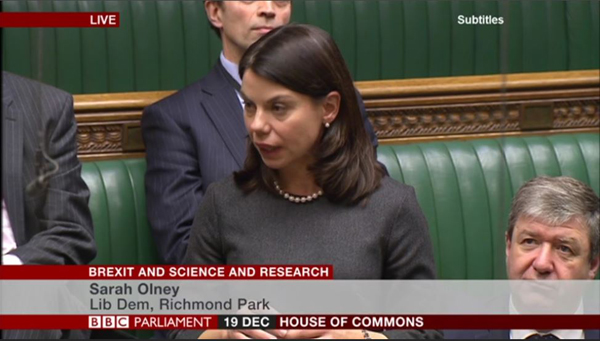
Sarah Olney’s maiden speech

Well, it has been a long time since we have been able to report on the maiden speech of a Liberal Democrat MP.

Sarah spoke today in the debate on the impact of Brexit on science and research. Until a few weeks ago she was working at the National Physical Laboratory, which lies just across the Thames from her Richmond Park constituency, so she has an insider’s view on the subject.

Here is her speech (taken from the rolling feed on Hansard which may be subject to correction):

Posted in News | Tagged | 12 Comments

Brian Paddick writes: Swearing an oath to British values would be superficial and divisive

At the weekend the Conservative Government proposed that civil servants and other holders of public office should be required to swear an oath to “British values”.  I suggested that such a move would be superficial and divisive and here’s why.

This is a reaction to ‘The Casey Review: a review into opportunity and integration’ where she found small pockets of minority communities who were not integrating with the rest of society.  These people represent a tiny proportion of the UK population but the report had the effect of further demonising minority communities generally and the Muslim community in particular.  Of course, we should do everything we can to encourage people to integrate.  We need to provide English language courses for those who find it difficult to communicate and we need to tackle the racism and xenophobia that makes some people feel unsafe in their own communities.  Promoting “British values” is not the way forward.

For a start we are the United Kingdom of Great Britain and Northern Ireland.  Apart from the far more encouraging tone of a being a United Kingdom, and not excluding Northern Ireland, I personally find Great Britain has echoes of the inglorious past of the British Empire. While this may  not be relevant to many young people today, it may be significant for older generations whose origins are in the Indian sub-continent.  Some “British values” from colonial times are ones we have thankfully left behind.

The Government has not yet defined “British Values” but they say they include democracy, the rule of law, individual liberty and mutual respect, and tolerance of different faiths and beliefs.  These are not uniquely British and you do not have to delve too far back in our history to discover that some of them were not very British at all.

Posted in Op-eds | Tagged and | 17 Comments

Call for Evidence: independent inquiry into improving process and culture within the Liberal Democrats – focusing on race and ethnicity

At the request of the Party President and the Federal Executive I am undertaking an independent inquiry into improving process and culture within the Liberal Democrats, focusing specifically on race and ethnicity.   I have not been asked to address particular individual cases but as part of the party’s commitment to build and safeguard a fair, free and open society this inquiry has been commissioned to focus on issues and/or barriers faced by BAME members and supporters of the Liberal Democrats.

Among the questions I am asking are –

  1. Are there barriers to participation for BAME members? If so, what and where are they?
  2. Do barriers differ in different parts of the party?
  3. How effective are existing mechanisms/procedures in addressing the issue?
  4. Does the Party do enough to engage with BAME voters and ensure accessibility for potential BAME members?
  5. What further steps should, or could, be taken by the Party to address the issues identified in this review

Having embarked on the process of gathering evidence I am keen to hear from all those who have relevant experiences and views to help me form an accurate picture.  All the submissions I receive, whether written or oral, will be treated in confidence, and in respect of written submissions, I may well need to follow up on specific aspects in a face to face conversation.

Posted in News | Tagged | 17 Comments

Left out in the cold – why the Left has failed to win


Politics in the West has entered a new era.

Those on the left of the political spectrum sit around scratching their heads on why power they had once taken for granted, has been taken from them. Why has the left failed to engage with the same people who they champion?

From the EU Referendum and the American presidential election, there was a common theme that Leave campaigner Michael Gove put so unashamedly, “people in this country have had enough of experts.” Slogans and punchy one liners were repeated tirelessly by Donald Trump and Nigel Farage until the masses were quoting them as facts and chanting them at rallies.

Then there was the argument from the neutrals.

“Both sides have acted dishonestly.”

“Both candidates are terrible.”

“I am sick of the liberal elite.”

Posted in News | Tagged | 49 Comments

Another Article 50 court case (and Article 127): why we should take notice

Just as the Supreme Court Article 50 hearings finished, another two potential cases appeared which could affect the government’s Brexit negotiating strategy, both of which address significant legal uncertainties remaining.

The first is a case developed by Jolyon Maugham QC that was crowdfunded in 48 hours last weekend. It seeks to resolve two legal uncertainties, i) whether Article 50 is indeed irrevocable (something that was not an issue in the recent Supreme Court case), and ii) whether the UK would automatically withdraw from the single market or European Economic Area (EEA) when Article 50 is triggered. The separate EEA Agreement was ratified by the UK in the EEA Act 1993. The case is being filed in the Irish courts, asking them to refer it directly to the European Court of Justice (ECJ), a process of at least 9 months.

Article 50 does not indicate whether or not its application is irrevocable, so it may be revocable following customary international law. Not surprisingly, David Davis sounded unsure when asked by the Brexit Select Committee! Only the ECJ can decide as the final arbiter of the EU treaties. If Article 50 is found to be revocable then we have a unilateral legal basis for implementing any second referendum decision to remain in the EU after the deal is agreed.

Posted in Op-eds | Tagged and | 13 Comments

Thirty-seven Americans have the power to change the course of history


Today, the US Electoral College will meet in 51 separate locations to decide who will become the next President of the United States. The decision these individual men and women make will determine the outcome of every significant global event for the next decade, if not the next century.

Earlier this year, on 4th August, the Harvard Republican Club issued a press release stating that, for the first time in their one hundred and twenty-eight year history, they would not be endorsing the Republican nominee for president.  The presumptive nominee, they said, was not just unfit to be president but represented, “a threat to the survival of the republic”.

They went on to say that, “His authoritarian tendencies and flirtations with fascism are unparalleled in the history of our democracy.” and that, “He hopes to divide us by race, by class, and by religion, instilling enough fear and anxiety to propel himself to the White House”. This approach, with a little assistance from foreign hackers, has brought him within touching distance of the White House.

Posted in Op-eds | Tagged , and | 13 Comments

Javid’s oath is nothing but dog whistle displacement activity

With barely a trace of irony, a minister in the Government which has just passed the most illiberal snooping legislation talked about defending freedom in an article in the Sunday Times (£) today. Not only that, but he seems to think that the answer to  any problems harming community cohesion could be resolved by holders of public office swearing an oath committing them to so-called British values of “equality, democracy and the democratic process.”

He spends the first 8 paragraphs of his article having a real go at Bangladeshi and Pakistani communities, setting up the scapegoats while using the language of tolerance as a fig leaf in which to wrap the dog whistle.

This is a government, struggling to get a grip on Brexit – trying to distract us by scapegoating an entire community of people, reinforcing the horribly divisive rhetoric of the referendum. Does that sound tolerant to you?

As an aside, the phrase “British values” makes me wince – as if respect for the democratic process or support for freedom of speech was a uniquely British thing that stopped at our borders. You can’t confine a basic human instinct to a tiny little blob on the map. These universal values are exercised every day in every part of the world – and often with great courage and bravery. The women in Saudi who defy the law and drive. The people who marched in places like Myanmar and Teheran for democracy. The people who attend gay pride rallies in places where being gay is punishable by imprisonment or even death. 

Posted in Op-eds | Tagged , , , and | 50 Comments

So who’s on the new Federal Board?

The new Federal Board is responsible for setting the strategy of the party. But it can’t do it alone. This strategy has to be passed by Conference – which means that the Board will have to get buy-in from across the party as outlined in Article 5.2 of the Constitution.

The Federal Board shall publicise a timetable for the production of the strategy and its submission for debate by Conference. In preparing the strategy, the Federal Board shall consult widely within the party, including in particular the Parliamentary Parties (as defined in Article 9), all relevant Federal Committees, the State Parties and Specified Associated Organisations.

One the strategy is passed, the Board has to oversee its implementation and report on progress to Conference.

So who are the people who will be charged with such responsibility?

The FB will be chaired by Party President Sal Brinton who starts her second 2 year term on 1st January 2017.

Other members on the Board as of right are:

Leader, Tim Farron

A Vice-Chair of the Federal Policy Committee and Chair of the Federal Conference Committee

Three parliamentarians

One principal local authority councillor (Chris White has been re-elected to this role)

A Liberal Youth representative

English Party Chair (Liz Leffman from 1 January 2017)

Scottish Convener (Sheila Thomson)

Welsh Chair (Rodney Berman)

One person elected by each state party from among its members

The 15 directly elected members announced yesterday, who are:

Posted in News | Tagged and | 15 Comments

What can we learn from the Federal election results?

Yesterday, we learned who party members had chosen to represent them on the main Federal Committees.  These were the first elections held under one member one vote. Previously, only those who had been elected as Conference representatives by their local party could have a say in the direction of the party.

Congratulations to all those who were elected – and commiserations to those who weren’t.

From 2012, Daisy Cooper and Sue Doughty led a process which led to the biggest internal democratic reform in the party’s history. In 2014, Conference accepted their proposals to give every member a vote. We now have not far off twice as many members as we did back then in the last days of the coalition.

So how did these elections go, and what can we learn from them?

Who was elected?

Posted in Op-eds | Tagged , , and | 30 Comments

Tim Gordon writes….Announcing the internal election results

Today is a historic day for our Party – we have now completed the first ever set of internal elections for Party Committees under One Member One Vote, and with the most progressive set of diversity criteria used by any political party.

I am proud to say that members overwhelmingly made choices in line with the diversity quotas passed at Conference, with more women than men elected to the Federal Board, for example. The full results can be found here. Many congratulations to all the successful candidates, and I sincerely hope that those who were unsuccessful will continue to contribute …

Posted in News | Tagged | 33 Comments

Article 50 in the Supreme Court: what we should do next?

It is just over a week since the Supreme Court Article 50 hearings finished and all the excitement that went with it. For those of you who were fighting a by-election, the case was not a rerun of the High Court hearings as interventions were heard from all parts of the United Kingdom. The decision could have fundamental ramifications on the relationship between Westminster and the devolved administrations on top of the decision on Article 50 and the extent of the Royal Prerogative.

No one can realistically predict the result and I, as a non-lawyer, will not even try. But we must decide how we should respond to it. I list some of the possible outcomes below. How we challenge the government will vary dramatically in each case and needs careful thinking through now before the Supreme Court announces its decision before the government moves quickly to meet its March 2017 deadline if we are to respond quickly.

  1. The UK Government wins and no legislation is needed to trigger Article 50, i.e. a reversal of the High Court decision.
  2. A very short bill to trigger Article 50 has to go through parliament, drafted so as to reduce the chances of amendment (and probably already prepared).
  3. Substantive legislation is required to trigger Article 50 modifying existing legislation – this could more easily be amended to bind the government’s negotiating mandate.
  4. On top of either 2 or 3, the government is also required to consult the devolved assemblies (the Sewel Convention) to agree legislative consequences on the devolved administrations. How should we respond if no agreement is forthcoming?
Posted in Op-eds | Tagged , and | 10 Comments

Is a Progressive Alliance the way forward?

Since the last general election – and even more so since the EU Referendum and the election of Donald Trump in the United States – there has been talk of a need for a “Progressive Alliance” between Labour, Lib Dems and Greens, in an effort to beat the Tories.

Much of this talk has come from Green Party members, with Caroline Lucas being a prominent voice in favour, but there are those in Labour and the Lib Dems for whom this would seem to be a beguiling idea. Indeed, former leader Lord Ashdown has long hankered for a realignment of the left.

Personally I’m a sceptic; for all sorts of reasons.

First, just how do you define “progressive”? To me it’s one of those political phrases that gets thrown around a lot, but means so many things to so many different people it has lost any real meaning. There are, for example, many in Labour who are perfectly happy with its authoritarian tendencies (evident in its internal organisation as well as in many of the policies it pursued in office) who would describe themselves as progressive, whereas I would not.

Posted in Op-eds | Tagged | 36 Comments

How could Liberal Democrats influence EU Reform?

This question has been raised by various contributors here lately, since the Referendum result revealed the depth of anti-EU feeling in the country. Some have wanted changes so radical that, if carried out, the EU would scarcely be recognisable afterwards. However, I realised that even those promoting more modest reforms had very varied ideas, which did not neatly split Leavers and Remainers either. Broadly, opinions seemed divided as to whether competency or constitutional reform was the main issue to be tackled.

Competency arguments have focused on the EU’s painful attempts to deal with the vast influx of migrants and refugees of the last two or three years. As the Dublin Accord was quietly set aside and eastern EU states in the Schengen area set up physical barriers at their borders, it seemed doubtful that the EU’s basic rule of freedom of movement within its borders could be sustained. While states argued about migrant quotas, contributors looked on with scepticism mingled with dismay, What were the rules now, what sort of people could be free to move? Maybe the EU should allow free movement to workers rather than people in general? All this needs rethinking.

Constitutional reform questions have centred rather on the ‘democratic deficit’ of EU government: basically, that legislative powers appear to belong to the Council of Ministers, executive powers to the non-elected Commission, and not much power at all to the Parliament. Moreover, the whole institution and its courts appear remote to ordinary people, and repulsive as a trans-national body with sovereign powers over us.

Posted in Op-eds | Tagged | 50 Comments

Friday Festive Fun as LDV does #christmasjumperday

Today is the day that Save the Children asks us to wear Christmas jumpers and donate £2 towards their work across the world.

We thought it was only right that we should get into the festive spirit to follow the example set by our Scottish leader. Here’s Willie Rennie with the other Scottish party leaders looking uncharacteristically bashful.

As you can see from the photo above, mine is a gingerbread man this year.  And I’ll point out the word “balderdash” above my head before someone else does. It’s a fun game which will no doubt be played over Christmas in this house. And, yes, that is Matt Smith’s Doctor lurking behind the tree.

Technical guru Ryan goes for the festive cardie chic:


And here’s Alex Foster looking very cool indeed.

Posted in Op-eds | Tagged , and | 3 Comments

What’s the sensible thing to do when you are at the top of a cliff?

Every day, we learn something else which proves that the Remain campaign was right all along. The Leavers brushed off any concerns as scaremongering but, in fact, the hit our economy will take if Brexit goes ahead is huge. We see from the Autumn Statement that we’ll be about £200 billion worse off by 2021. This week, a report highlighted that inward investment from US companies will drop like a stone. From the Independent:

Nearly 40 per cent of US businesses with a base in the UK say they are considering moving elsewhere in the EU because of Brexit, according to a report, warning that the vote to leave could also hit trade relations between Britain and America.

The survey by international law firm Gowling WLG also found that two-thirds of the 533 US firms polled said the UK’s vote to the leave the EU was already impacting investments choices in the country.

It’s not just the economic uncertainty. Elections in France and Germany could dramatically change the outcome of our negotiations with the EU and it would be prudent to wait until they are over before invoking Article 50. There really is no rush. After all, Governments don’t enact everything in their manifestos in their first year in power. That would be impossible.

All we have in terms of a Brexit from the Government, six months on, is that Brexit is both brexit and red, white and blue. You get clearer vision if you go out in the fog wearing sunglasses.

Despite all of this, Theresa May is determined to invoke Article 50 by 31st March regardless. This has more to do with keeping her own brexiteers quiet than what is safe and responsible for the country. She wants to get in there before the actual consequences start to hit and people get nervous – and change their minds.

Posted in News | Tagged and | 11 Comments

Boris Johnson’s foolishness and arrogance in purchasing water cannon

This week Sadiq Khan revealed that three redundant water cannon, bought controversially by his predecessor, are to be put up for sale, with the proceeds going towards helping to tackle gang crime.

It is a decision I totally endorse and welcome.

Back in 2014 Boris Johnson decided to purchase three second hand water cannon from Germany.  We now discover that £322,834 of taxpayers’ money has been spent by the Met Police on purchasing these 25 year old vehicles, and then transporting, fitting out and repairing the machines.

The scale of the foolishness, and quite frankly arrogance, in purchasing these water cannon is hard to underestimate.

For a start these water cannon were purchased before authorisation was given for their use by the Home Secretary.  After they had been purchased consideration of permitting authorisation of their use was undertaken by the then Home Secretary.  It was firmly refused.  On this issue Theresa May showed immense thoroughness in carefully examining the merits for and against the adoption of water cannon.  Her statement to the House of Commons on the 15th July 2015 is an example of a Home Secretary acting in a truly professional way.  The Hansard record is well worth a read.

Posted in Op-eds | Tagged , , and | 5 Comments
Advert

Recent Comments

  • Andy Daer
    Jonathan makes some good points about the welcome change of heart by the government – occasioned by a change of head, troubling evidence of how closely our pa...
  • Jonathan Brown
    Further to my introduction, I see it reported in the Guardian today that a number of other senior rabbis have declared in favour of the Government taking action...
  • John Kelly
    Good article Jonathan. One shocking piece of arrogance on the part of the Israeli government should be challenged immediately i.e. the notice to close the con...
  • Sam Ammar
    There is something particularly striking about the title of the book One Day Everyone Will Have Been Against This. Israel sanctioned 12 British MPs — indepen...
  • Tim Rogers
    As a South African I well remember sanctions in the 1980s. We never wanted for anything and became more self sufficient. I agree with the action but how will yo...