The EU referendum was decided by the baby boomers, the generation to which I belong and a generation that has spent a lifetime romanticising about a conflict in which it had little or no involvement. I spent my boyhood immersed in the glory of World War II. I knew the names of German generals, built Airfix models of Spitfires and ME109s and listened to family war stories. And I believe there are far more people in the UK than is healthy, who like me can name every capital ship in the German fleet! Little wonder then that my generation views Europe with suspicion.
For many baby boomers I suspect that attitudes to the EU are linked to WWII conflict, a war defined in the nostalgia of the opening credits of Dad’s Army where brave little union jacks are driven back across the Channel by menacing swastikas. But what if this nonsense were to turn out to be true? What if Brexit is history repeating itself, but this time without guns? If it is, then this is how things might play out in this admittedly fanciful scenario from an unrepentant Remainer:
By Caron Lindsay
| Wed 28th September 2016 - 1:15 pm
I spent Monday and Tuesday in Witney helping Liz Leffman’s campaign. If it is at all possible for you to go there between now and the by-election on 20th October, please do so. You will be worked hard – 10,000 steps a day before lunch, I found – but it is so rewarding. We are already out-campaigning both Conservative and Labour parties on the ground and there will be no let up in our activity. We really need to keep ahead of them both.
Liz is an amazing candidate. She combines a passion for the area, an anger against the neglect of the NHS and the scrapping of local bus services and what that means for people’s lives with such authority, serenity and real warmth. It is very early in the campaign for this to be happening, but people stopped us in the street and said they were voting for her – outside her own council ward. In her own council ward, she is hugely popular. She got pretty much two thirds of the vote there in May.
I spent yesterday canvassing in the village of Eynsham with Liz and her team. I was surprised by the warmth of the reception we got on the doorstep. I do feel for the poor people who had come back from a two week holiday and found themselves in the thick of a by-election at full pelt.
The campaign has a really good feel about it so I would strongly urge you to go and help. If you can’t get there physically make phone calls. I don’t like telephone canvassing either. Actually, it’s the thought I don’t like, but once I get started, I’m fine.
It’s worth remembering, too, that the County Council elections are next year and a good result in the by-election could also leave a legacy of a stronger local government base in future years.
Whatever you are able to do you can sign up here and someone from the campaign will be in touch.
Events prevent me from telling you more of my adventures in Witney right now, but they will be coming over the next few days.
However, I’ll leave you with this just now. I sat down with Liz and recorded an interview with her yesterday morning – and she also recorded this video about her campaign priorities and inviting you to go and help. Yes, that’s you she’s talking to.
If you want to read a short summary of the last 350 years of Liberal politics in Britain, the Liberal Democrat History Group has just the thing for you – a new edition of our booklet Liberal History: A Concise History of the Liberal Party, SDP and Liberal Democrats.
This is designed as a comprehensive but relatively short (about 10,000 words) summary of Liberal, SDP and Liberal Democrat history for readers wanting more detail than they can find on the party website, but less than a full book. We produced the booklet originally in 2005, and we’ve revised it twice since; this edition is up to date as of summer 2016.
Lib Dem Voice has run some cracking fringe meetings at Federal Conferences in the past, including the Blogger of the Year awards – the BOTYs. Even Tim Farron won one. The awards seem to have run into the ground, mainly because there are now so many forms of social media and it is difficult to capture good practice in all of them.
But we do want to reboot our presence on the fringe, and we are looking for someone to join the LDV team in order to take on the job of organising fringe meetings in future. There is no requirement to write for LDV, although we certainly wouldn’t stop you!
We’ve drawn up a job description:
Fringe meetings manager
LDV is looking for a volunteer to join our team in order to organise fringe meetings at Spring and Autumn Federal conferences.
One of the noticeable features of last night’s US Presidential debate (see full transcript here) was how Donald Trump was goaded into saying things to damage his chances with key constituencies. His “stop and frisk” proposal will not, I suspect, go down well with African American communities. Mention of his criticism of Alicia Machado, a hispanic former Miss Universe, probably met with displeasure from women and Hispanics. There was the airing of the “birther” controversy and a whole series of Trump favourites, as he was very successfully goaded by Hillary Clinton.
By Avril Coelho
| Tue 27th September 2016 - 2:14 pm
As a disabled commuter who is unable to drive for medical reasons, I rely as thousands of other people to on public transport to get to the shops, to get to work and back and to get to medical appointments.
Whilst I have a disabled person’s freedom pass, drivers don’t always notice that I need a priority seat. Certainly as my disabilities are hidden, other passengers don’t see my epilepsy or the three worn vertebrae in my spine. I need to sit where it’s not too hard to get up again and where the driver can see if I do have a seizure. I know that should I have a seizure, bus drivers have a protocol to follow.
I have been on a busy Tube and not offered a seat despite talking about my need for one with another standing passenger who was two weeks away from giving birth. Her need was obvious to anyone with sight but nobody got up. We were stood next to many seated men with briefcases and mobile phones in their hands who might have all needed their seats but it’s unlikely. A seat came up and I offered the lady the seat as her and her unborn baby needed it. The heat became unbearable and triggered a seizure and without anyone giving up a seat within the ten seconds I had to sit down, I fell down on the Tube floor. Only then did the men seated get up. Not to offer me their seats though! They picked me and my bag up and carried me of the Gunnersbury platform bench and left me alone there! My bag could have been stolen before the seizure ended.
Prior to previous set of strikes, there was an emphasis on patient safety. The contract was unsafe, argued doctors, and Jeremy Hunt’s plans were unrealistic. Chair of the Junior Doctors’ Committee (JDC), Johann Malawanna and a number of other doctors in the BMA did a superb job of appearing reasonable, measured and yet passionate. Junior doctors looked like professionals being harried and hampered by government from trying to help patients.
At relatively short notice, a ballot with a turnout of 72% gained 98% support for strikes. This is unheard of. The strikes were announced well in advanced, were each two days long and went ahead safely without incident. They had the support of the vast majority of consultants, other healthcare professionals and royal colleges. The BMA had shed its reputation for incompetence.
There were nine by-elections in total on Thursday. Seven were spread out across England with one each in Scotland and Wales so after celebrating our two gains I decided that they represented a big enough cross section to do some analysis.
Across the seats we contested the average increase in our vote was 12.3% and our total vote share was an impressive 24.7%.
However, we only contested six of the by-elections. 1/3rd of the elections went ahead without any Liberal Democrat on the ballot. Unfortunately when you add in these three 0% figures our vote increase comes down to 8.2% and our vote share down to 16.5%
In the 2016 local elections the media glossed over the fact that we had the biggest number of net gains and were the only party to gain control of a council. But what they couldn’t gloss over was the fact that we’d pushed UKIP back into 4th place with our vote share. LAB 31%, CON 30%, LDEM 15%, UKIP 12%. Wherever the graphs and tables were shown it was clear that the Lib Dems were back.
Everyone is aware of the electoral reasons for always putting up a candidate but it really does matter for another reason which I will show you below.
Well, at last we saw Donald Trump and Hilary Clinton facing each other this morning. You can watch the debate in full via CBS and YouTube below.
My first impression was that Hilary Clinton certainly put the “health” and “stamina” issues to bed. Donald Trump started to get a little frayed as the debate wore on. Clinton carried on confidently and was as fresh as a daisy at the end. She certainly looked “presidential”.
We have been telling you about the Conference Access Fund and how it has helped members to attend. Before we got to Brighton, Matthew Clark told us his experiences in a post titled ‘Young, disabled and believed in‘. By happy coincidence, I was delighted to be able to call him to speak in the debate on ‘Mending the Safety Net’ (the Social Security policy paper) which I happened to be chairing, and he was an impressive first time speaker. You can watch …
By Keith Aspden
| Mon 26th September 2016 - 4:05 pm
Keith Aspden at Heslington Sportsfield which benefitted from Ward Committee funding
I’m back in York after a very enjoyable conference in Brighton. From a local government perspective, I was pleased to participate in important discussions around education, housing, the impact of Brexit, the environment, devolution and more! I was pleased to speak (together with Cllr Keith House, Leader of Eastleigh Borough Council) at an ALDC training session about how Liberal Democrats can make best use of Area and Ward Committees. I’ve written up my notes from the meeting about York’s Ward Committees below, which I hope might be useful food for thought for other Councillors and campaigners.
What are Ward Committees?
In York, each ward is given a budget to spend on local projects and offer grants to community groups. Meetings are chaired by local councillors who work with residents and ward teams to decide collectively where money is spent.
Our 2015 Manifesto
Key campaigning themes for us in the run-up to the 2015 local elections were the Labour Council being out-of-touch with residents, taking all decisions centrally, and ignoring communities in the suburbs and villages around York. Ward Committees had suffered significantly under Labour – as a result of their cuts, wards had a total budget of just £75,000 across the city.
Our manifesto promised to change this and ‘re-establish proper Ward Committees as a way to put power and budgets back in the hands of local residents’.
This is the slightly edited text of the speech to party conference on Sunday 18th September, moving the motion with the same title. The text of the motion can be seen here.
We believe in social mobility, but social mobility is more than simply plucking a few from disadvantaged backgrounds, by unreliable assessment and unfair procedures, at the age of 11.
In any case, all-embracing division at age 11 sends a damaging message about how we value each young person.
Actually, we believe in more than social mobility; we want even people who choose to stay in particular social groups to be better educated and better off. Not only is that good for them, it is necessary for our economy.
Gone are the days when unqualified youngsters from secondary modern schools could walk into a good job.
Gone, we hope are the days when an educated elite takes charge of everything and the rest are merely simple-minded servants.
Likewise we need more education for our society and our democracy; local and national governments and voluntary organisations have more complicated decisions to make, requiring greater understanding and participation on the part of all our people.
By Joe Bourke
| Mon 26th September 2016 - 12:40 pm
Action for Land Taxation and Economic Reform (ALTER) seeks to build on support for Land Value Taxation amongst Liberal Democrats and to promote and campaign for this policy as part of a more sustainable and just resource based economic system.
The ALTER fringe meeting at Brighton this year was chaired by our MEP, Catherine Bearder. Jock Coats, a former Oxford city councillor, presented a paper aimed at infusing the Liberal Democrat mission statement as set out in the “preamble to the constitution” with explicitly “geoist” principles. The paper argues that only publicly collecting the “economic rent” from land and natural resources enables a genuine market and democracy to work together to optimally distribute economic welfare and save the planet.
The premise of the paper is that neither markets nor democracy can function properly whilst a monopolistic class, rentiers, captures so much of economic productivity. It leads to a two caste society, one of which reaps the benefits of public need and public programs through land values, while the other pays for it. “Tenants pay twice so landowners don’t have to”.
Her Majesty’s Opposition is in turmoil. Our country is in crisis. Corbyn won’t budge.
I am saddened by Labour’s demise. For all its flaws, for almost twenty years it has been a strong, progressive force in British politics. Corbyn has been re-elected with a sizeable 62% of the vote. Now Corbyn has a sizeable number of admiring activists – but they are talking to themselves. The public has already made up its mind about Corbyn – he is seen as incompetent, extreme and unelectable. It is all but impossible for Labour to gain seats in 2020 with him at the helm. The Labour party is already teetering on the edge of electoral oblivion.
And a lot of Lib Dems know what it’s like to lose elections. It hurts. We need to have sympathy with the thousands of Labour activists who want a united, centre-left Labour party. It would be opportunistic and insensitive to react to Labour’s turmoil with barely-disguised glee. How did you feel when parts of the left did just that after the 2015 General Election?
Imagine our surprise on Saturday when news of Jeremy Corbyn’s re-election of the Labour party came through hot off the wires. As it happened, my partner, who is about as a-political as you can get (and that’s saying something, considering we have been together through multiple elections, not least of all the General Election last year, somewhat inconveniently we were moving flat the day after – a story in itself) had made a special study of this election and mentioned the news.
In this age of anti-politics, the figure Corbyn cuts has great appeal for people like my partner, who are not necessarily overtly political, but are reasonably well-informed with no fixed views or attitude. In a sweeping generalisation, it is much akin to what we see in America right now with Trump, albeit in extremis politically to what the Hon. Member for Islington North has to offer. This is the stark zeitgeist we are operating in.
I was reminded yesterday, thanks to social media, of a status I had written some six years ago to the day, an observation I made about Ed Miliband’s election as Labour Party leader. “We (as Liberal Democrats) have the result we want”, I wrote. How wrong I was. At the time, I felt an inherently weak leader in the mind of the general public would only serve us well. The folly of this idea had its apex in the early hours of May 8th last year, when the very idea of Miliband and Scottish nationalists cobbling together a coalition drove the so-called ‘soft Conservatives’ – crucial to securing victories in all our Tory-facing seats – to the ballot box not caring really how brilliant their Lib Dem incumbent was, because the national situation required they duly vote blue. Which they did. A lot.
By Antony Hook
| Sun 25th September 2016 - 5:55 pm
Britain faces a challenging time in the next few years. We can meet these challenges if we are the best Britain we can be: open in our minds and hearts, tolerant and united.
I am one of those who believes that history has much to teach us about ourselves and the present. Past and present are not the same. But by studying the mistakes of the past we have a greater to chance to do better in future. My 3 years as a history student have formed my mind as much as …
Tim Farron has been writing in the Independent about how the Liberal Democrats are the only party capable of providing decent opposition to the Conservatives following the re-election of Jeremy Corbyn:
If one child was lifted out of poverty by Blair, that would be a progressive legacy. But what will Corbyn’s legacy be? At this rate, to render Labour so unelectable that successive Tories will be able to play pass the parcel with the keys to Number 10.
Perhaps the Corbynistas can afford such generosity to the Tories, but the people I grew up with in towns such as Preston can’t. Self-righteous, ideological purity doesn’t buy food, pay the rent or provide the training that might lead to a better life.
While the party may have struggled to make itself heard above the rhetoric of Brexit and the absurdities of the Labour leadership contest, there has been one facet of the party that has been consistently nailing it.
By Caron Lindsay
| Sun 25th September 2016 - 10:45 am
Over 300 people joined the Liberal Democrats yesterday in the wake of Jeremy Corbyn’s re-election, That brings the total of new members to over 1000 this week.
It’s been a good week for the party, which has 3 more councillors in seats gained from both Labour and the Tories.
Tim Farron welcomed the new members to the Lib Dems:
I am delighted to welcome so many new members to the party and look forward to working with them to provide the real opposition to this Conservative Brexit Government.
We are the voice for those who oppose the politics of fear, division and
This is basically a repeat of a post that I did last year when many joined the party in the wake of the election result in the hope that it might be useful to tell you a little bit about how our party works and give you a bit of an idea of the opportunities open to you. If you are not yet a member, read it and think it sounds appealing, sign up here.
What do we believe?
Before we get into the nitty gritty of organisation, the best statement of who we are and what we’re about can be found in the Preamble to our Constitution which underlines how we believe in freedom, opportunity, diversity, decentralisation and internationalism. Here’s a snippet:
The Liberal Democrats exist to build and safeguard a fair, free and open society, in which we seek to balance the fundamental values of liberty, equality and community, and in which no one shall be enslaved by poverty, ignorance or conformity. We champion the freedom, dignity and well-being of individuals, we acknowledge and respect their right to freedom of conscience and their right to develop their talents to the full. We aim to disperse power, to foster diversity and to nurture creativity. We believe that the role of the state is to enable all citizens to attain these ideals, to contribute fully to their communities and to take part in the decisions which affect their lives.
We look forward to a world in which all people share the same basic rights, in which they live together in peace and in which their different cultures will be able to develop freely. We believe that each generation is responsible for the fate of our planet and, by safeguarding the balance of nature and the environment, for the long term continuity of life in all its forms. Upholding these values of individual and social justice, we reject allprejudice and discrimination based upon race, colour, religion, age, disability, sex or sexual orientation and oppose all forms of entrenched privilege and inequality.
We have a fierce respect for individuality, with no expectation that fellow Liberal Democrats will agree with us on every issue. We expect our views to be challenged and feel free to challenge others without rancour. We can have a robust debate and head to the pub afterwards, the very best of friends.
By Antony Hook
| Sat 24th September 2016 - 7:50 pm
George Osborne is not a popular figure in the Liberal Democrats. He has never shown compassion of the poor and since the 2015 General Election followed an economic policy we disagree with – failing to invest and take advantage of low interest rates.
Many of us who gave all we had for Remain feel he let us down. His foolish threat of an “emergency budget” drove voters into Leave’s hands. Like Cameron, he contributed over years and years to the anti-immigrant, anti-Europe mood music that entrenched euro-scepticism in many people’s minds.
However, he has now made a speech clearly criticising the May government’s …
By Paul Walter
| Sat 24th September 2016 - 5:12 pm
(R-L) Party President Sal Brinton, Witney candidate Liz Leffman and Paul Walter with veteran Focus delivery dog Charlie at the Witney by-election campaign HQ today
The Lib Dem Witney by-election HQ was abuzz with activity when I visited to help today. I was astonished by the busy team all set to work so early in the campaign. It was great weather for delivering leaflets. I enjoyed doing my very large bundle in Carterton, with the sound of the aircraft at Brize Norton in the background.
There was a big difference between Tim Farron’s frst two conference speeches as leader. The first came 3 months after a brutal general election at a time of existential crisis for the party. The second, at a time of existential crisis for the country, enabled him to set out our party’s mission: to fight for the values we hold dear and not to let the Tories away with 25 years of untrammelled rule while Labour fiddle on the sidelines..
I said on the night of my election as Liberal Democrat leader: “Our survival, revival, our rebirth, our rebuild will happen in communities in councils in common rooms, away from the stuffy corridors of Westminster.
“Step by step, we will change people’s lives for the better and as we do that we will regain their trust.”
This is happening and you can see the results for yourself. I’m not getting ahead of myself but adding to our results in May’s local elections, when we had the best results in a decade, this shows we have started to turn the corner.
Some of the commentators will do what they always do and use up ink talking about our demise; but like we have shown many times in the past, they are wrong and we will show that again.
Just take the case of the byelection in Sheffield. Nearly two weeks ago our team in Sheffield delivered a local and purely liberal message and it worked. They campaigned from dusk till dawn and won. But where was Labour?
By Caron Lindsay
| Sat 24th September 2016 - 10:15 am
Knowing that there may be a lot of unhappy Labour members once the leadership result is announced, Richard Kemp and the Liverpool Liberal Democrats are setting up a stall outside Labour’s conference to offer them a home if they are feeling that their party has moved too far from them.
They will be outside the Liverpool Museum at the Pier Head between 11 am and 1pm.
They will be looking for people like Mark Robinson:
This week has seen ten prinicipal council by-elections across the country – nine on Thursday and one on Tuesday night. Lib Dem candidates contested seven of the ten.
In the Tuesday night by-election in Plasnewydd (Cardiff) Lib Dem candidate Robin Rea had a spectacular win, gaining the ward from Labour with a 48.1% share of the vote (up +15.4% since the ward was last contested in 2012). Labour were pushed into second place on 34.8%, and Plaid Cymru, the Conservatives and the Greens all saw a drop in their vote share. Congratulations to Cllr Rea and the team in Plasnewydd for an excellent result to round off our party conference!
Thursday night saw yet more Lib Dem gains. Alison Eden and the team in Teignmouth Central ward, Teignbridge BC almost doubled the Lib Dem vote share to gain the ward from the Conservatives. Alison and won the ward with an amazing 51.1% of the vote (+26.8% since 2015) and a majority of 205. Both the Conservatives and Labour both saw a drop in their vote share (of -3.7% and -8.1% respectively). Congratulations to Cllr Eden & the team for such an impressive result!
Another Lib Dem gain came in the form of Hadleigh ward, Suffolk County Council, where Trevor Sheldrick pushed the Tories into second place and won the ward with a 182 vote majority (36.2%; +12.0%). A huge congratulations to Cllr Sheldrick and the team!
By Simon Perks
| Fri 23rd September 2016 - 2:03 pm
The Prime Minister claims that her plans to create more grammar schools will enhance social mobility and will help to bring about a truly meritocratic society. They will, she says, create ‘a country that works for everyone’.
Sure. Because grammar schools proved so good at doing just that the first time around.
What Mrs May’s proposals will do, of course, is appeal hugely to the seething mass of baby-boomer Tory voters who just can’t wait to get us back to the good old days of the 1950s and serve as a temporary distraction from the Government’s shambolic approach to all things Brexit.
We should, I suppose, perhaps be grateful that the Prime Minister is at least talking about introducing selection on the basis of academic ability, rather than the religious faith, parental wealth and ability to move to a more desirable postcode that determine how many schools currently choose their students.
Let’s turn Brexit on its head. Let’s not only lobby to remain members of the European Union’s single market, but have free movement of goods, capital, services and people included in our future free trade agreements with some non-EU countries. After all, as liberals we’re not only Europeans, but internationalists. Let’s turn crisis into opportunity by breaking down borders between this country and others around the world.
Wouldn’t it be great if Britons could live, work, study and start a business in Japan, South Korea or Australia with the same ease as we can in Spain and Germany today? It would strengthen trade and political ties between us and those nations, enrich our cultural experience and ensure Britain is internationalist not isolationist in this brave new Brexit world.
Although many Britons would oppose free movement of people from large countries with low per capita incomes, such as India, or having any kind of free trade deal with autocracies like Saudi Arabia, it would be difficult to argue against these arrangements with small and medium-sized democracies with per capita GDP’s similar to our own: Migration from countries like Taiwan, Norway and Canada is likely to be moderate and counterbalanced by Britons heading the other way, so wage levels, public finances and housing supply are not likely to be strained.
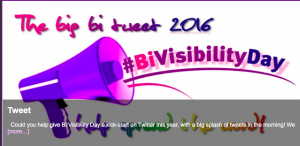
Since 1999, 23 September has been a day to recognize and celebrate bisexuality, bisexual history, bisexual community and culture, and all the bisexual people in our lives.
The day has gone by various names: Celebrate Bisexuality Day (or International Celebrate Bisexuality Day), Bi Pride Day, but has really become well-known to a broader audience in recent years as Bi Visibility Day. This has been extended in America to the whole week being known as Bi Awareness Week (and to some extent internationally, thanks to the internet; it’s been #biweek all over Twitter).
So Why Do Bisexuals Need Their Own Day?
Most non-bi people probably assume bisexuals are sufficiently included in other “days,” like Pride or IDAHOBIT (the International Day Against Homophobia, BIphobia and Transphobia). The councillors among you might have had requests for your town hall to fly the rainbow flag at such times.
But bisexuals suffer for being “lumped in” with LGBT all the time. Bisexuals’ experiences tend to differ not just from heterosexuals but from gay men and lesbians as well.
By Caron Lindsay
| Thu 22nd September 2016 - 2:21 pm
It’s not just that I am having withdrawal symptoms from a wonderful four days at Conference that makes me want to rush down to Witney to spend time with more Liberal Democrats.
That may be part of it, but why would I want to risk the guilt-inducing wrath of my dog by leaving her again so soon?
On Monday, I’m travelling 350 miles for a whirlwind 24 hours of leaflet delivery or whatever else needs doing to help the wonderful Liz Leffman’s campaign. I’m doing so for several reasons;
A good result for the Liberal Democrats is important for party and country
A major theme of Conference is that we’re not going to stand by and see our country ruined while there’s something we can do about it. We are going to stand up and make the case for the closest possible relationship with the EU and for our country to be that generous-hearted, internationalist, collaborative force for good in the world.
This by-election is our chance to show that we are making progress as a party, that we can get public opinion on our side.
The party is taking this very seriously. They are even playing the cute dog card very early on. Seriously, a picture of a local activists’ dog was used to lure us there yesterday.
We are going to be fighting a good campaign and the sooner we do stuff the better.
Richard Whelan Good luck Sarah. I wish you every success in your campaign....
Peter Davies Simon Hughes was an MP when he stood. He got our best result....
Mary Reid David Raw - yes, it would trigger a Parliamentary by-election if she won as Mayor. Selection itself would not require it....
Adrian Moss Outstanding article. Lib Dems need to lead the way on reasoned arguements in support....
John Kelly @jonathan brown “I regret to say that I believe our failure to take this message strongly out of parliament and to the people has contributed to us underperf...


 Follow @libdemvoice.org on Bluesky
 Like us on Facebook
 Subscribe to our feed
 Sign-up for our daily email digest

 Dysfunctional council to be abolished after years of controversy and "all out civil war"
 Will Burnham abandon neoliberalism by adopting a radical agenda?
 Conservative councillor joins Lib Dems in Cannock Chase
 The AI world and some fallacies about it
 Yet another government makes a mess of local government reform
 Front Street looking great
 Richard Whelan
 Peter Davies
 Mary Reid
 Adrian Moss
 John Kelly