Realignment of the left – an idea whose time has come?

Paddy Ashdown and Tim Farron have both suggested in recent days that those on the progressive side of politics need to work together to oppose the Tories and deliver change.

Of course, a defining part of Paddy’s leadership of the party was his desire to see closer co-operation on the left.

The Tories need to be beaten, now more than ever, even more than in the 1980s. Their destruction of the country then almost pales into insignificance to the damage they have done with their self-indulgent EU related civil war. How do we achieve it, though, while retaining the integrity of individual parties, most particularly this one? The last thing I want to see is the Liberal Democrats being the smile on the face of the right-wing Labour tiger.

It’s vital that we have a party that stands up for civil liberties and individual freedom in a way that neither Conservatives or Labour have managed.

Politics Home reported an interview with Tim Farron with BBC News in which he talked about the need to work together across party lines:

Asked about the prospect of a merger that would mirror the deal between the SDP and Liberal party that formed the Liberal Democrats, Mr Farron suggested the referendum campaign had led to a reconsideration of the party divides.

“Amongst the things that I think we’ve got out of the referendum is that we’ve discovered, lots of us, who have worked across party boundaries, that we’ve enjoyed doing so,” he told BBC News.

“I shared a platform with many people I won’t embarrass by naming, who they discovered and they discovered we had more in common than just our belief that Britain should be in the European Union.”

When pressed on whether he was open to the idea of a new party, he replied: “We shouldn’t put any construct or constraint on what might happen next. People could come to us, they could set up another party, who knows. But there needs to be a realignment – otherwise we’ll be left with a Tory government forever.”

In today’s Sunday Times (£), Paddy Ashdown has floated the idea of a progressive movement, talking about how political parties have failed the public:

Posted in Op-eds | Tagged , , and | 32 Comments
Advert

Tom Brake MP: After Brexit negotiations, give people another chance to have their say

Tom BRake speaking on pavement Two Chairmen pub London 2nd July 2016 #marchforeuropeAfter yesterday’s March for Europe in London, some Liberal Democrats repaired to the Two Chairmen pub in Westminster. As I approached, I became aware of a speech taking place. It was Tom Brake MP (right), on the pavement outside the pub, giving an impromptu view of the EU situation, and answering questions. It was, in many ways, a return to old-fashioned democracy. Certainly Tom gave a fascinating commentary on what might happen next.

Thanks to my colleague Joe Otten, who videoed most of the speech, I have been able to transcribe here much of what Tom said. He started by saying how much he was worried about eastern European countries, such as the Czech Republic and Poland, and how they might react to Brexit. He said that Poland’s people are in favour of the EU, broadly, but that their government might use Brexit as a trigger against the EU.

He went on:

We’ve got to fight.

Posted in Europe Referendum | Tagged and | 8 Comments

Farron: Lib Dems will champion right of EU citizens to stay in Britain

Tim Farron has set out why the Liberal Democrats will fight for those EU citizens who have made their homes in Britain to be allowed to stay post-Brexit.

Both David Cameron and Theresa May have only guaranteed their future to the conclusion of the negotiations. How awful, how unfair would it be if people who had settled, worked hard, married, had families here were forced to leave after the goalposts changed?

How cruel is it to put these people through years of uncertainty?

Tim said:

There is real, and legitimate, upset and worry from European citizens across our country about their long-term status in the UK. Liberal Democrats will not stand by whilst our communities are divided by uncertainty. Regardless of the outcome of any negotiations with Europe around Brexit, EU citizens who have made Britain their home must be allowed to stay.

To Europeans whose lives are now rooted in the UK my message is simple – the Liberal Democrats stand with you, and will speak for you. To the French family raising their children in Manchester, to the Polish mother working to pay her mortgage in Portsmouth, to the German graduate starting his business venture in Birmingham – the Liberal Democrats value you, we will stand by you and we will champion your future here in Britain.

Posted in Op-eds | Tagged , and | 3 Comments

What does Brexit mean?

Article 50 of the EU treaties, the one that sets out the terms for leaving the EU should perhaps have been read and understood by those arguing for Brexit, because a lot of rubbish is being spoken by people who ought to know better.

The full text is here

1. Any Member State may decide to withdraw from the Union in accordance with its own constitutional requirements.

2. A Member State which decides to withdraw shall notify the European Council of its intention. In the light of the guidelines provided by the European Council, the Union shall negotiate and conclude an agreement with that State, setting out the arrangements for its withdrawal, taking account of the framework for its future relationship with the Union. That agreement shall be negotiated in accordance with Article 218(3) of the Treaty on the Functioning of the European Union. It shall be concluded on behalf of the Union by the Council, acting by a qualified majority, after obtaining the consent of the European Parliament.

3. The Treaties shall cease to apply to the State in question from the date of entry into force of the withdrawal agreement or, failing that, two years after the notification referred to in paragraph 2, unless the European Council, in agreement with the Member State concerned, unanimously decides to extend this period.

4. For the purposes of paragraphs 2 and 3, the member of the European Council or of the Council representing the withdrawing Member State shall not participate in the discussions of the European Council or Council or in decisions concerning it.

A qualified majority shall be defined in accordance with Article 238(3)(b) of the Treaty on the Functioning of the European Union.

5. If a State which has withdrawn from the Union asks to rejoin, its request shall be subject to the procedure referred to in Article 49.

Posted in News | 24 Comments

Listening, not just hearing

I have had several requests through facebook from voters on both sides of the EU issue on how to find a healthy, positive way forward. As deeply upset as many of us still are, it is difficult to think in positive, helpful terms when there still so much anger about this referendum taking place at all.

But I have put some thought into this and wish to share some ideas. In conflict resolution and mediation, lot of weight is placed on listening. This is a deep kind of listening, not one in which words are heard and then our point of view put forward, ‘but, but, but….’ Having done a fair bit of EU speaking and hustings, I am familiar with the riposte and parry required in refuting arguments and arguing a case.

Deep listening is understanding what is behind the words a person is saying. Many have suggested that much of the ‘leave’ vote was an anti-establishment vote, not an anti-EU vote. Tim Farron has pointed out that worries over housing, lack of school places and an under-resourced NHS were salient factors in the ‘leave’ vote.

I would further suggest that fear is behind many of the views of those who voted against the referendum. We live in a global world, a shrinking world, one that is quickly changing with technological advances. Those who voted leave, among them the majority older people, I suggest would like a return to a simpler world of pen and paper, not email, where everyone knows everyone in the village and stays there their entire life. But that is not the world young people live in – we train in different cities and countries, we work around the UK and in the rest of the world, we fall in love and have relationships which transcend borders. Younger people understand and embrace a fluid, global world. Many older people are frightened by it.

Posted in News | Tagged , and | 17 Comments
Advert

Vikings, Unicorns and an open, inclusive Parliament to be proud of

Scotland’s Parliament is just 17 years old, but compared to its centuries old neighbour, it’s really been the grown-up this week. Four of its parties have really got to grips with strategic thinking, looking for ideas to help us through the current mire in which we find ourselves, a mire not of our making.

Today we had our equivalent of the State Opening of Parliament. It only happens once every five years and I was lucky enough to have a ticket. It\s very different from the Westminster event with all its pomp and tradition. True enough, there was a little bit of pomp, with the Queen’s Archers and bearers of such wonderful heraldic titles as “Unicorn Pursuivant.” However, this is very much an event for the people, filled with music, poetry and performance.

We were seated in the Gallery by 10am, an hour before the festivities were due to begin. We originally had fantastic front row seats, but were moved on because they were apparently reserved for the media. The National Youth Choir of Scotland sang songs including the Skye Boat Song, which has a special meaning for Lib Dems, and Burns’ Ae Fond Kiss.

At about 10:50, the state trumpeters who play the fanfare appeared near us. Screens showed the party leaders lined up outside, waiting for the Queen to arrive. We were slightly apprehensive about whether Willie would behave as he has form round royalty. Our fears were heightened when he bounded into the Chamber grinning and was the last to sit down and be quiet. We found out later that Prince Philip had complemented him on his buttonhole. The Duke wasn’t to know that five years ago, Willie hadn’t realised he had to have a buttonhole. His blushes were spared by Annabel Goldie, the then Tory leader, picking him a flower from one of Holyrood’s courtyard gardens.

Posted in Op-eds | Tagged and | 1 Comment

Why march today?

This is just to follow up my earlier post to talk about why we marched today. These are my personal views.

Since the referendum, there has been an increase in racial abuse directed at people in this country. One of the things I was marching for was to stay loud and clear that immigrants are welcome in this country.

Secondly, I was marching for the 48% of people who voted “remain”, to say that we stand with you, we believe the UK’s future lies in positive co-operation with our European partners. I was marching to say clearly that we believe that whatever settlement is worked through, visa vis our relations with the rest of Europe, we need to have those principles of co-operation and tolerance at the centre of our thinking.

Posted in Op-eds | Tagged | 3 Comments

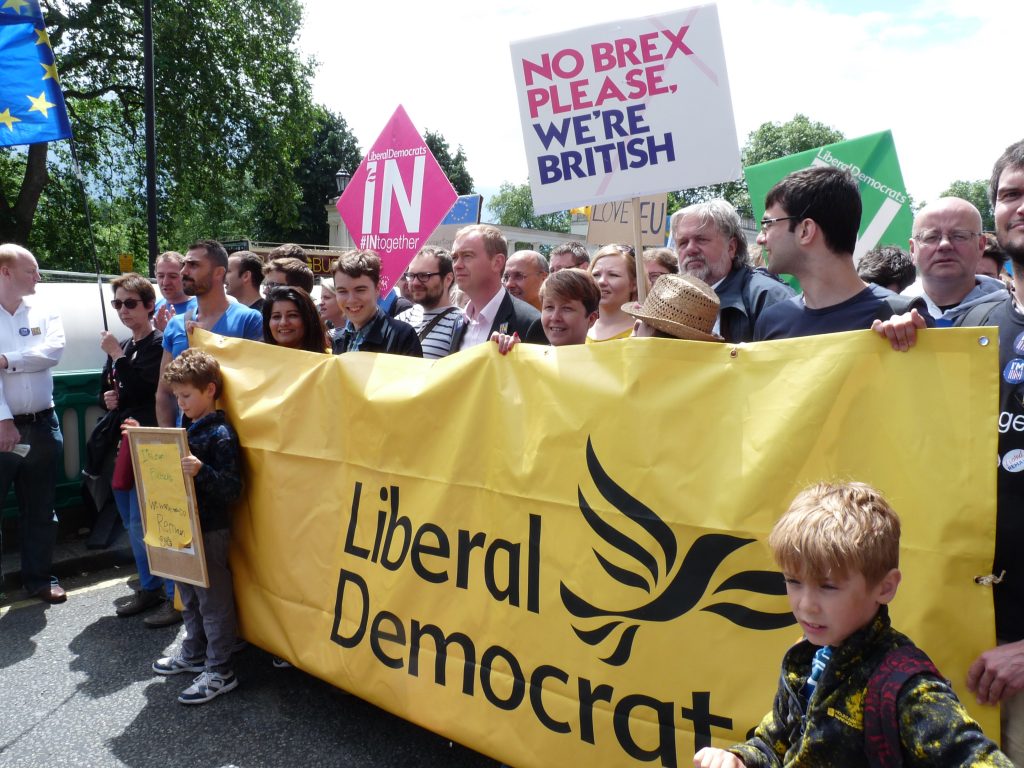
A very proud day for Liberal Democrats #marchforeurope

P1010579
Wow! That was quite a day! I got up at 6am and decided, on the spur of the moment, to go up to London to join the Liberal Democrat contingent at the March for Europe.

After being fortified by a breakfast from a well known food outlet in Praed Street W1, I hot-footed it to the assembly point at the Cumberland Hotel.

I was the first Liberal Democrat there. Nah-nah-na-na-nah!

Actually I was so early I did a recce and walked on. Or I would have walked on, if I had not overheard a comment from one of the two smart, frock-coated, top hatted doormen of the very posh Cumberland Hotel. One of them said to the other:

Posted in Op-eds | Tagged | 1 Comment

Tim Farron at #marchforEurope: We stand with EU citizens living here

Tim Farron led a noisy Liberal Democrat contingent at the March for Europe in London today. From Facebook:

Unfortunately the BBC couldn’t fit him on their list of speakers at the event, but speak he did.

Posted in News | Tagged , , , , and | 15 Comments

Willie Rennie invites 1.6 million Remain voters in Scotland to join the Scottish Liberal Democrats

Posted in News | Tagged and | 11 Comments

Remembering Cllr Ed Townsend: How you can help keep the Liberal Democrat flame alive in Newport

Cllr Ed TownsendWhen we lost Dad the day before the Assembly elections, we were struck by the kindness shown by the Liberal Democrats. The messages of support and the respect Dad was held in meant a great deal to us.

We loved Dad as children and had a huge admiration of him as Lib Dem members as well.

Ed – as he was known by everyone else – had been a long-standing member, first of the Liberals and then the Liberal Democrats. He joined after Margaret Thatcher won her second term, saying then that he felt he had to do something.

He cut his early campaigning teeth in election campaigns in Birkenhead.

In the years since he moved to Newport in South Wales, he came just over 800 votes behind Labour in the Assembly elections, and only 1650 behind them in the 2010 General Election.

Posted in News | 3 Comments

As hate crime rises, Farron and Pidgeon visit vandalised Polish Centre

Probably the most awful of many bad aspects of the referendum is that that very small section of the population who are racists and bigots feel emboldened. They think they have 17 million mates. Social media is awash with reports of attacks and the Police say that reports of hate crime are up 57%. While only a tiny minority of Leave voters are racists, they all need to take some responsibility, alongside the Leave campaign, for allowing this appalling behaviour to flourish.

It’s not just in the last few weeks, though. This prejudice has been stoked endlessly by the media and both Tory and Labour governments for long enough. If they had done what Holly said, years ago, we might not be in this mess now.

Posted in Op-eds | Tagged , , , and | 26 Comments

Tim and Vince write for the Times on the need for ministers to provide leadership on Brexit strategy

Tim Farron and Vince Cable have written for the Times’ Red Box website setting out what they think should happen in negotiations with the EU and in economic strategy as we face a self-induced Brexit recession.

As Nick Clegg said before the referendum, so called Project Fear was understating the impact Brexit would have. We are also suffering a void of leadership and some very unrealistic thinking from the Brexit camp who, as we discovered, didn’t really have a plan.

We can’t hang about, they say:

Business and investors won’t wait around forever to see leadership.  Many first tier organisations will simply pack their bags and go unless they see a path ahead.  Meanwhile our smaller businesses, and particularly those in high risk/ high innovation sectors will feel the squeeze as bank lending dries up as it did in 2008.

Two things need to be done. You get the feeling this was filed before yesterday’s extraordinary events:

The first can only be done by leaders of Leave – those who wish to lead us into the new unknown – and in particular, Boris Johnson and Michael Gove.  They must now show his vision for the UK and provide a clear plan for Britain’s relationship with the EU.  To reassure the market they, and other potential prime ministers, need to make clear that membership of the single market is the priority ask for any negotiations.  Businesses need to know that, whatever else, their key relationships will not have to fundamentally change.

It will require real leadership, rather than populist platitudes.  It may mean securing a deal which pleases no one and does not address many of the concerns raised by leave voters about immigration and freedom of movement.  Leading is about making choices, it’s now time for Boris and Gove to tell us theirs.

The second urgent priority must be the responsibility of the current government.  There is now every likelihood of a Brexit recession.  If the government acts now, by abandoning its already unnecessary financial straitjacket and allowing capital investment and stimulus support to flow into precarious parts of our economy, we might avoid the worst impacts on jobs and livelihoods. The economy could be stimulated through the Network Rail Capital Project and local authorities being allowed to borrow to build houses. The £250bn the governor of the Bank of England has put aside could be put into the Funding for Lending and the Regional Growth Fund.

Of primary concern must be our most innovative industries.  Those businesses on the cutting edge are likely to see funding from traditional financial institutions dry up as banks revert to their core business model.  Giving serious financial help and stability to these industries is vital to ensure their long term future in the UK.

The British Business Bank, set up by the Lib Dems in Government, is a crucial part of the support for business that’s needed:

Posted in LibLink | Tagged , , , , , and | 14 Comments

Progress in York – our report back after 12 months in joint administration

A little over twelve months ago, the Lib Dems in York entered into a joint administration on City of York Council. It wasn’t an easy decision to take, but we knew that having increased our representation by a third despite the disappointing national picture, we had a real opportunity to deliver on our manifesto commitments to the people of York.

I am very grateful to many colleagues in the city, including fellow Executive Members, Councillors, local party activists (and our very new members this week!) for their ongoing work.  A year on, we thought we’d let you know how we’re getting on.

Greenest City in the North

We promised to take steps towards York becoming the Greenest City in the North, including working with residents to reverse the decline in recycling rates and developing a plan to cut the Council’s carbon emissions. Additionally, we committed to reintroduce additional winter Green Bin collections and rule out cuts to the frequency of Grey Bin collections.

This was confirmed just two months after the election, as our Emergency Budget in July last year financed the reintroduction of 2 Winter Green Bin collections and scrapped Labour’s proposal for extra Green Bin charges. Our increased investment has funded a new recycling campaign and we have re-established a Green Jobs Task Group.

Posted in Op-eds | Tagged , and | 2 Comments

The Liberal approach to immigration

The Liberal approach to dealing with the unpopularity of immigration and immigrants is to challenge that concern. It’s to robustly make a positive case for immigration as a policy and — crucially — immigrants as human beings.

The Liberal approach is to shift attention unfairly directed at them to where it belongs: Government unwillingness to fund housing, the NHS and other public services.

The Liberal approach includes strongly differentiating between migrants and refugees, which lately have all too often conflated by media and politicians, so that everyone understands the different reasons that people want to be welcomed into the UK, be they economic migrants, asylum seekers, refugees, students, or any of a host of other categories that people in different circumstances will find themselves in.

Posted in Op-eds | Tagged and | 63 Comments

Good news – a big Liberal Democrat by-election gain from the Tories in Surrey

A massive 27.4 increase in the vote saw the Liberal Democrats gain a Council seat in deepest Tory Mole Valley last night.

The other two by-elections from last night saw us field candidates where we hadn’t before, attracting almost 5 and 14% respectively.

Congratulations to new Councillor Joe Crome and his team for such a brilliant result. Here’s what he wrote about himself for the Dorking Advertiser:

Posted in News | Tagged and | 4 Comments

Controlled migration with free movement – squaring the circle

No matter how we try and fool ourselves, migration issues played a substantial part in the Leave vote, and many Remain voters, myself included, voted to remain despite reservations about immigration levels. Doubtless racism played a part, perhaps 2 million of those Leave votes representing the percentage that the BNP received in 2009. The racists didn’t stop being racist, they simply moved to a new home. But over 90% of the 33 million voters were not racists.

When you dig down further as to why people are concerned about migration there is a common theme. As a country we have hugely expensive housing whether buying or renting. We have a creaking and overcrowded public transport infrastructure that is painful to negotiate and roads with commuter jams at 6:00am. We have a healthcare system that cannot cope with the demand yet struggles to pay off PFI stupidity promoted by Brown. We have schools that cannot deliver the quality our kids deserve and in some areas are hamstrung by the number of children with a poor grasp of basic English. Our infrastructure was not built for the numbers of people now trying to use it, and yet still more come in never-ending numbers. Patience has snapped and we must deal with it.

Freedom of movement is a precious right, for me probably the most important, although when it was first established it was reasonably balanced. The freedom to import labour at will, whether for agriculture or high tech projects, is critical to our economic success. And the EU will not allow us the benefits of unfettered access to the free market without freedom of movement whatever fantasyland Boris is currently living in. So we are in a near impossible position. What we need in terms of free trade relies on conceding free movement that we cannot cope with.

Posted in Op-eds | Tagged and | 37 Comments

Lord Paul Tyler writes…An early general election

All the runners in the Conservative Leadership steeplechase may be denying that they would seek a General Election before 2020, but I suggest that you should examine their track record in terms of broken promises.   If the Labour Party is still suicidal, and if the dishonest Brexit commitments are beginning to unravel with devastating effect on people’s expectations, what Prime Minister could resist the temptation to go to the country?

In any case, there will be a strong reaction to the imposition of a new PM and Government on the whim of a 130,000 electorate.  Where is our much vaunted “Sovereign Parliament”, and the demand that our democracy must “take back control”, in that process?  When Cameron was elected there were 253,689 eligible members of the Tory Party, down from 328,000 when they selected Iain Duncan Smith.

In such circumstances, the new Leader could justifiably claim a moral duty to seek a new mandate from the whole country.

I have challenged Ministers to confirm that an early General Election – this year or next – would be contested in the current constituencies, with no boundary changes or reduction in the number of MPs.  Not for the first time, they seem clueless – you can see our exchanges here

Posted in Op-eds | Tagged and | 23 Comments

Let’s be the party speaking for Rural Britain!

I can remember a time when the Liberals were the party representing the progressive voice of Rural Britain. Our voting base was here and Liberal MPs seemed to spend most of their time in the wild places of our islands.

As the Liberal Democrat’s we’ve widened our appeal, but in doing this we seem to have lost our rural voice to some extent.

Posted in News | 2 Comments

Introducing Liberal Democrat Expand

A message for every voter. No-no go areas. Local parties that are ready for every eventuality. These are the ideas that need to inform a ‘650 Seat Strategy’ for the Liberal Democrats. This is what we at Liberal Democrat Expand will be fighting for.

Liberal Democrat Expand was launched at the beginning of June with the aim of bringing about a ‘650 Seat Strategy’ for the Liberal Democrats, inspired by Governor Howard Dean’s ’50 State Strategy’.

When we launched we were riding high on the Liberal Democrat successes of the local elections. In areas like Watford, Southport and Portsmouth we showed that we were one again a force to be reckoned with. We were fighting back. We also saw many parts of the country where that fightback just didn’t materialise. The recovery from 2015 wasn’t underway. There were no candidates and no campaigns.

The shocking distribution of votes in the European Union referendum compounds this view. Metropolitan areas like London, Cambridge and Manchester – as well as Scotland and Northern Ireland – overwhelmingly voted remain, while places like Boston, Thurrock and Great Yarmouth voted Leave. The referendum divided the country into the Cambridges vs the Peterboroughs, the St. Albans vs the Watfords. Such divisions are the antipathy of a ‘650 Seat Strategy’ with a message for every voter. As Britain enters this turbulent period, an organised and effective Liberal Democrat party is needed more than ever. 

Posted in News | Tagged and | 14 Comments

Letter to a friend: Why I’m so upset about the Referendum result

No, my friend, my lodger. I don’t ‘feel better’ this evening than I did this morning, nor will I ‘get over’ this in a couple of days. Here’s why.

I want to express, calmly but passionately, why I am so distraught about the result of the referendum. I voted remain, primarily because I was, and am, intellectually convinced it was by far the better option, but also because I am, in my very being, a European. I am not arguing in any way against the outcome of the referendum. I am confident that it was fairly conducted. However, I am not comfortable about being asked, or sometimes told, that that’s the way democracy works and I just have to come to terms with it. Here are the reasons why.

I have a French surname. I was born and raised in Jersey, to a Jersey father and English mother. I learnt to speak French quickly. All our school trips were to France, sport competitions were against neighbouring French teams and we had partnerships with French youth orchestras. I was ‘adopted’ by a French family with whom I am still in contact. France is in my blood. In my twenties I moved to live there, in Angers. I bought a flat and had three of the happiest years of my life there. I was embraced by the French, got very involved in French life and have ongoing friendships with people there too. Looking back, I’m not sure why I left, but I moved to the UK to do a second degree. Apart from my three years at music college aged 19 to 22, it was the first time I’d lived in England.

Posted in News | Tagged | 21 Comments

Britain now closer to being part of European superstate?

So…Farage has won?

Yesterday I watched Nigel Farage facing off against Jean-Claude Juncker in the European parliament. Today the news commented on how they both seemed happy, and indeed embraced.

Indeed why would they not. Nigel Farage explained in his speech why he was having a good day, because he had fought for years to get Britain out of the EU, and finally he had succeeded.

So why was Juncker happy? Perhaps because at least there was a silver lining, he would no longer have to contend with British obstructions to his goal of an ever closer union. Maybe there were troubles ahead in reforming the EU, and more because of the instability caused by Britain leaving, but at least the goal would now be clear. No British veto to worry about. Just so long as those pesky Brits get on with it.

But there is much, much more. Britain has always turned the EU to its own advantage by skilled diplomacy across forty years. Thatcher’s celebrated rebate. Wider rather than deeper. Twin track Europe with Britain outside the Euro. A special place in the EU tailored to our needs and vetoes restricting attempts to change the EU against our will.

Posted in News | 10 Comments

Vince Cable writes…The birth of the 48 movement

For our party and its supporters in the country the last few years have brought one defeat after another:  local councils, devolved government, national government, AV referendum, now the EU referendum.  There is a limit to the number of times a boxer can climb back up off the floor.  What fortifies me is the adage that winners are losers who never give up.  And perhaps we should think bigger: not as a small party with an 8% core vote but the centre of gravity of a broad movement of 48% of voters who chose Remain.

The first step in responding to defeat has been to look for scapegoats: the people who led a poor and failing campaign.  Cameron has gone and (hopefully) Corbyn and Osborne are going.   But in truth the Remain campaign as a whole failed to grasp the strength of the opposing coalition: not just conservative pensioners who want the past back but the’ left behind ‘who have suffered declining living standards and public services, the Commonwealth voters who felt Europe was at their expense and many who felt this was the best way to give an unpopular and unrepresentative government a good kicking.

That is why we have to approach the result with some humility.  There is nothing to be gained by denial: crying foul. We wuz robbed, ref.  I see petitions demanding a re-run, legal challenges and appeals to parliament to ‘do something’.  Dream on.  Of course the Leave campaign was mendacious; of course the referendum shouldn’t have happened; of course parliament was negligent in not building in thresholds. But the public was clearly told by both sides that the result would be final. And there was a big turnout.  That is it..

Posted in Op-eds | Tagged , and | 132 Comments

How did our constituencies vote in the EU Referendum?

It’s obvious from the maps published after the referendum that several former Liberal Democrat seats voted remain – Cambridge, Bath, Cheltenham, Lewes and others. It’s equally obvious that plenty didn’t – all of them in Cornwall and Devon, for example. But because the results were counted and declared by local authority area, we haven’t been able to tell how individual constituencies voted – until now.

Chris Hanretty, Reader in Politics at the University of East Anglia, has tried to estimate how all the 574 Parliamentary seats in England and Wales voted (it’s a reasonable assumption that all or almost all Scottish seats voted remain). He’s taken each council area result and applied demographic factors – average age in the area, the proportion of residents with degrees, average income, etc. – which we know are strongly associated with voting leave or remain to break it down to constituency levels. He can’t be precise, of course, but his model fits reasonably well the results in the 26 local authority areas which are also parliamentary constituencies.

He expresses the result as an estimated leave vote with a prediction interval (i.e. a range of outcomes, since we can’t be precise) on either side. You can see his reasoning, and download the full spreadsheet here.

Based on his calculations, this is how all the seats Liberal Democrats won at the 2010 election break down, in descending order of the remain vote (seats we hold now are in bold):

Posted in News | Tagged and | 16 Comments

LibLink: David Boyle – Tim Farron – history demands you step into the breach and ‘speak for England’

David Boyle has been writing for the Guardian following the EU referendum result:

I believe that we have to take the referendum result seriously. We can’t just finesse it or constitutionalise it away. We also need to shape a narrative that interprets it in the most liberal way we can. In fact, history may belong to whoever can do that most convincingly.

Now I have my own biases, as a Lib Dem. But, say what you like about my own party, it is one political force that may be united enough to do that. Yet – perhaps for understandable reasons – it spent the first few days of Brexit claiming to speak only for the 48% who voted to remain.

Posted in LibLink | Tagged and | 5 Comments

What does the referendum result mean?

Almost every MP and politician from Tim Farron to Nigel Farrage has been saying that we must respect the result of the EU referendum last Thursday but there is no agreement on what the result means.

The act setting up the referendum deliberately made the result advisory, leaving parliament and the government to take the final decision (unlike the AV referendum, which was binding). But what is the final decision? To articulate a vision of the UK outside the EU, something not articulated by the leave campaign during the referendum? To prepare an initial negotiating position? To allow Scotland a second independence referendum? To notify the European Council under article 50 of the EU treaties?

We should respect the result of the referendum. But I believe this only means that the new prime minister, whoever they may be, has the obligation to clarify what our new relationship with the EU should look like (recognising our weak negotiating position). No more, no less! They should then go back to the electorate, through either a general election or second referendum, to gain a mandate for their proposed approach. This second plebiscite would then give a clear choice to the electorate and happen under very different conditions. 

Posted in Op-eds | Tagged | 14 Comments

Understanding Differences in the Canadian and UK Liberal General Election Strategies in 2015.

I recently reviewed Kenneth Carty’s “Big Tent Politics, the Liberal Party’s Long Mastery of Canada’s Public Life”, which was published after Justin Trudeau had become Liberal leader but before his sensational win in the General Election.  Liberals went from 34 seats to 184 seats and majority government.

As I noted in the review of Carty’s book, in his analysis the key planks of Liberal dominance of Canadian politics were expressing liberal values as national identity (being Canadian and liberal are the same thing, and we alone speak for all parts of the country), having a winner’s mentality (we will do whatever it …

Posted in News | 11 Comments

Pledge to rejoin EU needs to be matched by EU Impact Fund

Tim Farron has rightly pledged we should campaign to take Britain back into the EU in the next general election. Should the election take place earlier than expected, we may still be an EU member, and should propose to withdraw from the Article 50 process.

In either case, it would not be politically credible to advocate reinstating or maintaining EU membership without proposing major domestic initiatives on immigration. The overall Remain campaign failed to a considerable degree because it did not factor in concerns, whether real or imagined, about immigration. The voices of the, largely, English hinterland must be heeded. Any Lib Dem call to rejoin or remain in the EU should therefore be accompanied by proposals to alleviate the perceived and in many cases, real, impact of immigration.

Pressures on housing, education, health and other social services can only be attributed in part to immigration. Ageing, internal migration, austerity and underinvestment together are often the more salient causes. Free movement from the EU accounts for just under half of all net migration and is the price of access to the Single EU market. Ending free movement within the EU (including from Ireland and returning UK nationals) will therefore not substantially reduce immigration, a point of mine which Dan Hannan MEP agreed during a referendum debate. If the diagnosis of our problems is wrong, then the prescription of leaving the EU will not cure them. 

Posted in Op-eds | Tagged and | 10 Comments

How the Lib Dems can lead after the Referendum Result

The three days following the UK’s decision to leave the European Union saw Britain’s political landscape descend into chaos. Whilst both the Conservatives and Labour have been damaged both by intra-party division, the Liberal Democrats have remained unscathed, benefitting considerably from the turmoil the vote to leave has incited.

Division is rife within the Conservatives, with the likelihood of a leader attractive to both pro-and anti-Brexiteers in serious doubt. The 16 million that voted to Remain are unlikely to heed Boris Johnson’s call to “build bridges” with a man many perceive has just chosen isolationism over unity and progress. Likewise, 17 million Leavers are unlikely to vote for Theresa May, who’s second favourite to command the leadership, as David Cameron’s resignation is symbolic of the incompatibility of a Remain captain commanding a Leave ship. Whilst it is arguable that many Leavers have switched allegiances due to the perception that they voted on the basis of intangible promises (emphasised by Nigel Farage and Iain Duncan Smith’s abandoning of the Leave campaign’s promise that £350m would be injected into the NHS), it is likely that many are disillusioned with the Conservative Party as it has become synonymous with fear mongering, fragmentation and mistrust.

Posted in Op-eds | Tagged | 20 Comments

Fighting for votes at 16

In light of the recent referendum result, as a Young Liberal, I have found this result  disheartening and frustrating. Joining the party at 16 and now being 17, I have not yet been able to exercise my voice and vote in any democratic election aside from the Liberal Democrat leadership election. This matter disappoints me and,  I’m sure,  many other politically passionate 16 and 17 year olds massively.

From a personal perspective I cannot help but feel that there is an enormous need for change to cater for this currently unheard voice in politics. I and many other young people have been active  in the political landscape since the day I joined the party yet feel angry that I am not allowed to exercise my passionate views through a vote.

Young people have shouted louder than ever on the issue of the European Union and I feel unsatisfied and discouraged that David Cameron declined me and other 16 and 17 year olds the right to vote on an issue that has shifted the tectonic plates of British politics more than any other issue in recent times.

It is clear that young people favoured Remain by a landslide yet they did not get the decision they wanted. It could be argued that this is down to a lack of a voice amongst young people, but also the lack of action to energise the base of young people in the United Kingdom and galvanise their opinion on the issues that will affect their everyday lives and also their future.

Posted in Op-eds | Tagged , and | 9 Comments
Advert

Recent Comments

  • Jason Connor
    Excellent and a good speaker. Highly admired in Richmond and would certainly get my vote...
  • Richard Whelan
    Good luck Sarah. I wish you every success in your campaign....
  • Peter Davies
    Simon Hughes was an MP when he stood. He got our best result....
  • Andy Daer
    I’m afraid John Kelly is right. Our leadership seems to have a blind spot where the Israel/Palestine conflict is concerned....
  • Mary ReidMary Reid
    David Raw - yes, it would trigger a Parliamentary by-election if she won as Mayor. Selection itself would not require it....