ALDE Party Congress – it’s a Marathon, not a sprint…

Welcome to, as you might have suspected from the pun in the title, Athens, where liberals, friends and allies are gathering for the 40th Congress of the Alliance of Liberals and Democrats in Europe (ALDE) Party. I’m here in a myriad of capacities, and I’ll be covering the event for Liberal Democrat Voice.

It’s an interesting time to be a European Liberal. Good results in the European Parliamentary election earlier this year led to a rather larger centrist group in the Parliament – I use the c-word advisedly, as ALDE MEPs have been subsumed into a larger Renew Europe group, including …

Posted in Europe / International and News | Tagged | 4 Comments
Advert

Super Lib Dem Lords on Super Saturday Julie Smith: This deal is not in the national interest

We continue with our Lords speeches on the special Saturday sitting. This next one is highly significant. Julie Smith had not voted against the triggering of Article 50 because she felt that we would have to leave. She has changed her mind and explains why;

My Lords, it is normally courteous to thank the Leader of the House for repeating Statements from the Prime Minister. However, on this occasion, I rather wish she had not. The Prime Minister articulated a view, reiterated by the noble Baroness, Lady Pidding, that he hopes that the two halves of our country—the 52% and the 48%—can now speak with one voice. I made a similar comment in July 2016, straight after the referendum.

I am a democrat and was willing to respect the result of the referendum. It is a matter of record that I did not vote against triggering Article 50. During the referendum, like the Government, I was very clear and said time and again that a vote to leave meant that we would leave. However, the fact that I believe in democracy does not necessarily mean that I have changed my mind, any more than any of my fellow Liberal Democrats have done, about the importance and value of membership of the European Union. That the Prime Minister could stand in the House of Commons this morning and say, “I have not heard anybody over the last three and a half years make a case about Brexit other than in practical terms” is deeply disingenuous. The fact that people have been arguing on the basis of the situation we are in does not mean that we have changed our minds. I have not rehearsed the pre-referendum arguments over the course of the last three and a half years, because we had already had that debate. That does not mean that I do not think that membership of the European Union is by far the best thing that this country can aspire to.

Posted in News | Tagged , and | 3 Comments

Of course the Lib Dems oppose exposing our NHS in future trade deals

If you’re seeing attacks from Labour types on social media tonight, saying that we didn’t vote for their amendment which, amongst other things, called for the NHS to be protected in future trade deals, ignore them.

Political parties often do this. It’s a silly game and I don’t like it when we do it, either.

It goes like this.

You lay down an amendment that has a bit of good stuff in it, and you combine it with something that another party just isn’t going to go for. Then when they don’t vote for your amendment you go after them on social media.

Today Labour’s amendment read as follows;

At end add ‘but respectfully regrets that the Gracious Speech does not repeal the Health and Social Care Act 2012 to restore a publicly provided and administered National Health Service and protect it from future trade agreements that would allow private companies competing for services who put profit before public health and that could restrict policy decisions taken in the public interest.’

Now I know that many, including me, in this party had concerns about the reforms in the 2012 Act. But there was some good stuff in there, on social care and on mental health, both issues very important to us. So even if we think that the Act isn’t perfect, we would go with amending rather than appealing it.

So we didn’t vote for the amendment.We didn’t vote against it either. We abstained.  However, we have good form on the NHS and trade deals.  For a start, we have on very many occasions challenged the government on exactly this point. We do not want to see the NHS undermined by Donald Trump, thank you very much. Vince Cable used to challenge the government on this all the time. Look at this from February last year:

The Prime Minister’s non-answer to my question today can only infer that our NHS is indeed for sale under the Conservatives.

Her pathetic non-committal response, failing to even mention our health service once, stands in stark contrast to guarantees given in 2015 by the EU trade negotiator with the US during the TTIP negotiations that our NHS would be protected.

Unfortunately Brexit Britain, standing on our own, will be in a far weaker negotiating position.


Ed Davey said here that “we must make sure that the NHS is not up for grabs in any trade deal.”

Jo Swinson also talked about the danger to the NHS during the leadership campaign in an interview with the Standard. 

At the time of the Brexit vote we had Obama. Now the world is much more unstable. There’s the rise of China, Putin, strong men leaders — do you want to be at the mercy of these superpowers? They aren’t going to be giving us great terms on a trade deal; there’s chlorinated chicken, the NHS is on the table. Frankly that is a cause for concern.

We need to be a wee bit careful when we are under social media attack from Labour or (or SNP types for that matter). We can be inclined to think they must somehow be right – when in fact the trolls are at best grossly misrepresenting the facts.  It is hardly surprising that Labour want to throw some mud to deflect attention from the fact that their MPs helped get the awful Withdrawal Agreement Bill over its first parliamentary hurdle last night.

Posted in Op-eds | Tagged and | 54 Comments

Iain Dale to quiz party president candidates TONIGHT on LBC

Christine Jardine and Mark Pack will face broadcaster Iain Dale on LBC in just over half an hour’s time.

Listen live here.

Posted in News | Tagged , , and | 5 Comments

Time for a fresh start

My former boss, Tim Farron, was frequently heard to say that a party never lost a general election because its manifesto wasn’t long enough.

The Liberal Democrats’ manifesto process, whilst very democratic, has one fundamental weakness.  It starts from the bottom up with dozen of policies on top of which the party will then attempt to impose a central message, rather than with a core narrative, which it will then illustrate with a series of eye-catching retail policies.

For the European elections the party communications staff very successfully circumnavigated this difficulty by ignoring the content of the manifesto altogether and simply plastering “Bollocks to Brexit” across the cover.

But the challenge of making a general election manifesto short enough to win an election still remains.   The devil has all the best tunes and there is no doubt that the Conservative message of “Get Brexit Done” seriously resonates on an emotional level.  We are seeing it in their steady climb in the polls and in the willingness of nineteen Labour MPs to endorse a Withdrawal Bill which they surely know is even more deeply flawed than Theresa May’s.  And we see it in the Labour party’s ambivalence both to a general election and to opposing the Withdrawal Bill outright.

At the same time, the Lib Dem message seems to have lost some of its emotional appeal.   It is still a vow to ‘stop Brexit’ but it feels more resigned “We will fight on” but lacks an imperative for the public to support it.

So what should be the Lib Dem equivalent to “Get Brexit done”?  The attractiveness of the slogan is that it speaks to the overwhelming sense that this has all dragged on too long and that we are all just desperate to make it stop.   Of course, getting the Withdrawal Agreement Bill passed would in no way “make it stop” – it would merely just trigger the next stage in the negotiations which would drag on years.

What the Lib Dems need to be shouting from the rooftops is that the only way to “make it stop” is to revoke or overturn the referendum result. Whatever way you look the sense is that the last three years have been an unmitigated disaster for Britain: whatever way you want to go we are currently headed in the wrong direction with politicians at war with each other and ignoring the people.

But “make it stop” is not enough.  It is an instruction not an impulse.   Instead, the sentiment that most attunes with people’s emotional need to rewind and start again is a fresh start.

Posted in News | Tagged and | 38 Comments
Advert

Roger Roberts: Don’t build walls, build bridges

While all the drama was happening in the Commons yesterday, the Lords was debating the Queen’s Speech.

One of the measures in that is an immigration bill that makes any liberal reach for a sick bag. Roger Roberts very eloquently described why freedom of movement is a good thing – what would Londoners have done for their tea without the Welsh farmers who moved their to set up dairies?

My Lords, listening to the Queen’s Speech, what drew my attention was the reform of the immigration regulations and that these would include restriction of freedom of movement. I agree that we need reform of the Home Office Immigration Rules, because they are totally unfit for purpose. For instance, this year we saw Windrush remembered, and only last week heard that a lass born in Glasgow 30 years ago now faces deportation. The whole thing is agony for so many people. They are here and yet the Home Office seems to treat them very unjustly. I therefore suggest that we make a fair adjustment of the regulations so that nobody will feel that they are being used in an unfair way.

We face immigration problems that will increase as the years progress. We see that climate change in Africa could well turn many people from their homeland to look for somewhere else to survive. Warfare in places such as Syria and Afghanistan will also lead many people to leave their homeland to look for somewhere they can have a fair and peaceful existence. We, as the United Kingdom, could be the leaders in this reform of immigration thinking. So often we are the people who react, not the people who lead. We could be the people who lead on these immigration transformations. That means we would need to take the initiative; we would have to forget building walls and start building bridges. That is the only way we can become a whole human family.

Posted in News | Tagged , , and | 1 Comment

Super Lib Dem Lords on Super Saturday: Jeremy Purvis on the potential break up of the UK

At the weekend, Lib Dem Lords basically tore apart Boris Johnson’s Brexit deal, highlighting its danger to our prosperity and to the very make up of our country. Jeremy Purvis highlighted the threat to our country.

For the first time in our union’s history, part of our union will be under the legislative authority of a foreign entity in which the people living in that area will have no representation. Part of our union will have the laws governing its economic policy and trade regulations set by a foreign entity whose rules they will have no say in. Taxes affecting businesses and consumers will be set by that foreign entity but their representatives will have no vote on them. To be clear: according to the schedules to the new backstop, 371 laws and regulations that would not apply to Great Britain would automatically be applied to Northern Ireland. On 1 October, the noble Lord, Lord Duncan, stated:

“Any deal on Brexit on 31 October must avoid the whole or just part—that is, Northern Ireland—being trapped in an arrangement where it is a rule taker”.—

That is what the Government propose today. The Conservative Party frequently lauds the fact that it is the Conservative and Unionist Party owing to its role in the defeat of Irish home rule, but it now puts in front of us a proposal for the UK to be one country with two systems. We can see elsewhere in the world how effective that is. Yesterday, this “one country, two systems” Brexit was hailed by the Foreign Secretary as terrific news for Northern Ireland because it will stay aligned with the EU. Presumably, he will now say that doing so is also open to Scotland.

The deal is utterly contrary to the Government’s position when they adopted the UK internal market framework, which this Parliament debated, and when they explicitly said that there would be no division within the four nations of the union. Given that it is also the opposite of what Boris Johnson presented to ​the DUP conference, when he said that this would never happen under a Conservative Government, there is little surprise that the lines in the sand have been washed away by waves of duplicity. As my noble friend Newby said, in January the noble Lord, Lord Callanan, stated:

“We will give an unequivocal commitment that that there will be no divergence in rules between … Great Britain and Northern Ireland”.—

The House can make its own mind up about where equivocation lies. Yesterday, the Home Secretary spoke doublespeak with alacrity on the BBC. She claimed that the deal takes back our laws—but not the 371 of them that apply to Northern Ireland and, therefore, the jurisdiction of the European court. She said that it takes back our borders— but it creates a new border between the nations of our island and, as the noble Lord, Lord Kerr, indicated, a new European Union border within the United Kingdom for the first time in our history. She said that it takes back control over our money—but we will be a tax collector for the EU, and the UK bodies in Northern Ireland will be forced to apply EU taxes that they have no role in determining.

Posted in News | Tagged , and | 7 Comments

Sam Gyimah MP writes: Why it would be a fatal error for Parliament to pass Boris Johnson’s Deal in three days

In the almost 10 years I have been an MP, I have never seen the timetable for debating a Bill become such an issue.

But, it’s not just because it’s to do with Brexit.

Let’s be clear…the Deal we are debating is a constitutional treaty between the UK and the EU and its 27 member states that will set the foundations for our lives for decades to come. It is not like any deal that most people have been familiar with or negotiated in their time.

There are actually two deals here – two Brexits being negotiated. We have the deal for Northern Ireland, which is soft-Brexit, and the deal for the rest of the UK which is clearly a hard-Brexit.

So, we are being asked to analyse each deal on their own, how they interact together and how they link us with the EU in three days?

It shouldn’t be acceptable for the Government to give us this little time to properly scrutinise their plans. Nikki Di Costa, an expert on Parliamentary procedure and close advisor to Boris Johnson, said only a few months ago that four weeks isn’t enough time to debate Theresa May’s deal, so 72 hours is absolutely shocking and an affront to our democracy.

To put this in perspective, we will have spent longer discussing the Wild Animals in Circuses Act, something which affected 19 animals at the time of debate, than debating the future of our country.

A line often used by Brexiteers is that we have had three years to debate this. This couldn’t be further from the truth.

This is the first time we have seen the actual wording of the deal. What we have been debating up until now are the different ways we could leave the EU, but the Deal we have been presented with this week is the first time we have seen the actual plan and the legal consequences that flow from that and it needs proper scrutiny.

The Government is trying to weaponise the emotional aspect of this debate by saying ‘Get It Done’. But we have to get real and understand what this Deal will mean in the months ahead.

Boris Johnson will be able to go for No Deal in December 2020 and Parliament will not be able to stop it – all he has to do is fail to present any Free Trade Deal to Parliament and we will simply crash out.

Posted in Op-eds | Tagged , , and | 11 Comments

Review: Official Secrets – and contemporary parallels

Go to see ‘Official Secrets’.  It will remind you of the hard choices Liberals have to make in swimming against the tide of the received wisdom of the public debate.  And it will remind you that we stuck out our necks, against the received wisdom of almost the entire media, both the main parties, and much expert opinion, in challenging the case for the Iraq war.

The film is about Katharine Gun, a GCHQ employee with doubts about the drift towards the invasion of Iraq, who leaks (to the Observer) a memo from the US National Security Agency requesting material on representatives of states on the UN Security Council that could be covertly used to pressure them into supporting the US motion to authorise the use of force against Saddam Hussein.  It follows the subsequent investigation, her arrest, the involvement of Liberty in her defence, and after a lengthy delay the government abandonment of her prosecution on the first day of the trial.  There is much detail on the pursuit of reliable counter-evidence to contest the government’s case, the interaction between journalists and lawyers in London and Washington, and the uncovering of information on how advice to our government on the legal case for intervention had been altered under pressure from the US Administration and No.10.  

It’s well constructed; it links the personal tensions and agonies with the wider political context.  Several well-known living people are portrayed – some more sympathetically than others.  Good triumphs in the end, after much skulduggery.

It’s easy to forget how risky we felt it to be at that time for us to contest the dominant narrative of weapons of mass destruction and a link between Saddam Hussein and Al Qu’aida.  The film shows even the Observer editor and many of its senior staff resisting the plausibility of covert efforts to fix UN authorization and evidence being twisted.  I remember going with Ming Campbell  to a briefing, on ‘Privy Council terms’, from two very senior intelligence officials, and having afterwards to assess how far we had been persuaded by their presentation.  Charles Kennedy had to resist strong pressure from Blair’s government, and weigh up the costs of being attacked by most of the press against the case for refusing to accept the government’s rationale for war.   We stuck our necks out, without complete confidence that we knew what was happening; but our instincts proved right.

Posted in Op-eds | Tagged , , and | 4 Comments

Canadian Liberals win Federal Election, but lose majority

The Liberal Party of Canada have beaten the Conservatives in the Federal Election but have lost their majority in ‘the Hill’.

The Liberals won 157 seats (down 20), with the Conservatives trailing behind on 121. It was a good night for the separatist Bloc Quebecois (BQ), who won 32 seats in the region (up from 10 in 2015), while the NDP were pushed into fourth after losing nearly half of their seats. The Green Party trebled their numbers in the house to three.

The real story is that the Liberals actually lost the popular vote to the Conservatives and shed nearly 1.3 million votes on 2015. By narrowly winning ‘ridings’ in Ontario, Quebec and Atlantic Canada, the Liberals have just about squeezed their way on top.

It’s been a long 40-day campaign for the Liberals who have endured pressure from the Conservative machine, revelations about Trudeau’s ‘Blackface’ past, and a resurgent separatist movement in their Quebec heartlands.

After winning an outright majority in 2015, Trudeau had an easy ride in passing most of his manifesto (a credible 92% of his manifesto promises kept), but now needs to use all of his political skill to maintain power.

 So, what happens next?

Similar to what Johnson is facing in Westminster, its very difficult to pass any legislation as a minority, and so Trudeau will need to reach out across the House.

Posted in Op-eds | Tagged , and | 22 Comments

Super Lib Dem Lords on Super Saturday: Jonny Oates

This deal is the beginning of a tortuous process, said Jonny Oates when he spoke in the Lords, and it would be the poorest who would be hit hardest. Here is his speech in full:

My Lords, the Prime Minister, we are told, has succeeded where all said he would fail. He has returned apparently triumphant, with a deal that the nay-sayers said could not be done. Or so his champions claim. Not all the nay-sayers doubted he could do it. I certainly did not, and I suspect that many others who have studied him over the years did not either. Experience suggested that he had just the qualities to succeed. As the noble Lord, Lord Whitty, has said, he is the quintessential showman, the man of smoke and mirrors who always prefers style over substance. It is not so hard, after all, to get a deal if you do not care much about what is in it or anything about the people you are prepared to betray to get it.

The Prime Minister is well practised in the art of abandoning people who are no longer of interest to him, as the DUP is now finding out. I cannot pretend to have huge sympathy for the DUP, because if you make government a purely transactional matter to get what suits you, you should not be surprised when the entity you are transacting with repays you in kind.

Nor do I have much sympathy for the DUP’s claims that the deal breaches the consent principle. It did not seem to care much about the consent of the nationalist community, or indeed the people of Northern Ireland as a whole, when it backed the disastrous policy of Brexit. We all failed Northern Ireland ahead of the referendum in not recognising the full extent of the difficulties that would be thrust upon its people, but no party failed it more than the DUP, which has done more to undermine the union than any allegedly unionist party in history. It is living proof of the adage that tactics without strategy is the noise before defeat.

So much then for how we have got here. What about where we have actually arrived? It is a dismal location. Someone described it to me as lipstick on Theresa May’s deal, but that implies something more attractive, and the changes that the PM has secured make it less attractive, ​if that is possible. It is nothing like the outcome promised in the referendum: it undermines the integrity of our union; it makes one part of our country subject to the courts of the European Union, which the Brexiters told us was unforgivable; it puts a border down the Irish Sea, which the PM told us would be unconscionable; it will make us all substantially poorer—estimates suggest, as the noble Lord, Lord Reid, has said, that the deal will leave people around £2,000 worse off on average; far from having millions to spend on the NHS, we will have billions less to spend on everything. So much for the promises of the leave campaign. These are not abstract consequences; they are real-life consequences that will impact people up and down the country.

Posted in Op-eds | Tagged and | 1 Comment

LibLink: Chuka Umunna: Dark and dangerous threats against MPs like me are a sign that No 10 and Cummings are getting utterly brazen

The Government is reportedly investigating MPs who have had dialogue with representatives of foreign governments. It also intends to introduce legislation to stop MPs talking to foreign governments. In an article for the Independent, Chuka Umunna said that this had a whiff of the 1930s about it.

However, the right-wing nationalists running the government are now taking things to an altogether different level – this is quite frightening, particularly if they were to get a majority at the general election whenever it comes. They are seeking to persecute and harass MPs by falsely accusing them of colluding with EU governments over Brexit. It is an absurd proposition given that the EU27 and the UK government are all working to ensure the withdrawal agreement Johnson has negotiated with the EU is delivered, and he himself wrote to them over the weekend urging them to ignore parliament’s desire for article 50 to be extended.

This, he said, was a brazen attempt to suppress dissent.

These accusations are made to call into question our loyalty and patriotism. Former Conservative backbenchers and ministers Oliver Letwin and Dominic Grieve, and Brexit Select Committee chair and former Labour minister Hilary Benn are reportedly under investigation.

This has a strong whiff of the 1930s about it – it is a brazen attempt to suppress dissent and persecute political opponents in parliament by this right wing, nationalist government.

One foreign office official put it well today when they said: “Threatening MPs with investigation is something you would expect the government to be stopping abroad, not encouraging at home.”

Posted in LibLink | Tagged , , , and | 7 Comments

Jo Swinson appoints new MPs to Shadow Cabinet

Leader of the Liberal Democrats Jo Swinson has today announced an expanded Shadow Cabinet.

New MPs Luciana Berger and Phillip Lee will take on Health, Wellbeing and Social Care and Justice respectively. Angela Smith has been appointed Shadow Secretary of State for International Development while Sam Gyimah will shadow Business, Energy and Industrial Strategy.

Leader of the Liberal Democrats Jo Swinson said:

As we enter a crucial few days for the future of our country, I am delighted to announce the new Liberal Democrat shadow cabinet.

This team will take the fight to Boris Johnson and Jeremy Corbyn, and offer a brighter future

…

Posted in News | Tagged , , , , and | 81 Comments

Review: The Wolves in the Forest, tackling inequality in the 21st Century

The relationship between liberty and inequality is one of the central tensions in liberal philosophy – and one of the defining lines between economic and social liberalism.  So it’s highly appropriate that the Social Liberal Forum have published a collection of essays on this theme (edited by Paul Hindley and Gordon Lishman), taking its title from Lloyd George’s promise when presenting his ‘People’s Budget’ that there would be a time when ‘poverty…will be as remote to the people of this country as the wolves which once infested its forests.’

Peter Hain contributes a sharply-worded essay on the Liberal Democrat record in the coalition, accusing us of abandoning the legacies of Keynes and Beveridge, though recognising that the previous Labour government had also failed to challenge the conventional wisdom of ‘mainstream economics’.  Other contributors reclaim Keynes, and Hobhouse, as major Liberal thinkers.  Paul Hindley insists that ‘individual liberty cannot exist without social justice’; and adds that the distinction between social democracy and social liberalism is that the latter are committed to spreading power as well as wealth.  Gordon Lishman reminds us that spreading power and status at work is also a long-held Liberal theme – badly neglected in recent years.  Robert Brown notes that a Liberal citizen community must be politically and economically inclusive: ‘People must feel they have a stake in society.’

Several contributions explore the different dimensions of inequality – from Britain’s sharp differences in regional prosperity to wide gaps in educational provision and social aspiration, to continuing inequalities for women and for ethnic minorities.  James Sandbach traces the differential impact of cuts in legal aid and access to justice on already-disadvantaged citizens; Chris Bowers argues that poorer people suffer disproportionately from environmental degradation.

Posted in News | Tagged and | 32 Comments

Super Lib Dem Lords on Super Saturday: Sarah Ludford – No progressive politician could vote for this deal

Sarah Ludford is very much in our thoughts at the moment. It’s only three weeks since her husband, Steve Hitchins died. On Saturday she was in her place in the House of Lords pulling apart this appalling Brexit deal. She reminded peers that it was being sold to the Tory right wing as a delayed no deal. She talked about how it would mean more bureaucracy for businesses in Northern Ireland and all of us as we lose things like our pet passports and seamless access to healthcare. She warned of the effect on workers’ rights, saying that no progressive politician could vote for the deal.

My Lords, I am pleased to follow the noble Lord, Lord Reid; I agreed with every word. I found the opening remarks of the noble Baroness, the Leader of the House, somewhat perplexing. She reproached those of us arguing against Brexit for not arguing for a federal Europe. The clue is in the name: “remain”. We just want the status quo, not to expand or change our existing terms of membership.​

I agree with Tony Blair—not something I used to say. He rightly says that the Government are using the,

“sentiment of ‘let’s get it done, let’s get it over with, end the agony’, to sweep away proper scrutiny of what is a profoundly bad deal for our country”.

Tony Blair is right that:

“You don’t take a decision of destiny through a spasm of impatience”.

Boris Johnson had previously damned the division of Northern Ireland and Great Britain through regulatory checks and customs controls down the Irish Sea, declaring that:

“No British Conservative government could or should sign up to any such arrangement”.

Now, he says that this is a fantastic arrangement. It is a looking-glass world. Can the Minister, in winding up, clarify how these arrangements comply with Section 55 of the Taxation (Cross-border Trade) Act 2018, which makes it unlawful for the Government to enter into arrangements whereby Northern Ireland forms part of a separate customs territory from Great Britain?

It is astonishing that the Chancellor refuses to give us a new economic analysis, but both government and independent figures suggest that every household will be around £2,000 worse off than even under Theresa May’s version—a drop of 6% or 7% in GDP. The weaker Canada -minus trade relationship that this Government envisages, compared with Mrs May’s association agreement, will worsen that prospect. The Home Secretary, Priti Patel, told Radio 4 yesterday that access to the customs union and single market would be good for Northern Ireland’s economic stability and security. Excellent. So why is such access being torn away from England, Scotland and Wales? It would be good for us too. Instead, the Government want to cut the rest of the UK adrift from the continental internal market. This does not honour the heritage of Mrs Thatcher.

Posted in News | Tagged , , and | 6 Comments

Super Lib Dem Lords on Super Saturday: Dick Newby on the economic impact of the Deal

The House of Lords also sat on Saturday. We’ll be publishing or Lib Dem Lords’ s speeches in full. First up is Lib Dem Lords leader Dick Newby who said that the Government was trying to avoid scrutiny of a deal which would have a detrimental effect on our economy and the union.

My Lords, your Lordships’ House is sitting on a Saturday for the first time since 1983 and for only the fourth time in 80 years. These occasions have typically been to debate a serious foreign threat to the vital interests of the United Kingdom: the outbreak of the Second World War, Suez, the Falklands. Today, we sit on a Saturday to try to resolve a serous internal threat to the unity and future of the Conservative Party. There is no reason, other than the Prime Minister’s macho commitment to leave the EU by 31 October, for the Government’s decision to recall Parliament today.

Such a timetable is a complete abuse of the parliamentary process. It does not allow the appropriate impact assessment to be made, for the relevant Select Committees to consider the proposals, or for the Commons and your Lordships’ House to give proper consideration to the withdrawal Bill. It barely gives us time to read and compare the documents. The withdrawal agreement itself—some 535 pages—was available for the first time for noble Lords to pick up from the Printed Paper Office just this morning.

We certainly have not had time to identify and work out what some of the changes mean. For example, the sections in the political declaration on dispute settlement and the forward process have been substantially rewritten. Why? Parliament is being asked to approve these changes with no effective ability to question Ministers on them. It is a disgrace.

It is, of course perfectly understandable for the Government to want such a timetable, because if they were to give Parliament time to look at the deal properly, a number of its highly undesirable consequences would become clearer. There would, for example, be time to have an economic assessment. Latest figures from UK in a Changing Europe suggest that the hit to GDP of this deal would be about 6.4%. This is broadly in line with the Government’s own analysis of last November, which suggested that, with the kind of restrictive immigration system the Government have in mind, such a deal could have an even bigger effect. For the north-east, north-west and the West Midlands, the fall in GDP would be considerably higher again.

There would be greater time to expose the fact that, as a consequence of the new deal, EU components of goods manufactured in the UK will no longer be treated as of domestic origin. Given the low proportion of UK content in cars, for example, this would have the effect of making it impossible to export any car manufactured in the UK to a third country duty free, even under a free trade agreement. This raises the spectre of the end of bulk car manufacturing in the United Kingdom.

More time would enable us to examine the threat to the level playing field on environmental standards and employment rights, which were guaranteed in Theresa May’s withdrawal agreement but are now relegated to the eminently amendable political declaration, with no presumption there that we should follow future improvements in standards under EU rules. More time ​would give us the opportunity to question whether, as the Conservative John Baron has claimed, the Government see this deal as leading to the equivalent of a no-deal Brexit at the end of the transition period next year.

Posted in Op-eds | Tagged , , and | 1 Comment

Repeated delays to Brexit are down to the failure of Conservative leaders to persuade their own, and partner, MPs

We get comments here on Liberal Democrat Voice of this type from Simon today:

If you want to try to frustrate and cancel Brexit that’s up to you, you won’t succeed because eventually the majority will win. In the meantime you are just making people’s lives a misery. All this stuff about workers rights and the environment is nonsense scaremongering, any government that tried to do it would get voted out, that’s why we have votes albeit you don’t respect them.

This line of argument ignores reality.

The people who stopped the May deal being approved three times were Conservative MPs – the ERG – who voted against it each time. Yes, extreme Brexiteers and Euro-Sceptics stopped May’s deals – not the Liberal Democrats. They indicated support for her negotiating strategy in December 2017 but then withdrew it later. On 15th January 2019 May’s deal had no less than 118 Tory MPs voting against it, including the Eurosceptic’s Eurosceptic, Sir Bill Cash, plus Boris Johnson and Jacob Rees-Mogg.

Posted in Op-eds | 11 Comments

How super Lib Dem MPs contributed to Super Saturday

Here are the Lib Dem contributions from our MPs in yesterday’s “Super Saturday” debates.

First up was Jo, basically telling the Prime Minister that he was too feart to put his deal to the people:

The Prime Minister’s deal removes protections on workers’ rights. It puts a border down the Irish sea and, according to the Government’s own analysis, will damage our economy on a scale greater than the financial crash. Today, hundreds of thousands of people will be outside demanding a final say in a people’s vote. Is not it the truth that the reason why the Prime Minister refuses their calls is that he knows that, if given the option, the people will reject his bad deal and choose to remain in the European Union?

Which he didn’t answer, of course.

Then Luciana tackled him on the fact that the Government hadn’t even provided back of a cigarette packet figures for how the deal would impact on the economy:

The Prime Minister’s Brexit Secretary was on television this morning. He confirmed that no economic analysis of the deal has been done. I ask the House to let that sink in: no economic analysis of the deal, on which we are all expected to vote today, has been done. How does the Prime Minister anticipate that Members on all sides the House can, in good faith, be expected to vote on a deal today that will impact on our country for decades to come?

Answer came there none. And the same when Sarah Wollaston had a go later:

Evidence matters, Prime Minister. How can he possibly assure our constituents that this is a good deal if he has not carried out an economic impact assessment of what it will cost them? If he has carried that out, why on earth are we not able to see it as we debate this today?

Tom Brake challenged him to rule out leaving at the end of the transition period without a deal:

Would the Prime Minister agree to pass an Act making it unlawful for us to leave at the end of the transition phase without a deal?

And he refused to do so. Quelle surprise. But look at what he said, while thanking ministers and civil servants for procuring the deal:

I respectfully say to the right hon. Gentleman that I do not think their position has been made easier by measures passed in the name of the right hon. Member for Leeds Central (Hilary Benn). Not a good idea!

A bit of a contradiction since he’s been hailing this brilliant deal he brought back with the Benn Act in place.

Posted in News | Tagged , , , , , , and | 4 Comments

Labour MPs surely can’t support the bonfire of workers’ rights in Boris Johnson’s deal

One of the many compelling reasons to stay in the EU (alongside peace and prosperity) is the protection that workers get from being in the single market.

To create a level playing field, there are minimum standards on things like maternity leave, TUPE (protection if your job is outsourced), working hours and paid holidays. Certainly our current law goes beyond the minimum protections in many ways. However, if we leave the EU, all bets are off. We simply can’t trust the most right wing government in living memory with workers’ rights.

If our rights were safe, surely they would at least have kept in the pretty weak protections Theresa May put in to try and entice Labour MPs to vote for it.

But, no. The author of Article 50, John Kerr, told the Edinburgh March for Europe in September that UK negotiators had asked for all the labour, social and environmental protections to be removed from the Withdrawal Agreement..

The People’s Vote campaign outlined the other day exactly what the differences were. There’s a lot of shall and should in the previous version. Now it’s more “these are a thing.”

The first quote is from Theresa May’s Withdrawal Agreement

“With the aim of ensuring the proper functioning of the single customs territory, the Union and the United Kingdom shall ensure that the level of protection provided for by law, regulations and practices is not reduced below the level provided by the common standards applicable within the Union and the United Kingdom at the end of the transition period in the area of labour and social protection and as regards fundamental rights at work, occupational health and safety, fair working conditions and employment standards, information and consultation rights at company level, and restructuring.”

What Boris Johnson’s legally-binding Withdrawal Agreement says on workers’ rights:

“AIMING at continuing to promote balanced economic and social development in the area, in particular in terms of labour conditions, and continuing to ensure the highest levels of environmental protection in accordance with Union law”

 TUC General Secretary Frances O’Grady condemned the proposals and called for MPs to reject the deal:

I understand this is a difficult time. But defending working people’s rights is at the heart of everything trade unions believe in. For the sake of working families now and in the future, we can’t support a deal that will trash those rights. We ask MPs to vote against it.

And our Chuka Umunna made an apt analogy on Twitter:

Posted in Op-eds | Tagged , and | 20 Comments

WATCH: Jo at People’s Vote march: We must stop Brexit and build a brighter future

After the Parliamentary shenanigans yesterday, Jo Swinson spoke to the People’s Vote rally in Parliament Square. She told not just the crowd but the country to have hope, that we can stop Brexit and have a brighter future.

Posted in News | Tagged | 4 Comments

The People’s Vote March in pictures

Yesterday I was one in a million! The People’s Vote campaign estimated that there were one million people on the streets yesterday asking for a final say on the Brexit deal.

I hope that Ed Davey forgives me the internal flight down, but I felt that it was worth it, just this once, to show support for something that is so critical.

I left home, where it was bucketing with rain, at 5am. The taxi driver who actually knocked on my door, even though he was fie minutes early, is not popular as my family had to deal with a barking dog who then thought it was play time.

Unlike last year, when our plane sat on the tarmac for two hours, everything went really well and I was in central London just after 9. I had some fortifying pancakes and then headed to join the LIb Dem contingent.
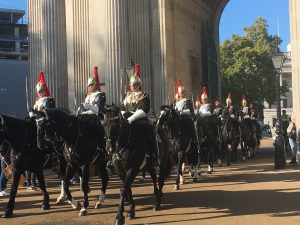
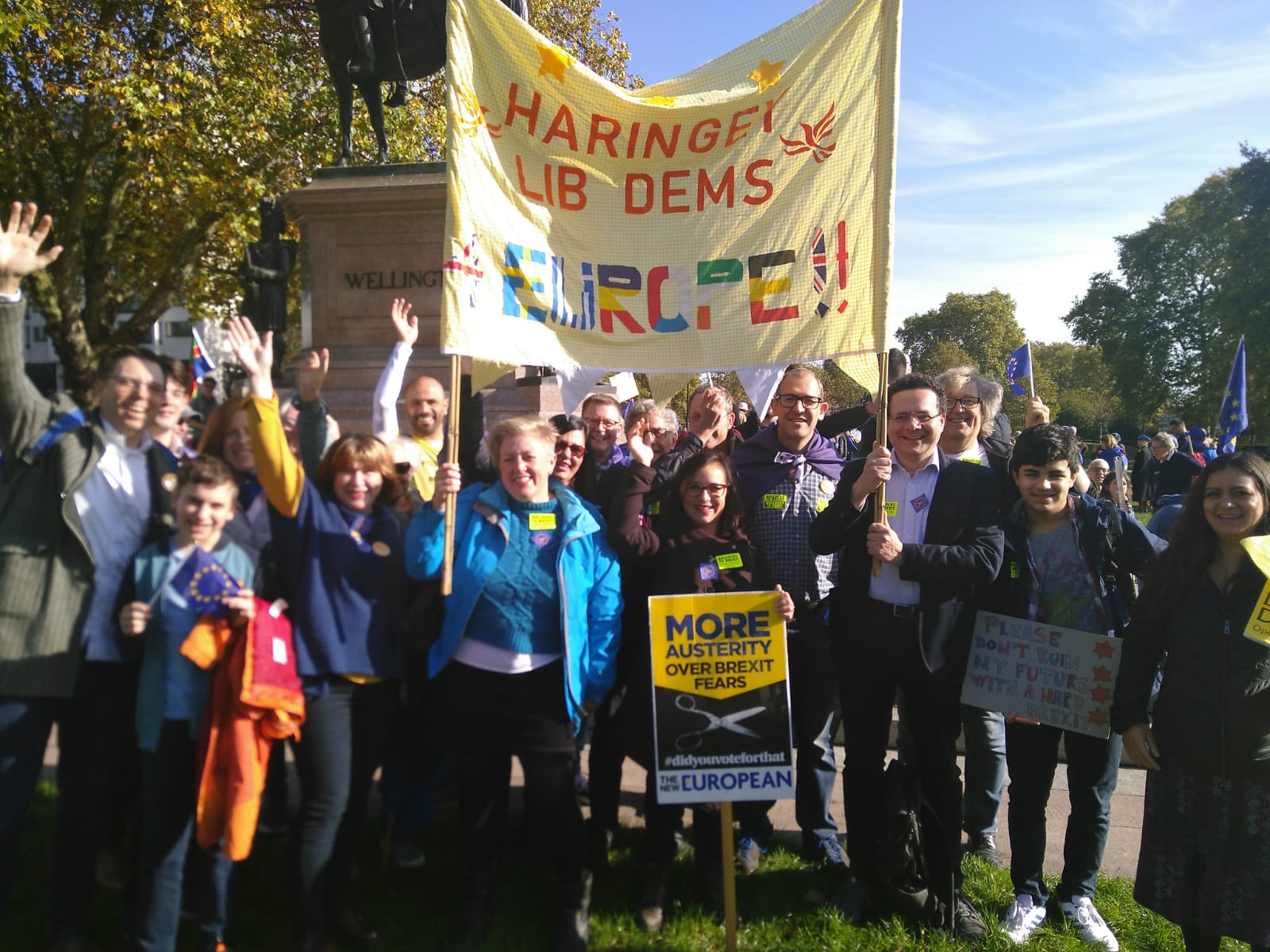
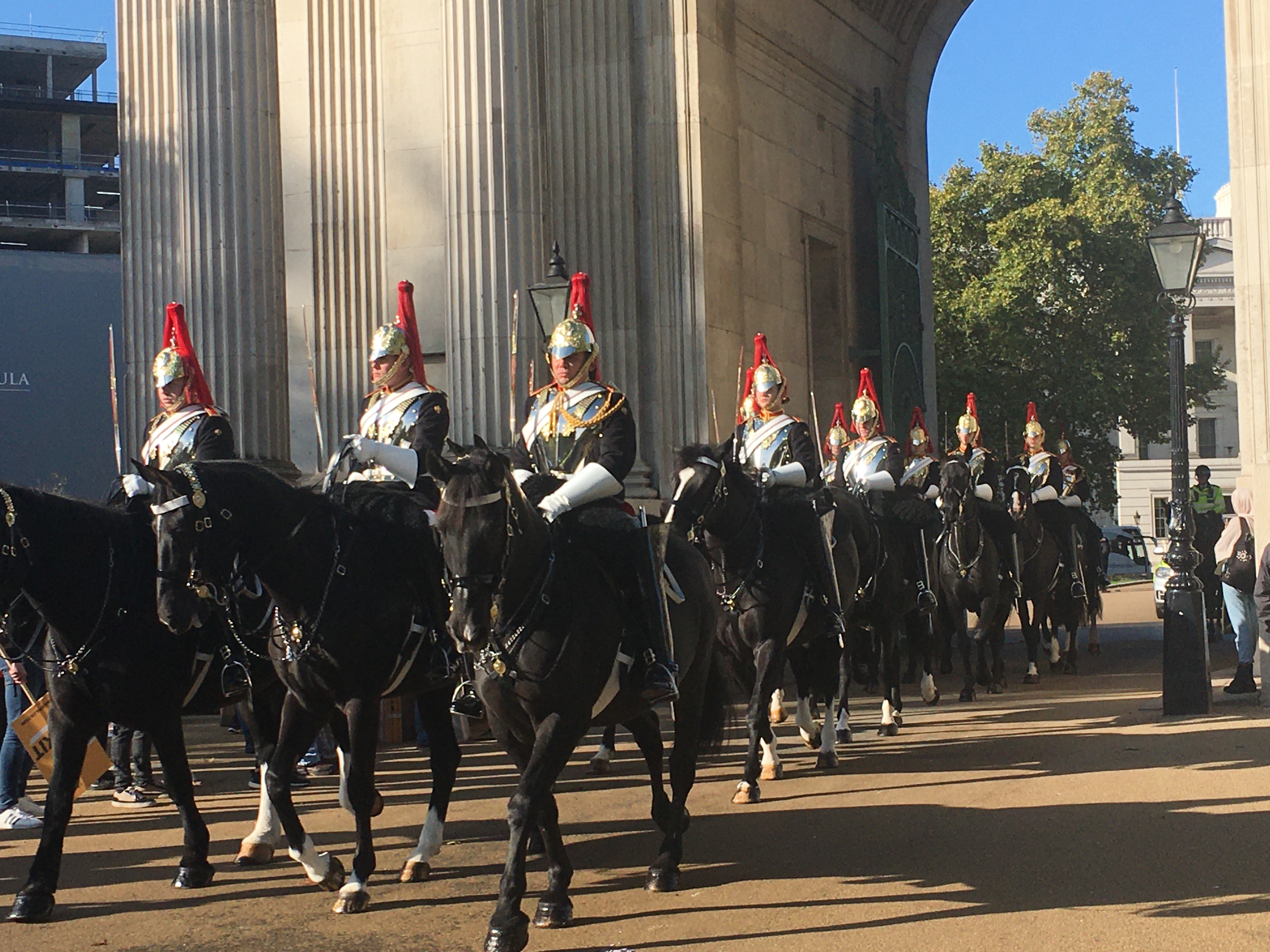
I was not expecting this as I arrived to pick up my placard at Wellington Arch.  It was quite a strange sight to see an example of British pomp next to Lib Dems in Bollocks to Brexit t-shirts.

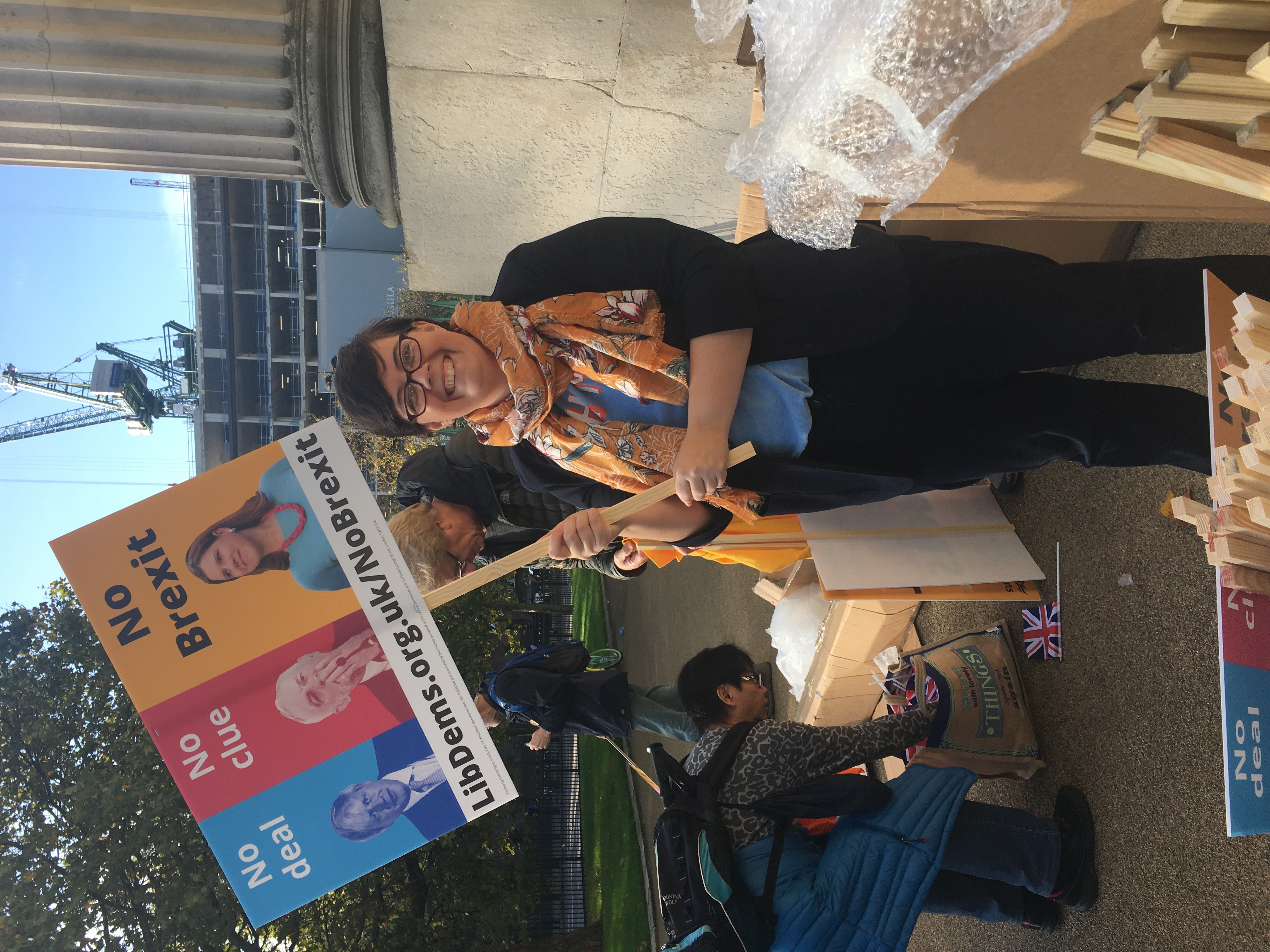
Sal Brinton was there to greet the Lib Dems who were turning up to march and Claire Halliwell was handing out a huge supply of placards. I enthusiastically grabbed one of the “No plan, no clue, no Brexit ones” which I thought were stunning.  At the front of the march, Lib Dem MEPs were gathering to lead the Lib Dem contingent while their Westminster colleagues were a wee bit busy.

It was so good to see so many Lib Dems from all over the country. I spent time with people from Sheffield, London, Glasgow, Torbay and Huntingdon. The latter group included  their PPC and regular LDV contributor Mark Argent who told me that he had been on Masterchef back in 1995. So we all want to go round to his house for dinner now.

The march had a huge pall of anxiety about it. Previous occasions had been much more joyful and hopeful, but on this one, we really didn’t know what was going to happen in Parliament.

There was one moment on the march where I almost ended up in tears. Someone sang Ode to Joy from a PA system as we were walking down Pall Mall. The way I felt reminded me of the last days of the Scottish independence referendum when it felt like my country was about to go through a damaging break up.

Siobhan Benita’s face when the Letwin Amendment passed was a joy.

Despite that outcome yesteday,  we are still at a moment of huge danger. The reasons this deal is terrible are getting lost in the “Get Brexit Done” and various toy-throwing episodes from the Prime Minister. Workers’ rights, environmental protections and the basic integrity of the UK are under threat. The idea that this could pass without us getting our say on it is one of the worst democratic outrages I have ever seen.

PPCs Richard Flowers and Lisa Maria Bornemann told me why they were marching:

Posted in News | Tagged | 2 Comments

Lord Martin Thomas writes: Building a justice system that offers rehabilitation and hope

No one will forget the pictures three weeks ago of the shaven headed prisoners  clad in orange trousers, sardined together in an improvised prison cell in Northern Syria. Nothing to do except exist. They were captured ISIL fighters, at least a third of whom were foreigners, including British citizens, who had flocked to join the caliphate. My sympathy for them is non existent.  Their captors, the Kurdish SDF, regard them as a time bomb and in the events of the last few days, can no  longer guarantee to hold them. But it was their eyes that caught my attention.

I have seen eyes like that before. In the early eighties, I was privileged to tour the Vietnamese Boat People’s heavily guarded camps in Hong Kong where refugee families were warehoused in three storey high, square steel pods, awaiting endlessly to be processed. They had nothing to do. My Report, made for the Leader of the Liberal Party, Lord Steel, and passed to the British government, was according to my UNHCR contacts at the time, influential in opening the gates of the camps to permit the males useful daytime work within the HK community.

Contrast Death Row in a Caribbean country, where 180 men sentenced to death stood around in a compound built for fifty and despaired. The opposition campaigned vigorously for the abolition of appeals to the Privy Council  so that the gallows at the end of the building could do their work. Why bother with rehabilitation?

So it was with some weariness that I heard again the proposal in the Queen’s Speech to waste the limited resources of the Justice Department on lengthening sentences of imprisonment, instead of focusing on running the jails properly, killing off the drug trade, and making a real effort to release into the community people who will not offend again.In 2014, with the active support of the Liberal Democrats in the Welsh Parliament, permission was granted for the Berwyn training prison to be built on the Industrial Estate of my home town, Wrexham. I was intrigued because in my youth, I had worked on that very site as a member of a railway gang with my pick and shovel. We were replacing wooden war time sleepers with concrete supports. I know the area well. I watched the buildings go up to open at a cost of £250 millions as the largest operational prison in the UK and the second largest in Europe. Here, I thought, was the opportunity with the excellent modern design and facilities, really to do something to tackle attitudes, to change people’s lives, to turn prisoners away from crime.  All “rooms” have integral sanitation, a shower cubicle, a PIN phone, and a UniLink laptop terminal. It opened in February 2017. It is designed to hold up to  2106 prisoners serving 4 years or more.

Posted in Op-eds | Tagged and | 6 Comments

Jo Swinson on “What’s next?”

Embed from Getty Images
Use the arrows above to see a slide show of today’s People’s Vote march

After today’s historic session in parliament, which has extended PM Johnson’s unblemished record of defeats, Jo Swinson has written to party members with the following summary:

After today’s votes, the fight to stop Brexit continues.

Hundreds of thousands of people are marching outside Parliament, where I’ve just finished voting, to demand a final say.

After today’s votes, Boris Johnson must obey the law and send a letter asking for Article 50 to be extended.

Posted in News | Tagged and | 65 Comments

Norman Lamb: I can’t vote for this deal

Norman Lamb has been part of the MPs for a deal group in Parliament. He has from the start wanted us to agree the least damaging form of Brexit.

This morning he has tweeted a short video to explain that he will not be supporting this deal.

I think it is important to acknowledge how hard this will have been for him and to reflect on what he has said about the abuse he has received. We are better than this. Watch here.

Posted in News | Tagged and | 34 Comments

What will MPs be voting on today?

As MPs meet to discuss the nation’s course for the next few generations, I thought it might be useful to go through the Order Paper.

First up is a statement from the Prime Minister followed by a vote on the deal itself.

There are a number of amendments to the motion. The SNP’s Angus McNeill has put down a straightforward revoke one. The rest of the SNP has put down an amendment calling for an extension and a General Election. They would prefer to get that over now than have it happen at the same time as Alex Salmond’s trial, currently scheduled for January.

The crunch vote will come on the amendment put together by Oliver Letwin and co-signed by the Rebel Alliance of Lib Dems, Hilary Benn, Dominic Grieve, Stephen Gethins and others. This would basically note the agreement and call for an extension to put it in legislation – so it can be amended by all sorts of things like a People’s Vote at some point in the future.

Posted in News and Op-eds | 7 Comments

The last time the House of Commons sat on a Saturday

I remember the last time the House of Commons sat on a Saturday. It was in the immediate aftermath of Argentina invading the British Falkland Islands. The British Government had pretty much neglected the islands and their inhabitants, who didn’t want to find themselves under Argentinian rule.

I was 14 years old.

I spent the 1982 Easter holidays decorating my bedroom under instruction from my Mum with the new radio station Moray Firth Radio playing in the background. On the hourly news programmes, syndicated from Independent Radio News, Anna Soubry gave us up to the minute accounts of what was happening 8000 …

Posted in Op-eds | Tagged , , and | 5 Comments

The one thing about this Brexit deal that everyone should know

Basically it is being sold to the ERG as staking the ground for no deal in a year’s time.

https://twitter.com/peoplesvote_uk/status/1185160014421299200?s=20

Posted in News | Tagged | 8 Comments

Daisy Cooper on why Boris Johnson’s deal is so bad for our country

I first met Daisy Cooper when we both had tea with Tim Farron in Portcullis House as newbie Federal Executive members at the end of 2012.

She is someone who has no problem with speaking truth to power and she quickly became a very trusted colleague.

I hope very much that we’ll have her as the MP for St Albans after the next election. She has put in so much work. She reminds me of Jo Swinson when she was campaigning to win East Dunbartonshire in 2005.

Today, she put a brilliant analysis of why Boris Johnson’s Brexit deal is so bad on her Facebook page. With her permission, here it is. Share widely.

The PM’s so-called ‘deal’ is an attempt to pull the wool over peoples eyes and deliver a hard no-deal BREXIT by the back door. Worse still, it deletes the UK’s commitment to workers rights and environmental standards, which Johnson’s Conservative would happily trash. Here are three important facts:

1. Voting for Johnson’s deal is voting for No Deal in a year’s time. With no backstop (which ensured a soft Brexit), if Tories fail to get a hard Brexit Free Trade Agreement, it’s no deal at the end of 2020, as ERG will never vote for the transition to be extended.

2. Johnson’s Deal is bad for workers’ rights and the environment. The commitment to a “level playing field” by adopting these EU standards has BEEN DELETED from the legally binding Withdrawal Agreement and now appears only in the aspirational Political Declaration.

3. Otherwise the deal still has all the flaws of Theresa May’s Deal. It introduces red tape bureaucracy as the UK will have to collect tariffs for the EU (derided by Johnson himself a year ago as a “crazy system”). It puts a border down the Irish Sea. It hastens the break-down of the Union and the UK (with Scotland already saying it wants the same advantages as NI, which will be subjected to an emulated customs union & single market arrangement). And it will open the door to smuggling, which will fund criminality and dissident activity. Northern Ireland is so divided it’s assembly isn’t even sitting at the moment – now it will have to uphold an international treaty and, whether it likes it or not, will have to hold “border polls” (referenda) every few years, and/but not until 2025.

Posted in Op-eds | Tagged and | 2 Comments

Electoral fraud – the truth about personation

I doubt that one in a hundred readers of LDV have ever heard of a tendered ballot paper, let alone seen one.

Electoral law makes provision at EVERY election for the issue of tendered ballot papers, sometimes known as pink ballot papers.

If you go down to the polling station to vote and the presiding officer says to you, “I’m sorry, but I can’t give you a ballot paper because you’ve already voted”, what do you do? The answer is that you can insist that you haven’t voted, and the presiding officer must then offer you a ‘tendered’ ballot paper. This is the same as the white ballot paper, but for two things.

  1. It is a different colour (usually pink)
  2. It is stored separately from the white ballot papers.

How is it counted? The answer is that it isn’t, unless the election is challenged in an electoral court. In that case, the original ballot paper is found and compared with the tendered ballot paper and the tendered paper is the one that is counted. Now of course you might quite correctly argue that this breaks the secrecy of the election, but it does give an element of protection against personation, that is the attempt to impersonate a voter and vote instead of him/her.

I have been involved in an election where tendered ballot papers were issued. This was in a big city in 2008, in a local election where the Lib Dem candidate lost by less than 120 votes. The election had many strange features, but it became clear that a party had engaged in personation by finding out who wasn’t going to vote and sending someone to vote for them. Following this narrow win, I asked the returning officer if there had been any tendered ballot papers issued and there had. He also told me it happened in many wards in the city.

Posted in Op-eds | Tagged , and | 17 Comments

Three reasons to back Mark Pack for President

When I first met Mark Pack almost three decades ago he made quite an impression. I was campaigning to become Chair of what was then the Young Liberal Democrats and attempting to secure his support. Unlike most others at the conference, Mark did not seem particularly interested in the hackery of student politics, but wanted to know what I was going to do, rather than simply what I thought, or what faction I was in.

I’ve no idea if Mark voted for me, but I’d like to think he did.  And 28 years later, with the roles reversed, I’m delighted to say I will certainly be backing Mark to be our next President.

There are three main reasons why I believe Mark is the stand-out candidate.

Firstly Mark is a born campaigner and communicator. His record within the party is unrivalled, both as a trainer and advisor and also as a foot soldier. There aren’t many places across the country where Mark hasn’t delivered an expert training session or a bundle of leaflets, or in many cases, both. I’ve attended his sessions and also trained alongside him. He motivates people and knows his stuff.

Our party is at a crossroads, with so many members, both old and new, impatient to grasp the current political opportunities and meet the social, economic and environmental challenges facing us today. With his core vote strategy, Mark has been ahead of the curve in seeking to build our support across the country.

Secondly, Mark knows the party inside out. He understands the different needs of members geographically, demographically and politically. Importantly to me as a councillor for the past 24 years and now a council leader, I know that Mark recognises the huge role of local government. He understands localism and knows that much of the excellent campaigning going on in the Lib Dems is outside any Parliament. 

Posted in Op-eds | Tagged , , and | 3 Comments
Advert

Recent Comments

  • Tim
    Hywel - the source of the "Norwegian gas is cleaner than UK gas" is here - https://www.petro-online.com/news/fuel-for-thought/13/sp-global/two-thirds-of-uk-and-...
  • Jason Connor
    No that was Nick Clegg in full flow on tuition fees....
  • Jason Connor
    I couldn't agree more with the first 3 posts. I heard a figure of 75% of households still use gas. The council stopped installing heat pumps on my estate as the...
  • Hywel
    "According to the regulator’s own figures, pipeline gas from Norway is produced with less than a third of the emissions of Britain’s North Sea output." W...
  • Chloe
    Well said David. There are 20 million gas boilers in the UK & not everyone has a spare few grand to change to heat pumps or have a suitable system that enab...