There is something corrosive happening in British politics. Not in any single policy decision, nor in any one government department, but in the way governing itself now seems to unfold with these latest U-turns. U-turns are not, in themselves, a sign of bad government. Sometimes they reflect learning, listening, or legitimate correction. But when reversals become habitual and almost ritual; they point to a more serious problem: a politics that has lost confidence in its own ability to persuade.
This provokes a very deep question: Are we becoming ungovernable?
In a country that feels increasingly fractious, and perhaps voters that might something you’d hear from a “Yes, Minister” episode ‘unreasonable’—but I think more broadly it comes down to this; politics has lost the art to argue, persuade, and inform.
With the latest U-turn on ID cards on top of the recent U-turn on business rates on pubs and then on the farmers tax; all policies I am glad they amended or dropped; much ink has been spilt on describing Starmerism as managerialism politics with seemingly lost the capacity to manage. Managerial politics, at least in its classic European technocratic sense, while yes technocratic all involved something crucial: the willingness to stick with unpopular decisions under the claim—sometimes arrogant, sometimes justified—that the experts knew best and benefits would follow in time.
Seeming here in the UK, we see not a technocracy but a politics hollowed out by hyper-responsiveness. A governing style so attuned to opinion polls, and social media sentiment that it has lost any sense of anchor. Policy announced, floated by rough seas of public reception, before immediately being parachuted out before the ship sailed—less like a programme for government and more like A/B test.
The BBC faces two existential crises. The first is obvious: the licence fee is dying. Younger audiences don’t watch linear TV. Coverage is declining. Enforcement costs over £100m annually to prosecute people who can’t afford £174.50. Within a decade, the model collapses completely.
The second crisis is worse: nobody trusts the BBC’s independence anymore. And why would they? Ministers appoint the Board. The government sets funding levels. Every charter renewal becomes a hostage negotiation where editorial freedom trades for financial survival. Trust in BBC impartiality has fallen 15 points since 2018. The public sees the strings.
Charter renewal in 2027 offers the chance to fix both problems structurally. Not tinkering with board composition or modest fee reforms, but genuine liberal reform: progressive funding and democratic independence.
Replace the Poll Tax with progressive taxation
The licence fee is a regressive poll tax. A nurse and a banker pay the same £174.50 regardless of income. That’s illiberal and unsustainable. We should replace it with a Digital Services Tax on companies profiting from content infrastructure.
Netflix, YouTube, Meta, Amazon, Disney+, Spotify: these corporations extract billions from UK users whilst routing profits through tax havens. Make them contribute, with 3-5% on UK revenues over £25m, and infrastructure providers and device manufacturers paying lower rates.
This raises £2bn annually. Combined with BBC Studios’ commercial revenue (£1.5-2bn from international sales), that’s £3.5-4bn total, which maintains current funding levels.
The liberal case is straightforward: progressive taxation replacing regressive levies. Those with greatest capacity pay proportionally more. Nobody gets criminalised for being poor. Universal access replaces means-tested exclusion.
Plus, it’s popular. Taxing profitable tech corporations polls well across the spectrum. And it’s sustainable: revenue scales with the growth of the digital economy, with no political negotiations required.
As previously stated in my piece, “In praise of destabilising tyranny“, it has been incredibly encouraging to see and hear Ed Davey be so vocal about his support for the Iranian protestors, as well as hearing the UK government voice its support and Conservative Party leader Kemi Badenoch, too. This is an issue that transcends political boundaries and strikes at the heart of our principles: democracy, human rights, and freedom.
It is with that same sentiment that I believe, on the matter of Iran, Donald Trump is right to strongarm the theocratic regime into backing down on executing citizens, and openly supporting Iranian citizens.
A jarring statement, for sure. There is so much that Trump has done and is doing that is beyond contempt, and he is by no means a good man. But multiple moralities can co-exist in the same space: Trump is wrong for his desire to capture Greenland, his isolationist approach to handling Venezuela, his appeasement of Russia, his multiple felonies, on top of literally everything else he has said and done. But on this particular issue, when it comes to tackling the Ayatollah’s dictatorship, he is right, and we would be right to stand with him.
I am allergic to attempts to define Liberalism and the role of Liberal Democrats in terms of “the centre”. If I thought Liberal Democrats were only aspiring to be a centre party I would have left years ago. More than sixty years ago I joined a party whose leader regularly described the Liberals as a “non-socialist radical alternative.”
In recent years the left/right terminology (which goes back to the French Revolution in the late eighteenth century) has become even less useful than it was in the Grimond era. The same may be said of “centre-ism.” Even if we take seriously the old left/right spectrum, the centre is a slippery place for doing politics because it moves as parties move who may or may not see themselves as in the centre.
I think the “One Nation Conservatives” who are now becoming an endangered species, understand this. They see themselves as belonging to a mainstream Conservative tradition for whom crude populism is anathema whether it is expressed through Reform or from within their own Conservative party.
I suspect the temptation to want to occupy some sort of centre ground belongs to a pattern now coming to end in which politics was dominated by Labour and Conservative parties who expected to get their turn at governing. This went with a see-saw model. For a sizeable chunk of the electorate it was relatively easy to see Liberals as the party which was not Labour or Conservative.
This week’s reports of Iranian security forces machine-gunning down scores of unarmed protestors, apparently including children and teenagers must surely strike a chill in the heart of any liberal. How can this be allowed to happen in the 21st Century? Meanwhile, the US military action in Venezuela has attracted widespread condemnation as a breach of International Law, despite Maduro’s Government being widely recognised as authoritarian and morally illegitimate.
In moral terms, the Iranian regime is little different from a bunch of criminal thugs with guns, killing whomever they please. But in International Law, they are the legitimate Government (largely by virtue of, they are the ones who managed to seize control in the country), and therefore international law sides with the thugs, not with the people being killed. Just as on the other side of the World in Venezuela, International law condemns the removal of a dictator who has driven a quarter of his own people into exile as refugees!
Why is this? Well, Article 2(4) of the UN Charter enshrines a near-absolute prohibition on the use of force, subject only to self-defence or Security Council authorisation, which is next to impossible to achieve under the veto system. It’s written that way because it’s designed to stop tanks crossing borders: to prevent wars between nations, reflecting the concerns of the 1940s, rather than to protect people from trigger-happy governments. The unfortunate upshot is that when a state massacres its own citizens, international law permits other states to do little more than investigate or condemn. And mere condemnation is impotence if the law does not permit any action that might actually be effective in protecting the people being massacred.
Worse still, the Security Council veto system is no accident. It was deliberately designed to give a handful of powerful states permanent control over when international law is enforced, thereby protecting the interests of those states.
By Edward Marsh
| Tue 13th January 2026 - 12:13 pm
The plates of British politics are drifting like never before, populism on the right and the left creating a chasm at the heart of the centre ground; now is the time to sprint towards it, claim it, and take the once in a generation opportunity to become the radical centre. Being noticed doesn’t need to be the next stunt, great ideas will suffice.
In an era defined by uncertainty, Liberal Democrats face a defining challenge: whether to speak plainly and bravely about the issues that most shape people’s lives and suggest radical reforms, even when those issues are complex, controversial, politically challenging, or indeed, a combination of these. Immigration, the economy, defence, health and yes – the welfare state, are not easy topics. They provoke strong emotions, expose internal disagreements, and invite fierce scrutiny. But they are precisely the areas where clear, liberal values are most needed in today’s Britain, and where populism is currently winning on messaging.
For too long, politics has rewarded evasion in a world dominated by the boiled down semblance of detail. Soundbites replace substance, and difficult trade-offs are glossed over in favour of comforting slogans. Yet voters are not naïve. They understand that governing a modern country involves choices, compromises, and sometimes uncomfortable truths. A party that is honest about this can earn trust—even from those who disagree. However, clarity and decisiveness are imperative in the face of populism, messaging on the country’s biggest issues is where we are often left wanting.
I was on GB News early this morning, setting out why I agree with Ed Davey that X should be suspended, pending an investigation into Grok.
Some readers may not relish the idea of me appearing on GB News. It is a channel many liberals feel uncomfortable with, and not without reason, but liberal voices simply cannot afford to be absent from platforms we find awkward, or from debates where the loudest contributions too often go unchallenged. If we genuinely believe in open argument, democratic accountability, and the contest of ideas, which I hope we do, then we have to be prepared to show up-not just where it is easy to do so, but where it is difficult.
That is why I’m grateful to have appeared on The Late Show Live with Ben Leo a little after midnight, debating with the IEA’s Reem Ibrahim to make the calm, liberal case for why X should indeed be temporarily suspended until it gets its house in order over Grok.
Predictably, the response from some was to cry “censorship” and invoke “free speech” as though it were an absolute trump card.
But liberalism is not libertarianism and has never meant free speech without responsibility. Free expression does not exist in a vacuum. It sits alongside other liberal values: consent, dignity, accountability, and the rule of law. When powerful actors ignore these values, it is not illiberal to respond – it is necessary.
At the heart of the current controversy is Grok, X’s AI system, and the way it has been rolled out without adequate safeguards, transparency, or ethical restraint. This is not about being hostile to technology. Liberalism does not fear innovation. But it does insist that power – whether political, corporate, or technological – is exercised responsibly and is subject to scrutiny.
What makes the Grok issue particularly disturbing is what it allows in practice. Users are able to generate/change/distort images of real people (of all ages) without any meaningful form of consent from those being depicted. These images can be misleading, degrading, or sexualised. This is not a hypothetical concern or a fringe misuse. It is exploitation, plain and simple-the digital appropriation of people’s likenesses without their permission, control, or recourse.
Last week, I opined in these pages that intergenerational fairness should be a liberal priority. A commenter rightly challenged my suggestion that pensions be linked to CPI: poverty is measured relative to median earnings, not inflation. CPI-linking would let pensioners fall below the poverty line even as their purchasing power held steady — precisely what happened after 1980.
The correction clarified my thinking. If relative poverty matters — and it does — then benefits should track earnings, not just prices. The triple lock gets this right for pensioners. We should extend the same logic to everyone else.
* * *
I should acknowledge I muddled two concepts worth distinguishing. Destitution is absolute — the inability to afford essentials like heating, food, and shelter. Poverty, as officially measured, is relative — household income below 60% of the median. A person whose basic bills are covered is not destitute. But fall below that threshold and you are, by definition, poor: unable to afford what society considers normal.
That exclusion is real. It shows up as hesitation over a grandchild’s birthday present, or quiet withdrawal from social life. The triple lock exists because we decided pensioners should not face exclusion.
The mechanism embodies a sound principle: benefits should keep pace with living standards, not merely with prices. The earnings link achieves this. The CPI floor provides protection against inflation shocks. These two elements — earnings-tracking with inflation protection — form defensible policy.
We will be fighting for the young people of our country if we demand that the government declare this year a national emergency to provide thousands of new houses, especially affordable homes, before the next General Election.
The house price-to-earnings ratio shows that in 2024-25 a home cost roughly 8 to 9 times the average individual wage to buy, compared to about 5 to 6 times twenty years ago. With private rents additionally being so high now, it is small wonder that, even if they are working full-time, many young people in Britain are these days remaining in their parental home into their 20s and even 30s. With house prices only reducing slightly recently, the need for rapid provision of more small affordable homes for young people, whether for single people or couples, is evident. But much more evident are three or four-bedroom Executive-type houses being built on new estates country-wide.
The government after its election promised to build 1.5 million new homes by 2029, and pledged in July it would build up to 300,000 affordable homes over a decade, 60% of them for social rent. Our own party’s policy, passed at the Bournemouth Conference in September 2023, is for 150,000 social homes (that is, homes costing less than 50% of current market value) to be built every year by the end of the next Parliament. Neither the government’s pledge nor our own party’s policy look at present remotely attainable.
Iran was once a society that embraced egalitarianism, was open to working with the West, and boasted natural resources that made countries like Japan reliant on partnerships to secure national energy security. The Pahlavi dynasty, albeit an absolute monarchy, oversaw this modernisation against a backdrop of press repression and the use of secret police to suppress opposition against its rule.
Back in 2008 when I first joined, Twitter was a lifeline for me. I had Glandular Fever which knocked me out for months and it was incredibly isolating. But here was a community of people I could communicate with in real time, many of whom became friends in real life.
There was the Formula 1 crowd. My life was made when then Brawn driver Rubens Barrichello replied to me.
Of course there were the growing community of Lib Dems – and Jo Swinson was quickly recognised for her authentic use of the platform not just as a broadcast mechanism, but a means of engagement.
Back then, it was truly fun, though looking back, I can’t believe I did one of these things:
Where else, before you’ve even got out of bed in the morning can you:
give Nadine Dorries some advice on how to tweet pictures from her Blackberry (not in the same league as my friend Sarah (@soggous) who recently helped Jenson Button’s girlfriend fix her Mac, mind you);
engage in intelligent discourse about the relative merits and demerits of Google Wave which included the phrase, from Charlotte Gore, “It’s collaborative, rich media, non-linear communications!”?
However, in recent years, it has become a much darker, more sinister place where dangerous misinformation and prejudice is spread with impunity. This week, confirmation of a new low came.
The posts offer a new level of detail on how the images are generated and shared on X, with users coaching one another on prompts; suggesting iterations on Grok’s presentations of women in lingerie or swimsuits, or with areas of their body covered in semen; and asking Grok to remove outer clothing in replies to posts containing self-portraits by female users.
Among hundreds of posts identified by Nana Nwachukwu as direct, nonconsensual requests for Grok to remove or replace clothing, dozens reviewed by the Guardian show users posting pictures of women including celebrities, models, stock photos and women who are not public figures posing in snapshots.
While the platform later clarified it would limit this facility to paid users, this really is not enough. Think about it? You can abuse women’s privacy if you can afford to pay a relatively small sum per month. That is not ok.
All this was too much for the UK Parliament’s Women and Equalities Committee who announced that it would be withdrawing from the site. The Committee’s vice chair, our own Christine Jardine has also left as reported in The Guardian:
Another, the Liberal Democrat MP Christine Jardine, said she was leaving the platform, calling the images generated by Grok “the last straw”.
Jardine said she had taken the view that X was a good way to communicate with constituents. “But I cannot in all conscience continue to use a platform which seems unwilling to act against this grossly offensive and abusive online behaviour towards women and girls,” she said.
In the past couple of days, Lib Dem MPs including Lee Dillon, Martin Wrigley, Tom Morrison, Vikki Slade, Caroline Voaden, Danny Chambers have said that they won’t be posting any more.
Our Mark Pack used a House of Lords question tochallenge the Government to reduce its use of X.
This is the first post in probably 15 years where my Twitter profile has not been linked to my profile on here. I have severely cut back on my Twitter use in recent years and hardly ever post, preferring Bluesky instead.Similarly, at Lib Dem Voice we have been winding down our use of X and preferring our Bluesky profile instead.
The shooting of young mother Renee Good this week in Minneapolis has further exposed the divisions in a fractured American society and President Trump’s determination to exacerbate rather than heal them.
Anyone who watches one of the many videos—or reads the eyewitness accounts—can only conclude that Ms Good was murdered by an ICE agent.
She was clearly driving away from a confrontation with the agents who were in Minneapolis as part of a politically motivated round-up of ethnic Somalis. As she was turning away from the armed agents, one of them fired through the car window and shot Ms Good in the head. A doctor then rushed forward to try and administer first aid but was blocked by the agents.
President Trump, Homeland Security Secretary Kirsti Noem, Vice President J.D. Vance and Attorney General Pam Bondi have rushed forward to claim that the agent fired in self-defense because Ms Good was trying to run him over. They have also claimed—without any evidence—that Ms Good was a professional left-wing agitator. Vice President Vance has gone so far as to falsely claim that the ICE agents are protected by absolute immunity because they are federal agents.
White House press secretary Karoline Leavitt increased the attack on Good even more by telling White House correspondents: “The deadly incident that took place in Minnesota yesterday occurred as a result of a larger, sinister left-wing movement that has spread across our country, where our brave men and women of federal law enforcement are under organized attack.”
The administration’s line has been picked up and repeated parrot-fashion by Fox News and the Republicans in Congress. Democrats and the bulk of the rest of the media have attacked ICE and the administration. The people of Minneapolis have taken to the streets in their thousands. Their action is being mirrored in other US cities. In Portland, Oregon two more people have been wounded.
President Trump had a personal message for ICE agents in the wake of the shootings: “It’s time to get rough.”
Iran
The Iranian authorities have shut down the country’s internet. The reason is quite simple: they don’t want people—inside and outside Iran—to know how many protesters they are about to kill.
And they are killing them. After protests in 2019 several hundred protesters ended up in their coffins. Human rights organisations reckon that 40 were killed before the internet was shut. The BBC has confirmed 20 of the deaths.
The country’s Supreme Leader, Ayatollah Ali Khameinei, has said that the thousands who have taken to the streets of Tehran, and at least 50 other towns and cities, are a “bunch of vandals” trying “to please” the US.
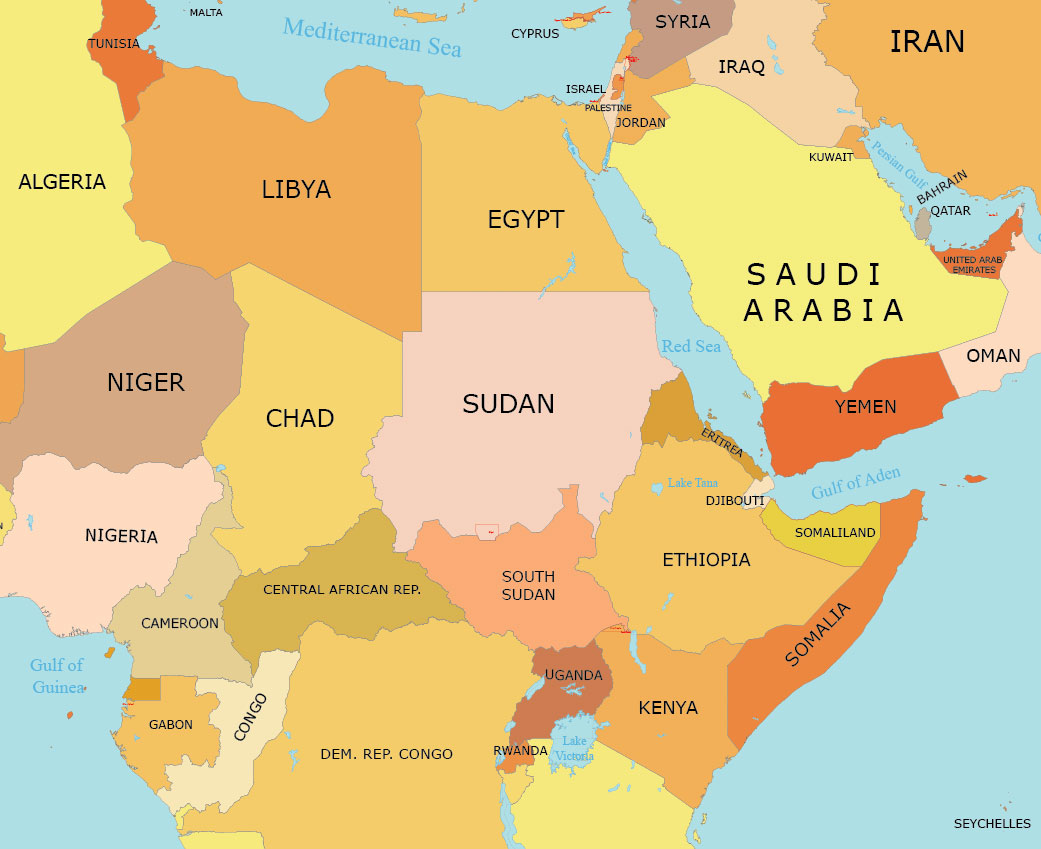
This small but strategic former French colony sits at the Red Sea gateway to the Suez Canal, overlooking the narrow Straights of Mandeb. It is famously home to a port serving Ethiopia and hosting the huge multi-agency Camp Lemonnier base for the US and in part the UK, with 4000 staff. However over the last 15 years Chinese companies have dominated and they also have a large Red Sea military base there, a short drive from Lemonnier, allegedly staffing up to 10,000 personnel.
Proposals for a bridge between Djibouti and Yemen, enriching this poverty-stricken area, have been many times scuppered by conflict. The Chinese take over of port facilities prompted DP World (Dubai, UAE) to develop the Berbera port in Somaliland, and potentially the small Bosaso Port in Puntland.
SOMALIA
After achieving independence in 1960 from Britain (Somaliland) and Italy (Puntland, South-Central Somalia), Somalia has been riven with conflict, especially since the collapse of the ‘unified’ government in 1991. There has been no stable government since, although Somaliland has been somewhat less in turmoil. A local movement emerged to settle local disputes, the Islamic Courts Union, but after 9/11 in the US this was seen as problematic.
With Western encouragement Ethiopia invaded in 2006, but were repelled in 2009 by a nationalist tribal movement, Al Shabab, which still controls much of ‘South-Central’ today, despite monthly US bombing. Right wing factions in the US have lobbied for recognition of Somaliland after 2009, but this came to nothing until December 2025 when Israel recognised Somaliland as a separate country, gaining a series of beneficial concessions. This had added to tensions between the UAE and Saudi Arabia, with the latter ‘less enthusiastic’ about such recognition, notably concerned about the possibility of Israeli bases both at the north and south ends of the Red Sea, inter alia.
ETHIOPIA
Apart from the Afar and Somalia regions in the East, Ethiopia is a landlocked, fertile, mountainous country, reliant on Djibouti for external trade. The country is divided into regions based on different ethnicities and their languages, which has led to ethnic-based internal conflict in the post-Italian-colonial-era, hindering development. Nearly two thirds are either Omoro or Amhara. One in eight Ethiopians is either Tigrayan or Somalian with affiliations to Eritrea and Somalia respectively.
The rules-based world order has been the cornerstone of international diplomacy since the end of World War Two. It is surviving by the friction of inertia alone, and many argue that we have already slipped into the abyss of the unknown.
The ancien régime depended heavily on American support and direction. Donald Trump has indicated that providing that support is no longer in America’s interests. According to Stephen Miller, Deputy Chief of Staff in the White House and a Key Trump adviser, what counts now is not law, but raw power.
As he told CNN: “We live in a world… that is governed by strength. That is governed by force. That is governed by power.”
In early January, Trump demonstrated this approach when he effectively kidnapped Venezuelan president Nicolas Maduro and announced the takeover of the country’s oil reserves for the “foreseeable future.” In a separate move, he appears to be moving quickly to gain control of Greenland.
This coming week Secretary of State Marco Rubio is expected to fly to Copenhagen with a firm offer to buy Greenland. Trump has made it clear that if the Danes refuse to cooperate, he might consider “military intervention,” raising the prospect of conflict with a fellow member of the North Atlantic Treaty Organization (NATO).
Greenland is a self-governing territory of Denmark, which retains responsibility for Greenland’s defense and foreign affairs. The Danish government has emphasized that any decision regarding U.S. ownership would ultimately rest with Greenland’s 57,000 residents. The mainly Inuit population has said that it wants nothing to do with America and, in fact, seeks independence from Denmark. However, a country with such a small population would face significant challenges in defending itself.
A U.S. invasion of Greenland would be a serious blow to the international order. One of NATO’s fundamental principles is that allies respect each other’s territorial integrity. They certainly do not attack one another. An attack on, or annexation of, Greenland—a territory of NATO ally Denmark—would seriously undermine the credibility of the alliance. Since the end of World War Two, American leadership of NATO has helped sustain one of the longest periods of relative peace and prosperity in modern history. Peace in Europe has spread ripple-like throughout the rest of the world.
Oddly enough, there is no need for a clash over Greenland. Under the 1951 U.S.-Danish Defense Agreement, the United States can base as many troops as needed in Greenland, and Denmark has indicated it may also allow American access to Greenland’s mineral resources, although this could face resistance from environmentally-conscious Greenlanders.
While foreign policy circles in London are focused on Ukraine, the Middle East/Iran and now Venezuela, as well as the dramatic new US National Security Strategy, a set of interconnected lower key conflicts around the Red Sea are escalating. This has global ramifications, especially in relation to the two Red Sea ‘pinch points’ for Europe; the Suez Canal and the Straights of Mandeb.
These conflicts involve Saudi Arabia, UAE, Sudan, South Sudan, Somalia, Turkey, Israel, Yemen, Egypt, Ethiopia, Libya … and Eastern and Western land gateways to …
I have a dark and deeply embarrassing confession to make.
I once voted for Margaret Thatcher.
Please don’t rush to judge me just yet. I’m sharing this not to shock, but because it contains an uncomfortable truth about how people really make political choices – and what liberals ignore at our peril.
When I cast that vote, I was young and foolish – and politically uninformed. I didn’t grow up in a household where politics was discussed. My parents voted, but never said who for. Politics wasn’t taught in school, at least not in any meaningful way. I didn’t yet have the tools to ask the most basic questions of power: who funds this party? What does the leader actually believe? Who benefits from their policies – and who pays the price?
That leads to the first lesson. Citizenship education matters. Democracy only works if people are equipped with critical thinking skills, not just facts, but the habit of interrogation. Without that, voters are left to rely on shortcuts or haphazard choices.
Which brings me to the second lesson: visibility matters. At the time, Thatcher was already Prime Minister. She was familiar. I felt I knew her. And the human brain, wired as it is to minimise risk, usually prefers the known to the unknown.
We see the same dynamic today. Donald Trump’s rise was not just about ideology; it was about exposure. He was ubiquitous long before he entered politics. People felt they knew him, and familiarity breeds a misplaced sense of safety.
I hear a similar pattern emerging among younger voters in the UK. Many are gravitating towards Reform or the Greens, not because they’ve exhaustively compared manifestos, but because those are the voices that dominate their digital world. The larger parties are simply absent from their daily reality.
Ask yourself honestly: are you more likely to trust a party that speaks directly into the spaces you inhabit, or one whose existence barely registers?
The third lesson is the most uncomfortable of all. Voters are drawn to leaders with clear, coherent principles – even when those principles are deeply flawed.
The brain is a prediction machine. It wants to know what comes next. Leaders who behave erratically feel unsafe, in the same way an unpredictable caregiver feels unsafe. Consistency, even toxic consistency, can be reassuring.
For all his many faults, Trump usually tells us what he intends to do. He may not deliver on everything, but his underlying themes – self-interest, deal-making, aggression – form a grimly coherent worldview.
With the 2026 Senedd election now around four months away, Welsh politics has entered a new phase. Campaigns are taking shape, narratives are hardening, and for the first time since devolution, both the electoral map and the voting system have fundamentally changed. Old assumptions about “safe seats” no longer apply.
In Neath, that shift is particularly stark. Under the new boundaries, Neath now sits within the Brycheiniog Tawe Nedd, combining Brecon, Radnor and Cwm Tawe, Neath, and Swansea East into a single six-member constituency elected by closed-list proportional representation.
Recent polling for this new constituency points to a fragmented outcome: two Reform UK seats, two Labour seats, one Plaid Cymru seat, and one Green seat, with the Green replacing what had previously been grouped under a generic “Other” category. This is not a two-party contest, and it is not a temporary anomaly. It is a snapshot of a post-Labour political landscape beginning to take shape.
For the Liberal Democrats, the strategic question is therefore not how to force a late breakthrough in the final months before 2026. It is about positioning the party to inherit trust once the first wave of volatility has passed.
2026 is not the realignment; it is the signal
What is happening in Neath is not simply electoral churn. It is the slow unravelling of a political settlement that once bound work, unions, public services, and Labour representation together into a single political home.
That settlement is weakening, not because Neath has rejected centre-left values, but because Labour increasingly feels distant, defensive, and managerial in devolved government. The new voting system has not caused this; it has merely exposed it.
Plaid Cymru and Reform UK are the immediate beneficiaries of that break. Plaid offers national confidence and Welsh self-assertion. Reform offers anger, disruption, and a rejection of politics as it is. Both speak to frustration. Neither yet represents a settled governing alternative for towns like Neath.
Realignments rarely resolve themselves in a single election. Protest comes first. Consolidation comes later. The next Senedd election after 2026 is where voters will begin looking for a new political anchor.
In December I stood for Shinfield Parish Council. I came fourth, nine votes behind Reform UK, ten ahead of Labour. I am 38, work full-time, and have two children under seven. My Conservative opponents—both elected—had advantages I could not match; but above all, the time to knock on doors while I was at work or putting children to bed.
This is not a complaint about my own result. It is a diagnosis of a system.
British local democracy has become structurally inaccessible to working parents. Borough councillors in Wokingham receive £7,784 annually—less than £150 a week—for what amounts to a part-time job, and that figure stays frozen because raising it looks bad to council tax payers struggling with the cost of living. The result is a vicious cycle: allowances remain too low for working families to afford public service, so only retirees, the self-employed, and the independently comfortable can stand. They are not villains. But they are, increasingly, the only candidates.
The Liberal Democrats should find this intolerable. A party forged in the fight to extend the franchise cannot be content with democratic structures that exclude a generation—and we should be honest that too often, we have learned to live with them. When democratic participation depends on wealth, age, or free time, it is no longer equally democratic at all.
The exclusion runs deeper than council chambers. Consider the basic economics of the British state.
Thirty-one percent of children live in poverty. Sixteen percent of pensioners do (DWP Households Below Average Income, 2023/24). Child poverty has barely moved in twenty years; pensioner poverty has halved. This is not accident. It is policy.
Keir Starmer’s recent call for closer alignment with the EU was welcome. Naturally, he felt he had to add the qualification ‘if it’s in our national interest.’ He couldn’t bring himself to say that such an alignment might be ‘in the interests of the UK and Europe as a whole.’ Like John Major declaring ‘Game, Set and Match’ after securing an opt-out from the Maastricht Treaty, it still suggested an ‘us and them’ approach. But at least it was an acknowledgement that closer ties with Europe could be good for Britain, something that might seem obvious after a decade of post-Brexit economic decline.
The government’s recent decision to re-enter the Erasmus+ programme, discussed in LibDem Voice, was also welcome. But there’s still an ‘us and them’ approach even to the question of youth exchanges. It’s not difficult to detect an undertow of concern along the lines of: Won’t it lead to a flood of young good-for-nothings crossing the Channel and adding to our ‘immigration problem’?
If that seems unfair, consider this article from Politico published last October and discussing last May’s EU ‘reset’ summit and the question of joining the Youth Mobility Scheme. As Politico reported, the Chair of the Migration Advisory Committee, Professor Brian Bell, a professor of economics at King’s College London, declared that it was ‘utterly implausible’ that the government would sign up to a new youth mobility programme. He insisted that ‘many more Europeans would likely come to the U.K. under an uncapped scheme than Brits who would go abroad.’
In the manner of economics professors, he then went for statistics. ‘There are six or seven times as many Europeans as there are Brits. So if the probability of wanting to move is the same for Brits as it is for Europeans, you’d have seven times as many Europeans coming here as leaving in that world. Suppose 50,000 Brits wanted to go every year. The equivalent will be 350,000 Europeans arriving.’
There we are. According to the Chair of the Migration Advisory Committee, which certainly has considerable influence on ministers, net migration ‘could be 300,000 up in the first three years of the scheme, when you’re getting the new cohorts arriving, and you’d have a 900,000 additional people in the UK, once you got steady state, and that would be a big effect on net migration.’ ‘New cohorts’ – it sounds like Caesar’s armies crossing the channel two millennia ago. Suddenly the chance to share experiences with different parts of Europe has become a threatened invasion.
These figures, as the article makes clear, are highly questionable. For one thing, there are currently more European citizens leaving the U.K. than arriving — 95,000 a year in net emigration, according to the government’s own statistics. Doubtless part of the reason is that they’re fed up with being seen as invading cohorts. For another, such movements are never simply a matter of the size of the populations on each side of the Channel. Between 2014 and 2020, Erasmus took around 113,000 British students, while the U.K. hosted 190,000 EU students through the programme. That’s a ratio of less than 2 to 1, not 7 to 1. In any case, a Youth Mobility Scheme could be drawn up which will agree a cap on numbers.
It is with deep sorrow that I heard of the sad news of the passing of Gerry Gable (1937–2026) — a towering figure in the fight against fascism, racism, and the far right in Britain.
Gerry devoted his life to defending democratic values and exposing extremism, leaving a legacy that will inspire generations.
I first met Gerry during my time as a Liberal Democrat councillor and Parliamentary candidate, when I faced sustained attacks from the British National Party in Epping Forest and Brentwood.
One notable moment came when the BNP brought a complaint against me as an Epping Forest Councillor to the Standards Board for England over my description of them as “Nazis.” With Gerry’s guidance and support, I successfully defended my words, and the Board ruled that describing the BNP in this way was entirely acceptable within normal political debate. It was a landmark moment — showing that standing up to the far right, and calling out their ideology, was both right and lawful.
Gerry was best known as the founder and long-serving editor of Searchlight magazine, which he co-founded in 1975. Under his leadership, Searchlight became the definitive source of intelligence on the far right, exposing networks, funding, and tactics, and supporting campaigns that pushed fascists back from public life. From the 1960s onward, including his early work with the 62 Group alongside the likes of Sir Gerald Ronson (who later went on to form the venerable Community Security Trust), Gerry never stopped adapting to confront new forms of extremism.
The British government has been scrambling to keep up with the outrageous behaviour of the rogue superstate which happens to be our main ally and with which we claim to have a ‘special relationship’. Keir Starmer says that he had no warning of the attack on Venezuela which suggests that he has clean hands but no influence.
A subject much closer to Britain’s long term vital interests are forthcoming negotiations with the Trump Administration on technology. These talks will determine whether Britain is to be a digital and AI colony or retains some vestiges of sovereignty.
They affect our freedom to levy taxes. They affect our freedom to manage the flow of sewage contained in social media content being defended as ‘free speech’. They complicate any move to realign regulations with the EU. Furthermore, the allegiance of the leading tech companies to the Trump Administration makes any commercial deal highly political. And geo-political too since we are being pressed to choose between the two superpowers.
The pending negotiations build on the Economic Prosperity Deal under which the USA agreed to reduce Trump’s ‘Liberation Day’ tariffs to the baseline 10% (rather than the EU’s 15%) in return for various UK concessions. One concession was accepting a ‘poison pill’ limiting agreements with ‘non-market’ economies (ie China).
The next stage is a Technology Prosperity Deal which promises more digital infrastructure investment in the UK in return for more UK concessions on policy. The USA objects to the UK 2% digital sales tax and to the UK On-line Safety Act which is said unfairly to constrain US AI companies. Other irritants have included British demands under the Investigatory Powers Act, for Apple to break its end-to-end encryption.
Britain has a high dependence on US tech companies. Britain’s digital economy accounts for around 13% of GDP (manufacturing is around 9%). The digital economy in turn depends largely on the platforms and services of US tech companies. The new growth area is AI where US companies also dominate.
Dependence stems from the power of the algorithms used by the tech companies which can be manipulated to slant output to serve the interests of owners or the ideological prejudices of the Trump administration. The opaque decision-making processes of AI make subtle manipulation easier. The sheer complexity of AI also makes it easier to lock users into platforms which then become embedded and difficult to replace.
In principle, users have the option of using competitive alternatives which, in practice, are Chinese: platforms like Alibaba or Deep Seek for AI. But Chinese companies have difficulty meeting privacy regulations; and there are security and geo-political concerns. In any event the UK has already conceded to the USA an effective veto over Chinese involvement.
Over the past week, something alarming has been unfolding at British airbases. At least ten US C-17 cargo aircraft, two AC-130 gunships, and specialised intelligence aircraft have arrived at RAF Fairford and RAF Mildenhall, with reports suggesting elite special operations helicopters may also be present. This isn’t routine. The timing, immediately following Trump’s Venezuela operation, raises urgent questions about what Britain is facilitating from our soil.
Ed Davey has rightly described Nicolás Maduro as “a brutal and illegitimate dictator” – but the Liberal Democrat leader also warned that “unlawful attacks jeopardise safety for all.” That second part is crucial. Trump’s pattern of unauthorised military strikes, over 626 in his first year back in office, now includes capturing a foreign head of state and bombing Iranian nuclear facilities. Now, US forces are staging from British soil for what appears to be their next operation: boarding a Russian-flagged oil tanker in the North Atlantic.
The Marinera is part of a shadow fleet transporting sanctioned oil. Intelligence suggests Venezuelan officials discussed placing armed personnel and air defence systems on tankers. This isn’t routine; it’s a potential armed confrontation with a Russian-flagged vessel that could spark US-Russia military conflict, staged from UK bases.
Trump’s dangerous pattern
This buildup follows an established pattern. Similar deployments from Fort Campbell preceded Venezuela. The Trump administration has conducted over 626 airstrikes in one year, with no Congressional notification, no alliance consultation, and no plan for consequences. The Venezuela operation exemplifies this: a regime change operation disguised as an arrest warrant, while his administration told Congress it wasn’t about regime change.
Starmer’s response has been inadequate. The UK offers only “cautious” reactions while providing infrastructure and diplomatic cover, with no real veto or meaningful consultation.
The risks are immediate. If this tanker boarding becomes violent, if Russian crew members are killed, we face a US-Russia confrontation. Russia will claim piracy and may retaliate with cyber attacks or naval harassment. Because operations launch from British bases, we become implicated in an escalation we neither chose nor control.
Trump’s contempt for the democratic process is clear. When he bombed Iran’s nuclear facilities, only Republicans received advance notice. For Venezuela, no lawmakers were notified. Why would Britain expect better treatment than America’s own Congress?
On 4 April 1949, 12 nations signed a treaty to establish collective security, combat totalitarianism, and strengthen transatlantic ties: Belgium, Canada, Denmark, France, Iceland, Italy, Luxembourg, the Netherlands, Norway, Portugal, the United Kingdom, and the United States of America. That treaty came to be known as the North Atlantic Treaty, now more commonly known as NATO.
Now, 77 years later, that same alliance is under threat. The United States of America, under the rule of Donald Trump, isthreatening to take control of Greenland, while US officials haverefused to rule out military action.
This is truly the darkest timeline. NATO was established to maintain security across the Atlantic and strengthen the ties that bind us. However, Trump has made clear that those ties are not just weak but completely obliterated, existing only when the price is right for Trump and his cronies.
Trump’s refusal to respect sovereignty and international law must be a wake-up call for those who have comforted themselves with the idea that he “would never do anything to us”. He already targets our institutions, strong-arming the NHS into a deal that would raise the price the NHS pays for new medicines by 25%, and carrying out funding cuts, leading some UK universities to cancel research projects due to his “assault on science“.
This is Trump toting his soft power. He is showing us “this is what I can do without raising a finger”. His approach to Ukraine, his attack on Venezuela, his military threats against Denmark are overt displays of his hard power; pulling military support, carrying out invasions and claiming dominion over an entire nation, and then willing threaten further military action against an ally, it all adds up to the same conclusion: Donald Trump does not care about international law, and Donald Trump will not stop until his vision is achieved.
Like most of us, I really like traveling, and I am not talking about simply going on holidays, that’s easy, but if possible, moving abroad, learning the language and challenging ourselves. I had a chance to do it quite a few times, and each experience taught me a lot and shaped me as a person. I remember so well that, when I was studying in Croatia, I had to regularly “check-in” at the Police Station as a foreign student. Yes, it was necessary, however it felt uncomfortable and at times, intimidating.
Although many of us might be a bit short of money in January, some of us have already started thinking and planning our 2026 trips abroad. Around Christmas, I came across an interesting statistic, which is the Passport Index, which refers to two primary global ranking systems that assess the travel freedom of citizens based on visa-free access. It helps to determine the resident’s level of global mobility, which was so limiting during communism in Poland, opportunity for economic development and personal safety.
Liberal internationalism is under pressure from two directions. On one side sits an authoritarian right that treats power as its own justification. On the other side sits a left that increasingly defines foreign policy by opposing the West rather than by supporting democracy, human rights, and self-determination.
The arrest and removal of Nicolas Maduro by the United States is a moment that should chill anyone who believes in international law, the rules-based order, and liberal democracy.
Let’s be absolutely clear from the outset: no one is defending Maduro. He presided over a brutal, corrupt, authoritarian regime that crushed dissent, hollowed out democratic institutions, and inflicted immense suffering on the Venezuelan people. His removal from power will prompt relief in many quarters – understandably so.
But relief cannot become amnesia. What matters here is how power is exercised, not simply who wields it. The unilateral seizure of a foreign head of state, without international legal authority or multilateral backing, is a profound breach of the very system of rules that liberal democracies claim to uphold. The rules-based international order does not exist to protect dictators, it exists to prevent chaos, lawlessness, and the return of “might makes right” geopolitics. Once we decide that international law applies only when it is convenient – or only when the violator is an adversary – we surrender the very moral authority on which liberal democracy depends.
That is why Ed Davey is right to have spoken out clearly and unambiguously. His stance – condemning this action while reaffirming commitment to international law -is precisely what principled leadership looks like. It is possible, and indeed necessary, to oppose authoritarianism without endorsing lawlessness. The same clarity and moral purpose has been evident in his decision to stand shoulder-to-shoulder with Denmark in the face of reckless rhetoric over Greenland. Sovereignty matters. Borders matter. International norms matter. We cannot credibly defend democracy abroad if we equivocate when those principles are tested by our friends.
Which brings us to the deeply disappointing response from the British government. Keir Starmer has, in effect, chosen to have no stance at all. Carefully worded evasions, an instinctive reluctance to upset Washington, and a studied vagueness masquerading as responsibility. This is not diplomacy; it is abdication.
Liverpool Lib Dems Spokesperson on Governance, Cllr Richard Kemp, has written to the Home and Community Cabinet Secretaries of State suggesting that when the position of Elected Police Commissioner is abolished in April 2028, they should be replaced with new Police Liaison Committees made up of representatives of the local upper tier or unitary councils in the areas that they cover.
Lib Dems campaigned against their establishment and welcome their abolition for the same reasons. They are pointless, costly, confusing, are inadequately scrutinised and lack the gravitas to push innovative ideas forward.
There are two ways forward, the attachment of the role to Regional Mayors or creating a new Police Liaison committee with the local authorities that they cover
I strongly favour the latter approach. In practice there are no other services provided by the Mayor which provide adequate links to the actions required outside crime fighting.
For example, a Merseyside Police Liaison Committee composed of members from the 5 councils who have responsibility for crime prevention and community safety would ensure that strong links are created between the police service and councils who are responsible for most of the services that could, in the long term, prevent criminality and in the short-term deal with problems faced by communities.
Does post-growth economics belong in the Liberal Democrats? Questioning the principle of eternal economic growth is such a heresy to the orthodox economic order, that by most it is rejected outright. We live in a world so addicted to growth that envisioning a world that exists outside this paradigm is seen as almost impossible.
We are currently experiencing a social-ecological polycrisis: rising inequality, climate change, it is all driven by the economy transgressing several planetary boundaries. Green growthers respond to this by rightly identifying that green investment and a path to net zero is essential to tackling the climate crisis. They also correctly cite examples of countries such as the UK managing to relatively decouple GDP growth from carbon emissions, which is great.
However, GDP growth must not just be relatively decoupled but absolutely decoupled from environmental impact. Green growthers argue that green growth will provide the necessary technological innovations required for absolute decoupling to occur.
However, when you apply the laws of thermodynamics to analyse the relationship between our natural environment and the economy, a different picture emerges. We can consider earth to be a closed system for materials and an open system for energy because Earth receives solar energy. The second law of thermodynamics sets the physical limits for economic processes from physical work and production to the energy needed to use information (Landauer’s Principle).
In what is likely to be a dramatic set of local elections this May, Birmingham is poised to be one of the most notable, with huge opportunities for the Liberal Democrats.
Think of Birmingham City Council and it’s likely the words ‘bankruptcy’ or ‘bin strike’ will come to mind. While these have done huge damage to the city, they are just a couple of the worst examples of Birmingham Labour’s failures. For example, the council has suffered badly from the botched implementation of a new IT system, now 4 years late with cost overruns of more than £100m. These failures have had a hugely damaging impact on the city. Birmingham’s relative levels of deprivation and child poverty, already bad, have worsened significantly in recent years.
Birmingham does have huge potential, thanks to ongoing major investments linked to the coming of HS2 and plans for a new multi-billion pound Sports Quarter led by the owners of Birmingham City. The opportunities to unleash the talents of our young city on the world are huge, but this will clearly require a change of leadership in the Council.
Be of no doubt, Brummies are fed up of the Labour Party. The combination of national unpopularity and local failure will be toxic for them at the ballot box in May. Already the signs of change are notable. Labour lost a vote in November’s Full Council and while largely symbolic it highlighted their losses through defections and our recent by election gain in Moseley. These have taken their numbers down from 65 out of 101 Councillors after the 2022 elections, to 53 now.
The question is not whether they will go, but who will replace them. There is clearly a risk that we jump out of the Labour frying pan into the Reform fire or the chaos and division of Your Party. By contrast, we are offering a positive platform of change focusing on getting the Council running efficiently, listening to communities and delivering core services well.
The 2026 local elections will see a 6 or even 7 party system operating in the city, so organisation and targeting will be particularly important, with seats likely to be won with as little as 25% of the vote. As well as ourselves and Labour we have one of the few remaining urban Conservative groups and a couple of Greens. Significant new challenges will clearly come from Reform and in the inner-city areas; the Your Party / Independent movement will challenge, though they may break into different factions.
The Liberal Democrats have seen steady growth in recent years. in the 2022 all up elections we grew from 8 to 12 and in Moseley made the only by election gain by any party in the current term. We represent all types of ward, from inner-city Aston, to middle class Moseley and the more suburban areas of Yardley. The hard work of our councillors and campaigners stands in stark contrast to what many communities have experienced under Labour.
I was delivering care early one morning when the radio cut through the routine. The BBC was reporting that Donald Trump had authorised direct military action in Venezuela, framing it as a decisive move to remove the tyrant Nicolás Maduro from power.
I won’t pretend to shed tears for Maduro. He has spent years hollowing out democracy, crushing opposition, and driving millions of Venezuelans into poverty and exile. But geopolitics isn’t a boxing ring where the loudest punch wins. It’s more like a line of dominoes: once the first falls, you don’t get to choose how the rest collapse.
When the world’s hegemon decides it can cross borders using “security threats” as justification, it lowers the bar for everyone else. If Washington can point to Venezuelan cartels near its borders, what stops Beijing pointing to “anti-CCP agitation” in Taiwan? What stops Moscow, again, from insisting Ukraine is merely a defensive necessity?
This is how small justifications become big wars. History is littered with leaders who said, “Just this once.”
Trump presents himself as a peacemaker. He boasts of being the “peace president”, even claiming credit for preventing nuclear war between India and Pakistan. But that reveals a shallow understanding of reality. India and Pakistan have been nuclear powers since the late 1990s. They endured an eight-month military standoff in 2002, the Mumbai attacks in 2008, and repeated border crises since none escalated to nuclear war because both sides understand what mutual annihilation actually means. Nuclear deterrence is not Trump’s personal achievement; it’s grim arithmetic.
And the optics matter, because Trump is not governing from a position of strength. His approval rating sits in the low-to-mid 40% range, with disapproval consistently higher. When domestic legitimacy weakens, foreign “strength” often becomes political theatre the strongman equivalent of waving a flag to distract from cracks at home.
PM "I firmly believe that silence on Brexit is what lost Labour the May 2024 elections."
Presumably you mean the May 2026 elections?
Only a Lib D...
Richard Church I joined ULS 50 years ago this month, at Reading University, but didn't join the Liberal Party until a year or so later. The things that attracted me? Industria...
Tim Rogers Interesting polling by YouGov last week had a massive 91pc of LibDem voters drawn to a closer relationship with the EU short of full membership or CU or SM. It ...
BigTallTim Congrats Simon. I can only claim 45 years activism, having joined the SDP at its launch. Including the pleasure of being a Councillor for 26 years - 1986-96 and...
Geoff Reid Interesting to hear of Simon being Treasurer of the Union of Liberal Students. I was the North Regional Treasurer of ULS in 1967. After my appointment the bank ...


 I was on GB News early this morning, setting out why I agree with Ed Davey that X should be suspended, pending an investigation into Grok.


 Follow @libdemvoice.org on Bluesky
 Like us on Facebook
 Subscribe to our feed
 Sign-up for our daily email digest

 A portrait of the last days of independent Penge
 LGS establishes new link with US National Winston Churchill Museum in Fulton Missouri
 Labour need to step up on abolition of leaseholds
 PM
PM  Richard Church
  Tim Rogers
  BigTallTim
  Geoff Reid