ALDC’s by-election report – 18 January 2018

A psephologically and geographically pleasing set of 4 local by-elections this week, with 1 Tory, 1 Labour, 1 LD and 1 Independent defence, from Bolton in the North West to Bournemouth in the South West and Rochford in the South East. Also pleasing from our perspective is the full slate of candidates.

A huge thank you to last night’s brilliant team of volunteers who came to 23 New Mount Street in Manchester to make calls at ALDC’s By-election HQ. It’s always good fun with such a lovely team – if you haven’t been yet please come and join our winning team! ALDC’s by-election support and the grants we offer to by-elections are funded through vital fighting fund donations. If you can help us fight in even more wards, please donate here.
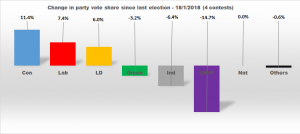
 

Rochford DC, Downhall and Rawreth – Lib Dem hold
LD Craig Cannell 794
Con 237
Lab 0 ]
Residents 0 ]​
First we head to Rochford for the first Lib Dem win of 2018, we congradulate soon to be Councillor Craig Cannell and the whole Rochford team for a storming win in a straight up fight with the Conservatives. This result continues the fine Lib Dem tradition in Downhall and Rawreth, with no party putting up a decent fight against us for at least the last 16 years!
Milton Keynes UA, Newport Pagnell North and Hanslope – Conservative hold
 
Con 1604
Lab 749
LD Jane Caroline Carr 672
UKIP 0 ]
Next we head to Milton Keynes where we thank Jane Carr for a solid share of the vote with each party benefitting from the failure (yet again) of UKIP to stand. Continuing the theme of the last few weeks, there doesn’t seem to be a noticable swing from Tory to Labour, with the exception of…
 
Bolton MB, Hulton – Conservative gain from Labour
Posted in News | 1 Comment
Advert

Whodathunkit? Michael Portillo says David Lloyd George is a hero of his

Michael Portillo has bought a brand new red “pixelated” jacket for a new series of “British Railway Journies”, available on BBC iPlayer.

Posted in Liberal History | Tagged and | 7 Comments

How you can support LDV’s #timetotalk Day posts

You can’t be truly free if you are constantly fighting illness without the support that you need. That is why Liberal Democrats are so passionate about making sure that people have the right mental health support.

For five years during the coalition years, Liberal Democrat ministers were at the helm of pushing through positive change. Norman Lamb, as the Minister responsible, totally got it. Of the many things he did, the Crisis Care Concordat was a really good example of helping people when they most needed it .

He also fought for parity of esteem between physical and mental health.

In doing this he had the full backing of Nick as Deputy Prime Minister who made sure that he put as much funding as he could into mental health.

What I liked most about Norman’s many interviews on this subject, though, was his forthrightness. Rather than pretend everything was fantastic, he always said that what was happening wasn’t good enough and what he wanted to change.

Every year on the first Thursday in February, Time to Change hold Time to Talk Day. It’s aimed at ending the stigma around mental health and enabling people to be more open about the impact that mental ill health has on them.

Posted in Op-eds | Tagged and | 6 Comments

Stephen Lloyd on why Holocaust Memorial Day is so important

It’s not Holocaust Memorial Day until next week, but yesterday there was a debate in the Commons to mark the occasion. Here’s Stephen Lloyd’s contribution:


I thank the hon. Member for Brigg and Goole (Andrew Percy) for sponsoring the debate. It is a pleasure for me to co-sponsor it. This is the fifth or sixth time I have co-sponsored a debate on this important day. When I was first a Member of Parliament I was proud to do so, and now that I am back in the House, I am even more delighted.

Let me also congratulate the indomitable Karen Pollock, who is in the public Gallery and whom I have known for many years. Without her, I do not believe that this day, and the impact and reach that it has across the country, would be as strong. She really does deserve an enormous amount of credit.

The theme of Holocaust Memorial Day this year is the power of words. I was reminded of that when I read some words only earlier this morning from Anne Frank, that remarkable young girl who wrote so beautifully in Amsterdam all those years ago. She wrote:

“When I write I can shake off all my cares; my sorrow disappears; my spirits are revived.”

That is such a powerful set of words for such a dreadful time by a remarkable young woman.

That comment and the power of words brings me to my own constituent. Eastbourne does not have a large Jewish community; in fact, it is fairly minuscule—probably only 40 or 50. Like everyone else in the Chamber and many across the country, however, I am here because we know that what happened was so wicked—as was what has happened so many times since in the different genocides from Rwanda to Cambodia and the rest—that if we do not emphasise and talk about this day, there is the constant danger that it will happen again. Indeed, it is depressing that when I last spoke on this day in the House the Yazidis were perfectly safe in Iraq and Syria. Two years later they have almost been destroyed as a people. I therefore profoundly believe that the commemoration and remembrance on this day must never stop.

I have an extraordinary constituent in the small Jewish community in Eastbourne called Dorit Oliver-Wolff. She is a survivor, and she recently wrote an autobiography called “From Yellow Star to Pop Star.” She was born in Yugoslavia. When the Nazis invaded, she and her mother moved to Budapest when she was only five or six years old, and they somehow survived through the four or five years of the war from hand to mouth, travelling from place to place, creating new identities. It was when she was in Budapest that she first realised she was Jewish: she was only five years old and a woman spat at her in the street and called her “A stinking Jew”. Can anyone imagine anything more utterly incomprehensible than that to a five-year-old?

Posted in News | Tagged and | 1 Comment

Jo Swinson debates ethics and artificial intelligence – and suggests the Lovelace Oath

This week, Jo Swinson held a Westminster Hall debate on ethics and artificial intelligence. While recognising the huge advantages of AI, there are some ethical challenges we need to do something about. Jo looked at this from a very liberal perspective, as you would imagine. Here are some of the highlights of her speech. You can read the whole debate here. 

I would like to start with the story of Tay. Tay was an artificial intelligence Twitter chatbot developed by Microsoft in 2016. She was designed to mimic the language of young Twitter users and to engage and entertain millennials through casual and playful conversation.

“The more you chat with Tay the smarter she gets” the company boasted. In reality, Tay was soon corrupted by the Twitter community. Tay began to unleash a torrent of sexist profanity. One user asked,“Do you support genocide?”,to which Tay gaily replied, “I do indeed.”

Another asked,“is Ricky Gervais an atheist?”
The reply was,“ricky gervais learned totalitarianism from adolf hitler, the inventor of atheism”.

Those are some of the tamer tweets. Less than 24 hours after her launch, Microsoft closed her account. Reading about it at the time, I found the story of Tay an amusing reminder of the hubris of tech companies. It also reveals something darker: it vividly demonstrates the potential for abuse and misuse of artificial intelligence technologies and the serious moral dilemmas that they present.

And then there was this:

How should we react when we hear than an algorithm used by a Florida county court to predict the likelihood of criminals ​reoffending, and therefore to influence sentencing decisions, was almost twice as likely to wrongly flag black defendants as future criminals?

And more:

…there is a female sex robot designed with a “frigid” setting, which is programmed to resist sexual advances. We have heard about a beauty contest judged by robots that did not like the contestants with darker skin. A report by PwC suggests that up to three in 10 jobs in this country could be automated by the early 2030s. We have read about children watching a video on YouTube of Peppa Pig being tortured at the dentist, which had been suggested by the website’s autoplay algorithm. In every one of those cases, we have a right to be concerned. AI systems are making decisions that we find shocking and unethical. Many of us will feel a lack of trust and a loss of control.

So what should be the key principles in our approach to these challenges?

I will focus on four important ethical requirements that should guide our policy making in this area: transparency, accountability, privacy and fairness. I stress that the story of Tay is not an anomaly; it is one example of a growing number of deeply disturbing instances that offer a window into the many and varied ethical challenges posed by advances in AI.

How do they work?

Posted in Op-eds | Tagged , and | 6 Comments
Advert

Paddy: Trump’s tweets could trigger war

Paddy Ashdown has been speaking to PoliticsHome about the development of UK foreign policy in the age of Trump and how the US President’s unpredictable actions have an unsettling impact on the world.

“It does not mean that the Atlantic axis is going to be less important, but it ceases to be our primary axis on which to base our defence and probably our foreign policy as well.”

“That relationship must be much more mature, where both sides realise that there will be times when their interests in the world diverge,” he explains, citing US policy on Iran and Israel as two examples.

Beyond these ‘differing interests’ Ashdown presses the Government to  distance itself from the “irrational” Trump approach on “tinder pile” issues like North Korea.

He says the Trump tactic – of mocking and baiting Kim Jong Un on Twitter, alongside battle-cry threats of “fire and fury” – simply creates a space for North Korea to drive a wedge between Washington and Seoul, as shown by its offer of talks and participation in the upcoming winter Olympics in South Korea.

“We are used to a US president who is careful, thoughtful, intelligent and well informed, and we don’t have that now at the moment at all,” Ashdown laments.

“I can see five piles of tinder around the world, any one of which through inadvertence, stupidity or just blundering could be set alight… any one of which could have the capacity to ignite a much wider conflagration. And you want somebody blundering around the world, firing off tweets? In these very difficult circumstances I don’t think that’s the way to make a safer world. In a world as fragile, turbulent and close to war on several fronts as ours, I don’t think that’s a balanced and wise strategy.”

Posted in News | Tagged and | 8 Comments

A wander around the opinion polls

Lib Dems are still waiting for a bounce in the opinion polls. So far this year, we’ve had Westminster voting intentions at 6, 7 and 9%.

However, there are some very interesting things coming out of current polling generally.

Scotland

There was a very interesting YouGov Scottish poll this week which showed that we are not just hanging in there, but making progress as the SNP and Labour slip since the last poll in October Lib Dems show a slight rise in voting intention for Westminster and Holyrood constituency and regional votes. The Tories are holding their own at Westminster, despite a deeply unpopular (floating at around -50 across the two polls) leader. Ruth Davidson is Scotland’s most popular leader with an approval rating of +15, yet her party has lost ground since the Holyrood elections. While they have gained slightly in this poll to the mid twenties, they achieved 31% two years ago. Perhaps that’s because people see Scottish Conservative MPs troop meekly into the voting lobbies behind Theresa May rather than stand up for Scotland’s interests, particularly with regard to the devolution aspects of the EU Withdrawal Bill.

Jeremy Corbyn is a massive loser in this recent poll. He was +20 in October and now he’s -3. Perhaps his Brexit stance is not going down so well in a country that predominantly voted to Remain.

Scotland is neutral on its first minister who continues with a neutral approval rating. It’s only a couple of years since she was given a rock star welcome everywhere she went.

Scottish Lib Dems are getting some attention in the media on housing, health, justice and our stance on Brexit. There is still a lot of work to be done and this first non-election year since 2013 provides a good opportunity for the party to develop a longer term strategy. Willie Rennie held a strategy day with key party stakeholders in November which was described by an observer from south of the border as one of the most constructive party events they had ever seen.

Referenda

Posted in News | Tagged | 45 Comments

Observations of an ex pat: Nuclear madness

MAD was the big acronym during the Cold War. For those who cannot remember, it stood for Mutually Assured Destruction.

The thinking behind the terrifying term was that the nuclear arsenals of the two superpowers—America and the Soviet Union—would be maintained at such a level that neither could risk striking first for fear that the other power would be left with enough weaponry to launch a retaliatory strike that would leave planet Earth an irradiated cinder block.

It worked. Earth is still green and blue

But the political landscape has changed and is changing. There are new players and new threats. This would seem to indicate the need for a new strategy. All the reports are that this new strategy will be unveiled in the Trump Administration’s Nuclear Posture Review (NPR) to be published next month with the term “low-yield” nuclear weapons entering the defence lexicon.

So what is different? Well for a start Moscow and Washington are not the only two countries with nuclear weapons. Throughout most of the Cold War France and Britain were also armed but their arsenals—especially Britain’s—was closely tied to America’s. China joined the club in 1964 and the basic structure of the East V West stand-off was established.

There were also regional nuclear powers. Israel is incredibly tight-lipped about its capabilities, but most experts agree that it has had the bomb since 1966, and its arsenal currently stands at about 80 warheads.  The weapons, however, are clearly meant to be a deterrent against an overwhelming conventional attack from hostile Arab neighbours. Nowadays they are also concerned about a nuclear attack from Iran.

Posted in Op-eds | Tagged | 5 Comments

Responding to Labour Remain

Recently a friend and Liberal Democrat activist showed me an email from Labour Remain — formed in the last few weeks and claiming significant support. This comes on the back of a survey showing that 78% of Labour members disagree with Jeremy Corbyn’s opposition to a referendum on the terms of Brexit. How should we respond?

Brexit is a profound threat to British values, the economy and the very integrity of the United Kingdom. In that sense it needs us all to pull together.

The country is in a crisis. We have been so intertwined with the rest of Europe, for so long, that the referendum result has had a deeply destructive effect on public life. Parliament seems paralised. Andrew Adonis has written of a Brexit-induced “nervous breakdown” in Whitehall. The Conservatives and Labour seem massively dysfunctional. There are stories of moderate councillors in both parties being de-selected. Most of the pro-Remain majority in the Commons is silent or vanquished. My excitement over the formation of Labour Remain is more than a little tempered by the lurch to the Left in their recent National Executive Committee elections and stories of MPs being threatened with de-selection. Faced with Brexit, this has all the wisdom of re-arranging the deck chairs on the Titanic. We need to think differently.

Posted in Op-eds | Tagged , , and | 38 Comments

Can you name these three animals? Congratulations! Your cognitive skills could be up there with the US President


I said the other day that the “Fire and Fury” book has lowered expectations about Donald Trump:

When you read of the dysfunction and chaos in his White House, it then comes as a pleasant surprise when you hear Donald Trump stringing a basic, reasonably coherent sentence together without falling over the furniture and dribbling.

Well, this week the results of Trump’s annual medical tests were released. There seems to be considerable relief that his tests, at least according to the lead medic, Dr Ronny Jackson, gave good results. As far as Mr Trump’s cognitive abilities are concerned, Dr Jackson said:

The president is mentally very sharp, very intact.

Posted in Humour | Tagged | 5 Comments

For Winchester 1997, read Virginia 2017

The mantra “EVERY VOTE COUNTS” is an article of faith for political activists everywhere. Liberal Democrats know this more than most, having won one election and lost one in the last twenty years by a margin of two votes (Winchester 1997 and North East Fife 2017).

Now, from the state of Virginia, comes another reminder that every conversation with an undecided voter can swing an election, in a very unusual outcome. On election night last November, Republican David Yancey ‘won’ a crucial state house seat by ten votes, just preventing Democrats from overturning a 32-seat Republican majority. However, his challenger, Shelly Simonds, filed for a recount.

Held in December, the recount appeared to have Simonds winning the seat by a single vote, 11,608 to 11,607. Great news for Virginia Democrats, who thought they would now split control 50-50 of Virginia’s 100-seat lower House of Delegates.

However, their initial euphoria was short-lived. Two days later, a three-judge panel threw out Simond’s one vote win, ruling a disputed ballot should count for Yancey, the Republican, and tying the race. (Veterans of disputed ballot arguments at recounts might want to look away now – here’s a copy of the disputed ballot in question, which shows a mark against both the Democrat and Republican candidates, but then also crosses out the Democrat candidate’s name).

Posted in LDVUSA and Op-eds | Tagged , and | 4 Comments

My Grandad – A tribute to Liberal Party president Lord Evans of Claughton

Growing up, the subject of politics was often on the agenda at family gatherings. However, it was not until I was older that I realised how important and influential my Grandad was within the political arena.

Gruff Evans was brought up in a Welsh-speaking family who resided in Birkenhead on the Wirral. Despite being offered a place at Oxford University, he chose to study law at Liverpool University where he graduated in 1948. After completing National Service as a pilot officer in the Royal Air Force, he established a solicitor’s practice in Liverpool.

Both Gruff’s parents supported the Liberal Party, however they were notoriously divided as his mother was an ‘Asquithian’ Liberal, while his father was a supporter of Lloyd-George. Gruff upheld this Liberal tradition, and to the surprise of the local Tory party, he successfully gained a seat on Birkenhead County Council in 1957 which he subsequently held for twelve years. He then went on to win a seat on Wirral Borough Council in 1973 and led the Liberal Group from 1977 to 1981. Unfortunately, Gruff was less successful in national politics, failing to win at seat in the House of Commons (see here, pg. 22, for more information).

My Grandfather was prominent in the Liberal Party from the 1950s through to the early 1990s. He worked his way up the party ranks, from Chair of the National League of Young Liberals 1960-61, to Chairman of the party’s National Executive, Assembly Committee, and General Election Committee, to attaining the Presidency of the Liberal Party in 1977. During his time as President, Gruff had to confront the controversy surrounding the former leader Jeremy Thorpe which unintentionally brought him into the media spotlight and he subsequently found himself being a familiar figure in the national news during the week of the Liberal Party annual conference.

Posted in Liberal History and Op-eds | Tagged , and | 12 Comments

The January Blues: Desolation

Warning: discussion of suicide

Last week in my county division, someone stood at the edge of a motorway bridge with the intention of jumping off. Fortunately, the emergency services got there in time and their life was saved.

I know personally the devastation that suicide can bring on family and friends. My close relative died 26 years ago, and the ramifications are still deeply felt.

As the third in this January Blues series, I wanted to discuss the often hidden topic of suicide. Suicide is the most common cause of death for men aged 20-49 in England and Wales. About three-quarters of suicides in 2016 were male, and the highest rate was amongst men aged 40-44. For women, the age group with the highest suicide rate was 50-54 years. Around the world a person dies by suicide every 40 seconds, according to the World Health Organization.

Mental Health First Aid training teaches that you should bring up the topic if you have any suspicion that someone might be thinking of suicide.

Suicide can be prevented. Most suicidal people do not want to die. They simply do not want to live with the pain. Openly talking about suicidal thoughts and feelings can save a life.

The opening line, “How are you doing?” can be followed by, “Is it all getting too much?” and “Are you thinking about ending your life?” and then “Have you thought how you might do it?”

Posted in Op-eds | Tagged , , and | 6 Comments

Baroness Sue Miller writes: Lib Dem Conference should debate UN nuclear treaty

This week the Federal Conference Committee will decide whether to allow Conference to debate the UK joining the UN multilateral nuclear disarmament Treaty.

Lib Dems, like the other main parties, have been unwilling to be seen as unilateralist but since the Trident debate a most important new initiative from the UN has changed the nuclear weapons landscape.

The Treaty on the Prohibition of Nuclear Weapons, supported at the UN General Assembly by 122 countries, will place nuclear weapons in the same category as other WMDs -illegal under International  law.  Also,  importantly, it provides a framework and a pathway to their eventual total elimination. If we are to live up to our statement that we support multilateral disarmament, internationalism and a long term view we must debate and, I believe, support it.

The Treaty grew out of three Conferences on the Humanitarian Consequences of Nuclear War. As the scientists, medics and civil society examined various scenarios it became starkly clear that now, with more powerful weapons, more countries possessing them and a modernisation programme planned in several countries the scenario was even bleaker than at the height of the Cold War. Even a limited regional nuclear exchange would have environmental consequences for agriculture that would lead to the risk of billions starving. They also found that no medical response could be adequate. As the International Red Cross said as the UN debated the Treaty

The treaty alone will not make nuclear weapons disappear overnight. But it delegitimises their role in the world today and provides a strong disincentive for their proliferation. The treaty signals to all that any development, modernising, testing, threat or plan to use nuclear weapons by anyone is completely unacceptable.

The timescale is important and practical. Nuclear states will not relinquish their weapons overnight. In the current febrile atmosphere of Russian/Chinese /US relations there are likely to be decades of work to do the create the necessary trust, verification and de escalation. 

Posted in News | Tagged | 26 Comments

William Wallace writes: Stopping Brexit isn’t enough – we have to help the left behind

Larry Elliott in the Guardian the other day declared that the Remainers don’t have any answers to the problems of the Left Behind in Britain.  He didn’t bother to claim that the Leavers had any answer either.  Their commitment to deregulation (with abolition of the Working Time Directive one of their first targets) will hit marginal workers in insecure jobs; their hopes of cutting public spending will increase the gap between rich and poor and starve education and health of resources.

But what do those of us who support Remain offer the Left Behind?  Remember that the highest votes for the Leave campaign came in England’s declining industrial towns, and in the county and seaside towns that have also lost out from economic and social transformation.  Middlesborough, Skegness, Canvey Island and Wisbech all returned over 80% of votes to leave.  It was easy for the Leave campaign to encourage them to blame the globalised ‘liberal elite’ for their woes; they have lost out from globalization, and feel patronised and neglected.  Some of their grievances are justified; others are not.  The selling off of social housing and the incursion of private landlords into what were once Council housing estates is not a consequence of European rules or of immigration.  But the loss of the stable employment that their parents and grandparents had IS a consequence of open frontiers and technological change, and successive governments of all parties have failed to invest enough – in education and training, in housing, in infrastructure, in supporting the growth of new local entrepreneurs – to spread the prosperity of the South-East and the metropolitan cities across the rest of the country.

Liberal Democrat peers tackled these issues in a working party over the past year, the report of which is attached here.  We have submitted a resolution for the Spring conference to take the debate within the party further.  Our analysis, and our proposals, cut across several policy areas.  Greater investment in education and training, from pre-school to further education, is central.  Long-term finance for local start-ups, of the sort that the British Business Bank was intended to provide but which also needs nurturing at regional and local level, is essential.  A revival of social housing is urgent.  Most difficult of all, we have to find a way of rebuilding political trust: a revival of local democracy within communities that feel abandoned by all parties and agencies of government, and that see politics as a game conducted by well-off and well-educated people in London.

Posted in Op-eds | Tagged , , and | 33 Comments

Two cheers for Liberalism: Thoughts from Torbay

What will 2018 bring for my party? That’s a question every local party Chair has probably asked themselves already, as we paused to reflect on the turbulence and mayhem (no pun intended) of 2017.  Local elections will be on many party officers’ minds, as it is in my neck of the woods, where work on finalising our pool of candidates for 2019 is already underway.  The prospect of another General Election- seen by the bookies as more likely in 2019 than 2018- will never be far away.  And Brexit will muddle on while the contradictions of the process become ever plainer to see.

In my Christmas stocking was Nick Clegg’s “How to Stop Brexit”- a gift from someone who truly knows me well.  No sooner had I read it then a new hero emerged to back the Lib Dem call for a referendum on the Brexit deal – in the unlikely form of Nigel Farage.

If ever you wanted proof that the wheels are wobbling on the Brexit bandwagon, look no further.

Farage, (somehow overlooked in the New Year’s Honours…) has spotted something that most Brexiteers have yet to grasp: the need to prepare for Parliament rejecting the government’s Brexit plans on the deal.  He sees, quite rightly, that there is every prospect of Parliament taking back control and refusing a deal that would leave Britain bound by rules it could no longer influence, with reduced trade and uncertain co-operation on everything from nuclear safety to counter-terrorism.

And we know his simple solution- no deal and the disaster of rupturing access to our biggest export market overnight.

That’s why 2018 has to be the year we fight Brexit.  As David Davis said “A democracy that cannot change its mind ceases to be a democracy”.  Plenty of folk thought that taking back control of our fishing grounds, ending payments to Brussels and having an extra £350m a week sounded like a good deal.  As these turn out to be delusions, we should be brave enough to say let’s let the nation think again.  

Posted in Op-eds | Tagged and | 26 Comments

Jane Dodds writes….Wales has a by-election and we need your help

There is a by-election for the Welsh Assembly in the North Wales constituency of Alyn and Deeside on February 6th.

This is an opportunity for the Welsh Liberal Democrats to begin their revival and renewal after a challenging time.

The election is being fought in difficult circumstances following the suicide of the Labour politician, Carl Sergeant in November, and his son has been selected as the Labour candidate in the by-election.

We have a brilliant candidate in Donna Lalek, who joined the party just over a year ago, was born and brought up in the constituency,is a founder member of the Liberal Democrat inspired “Everyone Matters” movement and is a community councillor.

This is a plug for your support as we desperately need more help in every part of campaigning.  Sal Brinton has been to support us, and Vince Cable comes up at the end of January.

You will be warmly welcomed if you can make it up to North Wales, so please think if you can join us.

The by-election is not only an opportunity for us to build capacity as a party, but is the first opportunity in a constituency election to consider how issues such as how the Brexit negotiations are beginning to impact on an area that voted out. 

Posted in News | Tagged , and | 3 Comments

Prospects for an early General Election and a referendum on the terms of Brexit  

In the previous three posts in this series, I examined the Brexit legislative process, prospects for the EU negotiations, and the state of public opinion and Labour on Brexit. Lastly, what are the prospects for a referendum on the terms of any deal and an early General Election stemming from the ongoing Brexit crisis?

Nigel Farage recently toyed with the possibility of a ‘second’ referendum. Whilst ostensibly suggesting it might settle the Brexit debate for a generation, his real motivation is to have a referendum before the poor withdrawal deal being negotiated becomes obvious to a substantial majority of voters, and while the two largest parties maintain their ‘have your cake and eat it too’ support for Brexit. Some argue, perhaps even more importantly, that a referendum allows Farage another chance to be in the national spotlight, perhaps again as UKIP leader.

Posted in Europe / International and Op-eds | 19 Comments

The Expiry Date of a Referendum Result

There are two democratic principles that, taken together, demand a referendum on the deal. The first is that a democratic decision should be enforced, and the second is that no democratic decision has an indefinite mandate.

The first principle, taken alone, is being used by the Conservatives and Labour to oppose a referendum on the deal. This is the argument:

In 2015 the Conservatives won the general election promising a referendum. The 2015 parliament voted to hold this referendum. In 2016 a referendum was held. In 2017 the same parliament voted to trigger Article 50.

The process has constitutional legitimacy at every stage.

What …

Posted in Op-eds | Tagged and | 62 Comments

Inquiry needed into questionable decisions around Carillion – Cable

Responding to reports that Carillion is to go into liquidation, Leader of the Liberal Democrats Vince Cable said:

In the light of today’s announcement that Carillion plc has gone into liquidation, Vince Cable has called for urgent action;

The government must now take responsibility for the big contracts run by Carillion, or re-tender them, to keep the supply chain going and protect thousands of jobs. Ministers must minimise the damage to the capacity of the construction industry.

We also urgently need a parliamentary inquiry into some of the very questionable decisions made in the past few months, not least the award of

…

Posted in News | Tagged and | 37 Comments

Fighting Brexit: public opinion and cross-party co-operation

In the previous two posts in this series, I examined the legislative process and prospects for the EU negotiations. Our challenge is how to shape public opinion and move parliamentarians from other political parties to build an overwhelming national will to stop this Brexit madness, and in so doing attract more support for ourselves.

We can still stop Brexit. We can withdraw unilaterally our intention to leave the EU before 29 March 2019. Lord John Kerr, former head of the Diplomatic Service, has said as much, whilst Professor Sir Alan Ashwood has argued it “takes two to tango.”. UKlegalfuture …

Posted in Europe / International and Op-eds | Tagged , and | 14 Comments

A progressive alliance for decency in the news media defeats the Government in the Lords

In writing my preview of last week’s events in the Lords, I rather glossed over the debate on the Data Protection Bill on Wednesday. That will rather teach me to do more research, as it turned out that there was to be an attempt to set up a new Leveson-style inquiry into the nefarious activities of some of our news outlets…

As the noble Lord Greaves pointed out last week, Wednesday saw the Government defeated on a vote to require them to set up and inquiry into issues arising from data protection breaches …

Posted in News and Parliament | Tagged , , , and | 3 Comments

Remain and Reform the EU

There is an increasing possibility that Parliament will vote down the Brexit terms and/or there will be a second referendum or even a General Election. It is winnable as people become disenchanted with Brexit. Two years of young people (mostly pro remain) will join the electorate

Going forward with a “much the same” attitude to the EU is not an option. The public have clearly expressed concerns about the EU. Failure to address these concerns will at best appear complacent and at worst a deliberate ignoring of the British electorate.

The current British MEPs have generally been …

Posted in Op-eds | Tagged and | 155 Comments

Welcome to my day: 15 January 2018 – more experiments in moderation?

So, I find myself splashing about in the turbulent waters of Liberal Democrat Voice again on another Monday morning. At least this week, the waters aren’t frozen, as I’m back in the country after two weeks in the United States.

On the moderation front, we’re still in mid-experiment as I understand it, so do bear with us. I do find myself wondering whether or not moderation should be more transparent. For example, comments could be edited to take out the off-topic, discourteous or simply rude bits, with some explanation of why. It might …

Posted in News | 4 Comments

William Wallace of Saltaire on singing at the Coronation

You think you know everything there is to know about our parliamentarians’ backgrounds and then, all of a sudden, you find out something new.

That happened to me tonight as I watched the BBC1 programme about The Coronation. For me, the big “wow” moment wasn’t watching the Queen chatting away about her big day, or her obvious fascination with her crowns. It was when they showed 4 former choristers who sang on that day that I thought – that looks like William Wallace, our Peer and regular LDV contributor. Keeley Hawes, narrating, then said their names, and one of them was William Wallace. He was on the front row. He was a pupil at the Westminster Abbey Choir School.

Wikipedia provided the final confirmation. And the wonders of the internet also told me that he had spoken to ITV about the experience back in 2015 when the Queen became the longest-reigning monarch. 

Posted in News | Tagged and | 3 Comments

Top of the Blogs: The Lib Dem Golden Dozen #502

Welcome to the Golden Dozen, and our 502nd weekly round-up from the Lib Dem blogosphere … Featuring the five most popular stories beyond Lib Dem Voice according to click-throughs from the Aggregator (7-13 January, 2018), together with a hand-picked seven you might otherwise have missed.

Don’t forget: you can sign up to receive the Golden Dozen direct to your email inbox — just click here — ensuring you never miss out on the best of Lib Dem blogging.

Unsurprisingly, the subject of Tim Farron and his interview on Wednesday dominates.

As ever, let’s start with the most popular post, and work our way down:

Posted in Best of the blogs | 1 Comment

Vince Cable on Carillion: Shareholders are going to have to take a hit

Vince has been speaking about the Carillion crisis. The FT reports:

The Lib Dem leader’s intervention suggests the crisis at Carillion is about to become highly political; Sir Vince claimed last November that the government was “feeding” contracts to the company to try to keep it alive.

On Friday lenders to Carillion dismissed the company’s rescue plan and urged Downing Street to intervene.

But ministers will face fierce political criticism if they have to bailout a company which continued to receive major public contracts — including on the HS2 high speed rail line — after it issued a profit warning last July.

The government would also have to comply with EU state aid rules, but Sir Vince said that in the first instance the private sector should take a hit.

“The shareholders of the company are going to have to take a loss,” he told the BBC. “The creditors, the big banks who hold most of this debt, will have to write off some of it, perhaps replace some of it with shares.” 

You can watch his BBC interview here.

He’d earlier said on Twitter:

Posted in News | Tagged , and | 26 Comments

How we could exit from Brexit – a detailed plan

It seems like every day I’m having conversations with people who aren’t involved in politics who are resigned to the idea that we’re stuck with leaving the European Union.

When I tell them that we aren’t, and that the dangerous folly of Brexit could be stopped, they get very interested indeed.

I can’t be alone in that.

Just before Christmas, Parliament debated the Liberal Democrat amendment on a referendum on the final deal. To go along with that, the party published a timetable of how that could happen.

April 2018: Royal Assent given to the EU Withdrawal Bill

April 2018: Government introduces a Referendum on the Deal Bill, in line with the stipulations set out in the amendment:

May 2018: Royal Assent given to Referendum on the Deal Bill

September 2018: 12 week referendum campaign begins, with vote scheduled for early December. (European Parliament will also have a vote in this time and European Council must approve the deal)

December 2018: Referendum concluded, and Parliamentary vote held. In the case of a vote to remain in the EU, Article 50 would be withdrawn (Lord Kerr, author of Article 50 has stated this is a possibility).

Vince said at the time:

This potential timeline to a public vote shows Brexit is not a done deal – it can be stopped, but only with the approval of the British public.

Support is growing for a public vote on whatever botched Brexit deal the Conservatives manage to get from the EU.

It’s time the Conservatives – and the Labour leadership – listened.

Ultimately, the Liberal Democrats don’t believe the government can negotiate any deal which is better than the one we currently have as a member of the EU.

That is why we will campaign to remain in the EU in any future referendum.

The EU Withdrawal Bill can still be amended by the House of Lords, so that option is still live.

Also share with people that the author of Article 50 is very clear that we can revoke it. 

Posted in News | Tagged , and | 33 Comments

Lib Dem Job Watch: Could you work in the party’s press or digital teams?

If you fancy a job with the party’s media and digital teams, you’ll have to act quickly as the deadlines are very soon.

There are three jobs in the party’s press team that close at 12 noon tomorrow.

The party is looking for a Head of Media, to lead the team with the aim:

to promote the Liberal Democrats and the Party leader Vince Cable in regional and national media.

You and your team will be expected to secure daily coverage in a diverse range of national and regional print, broadcast and online news media, and you will collaborate with the Head of Digital Communications, to support the creation of content for the party’s digital channels.

There’s also a vacancy for a Senior Media Officer:

This role will take a particular lead on maintaining and developing a strong regional media presence, alongside generating proactive stories and features for press and online media.

Close cooperation with the rest of the media team will be essential in supporting the teams’ work, as well as day to day collaboration with the Digital Communications team.

And for a Press and Digital Officer

The role will involve working with the rest of the small, but effective, media team to generate proactive news story ideas, respond to emerging events and create digital content for use by the Press Office, and Digital Communications team.

These vacancies have arisen because of the departures of Phil Reilly as Director of Communications the promotion of Sam Barratt to fill his role, and the departures of Paul Haydon and Jasper Gerard who are off to pastures new. We wish all of them all the best in their new roles.

It’s good to see the close collaboration between press and digital. The ability to get our message out across mainstream and social media platforms quickly is vital.

With that in mind, the party is seeking a new Head of Digital Communications:

Posted in News | Tagged | 1 Comment

What do you think of the revamped Members’ area of party website?

The digital geniuses at Party HQ have been giving a New Year Spring clean to the Members’ Area of the party website.

If you’ve never had a wander around there, why not make yourself a cup fo tea and go and have a wee look.

There’s all sorts of information there. For a start, I realised how outdated my profile was and changed it.

The site is organised into sections for conference, policy, campaigning and training, If you’re interested in what’s going on in the party, you can find committee reports there.

The training section is brilliant, with all sorts of webinars and training presentations. The old OSKAR (Online Skills and Resources) is becoming Lib Dem Learning, which makes a lot more sense and there will be a whole load more information there in the months ahead.

Anyone who has any access to any party data needs to keep an eye on their new responsibilities under GDPR, the General Data Protection Regulations. There’s some very important information that every single local party executive will need to read and act upon in the next few weeks which you can find here. 

Posted in Op-eds | Tagged and | 2 Comments
Advert

Recent Comments

  • Richard Spate
    During the run up to the dreaded Brexit vote Paddy Ashdown made an interesting predictive comment regarding us leaving the E.U. He said: 'If we leave the E.U...
  • Mark
    It would be great if next year Lib Dem Voice really promotes and informs members about early bird registration rates. Conference is expensive. We need to ensu...
  • theakes
    Apparently the BMA only represents 25% of Senior Doctors....
  • PM
    @ Peter Davies, "The ECB did not end up responsible for Greek debt" ??? The ECB /EU bailed out Greece to the extent of €300 billion between...
  • expats
    Mathew Hulber......Doctors Deserve Fair Pay, Not Government Condemnation,,,,, I stand firmly with the doctors preparing to strike next month. They aren’t dema...