Except in Northern Ireland, the d’Hondt electoral system will be used to elect UK Members of the European Parliament.
The d’Hondt system is a party list system, it allocates seats to parties proportional to their share of the vote. But the small number of seats in each region means that the seats can only be allocated at an approximation to proportionality. That approximation gets better as the number of seats in a region increases, but even in a ten seat region it is a pretty rough approximation. What tends to happen is that the higher proportions of votes are over rewarded with seats while the parties coming further down the poll lose representation entirely.
It is not perfect, it does have its issues.
Not being used to the d’Hondt system, but very used to First Past the Post, we have a tendency to misapply First Past the Post strategies for d’Hondt problems. The calls have gone out to “vote Labour to stop Farage”, vote for the most pro-EU candidate, and to combine the pro-EU vote behind one pro-EU party.
The first two are pure First Past the Post strategies utterly misapplied in the d’Hondt world. The third “solution” tinkers at the edges and avoids the key problem to be solved.
Vote Labour to stop Farage.
This is being actively pushed by the Labour Party, and it’s a lie.
The d’Hondt system may be only roughly proportional, but it is proportional. It allocates seats based on the proportion of the vote a party has, not based on the votes for other parties. If Farage’s Party gets a quarter of the votes then it will get, very roughly, a quarter of the seats. And it will get roughly a quarter of the seats whatever the Labour Party polls.
The d’Hondt solution is to reduce Farage’s proportion of the vote. To do that you vote, just vote, lending that vote to Labour will gain you nothing.
Vote for the most pro-EU candidate.
Michael Heseltine, on Newsnight, fell prey to this. He talked, in the singular, about whether the Conservative Party candidate he will see on his ballot paper on 23rd would be a Remainer.
You vote for a party Michael, not an individual. You cannot vote for a pro-EU Conservative candidate, you can only vote for the pro-Brexit Conservative Party. Similarly, Labour voters cannot vote for a pro-EU Labour candidate, they can only vote for the pro-Brexit Labour party.
The d’Hondt solution is straightforward: vote for a pro-EU party.
Combine the pro-EU vote behind one pro-EU party.
But which pro-EU party? Should we, Liberal Democrats, switch to the Greens? Should they switch to us? Should we both bite the bullet and vote Change UK?
This has led to Green activists falling out with Liberal Democrat activists and pro-EU politicians attacking pro-EU parties in the media. We undermine each other and miss the cause of the issue, which is that even together the pro-EU parties are polling nowhere near the level of support for Europe in the country.
That support is edging towards two thirds of the population. A total like that can be split many, many, ways before it comes close to falling under the no-seat level. A total substantially less than that can still be split many ways before it comes close to falling under the no-seat level.


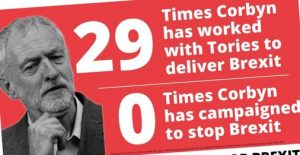 The Liberal Democrats today unveiled an election poster slamming Jeremy Corbyn for spending time helping the Tories deliver Brexit rather than doing anything to Stop Brexit.


 Today the Liberal Democrats announce the list of MEP candidates in England and Wales for the EU elections on the 23rd May (Scotland should follow later today).

 Follow @libdemvoice.org on Bluesky
 Like us on Facebook
 Subscribe to our feed
 Sign-up for our daily email digest

 Bodhana Sivanandan is youngest ever female international master
 Yes, I'm still in favour of making the House of Lords democratic
 British music only!
 Whickham North Focus delivery
 United Nations Day, 24th October
 David Blake
  Richard Dickson
  Richard Cripps
  Steve Trevethan