With the European Elections looming they could be regarded as a test of public opinion, almost a second referendum.
However given that what UKIP and Boris Johnson et al promised in the run up to the 2016 referendum has been shown to be unattainable it is almost inconceivable that
Nigel Farage’s BREXIT Party should be riding so high in the ratings. One can only assume that this a matter of dictatorial principle “you will do as we tell you”, an anti- establishment stance from people who feel totally undervalued, powerless and ignored – determined to win at any cost and regardless of outcome. Nigel Farage now says it is about democracy.
It will therefore need the pro-European Parties, and hopefully Labour, to work together to get the facts across. This is not about democracy: it is about the future of our country for generations to come.
BREXIT could lead to the break-up of the UK, the loss of Gibraltar, and the outbreak of hostilities in Ireland, which could very quickly escalate out of control, and will certainly leave the UK worse off economically. It is doubtful that anyone voted to be worse off and yet this is what the most optimistic predictions, even those of the Government, suggest. Just recall how hard Britain fought to gain access to the“common market” and that 44% of our exports go to Europe (with only 18% ofEurope’s exports coming to Britain) and a further 20% of Britain’s exports go via trade agreements with Europe.
Therefore the NET contribution Britain makes to the EU pales into insignificance compared to the advantages of this free trade agreement. And those that argue that the UK would not have to pay the £39b, so called divorce settlement, were it to leave without a deal, should bear in mind that this is to honour our contractual obligations and what country would enter into an agreement with a country which failed to honour such commitments – not to mention the possibility of sanctions imposed by the EU on top of tariffs
The Irish Border, together with Gibraltar, was always going to present insurmountable problems. It was perhaps “freedom of movement”, more so than the “Good Friday Agreement”, which led to the end of hostilities in Ireland, with people crossing the invisible border daily. However one cannot “control one’s borders” without a border and the only way to retain an open border in Ireland, and avoid hostilities, is to remain in a Customs Union and Single Market (Free Trade Area).


 Referendums are strange things. Uniquely divisive, and their outcome unpredictable. No matter what the issue, voters flock to opposing sides like supporters at a football match. There is no sitting on the fence.


 Snapshot from BBC4’s “
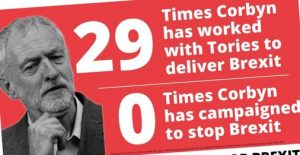 The Liberal Democrats today unveiled an election poster slamming Jeremy Corbyn for spending time helping the Tories deliver Brexit rather than doing anything to Stop Brexit.


 Follow @libdemvoice.org on Bluesky
 Like us on Facebook
 Subscribe to our feed
 Sign-up for our daily email digest

 Peter Kellner: Zack Polanski should have won at a canter
 Liverpool near bottom of the league for recycling
 Labour's recovery in by-elections continues.
 Vote Tory, get Reform?
 Looking good!
 Ian Patterson
  Nick Baird
  Tim Rogers
  John C