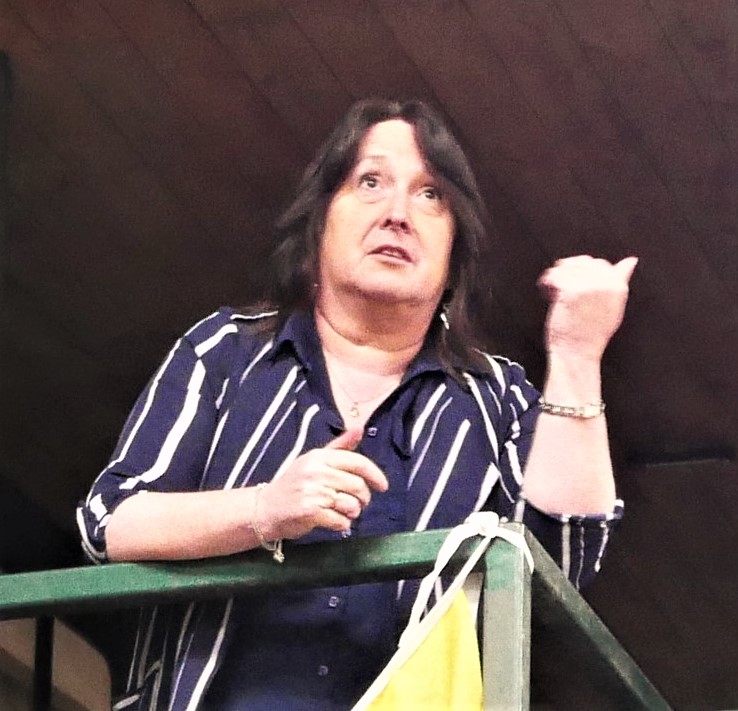
Did our Leader Ed Davey in Conference, and can we as members on the doorsteps, explain a distinctly Liberal point of view?
Ed told us we should say that we stand for a fair deal, and are decent politicians who care about you. We perhaps confirmed that at Conference with the passage particularly of the F24 motion, A Fairer, Greener, More Caring Society, which was built on the Themes policy paper.
Liberalism is certainly not populism, but we Lib Dems do incline to believe that a large proportion of the British public share our moderate, centrist views, together with our belief that the State is needed to enable all citizens to have the chance of secure, healthy and fulfilling lives. We don’t believe in the centralised over-powerful State sought by Socialism, nor the small-state attitude of Conservatism.
By Caron Lindsay
| Thu 23rd September 2021 - 8:24 pm
Today is Bisexual Visibility Day, a day to celebrate bisexual people and raise awareness of the particular problems that they face.
In an article on Pink News today, Lois Shearing highlights the effects of the discrimination that bi people face – and this can come from within the LGBT+ community:
Despite the prevalence of biphobia, it’s common to read or hear comments about bisexual people having privilege or not facing any real oppression. But this is provably false: it is well documented that bi people face higher rates of mental illness, due in part to biphobia and double discrimination. Bi+ men are less likely to get tested for HIV due to social stigma and biphobia within healthcare settings. Bi+ people are also more likely to suffer from addiction or abuse drugs and alcohol. Yet bi people are still seen as deserving targets of cruel jokes or comments.
Labour MP Rosie Duffield, added biphobia to her transphobia on national radio earlier this week, when she accused bisexual men who are married to women of “appropriating gay culture.”
There’s a real culture change from government, too. Silence from Liz Truss, the Women and Equalities Minister, in contrast to a previous holder of that office:
In contrast, not a peep from Liz Truss this year. Which is both invisibility and phew, she's not trying to pass herself off as any kind of ally to LGBT folk today any more than the rest of the year. https://t.co/hvGUCeNxGy
I welcome Bi Visibility Day which helps to raise awareness of the issues that bisexual people can face and provides an opportunity to celebrate diversity and focus on the B in LGB&T.
By Caron Lindsay
| Thu 23rd September 2021 - 1:45 pm
Orkney MSP Liam McArthur has today launched a consultation on his proposal for a Members’ Bill which would enable assisted dying for terminally ill people in Scotland.
His Bill would have safeguards, including:
Two doctors independently confirm the person is terminally ill, establish that the person has the mental capacity to request assisted dying, assess that the person is making an informed decision without pressure or coercion
Two doctors ensure the person has been fully informed of palliative, hospice, and other care options.
The person signs a written declaration of their request, this is followed by a period of reflection
The person must administer the life-ending medication themselves; It would continue to be a criminal offence to end someone’s life directly
Every assisted death would be recorded and reported for safety, monitoring, and research purposes.
Liam said:
“In my time as an MSP I have heard from many dying people and grieving families who have been failed by the current blanket ban on assisted dying. I have watched other countries, such as Australia and New Zealand put new laws in place to ensure their citizens can have a peaceful and dignified death and I believe that the time is right for Scotland to look again at providing our dying people with more choice at the end of life. The consultation sets out a blueprint for how we can do this safely and compassionately.”
As a member of the Policy Working Group chaired by John Shipley, delivering the motion F21 A Framework for England in a Federal UK, I volunteered to write this follow-up to Sunday’s Conference debate. This is my consolation prize for disconnecting my audio and embarrassingly failing to speak in the debate myself – somewhat riling, given my work on regionalism and federalism since 2015.
It seems, however, that I need not have worried about the result from a personal perspective. After a clear, explanatory opening speech by Prue Bray, many contributors spoke in favour of a strong tier of English regions constitutionally equivalent to Scotland, Wales and Northern Ireland as states of a federal UK, providing for a union that would work better in terms of fairness, localism, empowerment, democratic accountability and, importantly, creating constitutional stability between the home nations.
This is not to say that the Working Group’s views were unanimous. We recognised the need to present several options, not just one proposal. We excluded English regions with separate legal jurisdictions, as different from each other as Scotland is from England, as lacking popularity and seen by some as dangerous. The choice was between a single English state or a set of regional states and then a further decision on the nature of an all-England legislature. By a two-thirds majority Conference chose regional federal states and an English legislature separate from the federal structure, formed by regional representatives rather than a directly elected national body.
Accompanying that, Conference endorsed a Union in which at least half of tax revenue would be spent by sub-national bodies, competing with Canada and Germany as two of the most fiscally decentralised countries. We also outlined – not exhaustively – the sort of powers that the federal states should have.
Our answer to the Tories’ “levelling up” is that we have an actual plan: a massive shift in power towards local and regional authorities and a fair distribution of resources across England and the UK as a whole, taking money away from Whitehall and giving more local control over finances.
By Paul Tyler
| Wed 22nd September 2021 - 11:52 am
As with so much else in politics, our conference this year was by turns very different and strikingly similar to the first I attended some 60 years ago. This year’s conference was beamed into my living room; my first Liberal Assembly took place in the Usher Hall in Edinburgh. This year’s conference took place in the shadow of Western humiliation in Afghanistan. My first took place when Britain was still reeling from the Suez scandal.
Either way, this year’s was my last as a Parliamentarian. The House of Lords is a place of many anachronisms, and I wouldn’t like to risk becoming one of them. Since I turn 80 at the end of October, the moment has come – after 65 years as a party member – to take a back seat.
Don’t despair: this is not just a forlorn trip down memory lane, but a reflection on how the present and future should be faced, after that experience. In the 1950s and 1960s the UK political landscape was remarkably two dimensional. In General Elections a large majority voted for – and against – the two major parties. In the former decade that total was regularly well over 90%. Even in my first parliamentary contest in 1966 some 89.8% of those who voted supported Labour or Conservative candidates.
Canvassing experience reflected that dichotomy. “My husband is in the union, we’re Labour” or “We’re in business, we’re Conservative”. In Cornwall and Devon there was a very welcome variation: “Our family have always been Methodists, we’re Liberals”. Only very much later, during my 1982 Beaconsfield by-election campaign, did I encounter the show-stopping response “We are not interested in politics, we’re Conservatives”.
All that has fundamentally changed. The population, and especially the regularly voting component, are nowhere near so consistently aligned. Their motivation is far from that previous clear economic/social divide. Their support churns around between elections, and even during the last few days of a campaign.
Ed Davy makes a storming attack on the Conservative administration into today’s Guardian. The mounting cost of heating bills and food price-hikes due to increasing transport costs and the energy crisis means the poorest people will be hit the hardest. Davey says no one should be surprised that Boris Johnson has dismissed these problems. He wants us to believe it’s a global problem, with nothing unique to the UK. And he wants us to think it will all be over quickly. He is wrong. This is just the latest example of the Conservative party taking people for granted.
By Caron Lindsay
| Wed 22nd September 2021 - 7:05 am
Edinburgh South Chair Fraser Graham delivered this cracker of a speech in the debate on What Liberal Democrats believe on Sunday morning. Where are the limits of free speech and how should our party deal with the boundaries?
Conference, I joined this party in 2016 because of one issue – Brexit. The reason I am still here is because of the values and principles our party upholds.
This speech is somewhat of a paradox. It should be completely unnecessary, because I’d take it entirely for granted that any true liberal would have no objection to the values put before you, either in the paper, the motion or the amendment.
But in this current climate, where members of the LGBT+ community, MY community, are facing almost constant daily attack through the media, on twitter and even here, at conference, we NEED to be bold, and firmly plant our flag as a party that is standing up for the rights of those we need to support and protect.
On Liberty, the paper states “We embrace freedom of thought and speech, and argue for stronger protection against those who abuse free speech, use it to promote division and hatred, or spread falsehoods and ‘fake news’.”
This is crucial. Free speech is not freedom to discriminate without consequence. It’s not freedom to be given a platform to espouse views which are actively harmful, or freedom to hound people on social media to the point of taking their own life. We need to be clear on this and push back against those who demand to be able to say whatever racist, transphobic, homophobic or ableist claptrap they desire without fear of consequence.
By Caron Lindsay
| Tue 21st September 2021 - 3:30 pm
I was at a loss to understand why I was so absolutely knackered at the end of Conference last night. It’s not as if I had had to drag my sorry, Glee-Club hungover backside the length of the country as I would have been if I’d been at an in-person conference. It’s not as if I had had about 15 hours’ sleep over the past 5 nights of “networking.”
Certainly, sitting in front of a screen for 12 hours a day is pretty exhausting. So, I guess, is the emotional energy used up wishing I was actually with my friends in the Goat and Tricycle in Bournemouth or Smokeys in Brighton.
But that was pretty much all I was doing. For those organising Conference, it was much harder. Spinning the plates over the four days of the virtual Conference is pretty intense for Federal Conference Committee. They have to deal with all the speakers’ cards, manage the debates, deal with unexpected tech problems, make decisions about what separate vote requests, requests for references back etc to take.
So, Federal Conference Committee, take a bow. You did a superb job. Those based in the Docklands HQ that I remember seeing over the weekend included Jennie Rigg, Jon Ball, Bex Scott, Chris Adams, Cara Jenkinson, Chris Maines and Joe Otten. This does not mean I agreed with every single one of their decisions, because that would be weird, but I do want to pay tribute to their hard work.
One person I want to single out was also there. It was new Committee Chair Nick Da Costa’s first Conference in charge and by all accounts he did a great job. My spies tell me that he was the most supportive and appreciative manager and he was also quick to respond to queries from Conference attendees on social media.
By Caron Lindsay
| Tue 21st September 2021 - 2:15 pm
Christine Jardine went on Woman’s Hour yesterday to talk about transgender rights in the wake of Ed’s Marr interview on Sunday where that topic was the only one Andrew Marr seemed interested in talking about.
Woman’s Hour host Emma Barnett threw absolutely everything at Christine, who patiently and calmly answered questions for over 20 minutes. It’s worth a listen here.
Barnett repeated the question Marr had put to Ed yesterday – what was wrong with a t-shirt with the slogan woman: adult human female. Ed stood up for our policy that trans rights are human rights and we support the right of trans people to self-identify very well. The one tweak I would have made was the point that Christine made. That phrase is used as a dog-whistle by anti-trans activists to justify their misinformation about and attacks on trans people.
On that question, I liked the way that my friend Duncan put it on Twitter
Look, my "Woman = adult human female" t-shirt is just stating a scientific fact. Like my "From the river to the sea" t-shirt is just describing an area I find picturesque, and my "White power" t-shirt is simply extolling the virtues of Persil non-bio. Stop reading into things!😉
No matter what the subject, one of the things that Christine always does is bring it back to people. She doesn’t do abstract. It’s all about the human impact. She talked about one friend with a transgender son, another who had transitioned and stayed married and how, if she had one child who was trans and one who wasn’t, how she’d want them both to have the same life chances.
Welsh Lib Dem leader Jane Dodds gave her first speech to Federal Conferece since she was elected as a Member of the Senedd for Mid and West Wales in May.
Here is the text in full:
I want to take you back to May 1999, and the first-ever elections to the then Welsh Assembly.
Almost 600 years after the first Welsh Parliament was established in June 1404, the people of Wales once again had its own national democratic institution.
Wales was entering a new dawn – an opportunity to meaningfully hand power to people, to communities, away from the corridors of power.
It was an opportunity to cast off the dust and to set about creating our own destiny here in Wales.
Our job here in Wales is made all the more difficult by Conservatives in Westminster and their assault on devolution and our national parliament.
But that quiet earthquake in 1999 has passed many people in Wales by. 22 years on and that radical, reforming streak that ushered in a new era has, in too many ways, been replaced by a steady incrementalism, slow to move when the world is hurtling on.
Now, granted, even after 1999 Wales operated with two hands tied behind its back and we don’t yet have all the tools we need to shape a fairer, greener, more liberal Wales. And our job here in Wales is made all the more difficult by Conservatives in Westminster and their assault on devolution and our national parliament.
It is our job, as liberals, and my job as the leader of the Welsh Liberal Democrats, to make the case for a new relationship between people and parliament and between the nations of the United Kingdom.
We need to rediscover our radical, progressive voice and offer new and inspiring ideas – and we have work to do.
In last week’s reshuffle, Robert Jenrick was booted out of cabinet and Michael Gove nudged across to take over the housing and planning brief. His duties as secretary of state now also include the struggling levelling up agenda. So the department that was most often called the housing ministry has been renamed the Department for Levelling Up, Housing and Communities, DLUHC, perhaps pronounced duller huck. Given the ordering of priorities in the title it seems inevitable that the department will be known as the Levelling Up Department, or LUD, though some may think that acronym LUDicrous. Indeed, it has attracted both criticism and satire.
We should only sparingly call things ‘Orwellian’. The ‘Department for Levelling up’ *is* one such thing. Nothing encapsulates 1984 more than naming a department after a thing that isn’t even happening…
Gove’s main job is to prevent the Blue Wall collapsing by rolling back Jenrick’s failing planning reforms. He must also secure the Red Wall by making levelling up happen. That’s tough for a man, although born in Aberdeen, who is identified with Blue Wall Tories. And there is already concern that local government will suffer yet again now it has been dropped from the department’s title. Michael Gove may feel he has a collar around his neck, tasked with delivering what his boss Boris Johnson could not.
By Caron Lindsay
| Tue 21st September 2021 - 10:56 am
After a $600 million election that Liberal Canadian Prime Minister Justin Trudeau didn’t need to call, voters have delivered virtually the same result as in 2019. Trudeau failed to re-gain the majority he won in 2015. In fact, his Liberal Party is likely to lose a seat and the Conservatives will gain a seat.
I had been hoping that the New Democrats would have won more seats to anchor the Liberals to a more progressive path, but they are projected to only gain 3 seats.
The Greens will stay on two but not the same two as last time as their vote share fell. They held their former leader’s seat in Vancouver and gained one in Ontario where the Liberal candidate was not supported by the party after a scandal but there was no time to replace him on the ballot. Internal divisions led to them losing their original two and having a pretty miserable election. Their leader will not be in Parliament as she went from 2nd (in a by-election) to 4th in her seat. Thanks to Em Dean for providing me with more detailed information.
The odious UKIP style People’s Party have more than doubled their vote.
Liberal Leader Justin Trudeau has won enough seats in this 44th general election to form another minority government — with voters signalling Monday they trust the incumbent to lead Canada through the next phase of the pandemic fight by handing him a third mandate with a strong plurality.
After a 36-day campaign and a $600-million election, the final seat tally doesn’t look very different from the composition of the House of Commons when it was dissolved in early August — prompting even more questions about why a vote was called during a fourth wave of the pandemic in the first place.
: Yesterday, Alex-Cole-Hamilton gave his first speech as Scottish Leader to Conference. It was delayed, despite being pre-recorded. Some technical hitch meant that we had to vote to allow the agenda to change so they could sort it out.
Watch here:
Filmed outside Holyrood in the sunshine, he paid tribute to his predecessor Willie Rennie and other Scottish Liberal legends Jim Wallace, Jo Swinson and Charles Kennedy.
He talked about how the party under him will offer new hope to a Scotland whose public services were struggling due to SNP neglect even before the pandemic.
“We are a people trapped between flags” he said of the SNP’s Scottish Nationalism and Boris Johnson’s Brexit nationalism.
Liberal Democrats have backed calls from Sir Elton John for the UK Government to urgently resolve the growing crisis facing the UK cultural sector.
At their national Conference today, the party has unanimously backed calls for swift action to address the red tape and paperwork that is stopping UK artists, performers, and musicians from being able to tour and perform in Europe.
Sir Elton has been a vocal critic of the Government’s failure to resolve this issue, which was caused following the UK’s withdrawal from the EU without a full scheme in place to enable paperless travel for performers.
The Liberal Democrats have called for more trade with Palestine and Israel, more resources for peace and upholding of international law by ceasing trade with illegal settlements.
Liberal Democrat members have today passed a motion at party conference calling for a new approach to the Israel/Palestine conflict.
The motion, the first on Israel/Palestine at Lib Dem conference since 2017, reaffirms the party’s call for immediate recognition of the state of Palestine alongside calling on the UK Government to commit further resources to peace.
The Liberal Democrats have become the first UK political party to formally support the creation of a peace fund for the region to build trust between Israeli and Palestinian communities, modelled on similar schemes previously used in Northern Ireland.
Conference, I want to begin by thanking Duncan Brack, who led the work on this Principles and Values motion with Alyssa Gilbert, on behalf of FPC. Duncan was kind enough to let me take his moment of glory this morning. And he did so because he felt it was important for a new member like me to share my experiences of the LibDems with all of you. So he handed over this slot to me because he felt it would be good for the party. And so we begin, with our principles in action.
Conference, the values put forward in this motion are values that I know we already share. And I know you share them with me because you’re all staring at a screen right now instead of having a lazy Sunday morning breakfast. I suspect I don’t have to work too hard to convince you of the merits of Liberty, Equality, Democracy, Community, Internationalism, and Environmentalism.
Instead, I want to tell you about how I have seen these values practised at all levels of the party, pretty much from Day 1 of my time with the LibDems.
This motion isn’t just about what we believe, it’s also about how we behave. It isn’t just about a set of principles on paper- it’s about how we translate these principles into action. Every single day.
A very good friend of mine from Croatia (thank you, Hrvoje!) has recently invited me to an international online meeting, attended by 40 + different business leaders from around the world. The main theme for the session was the importance of building and strengthening the trust. The meeting, and in particular some of the expressions used, was quite revealing.
Whilst going through the process of being approved as a candidate in the next local elections, I had an opportunity to spend one Saturday morning with some of my colleagues, who are very experienced campaigners.
By Richard Joy
| Mon 20th September 2021 - 9:14 am
Now, I’m not the sort of person that resorts to hyperbole for a dramatic opening sentence but, in case you hadn’t noticed, the future of the planet is hanging in the balance. This is not the statement of a wild-haired fanatic, living with badgers and chanting cross-legged in the woods but a widely acknowledged scientific fact. For the last few years a growing list of eminently respectable people have been warning us that urgent action is required: Sir David Attenborough does it, HRH Prince Charles regularly does it, António Guterres, the ninth Secretary-General of the United Nations definitely does it, even peers of the realm do it. Given irrefutable scientific evidence and the reverberating voices of powerful and respected people, then surely, you would think, something is going to change. We know the causes of climate change. We know what action needs to be taken. So, what is stopping us?
By Caron Lindsay
| Sun 19th September 2021 - 8:52 pm
This morning Conference passed the party strategy motion. One of the Federal Board’s key tasks is to bring a motion on party strategy to Conference for approval.
This one had lots of good stuff in it on developing a strong narrative, improving diversity and menber experience, developing our campaigning capacity and having a “one party” approach where we co-ordinate our effort.
There were four amendments, all of which passed and, I think, substantially improved it. Lib Dems for Racial Equality called for this party to finally pull its finger out and implement the Thornhill and Alderdice reviews and get out and engage with ethnic minority communities. The Parliamentary Candidates Association called for greater support for candidates and 10 members called for our progress towards net zero as a party to be expedited.
These three passed with little opposition. The drama was all around an amendment proposed by Federal Board member Simon McGrath. It called for us to stand a candidate in every seat at the next General Election unless local members agreed not to. Anyone who bears the scars of the Unite to Remain effort in 2019 will probably have some sympathy with this. However, others, including me, felt that it would bind any attempts to stand down in some places where it would be sensible to do so. I generally think we should stand everywhere, and I think that voices calling on us to stand down are generally from parties who wouldn’t do the same in return, but I felt we should give ourselves the flexibility.
ALDC Chair Prue Bray made such a good speech in support that I asked her if we could publish it. It’s just rammed with good sense about how we should work together and I love it.
I want to get rid of this government. Not because it’s Conservative but because it’s dreadful. It’s dreadful because it isn’t liberal, in its policies, values or behaviour. I want a liberal government, or at least one that we can exert the maximum liberal influence on. And the only way to get that is to get more Lib Dems elected. Labour aren’t liberal, nor are the Greens, the SNP or Plaid.
It’s us or nothing.
We won’t get more Lib Dems elected if we don’t stand, however tempting a pre-election pact might look. Unite to Remain looked tempting. It didn’t deliver anything.
When the battle is over, when the votes are counted, that’s the time to make pacts to further the progressive cause. And that’s why I strongly support amendment 3.
There are people who don’t agree. That’s fine, I don’t mind challenge. What I mind is people who tell me I am wrong without producing any supporting facts, and then go off and do whatever they want even if it’s completely against the interests of the party.
By Caron Lindsay
| Sun 19th September 2021 - 7:26 pm
The Federal Board report usually goes through fairly uncontroversially. However, there has been a bit of drama at the past two conferences. In Spring important board business relating to the disciplinary process was withdrawn at the last minute after a serious error was discovered.
This delayed desperately needed improvements to the disciplinary process until now. You can find out more about the detail here in the Board report.
Thankfully, those changes, which make the process quicker, less stressful on those using it and on those administering it and clearer, passed easily this afternoon.
Last Summer, the Federal Board started operating in a different way. One of the Thornhill Review’s 78 recommendations was to improve the governance of the party and make the Federal Board smaller. The Board decided to delegate most of its powers to a small, mostly not directly elected people. As a directly elected Federal Board member, I opposed it from the outset. If such a centralising power grab was being done in a council, we would be up in arms about it. I always think it is very important to live our values and I don’t feel that the Steering Group project does that. We are a member led organisation but we concentrated power into too few hands.
Today Liberal Democrat Leader Ed Davey has announced a new flagship Education policy on the third day of the party’s conference – Catch-Up Vouchers.
The Liberal Democrats are calling for a £15 billion package of education catch-up funding, as recommended by the Government’s former Education Recovery Commissioner, Sir Kevan Collins.
As part of this, the party is calling for a £5 billion programme of Catch-Up Vouchers for every school child, putting the money directly into parents’ hands to spend on whatever their children need most: tutoring in reading, writing or maths; music lessons; swimming classes or other physical education.
This idea of a three-year programme of education Catch-Up Vouchers would become the world’s biggest ever parent-listening exercise.
By Caron Lindsay
| Sun 19th September 2021 - 10:30 am
Unfortunately I missed the housing debate last night as for once I put party over Party. My sister insisted on having two of her children during Federal Conference and I can almost never celebrate with them because I am at Conference. So I took advantage of the chance to do so.
By all accounts the debate was excellent, thoughtful and passionately argued. The issue was whether we should have a national target for house building, which the motion proposed, but ALDC’s amendment did away with. Conference voted to keep it so we are committed to building at 150,000 homes suitable for social rent out of a total of 380,000 per year. I am so pleased that got through. Too many young people find it impossible to find somewhere decent to live that they can afford and we have to be ambitious about resolving that.
But there are two points that weren’t really part of the debate. Stockton’s Suzanne Fletcher wanted to raise the need for accessible housing and freeing up brownfield sites. This is what she would have said if she had been called:
In her conference speech, Daisy Cooper – MP for St Albans since 2019, deputy leader and Lib Dem spokesperson for education – tackles liberty and rights. She talks about how how individual liberties and freedom of expression have been eroded by Labour and Conservative governments. And about how Liberal Democrats have challenged and protested over decades. Rights and liberties are under attack again from a nationalist Tory government which is attacking our right to peaceful protest and weakening the right of every individual to take the government to court when it fails them. A liberal Britain would give people the freedom to be whoever they want to be and live their lives as they choose. There will be more power to people to make decisions in their communities, at work and in their everyday lives.
In this weekend’s World Review, Tom Arms reports the Taliban is proving to be a loose coalition that is quickly falling apart along centuries-old tribal lines and more contemporary political axes. He turns his attention to the impact that Covid is having on child labour in the developing world. And he reviews how Marcon’s insistence on vaccine passports turned France from an country opposed to vaccination to one where 74% of adults have had at least one dose.
In his usual, often sardonic, style, Ed Davey has profiled by Mark Coles. In this 15-minute broadcast, we hear things we knew and things we probably didn’t. The profile begins with his birth on Christmas Day. Being orphaned. Neighbours leaving food on the doorstep. His school but good exam performance. Setting up a debating society. Being a prog rocker. Falling asleep at parties. In a gap year working in the local pork pie factory before interrailing and on to Oxford for PPE. Despite bad green jumpers, MI6 tried to recruit him. Rescuing woman from path of ongoing train.
Today, at their Conference, the Liberal Democrats have backed ambitious plans to safeguard private health data.
The party is calling for the establishment of a five-point ‘Health Data Charter’, which will set out key tests for whether data sharing is in the interest of the public and the NHS.
They also propose a ‘Sovereign Health Data Trust’, which would bring together experts, clinicians and patient representatives to oversee the implementation and observance of the new charter.
Layla Moran has written to Chancellor Rishi Sunak urging him to “demonstrate a clear commitment” to the Conservatives’ manifesto pledge of ending rough sleeping by the end of this Parliament by rolling out Housing First across England at the forthcoming Spending Review, and by pushing for the scrapping of the Vagrancy Act.
In her letter, Layla says that the “time is right for a new national and political effort to tackle homelessness”, adding that “Because Housing First works, we also know in the long term it saves us money.”
There have already been successful pilot schemes in England, and in her debate on rough sleeping in the Commons last week, Layla urged for the programme to be rolled out.
The Liberal Democrats have passed a motion at their party conference that calls for sanctions on Chinese officials and a boycott of the Winter Olympics.
The motion also calls for family reunification of those forced into “re-education” camps and calls on the Foreign Secretary to grant asylum to Uyghurs fleeing persecution.
Liberal Democrats have consistently called on the UK Government to take urgent action against those perpetrating these atrocities, including the use of Magnitsky sanctions.
Ahead of the vote at their party conference Lib Dem Foreign Affairs Spokesperson Layla Moran has written to every UK Government Minister urging them to back a boycott of the Winter Olympic games due to happen in February 2022.
Rose Runswick I appreciate the concerns here that we are not in the running for this Seat currently, but this has not always been the case, at one stage we were the main chal...
Tim Rogers I agree. We are not in the running for this seat. However we must hope that Green party do not win. Next year's local elections are going to be truly massive an...
Mohammed Amin I would not put any national resources into this by election. It looks extremely unpromising, as it will clearly be a two horse race between Labour and Greens.
...
Katharine Pindar What can be seen as 'progressive' new taxation, for Andy Burnham and his Chancellor to try in order to raise further much-needed funds? Not surely by any means ...
Peter Davies "The only thing I can suggest is if We campaign on one or two issues that make The Right-Wing Media so angry that they forget to ignore Us." - and that includes...