Category Archives: Op-eds

Liberal Democrats for the heart of England

Many of us living in the Midlands often feel we’re a part of the country forgotten by Government.

Liberal Democrats in the Midlands, having had some tough general election results, may sometimes feel we’re a forgotten part of the party.

To try and address these issues a group of Midlands Lib Dem activists have come together to found Liberal Democrats for the Heart of England. With twin aims of raising issues for the Midlands that need championing within the party and to get more Lib Dems elected at local and Parliamentary level to champion the Midlands’ cause.

As a Leicestershire County Councillor I see first hand how we’re often a part of Britain forgotten by the Tory Government. Despite having all Tory MPs, Leicestershire is about the worst funded county in Britain. Residents see Council Tax regularly soar but services, such as Sure Start Children’s Centres, support for rural bus services, cut right back. Similarly a number of other Counties across the Midlands are among the worst funded in Britain.

Leicestershire also has among the worst funded schools in Britain. This has an effect in limiting opportunities. With social mobility in places like my area of Hinckley and Bosworth being among the lowest in Britain. If a young person grows up here in poverty sadly they’re very likely to stay there. Championing fairly funded education services to give everyone a fair start in life is a key cause for the group.

Tagged | 10 Comments

Isolation diary: Getting some exercise

I have mentioned before that I have been starting most mornings with Joe Wicks. Given my age and general state of fitness, I haven’t been following the daily PE with Joe sessions, although a million other people have.

Instead I have been following his videos for seniors. Each of the five different workouts takes you through a 10 minute set of exercises, which can be varied to suit your capabilities.

I bought a Fitbit a couple of years ago to encourage me to get out for a walk each day. My daily step rate was never very high, reaching 8k or more on a good day. I achieved my highest rate ever of 23k  when I took the grandsons to Disneyland Paris last year. I have been alarmed to see that whilst in self-isolation I have rarely got above 4k.

Apart from a dance class I once attended at a health centre (and a long since abandoned involvement in fencing when I was at University), I have never really taken to exercise or sport, so following fitness videos is new for me. In fact, I am very surprised to find I actually look forward to them each morning.

Tagged | 4 Comments

A longer read for the weekend: The case for an extension to the Brexit transition period

It’s hard to believe that something which had dominated our lives for so long – Brexit – has almost completely fallen off the radar.

After the shock of the December General Election, and the brutality of losing our jobs and heading home from Brussels in January, we former MEPs were geared up for the long haul of holding the government to account as it ground its way through tortuous post Brexit trade negotiations with the EU.

And when Boris Johnson spoke of ‘healing the rift’ between leavers and remainers, it seemed an impossible idea. 

Little did any of us think a global pandemic would sweep across the globe and make those two words almost redundant within weeks. We are now a people divided between frontline workers and those who stay at home, the vulnerable and those less at risk, the sick and the well.

But while many people have far more urgent things to concentrate on, it is vital that some of us don’t take our eyes off what’s happening with Brexit. The transition clock is ticking loudly and it’s only a few weeks until the UK has to decide whether it will ask for an extension to the transition period that is due to end on December 31. 

Senior Europeans say that while the case for an extension is overwhelming, there is little appetite for it on the UK side. And while the Government might be tempted to use COVID-19 to camouflage the disaster of a crash out from the single market and customs union at the end of the year, the costs will be high – and less affordable than ever. 

This government, picked for its adherence to the Brexit mantra rather than its ability to steer us out of the COVID-19 crisis, still seems hell bent on crashing out, rather than looking at the changed landscape we now find ourselves in and accepting that not only we, but other governments too, have other things to think about.

We are so far away from reaching an agreement with the EU that it is fantasy to assume it is now possible. The timeline was extremely tight to begin with, but after talks stalled due to illness and isolation, the prospect of a deal has become even less likely.

And the UK’s refusal to make their negotiating mandate public is infuriating EU capitals. They don’t even know what the UK side is aiming for.

“The problems are immense: the British texts, which are not made public, don’t cover a number of key priorities. Nothing substantial on a level playing field, no text whatsoever on fisheries so far, no recognition of the role of ECJ or ECHR, no commitments regarding climate change, no certainty in the protection of data… The Political declaration is forgotten,” said one senior European who is well aware of what’s happening in the negotiations. 

The source said there was nothing concrete so far on how the UK sees its relationship with EU security or defence policies but by contrast they are making huge demands about access to European data, with no strings attached. 

“More generally, there is an aggressive tone which hurts and doesn’t help. There are many reasons why the talks are only talks, and not proper negotiations. The risk of a no deal is serious and obviously a scenario which has some traction in London.” 

During a remote meeting of the UK-EU Friendship Group set up by MEPs before the UK contingent headed home, Polish MEP Radek Sikorski (EPP) said: “We should all prepare ourselves for a super hard Brexit at the end of this year.”

And French MEP Nathalie Loiseau (Renew Europe), said: “The pace of negotiations is pretty slow. There’s very little progress. We ask for no posturing ideology, but for care for individuals and businesses who will be affected by this.”

The feeling in Brussels is that the UK still wants an agreement with all the benefits, but with minimal obligations. Their language is couched in ideology and hubris. Never mind the details of what being a ‘third country’ means in reality, fulfilling an election promise still seems far more important – regardless of the fact that whole world order has fundamentally changed. 

Tagged , and | 39 Comments

Opposition councillors can achieve real change in our community

In Ealing I lead a small but proactive team of four Lib Dem councillors who provide real opposition to the Labour-run council.

In these times where we are all trying to deal with Coronavirus, there are many ways we can help the community by promoting advice to our constituents, holding virtual meetings in our wards to answers residents’ concerns and scrutinising what the Council can do differently or better to help residents and users of Council services.

By campaigning in an active and smart way consistently, you can be an effective opposition party by getting the Council to listen to you and to introduce policies that will help people in your local area. Some of these include:

  • Reversing changes to Council Tax Support scheme that were causing harm and greater levels of Now more vulnerable residents are exempt.
  • Leading the campaign to stop Charing Cross Hospital’s Accident & Emergency ward from closing.
  • Highlighting a £1.1 million IT blunder causing the telephone system to stop working for a week and then leading the charge to enable changes to stop this reoccurring.
  • Extending the use of powers of local Ward Forum meetings which have a budget to spend on local matters including play facilities for teenagers, care facilities for the elderly and providing cycle training.
  • The introduction of one of London’s first ward wide 20 mph zones and other road safety initiatives.
  • Persuading the Council to be opposed to an expansion of Heathrow airport.
  • Forcing the Council to introduce a large number of policies which will help reduce the negative impact on our environmental from the Council and its contractors.
Tagged , and | 4 Comments

Isolation diary: Smelling the Roses

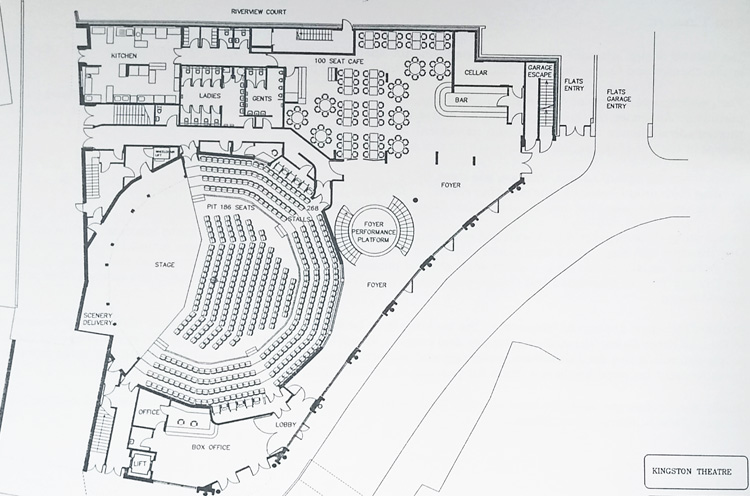
Last week I wished Shakespeare a Happy Birthday with a photo of the pop-up Shakespeare’s Rose theatre in York in 2018. Friends in Kingston will know the significance of that picture, and it is not simply because York is my favourite city in the UK (and I went to University there).

Soon after I was elected to Kingston Council in 1997 I was asked to represent the Council on Kingston Theatre Trust. Our chair was the broadcaster David Jacobs, who was the Representative Deputy Lieutenant for the Borough and who took a keen interest in the cultural life of the area.

Our mission was to build a theatre in Kingston, and at that stage we were planning a traditional proscenium stage with a fly tower. St George’s plc was being encouraged to bring new life to the river front by building luxury flats and improving the access. The Council owned some of the land in the development parcel, which became a useful bargaining ploy. As part of the planning agreement St George’s was to construct the shell of a theatre, and we eventually got outline planning permission for it.

The Theatre Trust had applied to the Arts Council for capital funding and it was a huge blow when the application was refused. At one stage it looked as though the project would have to be shelved, but, in 1997, with Lib Dems in control, Council decided to go ahead with a feasibility study. The challenge was to see whether we could create a low budget “warehouse-style” theatre.

Tagged | 1 Comment

Pubs need support now and inclusion for their future

Embed from Getty Images

Having relaunched a pub in Brighton during the election, watching it grow into a successful community pub then suddenly falling complete silent has been an absolute roller-coaster of emotions. Not seeing your regulars every day is a weird feeling and not knowing when those doors will open again leaves me anxious for the future of the industry.

I’m a lucky one though, my parent pub company have been incredibly supportive and with their help and the coronavirus retention scheme, I’ve been able to continue paying 100% of my staffs’ wages. But for lots of publicans this is not the case.

Some of the big Pub Co’s are still collecting extortionate rents from their tenants, even though there has been zero footfall through the doors. Pubs with higher rateable values are exempt from grants. Bank loans are little to none in the hospitality sector and seasonal staff will be significantly worse off with the summer season limited. All these issues need addressing urgently, if we want pubs to be there able and ready for when we can enjoy that much anticipated pint with our friends again.

Tagged and | 8 Comments

Covid-19 … The new Liberal reality

Embed from Getty Images

While we may disagree on the timing of the UK government introducing the Covid-19 lockdown, I hope we can all agree that doing so was a necessary measure.

However, it’s a holding measure, not a solution in itself. It is becoming apparent that the scenario of staying in lockdown till Covid-19 is eradicated, or at least until it’s constrained in known isolated pockets in hospital ITUs, is highly unlikely. With no coordinated international response, even if we were to achieve this in the UK, there would be high probability of infection being reintroduced. If we have similar (or higher) infection rates than other countries, it’s even arguable whether closing the borders would make any significant difference to the situation in the UK.

The lockdown is a rather blunt tool. It’s a list of permissible activities – a straightforward public health message that can be quickly conveyed. It’s not perfect – jogging or cycling can still result in injury, placing additional pressure on A&E. Perspiring and breathing heavily in public parks bring their own risks of transmission. You can still go to the supermarket as often as you like, for as long as you like, wearing no protection, even if you’re in a vulnerable group. So let’s not kid ourselves that this lockdown is perfect. And while we’re at it, let’s not kid ourselves that this lockdown is sustainable indefinitely.

Ideally, all activity would be assessed for its statistical probability of virus transmission, and a highly refined lockdown could then be issued. Unfortunately, this would be an impossibly complex public health message to convey. So what’s the way out of this?

Tagged | 41 Comments

Observations of an expat: Where is Kim? 

Embed from Getty Images

Where is Kim Jong-un? Is he alive? Is he dead? Has the obese 36-year-old with a weird haircut had a stroke or heart attack? Has the coronavirus pandemic forced him into a secret lockdown? Does he have coronavirus? Has he been the victim of a palace coup?

The questions are being asked because the North Korean leader failed to make an appearance on 13 April at one of the most important annual celebrations in the country’s political calendar – the birthday anniversary celebrations for his grandfather, Kim il-Sung.

All the above questions are important. But even more important is who is likely to succeed him and what would a post-Kim world look like?

The current front-runner to succeed as leader of the Democratic People’s Republic of Korea is “Dear Leader’s” little sister, 32-year-old Kim Yo-jong.  The main reason is that the running of the highly secretive and oppressive communist regime is a family affair and the little sister is Km Jong-un’s closest family. However, there are some issues with the sibling. First of all, Kim Yo-jong, is a woman in a highly patriarchal society.

Tagged and | 10 Comments

Local leadership in Watford

When I was standing to be the Elected Mayor of Watford in 2018, Sir Vince Cable kindly came to help the campaign several times. When asked by local journalists why electing Lib Dems in local government mattered, his answer was always a straightforward one; because up and down the country we provide caring and competent local leadership. During the coronavirus pandemic I have seen Lib Dem-run councils doing just that.

As soon as the scale of this emergency became clear, Watford’s Liberal Democrat councillors and campaigners started to phone hundreds of older residents to ask them if they were alright and to find out what help they might need. This was extremely well received and meant that we were able to identify many people in particular need at a very early stage.

From the very outset it was clear that the whole way the council operated would have to change with many staff moved to new priority areas. Our approach has focused on making sure that our town is caring for all those in need, that key services are maintained, we engage with our residents and that Watford remains as connected and positive as possible.

Many people wanted to know what they could do to support those more vulnerable than themselves during the lockdown. To make sure that local volunteer effort was coordinated and effective we worked with local voluntary groups to set up ‘Watford Helps’. Over 1,000 people have signed up and are helping people to get the food and medicines that they need and making friendly phone calls to those who are lonely or isolated.

Tagged and | 1 Comment

Isolation diary: Correcting the headlines

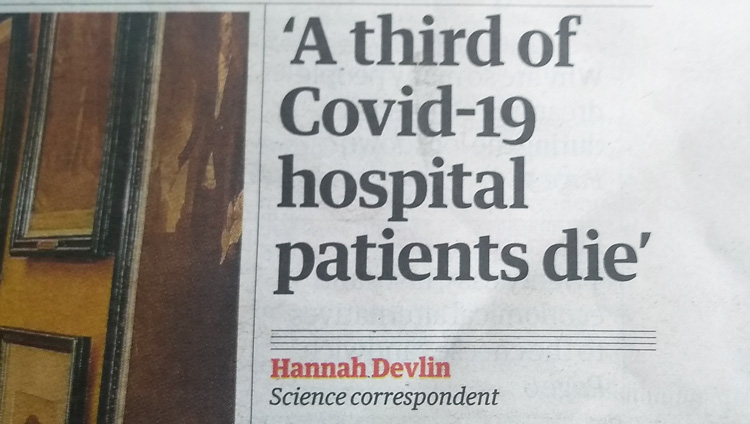
“A third of Covid-19 hospital patients die“. That is the stark headline in the Guardian today, echoed in other media.

But shouldn’t it read “Two thirds of Covid-19 hospital patients survive”? We rightly applaud the NHS workers at every opportunity, and we do so because they are saving lives.

People are only being admitted to hospital with Covid-19 when their lives are at risk. This is a vicious new disease that no-one knew anything about just four months ago, and yet everyone in the NHS, from the whole range of health care professionals to administrators and ancillary workers, are together contributing to a remarkable success rate in treatment.

Coronavirus and its fallout totally dominate the news at the moment. But we desperately need some good news – what else could explain the phenomenon that is Capt Tom? (Happy Birthday!).

We all need to know that catching Covid-19 is not a death sentence for the vast majority of people. Even in the most serious cases, where intensive care interventions are needed, most people recover. So why are we not being told this directly?

Tagged | 1 Comment

Things we hold dear

Like many the lockdown left me searching for things to do in this unique situation.

A search on the Film 4 website took me to the complete series of the hit US comedy Seinfeld so I decided to work my way through it knowing that it would make me laugh as it did 25 years ago. Throughout the series there are passing references to sport and politics which got me thinking about both in a somewhat unusual way.

Seinfeld is set in New York, a city that lost its iconic baseball team the Brooklyn Dodgers back in the late 1950s when the owner moved them to Los Angeles. Thousands had packed into the Dodgers stadium for decades but that didn’t save it from the wrecking ball.

Here in the UK too stadiums and teams have also been consigned to history. In my home town of Reading the football team I have supported since childhood moved grounds in 1998 and, although it was within the same borough, I always missed the old place where I stood on the terraces engrossed in the action. Worse still, the town’s speedway club Reading Racers, twice British champions, saw their stadium close in 2008 with promises from the local council to find a new one coming to nothing. Racers fans are still waiting. Now the economic crisis brought about by Coronavirus threatens the existence of many more sports clubs.

Tagged and | 5 Comments

Should we be taking population density into account when comparing countries on Covid-19?

Embed from Getty Images

May I first offer my sincere sympathy to all those who have been directly affected by Covid-19 through their own illness or through loss or illness of loved ones. This is a truly terrible illness and my heart goes out to all those who have suffered, as well as the many NHS, care and key workers who have put their life on the line to help others.

One of the horrible sides of the pandemic is that it is often reduced to slides of statistics. When reducing thousands of individual tragedies of people’s lives cut cruelly short to graphs, it is terribly superficial. So I apologise for writing a post about the numbers. Behind every fatality there is the story of a beloved human being leaving behind grieving loved ones.

I suspect it will be many years before the full picture of this pandemic and our (human beings’) handling of it becomes clear.

When comparing countries, it seems now that poor old Belgium is top of the list of Covid-19 death rates. (Originally it was the USA, based on sheer absolute figures, which was a bit bonkers given the size of the country).

However, even though it is many moons ago, I remember the odd school geography lesson telling us that the Low Countries have a very high population density. So, surely the disease is bound to spread more quickly when the population is much closer to each other.

Tagged | 17 Comments

Reforming capitalism: The need for popular ownership

In the wake of coronavirus, how should Liberal Democrats think about and approach capitalism?

For those on the left this pandemic is confirmation that capitalism has failed; without significant state assistance it lacks, we are told, the resilience to manage in times of crisis. As a result, socialists declare that the market must be restrained, tempered, and tamed. Crucially, however, it is the state which is to be charged with achieving this. We must, we are told, have more taxation and greater regulation as well as greater state spending.

In contrast, for those on the right this episode has confirmed that we need more, not less, of the Chicago school thinking that has dominated so much economic thought since the days of Thatcher and Reagan: we require, we are told, less taxation and fewer regulations.

Contrary to the above, Liberal Democrats should draw on our rich intellectual heritage and demand a new, reformed, and radical form of capitalism. The hallmark of such a vision should be one in which capital is much more widely owned than is currently the case and in which as many people as possible own capital.

Tagged | 19 Comments

How the health crisis could help advance our society’s wellbeing

Everyone can recall the bitter divisions in our society last year. Families were split about Brexit; friends chose which friends to talk to, there was rage and blame ringing across the airwaves and on social media, while In the House of Commons, the MPs tried and tried again without success to reach agreement on whether, when or how to leave the EU.

But this spring the bitterness is gone. That isn’t because of general weary resignation that Brexit is settled. It’s because in facing the pandemic disease to which we are all susceptible millions of us are pulling together in facing up to it. We have surrendered civil liberties, altered our lifestyles, closed businesses, foregone sociable pleasures and knuckled down to hard work or to the new challenge of staying mostly at home. Nobody is pleased about it, but we are generally united in our feelings about its inevitability. Where will this newfound unity, which is so reminiscent of what we understand happened in the two World Wars, take us next?

Tagged and | 89 Comments

Isolation diary: Losing my marbles

The cupboards that I have been clearing out have been a rich source of memories. I found a large biscuit tin full of marbles.  Some of the contents go back to my childhood and my sons added to them when they were small.

Children don’t play with marbles these days. However, I don’t do “Things were better in my days”.

Things were different, but largely worse for children when I grew up. Children were abused, legally, by the very people who should have been protecting them.

School was horrible. From the age of six we sat all day at our desks in silence. The first school I attended was in a Victorian red brick building. I just remember the Infants section as dark. Outside was a tiny playground, which was an uneven stretch of tarmac devoid of any play apparatus. The toilets were across the yard, and we called one of the cubicles the ‘fever toilet’ because it was filthy with broken pipes.

The building was completely inadequate. One day we arrived at school to be told we were moving to a new Infants school. We walked in a crocodile to the new site. Unfortunately our parents (schools didn’t work with parents at all in those days) had not been informed so apparently turned up at the old school to pick us up at the end of the day.

Tagged | 2 Comments

Forecasts for the end of the COVID-19 epidemics similar to Singapore lab’s

Between March 17th and 20th, using my former scientist’s PhD knowledge, I started making forecasts, with graphs, of when the COVID-19 would end for the main European countries and the UK. The shot was a long one, and the forecasts sent in a private email to colleagues. At the time the government announced a minimum ’12 weeks’ epidemic. Hence until at least June 17, with statements that it may last over six months to 2021.

With data consolidating from March 30, I took the risk to make my previsions public on LINKEDIN (https://www.linkedin.com/pulse/update-previous-coronavirus-covid19-reports-analysis-de-vartavan/) forecasting the end of the UK epidemic between April 30 and May 6 +/-. In another April 21 report, I also calculated, among others, the end of the Italian epidemic around May 6 +/-.: (https://www.linkedin.com/pulse/now-witnessing-end-coronavirus-epidemic-central-christian-de-vartavan/). The aim is to provide intelligence to UK companies of when to prepare to exit the costly lockdown and hence reduce at soon as possible its economic damages. I suggested May 1 to start preparing and still do. 

Tagged and | 15 Comments

New leader should be banging on Starmer’s door on day one

The election of Kier Starmer as leader of the Labour Party, and therefore the leader of Her Majesty’s Opposition, presents a challenge for us as Liberal Democrats. On the one hand, it’s good news for our democracy that there’s now a serious Leader of the opposition who will be asking probing questions of this terrible Conservative government.

On the other hand, it presents a threat to us. A Starmer-led Labour Party will be fishing in the same pond of voters that we hope to seek support from. Some who had fled Corbyn’s Labour may now return to them. Our chances of making inroads into Labour-held seats that voted Remain in 2016 will have significantly diminished.

We are probably never going to see an overall Labour majority in this country again. They’ve lost Scotland to the SNP, and the Tories have breached the so-called ‘red wall’ in the north of England. It seems unlikely that many of those seats are coming back to them any time soon.

Also posted in News | Tagged and | 34 Comments

Are we being led by the science?

Well, that’s what we are told at the daily press conference, but is it true?

It’s becoming evident that the 2-metre social distancing rule is exceedingly problematic if it’s to be continued once businesses re-open, particularly for small cafes, restaurants and shops which are too small to implement it and will cease to be viable. So, the evidence to support it must be very strong, mustn’t it?

I have not been able to find that evidence anywhere, and significantly the WHO has settled on a much more pragmatic, achievable and sustainable one-metre distance. I made a few more discreet enquiries yesterday, and the answer came back that ‘there is no evidence’.

Does Chris Whitty, Patrick Vallance and SAGE know something we don’t?  – we certainly hope so, but if this secret society does not publish its membership and meeting minutes how can we trust the government to have taken their advice seriously, rather than manipulated it, particularly now we know who else attends these meetings.

Tagged and | 30 Comments

Isolation diary: Getting my prescription

Simple everyday procedures can get a bit complicated when in self isolation, but we are discovering some new ways of doing things.

Like most people of my age I do take some medication; there is nothing serious to worry about but they do make my life more comfortable.  Our local medical centre houses two GP surgeries and a pharmacy, so every two months I email the pharmacy and ask them to request my repeat prescription. They then email back when it is ready for collection.

Fortunately, the pharmacy already offers a delivery service, so it was easy enough to ask them to deliver it this time. I do know that I could also call on the local Covid-19 volunteers to help if needed.

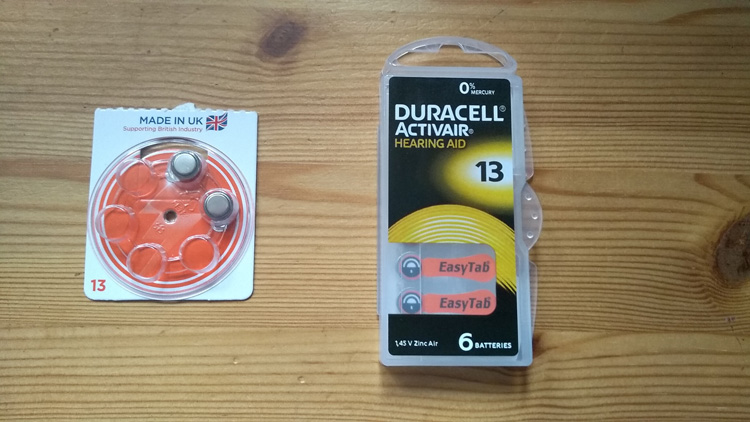
The surgery also holds a number of drop in clinics, including one for people who have hearing aids, as I do.  Every couple of months I turn up, and the technician replaces the silicone earpieces and gives me some more batteries. It is so much more convenient to do that locally instead of attending the hearing clinic at the hospital.

When I realised that I was almost out of batteries, I wondered how I would get replacements. I could, of course, have phoned the GP or the hospital audiology department and asked what I should do. But I really didn’t want to bother them, so just bought some online. I paid £15.99 for a pack of 60 which will keep me going for over a year.

Tagged | 3 Comments

A longer read for the lockdown: Why I left the Tories and became a Lib Dem


Embed from Getty Images

It wasn’t Brexit that made me leave, but a stark realisation that there was something deeply wrong with the Tory party.

I owe my life in Britain to a Tory MP. In 1957, newly elected Keith Joseph was instrumental in persuading the government to grant sanctuary to Jews fleeing Egypt following the Suez crisis, which included my father aged 8.

My grandfather, a 32-year-old dentist at the time, was asked by Egyptian authorities why he was leaving the country. Predicting a surge in hostility towards non-Arabs inspired by President Nasser’s populist speeches, he responded “because you’re allowing me to”.

Tagged , , , , , and | 35 Comments

Solving the pandemic crisis and climate change go hand in hand


Embed from Getty Images

The climate and ecological emergency have had to compete with concerns about immigration, the Brexit negotiations and public spending on the NHS and schools.

The desire to stop a damaging Brexit has even led staunch environmentalist Liberal Democrats to take their eye off the political ball. Just when climate change and the environment had finally risen up the political agenda in the UK and beyond, the coronavirus outbreak has forced it back down the list of government priorities.

The cost of the response measures and the subsequent economic fallout may undermine the commitment of many governments around the world to the reduction of carbon emissions and the restoration of ecosystems. Some people have already raised questions over whether we can still afford the fight against climate change with the economy on its knees.

Meanwhile, as air quality in normally polluted cities improves and the number of flights fall to an all-time low, goats have been seen running through the streets of Llandudno and deer are roaming Essex housing estates. Environmentalists are quietly cheering and nature lovers are cherishing government mandated walks in the spring sunshine. Even if the lockdown has shed light on how human activity pollutes the air and harms animals, the current lockdown is as economically unsustainable as our economy is environmentally unsustainable.

10 Comments

Do we need to be careful about “Liberal Drinks”?


Embed from Getty Images

I wonder if anyone has had a think about “Liberal Drinks” and, in particular, about the impact of meeting up over drinks (or, these days, “virtual drinks”). Is it possible that this puts off some people from becoming more involved in the party?

Of course, “drinks” can mean non-alcoholic drinks. But the implication is that “drinks” means alcoholic drinks. This is underlined by such events normally being in pubs.

I’m not asking for such events to be curtailed.

Tagged | 18 Comments

Isolation diary: Excavating the Ness

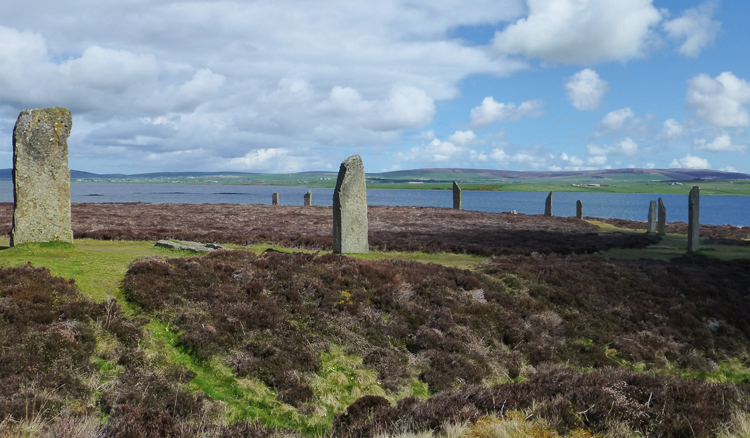
The ring of Brodgar is a huge stone circle set in a most dramatic setting on Mainland Orkney. It lies on a narrow strip of land between two lakes – on one side is the saltwater Loch of Stenness that opens to the sea and on the other side is the freshwater Loch of Harray. They all sit in a vast bowl surrounded by green hills. No trees to be seen.

Nearby is one of the most astonishing archeological sites in the British Isles, known as the Ness of Brodgar. It was discovered very close to a farmhouse in 2002.

The first structure to be uncovered was the remains of a large rectangular building, similar to ones nearby at the Barnhouse Neolithic Village. As more buildings and artifacts were found it became clear that this was not a domestic site but a vast ceremonial centre that was first built around 3200BC, 200 years before Stonehenge. Many of the buildings had been given complex decorations and paving. In fact, over 800 pieces of stone incised with patterns and other markings have been found. Some stones had been painted with a reddish pigment, probably derived from local iron ores.

One of the structures is 25 by 20 metres and its external wall is 5 metres thick. It is thought to be a burial place. The site has also revealed a surrounding 4 metre thick stone wall – an extraordinary structure.

When we first visited the Neolithic village of Skara Brae, only a few miles from the Ness of Brodgar, we learnt that the buildings probably had roofs constructed from whalebone or driftwood, then covered with animal skins and turf. Nothing had survived of the roofing materials. But at the Ness, which was built around the same time, they discovered rectangular roof tiles.

Tagged | Leave a comment

Stepping up as a Liberal Democrat Councillor in Bradford as part of the response to the national emergency

Regular involvement in our local communities meant we could respond quickly to pull local partners together before lock-down was announced. Our Parish Church offered to provide a base for a ‘Community Response Hub’, the Church Secretary took on the role of co-ordinator and other volunteers from the congregation stepped up to run social media. This gave us a flying start in organising a grass-root team offer to local people into which representatives from the Police, a Council Officer and other representatives from local groups met and worked together. We met every day for the first 16 days to make sure …

Also posted in Campaign Corner | Tagged and | 1 Comment

Now is the time to stand up as champions of deliberative democracy

Our party is back on the right track. Covid seems to have brought us to our senses: the reaction of local parties, of MPs, and of peers to Covid has been impressive, and it does seem that there is a renewal of our central commitment to the idea of the empowered citizen as the most important element in a healthy politics.

The next step is to make ourselves the party of deliberative democracy, and to do so right now, by calling for a Covid Citizens’ Reference Panel to deliberate on and input into government policy as we transition over the …

Tagged and | 20 Comments

An evening with General Franco

One of the strange, perhaps dubious, pleasures of lockdown is straying into obscure Freeview channels while looking for something different to accompany the next cup of coffee. I suspect PBS America (Freeview 91) comes into that category. This is a site for curate’s egg documentaries, rather like some aspects of Channel 5. Sometimes they are a waste of electricity, sometimes they can be rather good, indeed educational. PBS America has its share of US military history but it does not really compare with the Yesterday channel’s obsession with World War 2. It is pretty good at looking at the wider …

Tagged and | 6 Comments

Liberal England died a century ago and we still haven’t learned anything

I have a strong interest in political history and in liberalism. Despite that, I am ashamed to say that I have only just read George Dangerfield’s seminal The Strange Death of Liberal England for the first time.

However, I am also glad that I waited so long, because the parallels between the situation in which the great Liberal Party found itself in 1914 and the situation into which liberals have got ourselves today are striking. Many of the tragic mistakes made by the Liberal leaders in the pre-war years have been repeated, with the lessons the Conservative Party taught the country about itself during the great People’s Budget and Home Rule crises either forgotten or ignored.

Yet again, the Conservatives have set the terms and we liberals have failed to grasp how and why things have changed around us. Dangerfield describes the pre-war Liberal government as “dying with extreme reluctance and considerable skill” – and if today’s liberals continue to fail to learn the lessons set out clearly in his book, that is the fate that awaits our movement as it drifts aimlessly and with no obvious purpose through these post-Brexit, post-liberal settlement times.

I am no Marxist, but there is truth in the notion that history repeats itself, first as tragedy and then as farce. It was a tragedy that Asquith, with his Victorian notions of fair play and gentlemanliness, singularly failed to either anticipate or to respond effectively to the Conservatives’ evidently unfair and ungentlemanly attempts to wreck the People’s Budget.

The irony of the Liberals talking radically while remaining unflinchingly committed to a parliamentary solution, while the Conservatives made appeals to the sanctity of the constitution while making every effort to destroy it, should not be lost to modern liberals. We spent the May and Johnson eras patting ourselves on the back for each parliamentary defeat, only for Johnson to simply close Parliament down; we congratulated ourselves for playing by the parliamentary rules, only for Johnson to simply rewrite them by repealing the Fixed Term Parliaments Act and secure an eighty seat majority (while ensuring the liberal, anti-hard Brexit Conservatives who had stood up to him inside the Commons chamber were booted out of politics forever). Liberals stood for the status quo and for institutional stability while the Conservatives made the radical case for change, and when that happens, the Conservatives usually win (see also: Thatcher).

There are echoes of the Brexit campaign and its aftermath in the Conservative response to the Irish Home Rule crisis, too. Again, those on the Liberal side of the argument – the Irish Party leader John Redmond, David Lloyd George, Winston Churchill and the rest – spoke in radical terms of Irish freedom from England while expecting the parliamentary system to deliver it, at the same time as the Conservative Edward Carson was overseeing the creation of a citizens’ militia and the formation of a provisional government in Ulster should there be any attempt to include that province within an independent Irish state. As a result, Home Rule was weakened and eventually destroyed, with six of the nine counties of Ulster immediately contracting out of the Irish Free State that eventually came into being.

Tagged and | 53 Comments

Isolation diary: Finding a balance

I had a nightmare last night. I won’t go into details because people will start doing deep analyses of my psyche, but I can reveal that it left me with a strong sense of injustice. (It had nothing to do with James Corden, though). I don’t often have bad dreams and it is a long time since I have had an anxiety dream like this one.

I have been very fortunate in not having experienced any serious mental illness in my life. I did develop post-natal depression, and I reacted with stress when I found myself in a job I hated, so I have an inkling about how it must feel. However I have observed people I am close to with more severe bouts, and I wouldn’t wish it on anyone.

But we cannot deny that many of us have heightened levels of fear and anxiety during lockdown, and we all need to monitor our own mental health and that of the people we live with. We need to develop coping strategies, to deal with the dark moments.

A recent analysis of diaries being kept by people in lockdown showed that a third felt they were not coping well. It seems older people, who may actually be more vulnerable, are cushioned financially and emotionally to a certain extent, whereas half of all the younger people reported a rise in anxiety and fear.

Tagged | 7 Comments

Layla Moran writes: Campaign for Coronavirus Compensation Scheme gathers momentum

Over the last four weeks, the numbers of NHS workers losing their lives to Coronavirus have risen. The figure now stands at well over a hundred. And then there are the other frontline workers: bus drivers, carers, teachers, to name but a few, who are risking their lives to help others.

I want to ensure that the Government recognises their bravery and courage. I’ve been calling on them to introduce a Coronavirus Compensation Scheme, to look after the families of frontline workers should the worst happen.

Over 8000 people and 50 cross-party MPs have supported the campaign so far. And this week, I unexpectedly teamed up with The Express, who to their credit, put their weight behind this campaign and are proving instrumental in helping drive this forward.

You can help too. Please sign the petition and share it far and wide.

My campaign has clear asks. This new scheme should mirror the Armed Forces Compensation Scheme and include:

  • a lump sum upfront
  • a guaranteed income for their family
  • child payments to eligible children under 18

This would be in addition to pension benefits. Furthermore, given the extraordinary nature of this crisis, the state should also contribute to funeral costs.

Also posted in News | Tagged , and | 5 Comments

‘Power for All’: A Liberal agenda for the future

The question of what the Liberal Democrats should look like, and stand for, in a post-coronavirus world is being increasingly asked. Indeed, we already have hints of the future directions of Labour and the Conservatives and it would not be surprising to see both indulge in the politics of nostalgia and advocate a return to their favoured status quo in response to this health crisis.

In the case of the Conservatives this may translate into a continuation of the neo-liberal agenda that has dominated so much economic thinking for the last forty years (a call for ‘Reaganomics’ has already appeared on ConservativeHome).

In contrast, for Keir Starmer’s Labour, particularly given how many Fabians belong to his Shadow Cabinet, it may appear in the form of a call to return to a statist, corporatist, technocratic, social democracy that dominated Britain for some thirty or so years prior to the triumph of neo-liberalism.

Just as Labour and the Conservatives failed to provide a radical and transformational response to the 2008 financial crisis, the possibility that they will fail to do so in response to this crisis is not a small one.

Both responses are, however, uninspiring and backward-looking and liberals must resist the temptation to favour either. Additionally, the alternative of merely splitting the difference between the two, picking and attempting to stitch together elements from each ‘vision’, must also be opposed.

21 Comments
Advert

Recent Comments

  • Jason Connor
    Yes that's why the triple lock should be retained....
  • Jana
    “Pensioners deserve that respect, as do younger people who will help fund the system and may one day depend on it.” Yes, just as current pensioners funde...
  • Nigel Orchard
    I welcome the announcement of this Review, particularly its proposed examination of the fairness, timeliness and consistency of the Party's complaints and disci...
  • Jana
    “ our Federal party Constitution makes clear that, as a party, we reject all discrimination and prejudice based on religion or belief and that we respect the ...
  • Chris Nicholson
    I am not sure where Theakes gets his information but Lambeth Lib Dems are not in cahorts ( or cahoots) with the Greens. We are not in coalition with the Greens ...